42 agentic systems deployed · 30+ enterprise teams served
Agentic AI consulting services
Ship autonomous AI agents your enterprise can actually trust
Most AI agent projects stall at the demo stage because governance, observability, and rollout mechanics were never designed in. We build custom AI agents with the orchestration layer, guardrails, and human-in-the-loop controls enterprises need to deploy confidently.

The cost of waiting
Your team is doing work agents should own
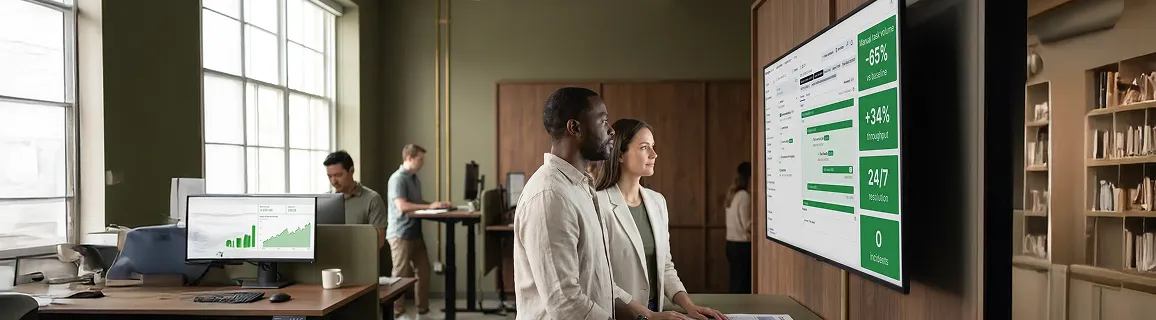
Every hour your knowledge workers spend on repetitive orchestration, routing, and retrieval is an hour not spent on judgment and strategy. Here is what that gap looks like before and after agentic AI is deployed correctly.
With agentic AI from Redefine
- Orchestrated agents retrieve, classify, and route documents in under 90 seconds, no human required
- Support agents resolve routine queries 24/7, escalating only when genuine judgment is required
- Agents pull context from your retrieval-augmented-generation layer, APIs, and databases. Your team gets answers, not search results.
- Guardrails, observability, and human-in-the-loop controls are built in from day one, not bolted on after incidents
- Your analysts shift to decisions that require judgment, the work only humans should be doing
Median outcome: 65% reduction in manual task volume within 90 days of first agent go-live
Without agentic AI
- Analysts manually route documents across 4 to 6 systems before a decision can be made
- Support queues build overnight because no agent handles routine resolution
- Data retrieval depends on tribal knowledge. No system pulls context autonomously.
- Pilot programs fail because governance and rollout mechanics were never planned
- Your best people spend 60% of their time on tasks automation should handle
Average cost of inaction: $180K to $420K per year in buried analyst hours per 50-person knowledge team
Agent types we design and deploy
The right agent for every job your team handles
Custom AI agents are purpose-built for specific workflows. We identify the highest-value targets in your operation and deploy agents sized and governed for each one.
Conversational support agents
Handle tier-1 and tier-2 support at scale. Retrieves from your knowledge base, resolves, escalates with full context, no human handoff needed for routine cases.
24/7 resolutionRetrieval-augmented-generation-poweredEscalation logic
Document processing agents
Ingest, classify, extract, and route documents across your systems. Eliminates the multi-system handoff chain that buries analysts in routing work.
Optical character recognition + extractionAuto-classificationMulti-system routing
Research and synthesis agents
Pull from internal knowledge bases, APIs, and web sources to generate briefings, summaries, and reports. Your analysts review outputs, not raw data.
Multi-source retrievalSynthesis layerCitation tracking
Workflow orchestration agents
Coordinate multi-step processes across tools and systems. Trigger actions, wait for conditions, branch on results, without a human managing the sequence.
Multi-step executionTool useConditional logic
Monitoring and alerting agents
Watch metrics, logs, and feeds continuously. Generate plain-language summaries, flag anomalies, and route alerts to the right person before issues escalate.
Continuous watchAnomaly detectionSmart routing
Customer-facing AI agents
Deploy agents your customers interact with directly, product advisors, onboarding guides, account agents, with full audit trail and brand guardrails.
Brand-safe outputsFull audit trailHuman-in-the-loop escalation
Most agents depend on a reliable knowledge retrieval layer. See how we approach retrieval-augmented-generation development services to give your agents accurate, up-to-date context.
Architecture and orchestration
How a production-grade agentic system actually works
Click any node to see what we build at each layer. Every agent we ship has all five layers active, not just the inference call in the middle.
Click any node above to see what we engineer at that layer.
How to use this diagram
Select any node in the architecture diagram to see what Redefine builds at that specific layer, from trigger logic through to the observability plane that watches every agent decision.
Most vendors build only the Agent Core node. We build and own all six layers.
Shipped on every build
Six layers plus observability plane
- TriggerIncluded
- OrchestratorIncluded
- Agent coreLLM + context
- Tool layerIncluded
- Memory storeIncluded
- Guardrails + HITLPolicy gate
- OutputIncluded
Observability layer: traces every step, model call, and tool use across the full stack. Not an optional add-on.

What makes our approach different
Observability, governance, and rollout not afterthoughts
We own the full stack, not just the model call
Other shops hand you a prompt wrapper and call it an agent. We design and own the trigger, orchestration, tool, memory, guardrail, and observability layers. You get a production system, not a demo.
- Six-layer agent architecture shipped as standard
- Model agnostic: we pick the right inference provider for each task
- Full code ownership transferred at project close
Time to first agent in production: 3 to 5 weeks
Guardrails designed, not defaulted
Every agent has a written policy spec: what it can do autonomously, what confidence threshold triggers human review, and what it must never do. Reviewed and signed before Sprint 1 begins.
Observability on every trace
Every model call, tool invocation, and decision branch is traced and stored. You can replay any agent run, understand why it did what it did, and catch drift before it reaches production volume.
Human-in-the-loop by design
Human-in-the-loop is a first-class feature, not a workaround. We build the review queue, the approval user experience, and the audit log your compliance team will ask for before you go live at scale.
Rollout in controlled phases
Agents start on shadow traffic, then a canary cohort, then full volume. We define the acceptance criteria and monitor each phase before advancing. No big-bang releases to real users.
Delivery plan
From agent strategy call to production in 5 weeks
You see a working agent in week two. You see it running on real data in week four. By week five, it has passed your acceptance criteria and is handling live volume.
1
Days 1 to 3
Agent strategy and scope
Workflow audit, value mapping, architecture decision
2
Days 4 to 10
Architecture and guardrails design
Six-layer spec, policy document, tool schema, data access review
3
Days 11 to 20
Build and behavioral evaluation
Agent core, tool integrations, human-in-the-loop queue, first demo
4
Days 21 to 30
Shadow traffic and canary rollout
Real data, monitored volume, acceptance criteria gating
5
Days 31 to 35
Full go-live and handover
Production traffic, runbook, your team trained and owning it
AGENT SCOPE DOCUMENT
Agent nameSupport Triage Agent v1
Target workflowTier-1 support routing
Estimated hours saved per week~22 hours
Sprint 1 startWithin 1 week of sign-off
Proof
From fragmented systems to $90M, built on automation and AI-driven workflows

The problem
Enterprise · Promotional products · B2B
An enterprise promotional products distributor operated across 30 storefronts, one million-plus inventory items, and multiple backend platforms. Reporting was fragmented and manual. Operational decisions required analysts to reconcile data across systems that never spoke to each other.
Scaling to eight-figure revenue was not a marketing problem. It was a systems and automation problem.
Manual reconciliation across 30 storefronts delayed decisions by 3 to 5 business days
The result
$0Mannual revenue
Automated Power BI analytics, headless commerce architecture, enterprise resource planning integration, and intelligent workflow orchestration replaced the manual reconciliation layer entirely. Decisions that took days now happened in minutes.
Revenue grew from $14M to over $90M: system automation enabled the scale
Real-time analytics replaced multi-day manual reporting cycles
Warehouse operations, customer experience, and brand visibility improved simultaneously
Why Redefine
What governance-ready agentic AI actually looks like
Other implementation partners often lead with hype and under-deliver on the mechanics that make enterprise AI deployable. Here is how the approaches compare.
Capability
Typical partners
Redefine
Full six-layer architecture
Model call only
All six layers
Written guardrail policy
Not standard
Signed before Sprint 1
Human-in-the-loop queue built in
Manual escalation only
Designed with audit log
Full trace observability
Logs only, no replay
Every trace replayable
Phased rollout plan
Big-bang launch
Shadow, then canary, then full
Code ownership at close
SaaS dependency
Full code transfer
Common questions
Questions before you book
We run a workflow audit in the first three days of engagement. We map where your team's time actually goes, score each workflow on volume, predictability, and cost of error, and identify the highest-value target. You do not need to arrive with a brief. You need to arrive with access to your team's operational data.
Most enterprise data is messy. Part of our architecture work is designing the retrieval, preprocessing, and validation layer that sits between your raw data and the agent. Agents that work on clean, curated context make far fewer errors than those that query raw databases directly. We scope that layer into every engagement.
Guardrails are not a system prompt instruction. They are a layer with its own logic. Before Sprint 1, we produce a written policy document that defines what the agent can do autonomously, what confidence threshold sends an output to human review, and what it is categorically prohibited from doing. That document is signed before a single line of agent code is written. Output validation runs before every action the agent fires.
Two to three hours per week. One sprint review every ten days where you see the agent running on real scenarios and give feedback. Async review of the guardrail policy document before we start building. Final user-acceptance-testing sign-off before we advance from canary to full traffic. That is it. We own architecture, orchestration, tool integration, testing, observability setup, and deployment.
Yes. Full code ownership transfers to your team at project close along with a runbook, architecture documentation, and a handover session with your engineering team. You are not locked into us for operation or maintenance. We build to hand over, not to retain.
Fit check
Is this the right engagement for you?
Good fit
You have a specific, high-volume workflow your team handles manually today
You need governance and audit trails, not just a fast prototype
Your team can give 2 to 3 hours per week for sprint reviews and feedback
You want to own the code, not depend on a software-as-a-service platform to keep it running
Not the right fit
You want a chatbot wrapper for your website rather than a process automation agent
Your workflow is entirely unpredictable or judgment-heavy. AI can assist, not own it.
You need a fully autonomous agent with zero human oversight from day one
Not sure which category you fall into? Tell us your situation and we will be straight with you.
What happens next
A 45-minute strategy session maps your workflow, scores automation fit, and ends with a clear yes or no. No pitch deck.
Call within 48 hours of your brief
Scoped agent architecture in 3 business days
Sprint 1 can start within 1 week of sign-off
Book an agent strategy session
Tell us what your team is doing manually
We review your brief, identify the highest-value automation target, and come back with a scoped agent architecture, not a slide deck about AI.
Call within 48 hours of submission
Scoped agent brief in 3 business days
Sprint 1 begins within 1 week of sign-off
No commitment. No pitch. Just a straight conversation about your operation.
Form
Brief received
We will review your operation and send a scoped agent architecture proposal within 3 business days. Expect a call from us within 48 hours.
48 hours
Response time
3 days
Scoped proposal
42+
Agents deployed
100%
Code ownership
Ready to start
Your first agent could be in production in five weeks
No commitment. No pitch. A 45-minute session where we map your highest-value automation target and tell you exactly how we would build and govern it.