Agentic AI solutions built for agents that work autonomously across your enterprise
Your operations team is running workflows by hand around the clock. Your AI agents should handle them instead. We design, build, and deploy enterprise AI agents that orchestrate decisions, retrieve knowledge, and complete multi-step workflows without a human in the loop for every step.

Most AI projects ship a demo. Not a system.
Your teams are still doing manually what an AI agent could handle end-to-end. The gap between a proof of concept and a production agent that earns its place in your operations is where most AI programs stall.
Pain · operations team with fragmented workflows

- Orchestrated AI agents that take real action across your existing systems via application programming interfaces
- Human-in-the-loop controls scoped to exactly the decision types that require oversight
- Governance and observability layer built in from Sprint 1, not bolted on before launch
- Retrieval-augmented generation pipelines that surface the right knowledge at the moment the agent needs it
- A chatbot wrapper around a large language model that cannot take action or retrieve live data
- Manual human review at every decision point, removing the value of automation
- No governance layer, so production rollout gets indefinitely delayed by risk teams
- Isolated AI tool that does not connect to your customer relationship management, enterprise resource planning, or data warehouse
One orchestration layer for multi agent system development.
Click any node to see how each layer of the agent stack operates and what it owns in your environment.
Orchestrator Agent
Receives intent, routes sub-tasks, assembles final output
Retrieval-Augmented Generation Memory Layer
Vector search across your knowledge base, documents, and live data
Tool and Action Layer
Application programming interface calls, code execution, form submissions, data writes
Guardrails and Human-in-the-Loop Controls
Policy enforcement, confidence thresholds, escalation routing
Observability and Logging
Every agent decision traced, scored, and auditable on demand
The orchestrator is the central planner. It interprets intent, decomposes it into sub-tasks, assigns each to a specialist agent, and assembles the final output. Your operations team describes the job once. The agent handles sequencing.
The retrieval-augmented generation layer gives your agents long-term memory and real-time knowledge. It searches across embedded documents, live database records, and structured data sources to surface the exact context the agent needs before it acts.
The tool layer executes real actions against your systems. Application programming interface calls, database writes, notification triggers, code runs, and form submissions, all logged with inputs, outputs, and timestamps so every action is traceable.
Guardrails define exactly which actions require human sign-off and which can proceed autonomously. You set the thresholds. The agent routes accordingly. Your risk team gets oversight precisely where it matters, and nowhere it doesn't.
Every decision, every tool call, every token, logged and queryable. Your security and compliance teams can audit any agent run end-to-end. Anomaly detection flags behavior drift before it becomes a production incident.
Every capability your enterprise AI agents need.
Each service is a dedicated practice, not a sales pitch for the same team. Explore the one that matches where your program is today.
Agentic AI Consulting
Define the right agent architecture for your operations: use cases, orchestration patterns, governance frameworks, and a delivery roadmap scoped before a line of code is written.
AI Agent Development Services
Custom AI agents built for your specific workflows: from single-task bots to multi-step autonomous systems that retrieve, reason, and act across your production environment.
RAG Development Services
Retrieval-augmented generation pipelines that connect your large language model to live, domain-specific knowledge, eliminating hallucinations and ensuring agents answer from your data, not general training.
Built for production.
Governed from day one.
Enterprise AI agents operate in regulated, high-stakes environments. Your agent stack is designed with security posture, data residency, and auditability as first-class constraints, not afterthoughts.
Large Language Model Provider Agnostic
OpenAI, Anthropic, Gemini, or on-premise models
Data Residency Controls
Regional deployment, no cross-border PII transit
SOC 2 and GDPR Alignment
Audit logs, data minimization, deletion workflows
Zero-Trust Application Programming Interface Boundaries
Scoped credentials, encrypted at rest and in transit
Switching providers requires a configuration change. No application code changes required.
From fragmented data to automated operations.
Case Study · enterprise resource planning automation team
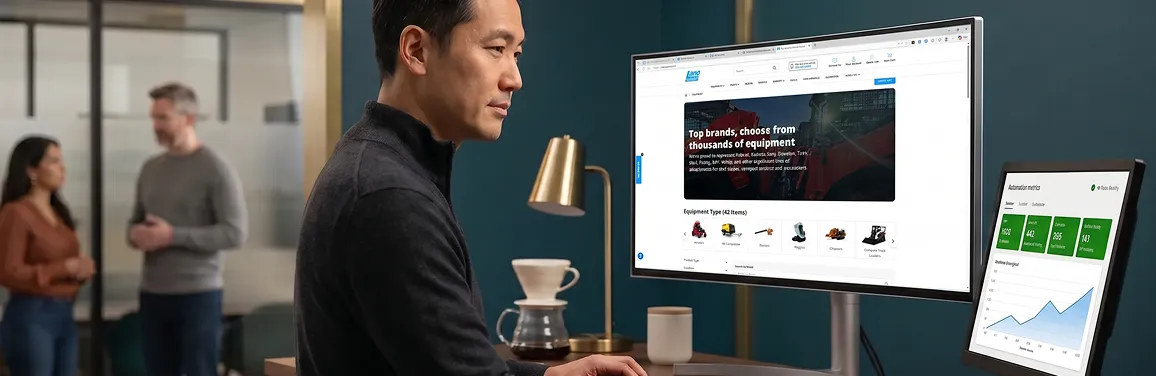
Lano Equipment, Inc
Long-standing regional B2B and B2C dealer: heavy equipment sales, rentals, parts, and service operations running across a fragmented legacy stack.
The legacy WordPress platform could not support complex B2B workflows or the size of their inventory. Inventory and parts data were incomplete or unavailable online, forcing manual data handling that added friction at every stage of the customer and operations journey.
- Application programming interface-first headless architecture built on Node.js and Next.js
- Full enterprise resource planning integration with automated data synchronization pipelines
- Complete user experience redesign for enterprise B2B purchasing workflows
- Klaviyo lifecycle automation flows integrated post-launch
Service match
Enterprise resource planning integration and application programming interface automation: the same foundation we build agentic AI systems on. Automated synchronization is step one of any production agent architecture.
Online visibility into equipment and parts inventory: from near-zero to complete coverage across all SKUs and product lines.
What separates a deployed agent from a stalled demo.
Other implementation partners excel at building demos and presentations. We build systems that run in production. The differences are structural, not stylistic.
Governance built in Sprint 1, not before launch
Typical partners design governance last. We define guardrails, escalation paths, and compliance constraints in the first sprint. Your risk team unblocks the rollout instead of blocking it.
Every agent decision is observable and auditable
We instrument every agent with structured trace logs: inputs, tool calls, confidence scores, escalation triggers. Your operations and security teams can query any run end-to-end.
We own the orchestration layer, not just the model call
Most shops wrap a large language model in a prompt. We build the state machine, retry logic, tool routing, and memory architecture that makes a system work reliably at scale, not just in a demo environment.
Retrieval-augmented generation pipelines grounded in your data, no hallucination risk
Generic AI consultants configure public large language models and hope they answer accurately. We build retrieval pipelines that search your internal knowledge base, live databases, and domain documents before the agent responds.
Questions buyers ask before they commit.
A chatbot responds to messages. An automation script follows a fixed flowchart. An agentic AI system plans, reasons, and decides how to complete a goal: including which tools to call, which knowledge to retrieve, and when to escalate to a human. It handles novel situations that a script cannot anticipate. The key capabilities are planning, memory, tool use, and feedback loops: none of which a chatbot or rule-based automation provides.
Every agent system we build includes a guardrail layer that enforces your policies before any action executes. You define the confidence threshold below which the agent escalates to a human, the action categories that always require sign-off, and the list of tools the agent is never permitted to call. These are not prompts: they are code-level controls. In addition, every action is logged with inputs and outputs so you can audit any decision after the fact.
Your existing systems stay in place. We build the agent stack on top of them via application programming interfaces. If your customer relationship management, enterprise resource planning, or data warehouse exposes an application programming interface, or we can add one, the agent can read from and write to it. We have integrated with Salesforce, SAP, NetSuite, HubSpot, custom databases, and proprietary internal application programming interfaces. The first step in your scoping session is mapping which systems the agents need to connect to.
Submit your brief through the form below. We call within 48 hours, spend 60 minutes mapping your use cases, existing system landscape, and compliance requirements. Within 3 business days we send a scoped proposal with a line-by-line breakdown of sprint deliverables, agent architecture, integration points, and pricing. There is no commitment to receive the proposal. If you want to proceed, Sprint 1 begins within 1 week of sign-off.
Every engagement is scoped before work starts with a line-by-line proposal: no hourly billing or surprise overages. Pricing reflects the number of agents, integration complexity, and guardrail configuration required. You receive the full scope and price before any commitment. For details on typical engagement ranges, visit our AI services pricing page.
Describe your workflow. We'll show you what an agent can own.
Tell us which parts of your operations your team is handling manually. We map the agent architecture, identify integration points, and send you a scoped proposal: no commitment required.
Submit brief → call within 48 hours → scoped proposal in 3 days → Sprint 1 within 1 week of sign-off
Call within 48 hours
Proposal in 3 days
82+ enterprises served
Code ownership with every build
Brief received.
We will review your situation and send a scoped agent architecture proposal within 3 business days. Expect a call from our team within 48 hours to align on context before we write the proposal.
Your first agent could be in production within a sprint.
One 60-minute scoping call starts your agentic ai consulting services engagement. A line-by-line proposal in 3 days. Sprint 1 begins within a week of sign-off. Your team contributes 3 to 4 hours per week. We handle everything else.
No commitment. No pitch. Proposal in 3 days.