Enterprise AI implementation services from first pilot to governed scale
Most AI pilots stall before production. Your data is not ready, governance does not exist yet, and no one owns the handoff from experiment to system. Redefine runs the full delivery arc: readiness through roadmap through governed production, so your AI investments actually ship.

Why AI pilot projects rarely make it to production
The problem is not the model. It is everything around the model: governance, data pipelines, stakeholder alignment, and a delivery process built for shipping, not experimenting.
One delivery arc: readiness through governed production
Every engagement starts with a readiness and discovery sprint, so pilots are designed to ship from the first day of scoping.
Governance designed before Sprint 1
Risk controls, compliance guardrails, and audit trails are part of your architecture: not bolted on after go-live.
Data readiness assessed and resolved upfront
Your AI data readiness assessment happens before the build quote, so there are no surprises during implementation.
Roadmap to revenue, not to more workshops
Your AI roadmap consulting engagement ends with a scoped delivery plan, milestone ownership, and a live return on investment model.
Production support built into the engagement
Post-launch monitoring, model drift detection, and retraining schedules are scoped from day one: not sold later.
Pilots run in isolation
Each team builds its own AI experiment with no shared data, no governance framework, and no path to production.
Governance is an afterthought
Risk controls and compliance guardrails get retrofitted after deployment, when they are most expensive to add.
Data readiness assumed, never confirmed
Consultants scope the build before anyone checks whether your data pipelines, labels, or access policies are production-ready.
Roadmaps that lead to more workshops
Six-figure strategy engagements that produce slide decks instead of shipping systems or traceable return on investment.
No handoff. No ownership post-launch.
The consultants leave after go-live. Model drift, production incidents, and retraining cycles land back on your team.

From scattered AI experiments to governed production in a structured arc
Select a delivery phase to see what each engagement produces, what your team provides, and what you receive at the end of each sprint.
AI Readiness
Baseline your org
AI Discovery
Map use cases
Governance
Risk and controls
Data Readiness
Pipeline and quality
Pilot Delivery
Build and ship
ROI and Scale
Measure and expand
AI Readiness Assessment
Before any build begins, your organisation's AI readiness is assessed across five dimensions: data maturity, infrastructure, skills, process, and governance baseline. You receive a scored readiness report and a prioritised gap list.
Duration: 2 weeks · Your time: 4 hours total
See the AI Readiness Assessment →Dimension scores
Priority gap: Governance baseline is critically low. Recommend governance framework sprint before any model deployment.
AI Discovery Workshop
A structured workshop with your cross-functional team to surface, score, and prioritise AI use cases. Output is a ranked opportunity register with effort-impact scores, technical feasibility notes, and a 90-day pilot shortlist.
Duration: 3-day workshop + 1 week analysis · Your time: 12 hours across stakeholders
See the AI Discovery Workshop →Document classification engine
Pilot shortlistSupport ticket routing AI
Pilot shortlistDemand forecasting model
Wave 2Contract extraction pipeline
DeferredAI Governance and Risk Assessment
Before the first sprint, your AI governance and risk framework is designed. Risk register, model card template, bias testing protocols, and compliance mapping against relevant standards such as EU AI Act, SOC 2, and sector-specific rules.
Duration: 2 weeks · Your time: 6 hours with legal and compliance stakeholders
See Governance and Risk Assessment →Bias in classification outputs
Mitigation: fairness testing each sprint
Data access and PII exposure
Mitigation: RBAC + data masking layer
Model drift post-launch
Mitigation: monthly drift monitoring dashboard
EU AI Act Article 9 compliance
Mapped: risk management system documented
AI Data Readiness Assessment
Your data pipelines, labelling quality, access policies, and schema consistency are audited against the requirements of your target AI use case. You receive a data readiness score and a remediation roadmap your data team can act on immediately.
Duration: 1 to 2 weeks · Your time: 4 hours with data and engineering leads
See the AI Data Readiness Assessment →Data completeness
94.2%
of records usable
Label quality score
67%
needs relabelling
Schema consistency
Pass
across 3 sources
Access policy
Gaps found
2 prod datasets open
Remediation: 3-week label quality sprint recommended before model training begins. Estimated effort: 80 annotation hours.
AI Pilot to Production Delivery
With readiness, discovery, governance, and data resolved, the build begins. Two-week sprints with a working demo at every review. Your AI delivery framework document ships at go-live alongside model cards, runbooks, and handoff documentation.
Duration: 8 to 14 weeks depending on scope · Your time: 3 to 4 hours per week for sprint reviews
In Progress
Model training pipeline v2
ML-041Drift monitoring hook
ML-042Review
Inference API endpoint
ML-039Model card docs
ML-040Done
Feature store integration
ML-035Training data pipeline
ML-036Eval harness setup
ML-037AI ROI Assessment and Scale Plan
Once the pilot is live, your AI ROI assessment captures actual versus projected value, surfaces the next highest-value use cases, and produces a scale plan for your Wave 2 roadmap. This is the handoff document your board needs to approve the next phase of investment.
Duration: 3 weeks post-launch · Your time: 4 hours with business and technical leads
See the AI ROI Assessment →Hours saved per week
140 hours
versus 12 projected
Accuracy at 90 days
93.4%
versus 88% target
Annualised ROI
4.2x
cost of engagement
Wave 2 recommendation
Apply same architecture to contract extraction use case. Estimated additional 60 hours/week saved. Data readiness already confirmed in Phase 04.
Every delivery service in your AI governance and implementation programme
Run them in sequence as a full delivery arc, or deploy any individual engagement to close a specific gap. Each produces a concrete, actionable output: not a summary deck.
AI Readiness Assessment
Score your organisation across data maturity, infrastructure, skills, process, and governance. Receive a prioritised gap register and a recommended starting point for your AI implementation programme.
AI Discovery Workshop
Surface and score your highest-value AI use cases with your cross-functional team. Output is a ranked opportunity register with effort-impact scores, feasibility notes, and a 90-day pilot shortlist ready for scoping.
AI Governance and Risk Assessment
Your governance framework, model risk register, bias testing protocols, and compliance mapping: designed before the first sprint so they are embedded into your architecture, not retrofitted after deployment.
AI Data Readiness Assessment
Audit your pipelines, label quality, schema consistency, and access policies before the build begins. Your remediation roadmap lets your data team resolve gaps in parallel, so the model build is not waiting for clean data.
AI ROI Assessment
Measure actual versus projected value 90 days post-launch. Surface your next highest-value use case. Produce the board-ready return on investment document and Wave 2 scale plan your leadership team needs to approve the next phase of AI investment.
What structured implementation delivers for enterprise operations
Half Price Drapes
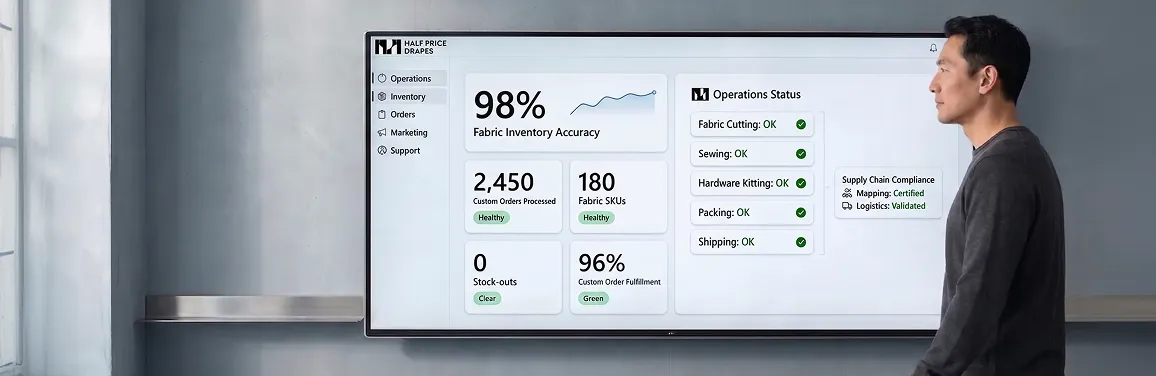
Ecommerce and ERPLarge-scale ecommerce retailer. Multi-channel operations across inventory, orders, and customer data: all fragmented across systems with no unified delivery programme.
The problem
Disconnected data across multiple systems created operational bottlenecks, decision-making was slow, and the ecommerce platform could not support scale across channels. Each system was maintained independently with no shared governance or real-time visibility.
Delivery approach
A structured platform migration and data integration programme unified inventory, order, and customer data into real-time dashboards and automated reporting via a centralised ERP and analytics layer. Ecommerce platform upgraded with a conversion-focused, mobile-optimised architecture.
Klaviyo lifecycle automation, GA4, Google Shopping feeds, and paid acquisition infrastructure were all integrated in a single governed delivery arc, with clear handoff documentation at every milestone.
Result
Million in annual revenue
Operational efficiency improved through real-time inventory and order visibility across all sales channels
Integrated analytics reduced manual reporting overhead and accelerated decision-making cycles
Scalable, governed architecture positioned the organisation for continued growth without future replatforming
Enterprise implementation and platform migration. Service: Microsoft Dynamics 365 and Headless Ecommerce.
Five governance layers built into every AI delivery engagement
Select a layer to see what it covers, what it produces, and where it sits in your architecture.
Risk Controls
Layer 1
Model Registry
Layer 2
Compliance Engine
Layer 3
Audit Trail
Layer 4
Human Oversight
Layer 5
Layer 01: Risk Controls
Every use case receives a risk classification before the build begins. Risk categories: operational impact, bias potential, data exposure, adversarial vulnerability, and regulatory applicability. Controls are designed per risk level: not applied universally.
Layer 02: Model Registry
Every model deployed through a Redefine engagement is registered with a structured model card: training data provenance, performance benchmarks across demographic slices, known failure modes, and retraining schedule. The registry is versioned and auditable.
Layer 03: Compliance Engine
Regulatory applicability is mapped at the discovery phase. For most enterprise deployments this covers: EU AI Act risk classification, SOC 2 data handling controls, GDPR Article 22 automated decision rights, and sector-specific requirements such as HIPAA or FCA guidelines where applicable.
Layer 04: Audit Trail
Every prediction, classification, and automated action is logged with a structured audit record: input hash, model version, confidence score, output, and timestamp. Immutable log storage is configured at deployment. You can answer any audit question about your AI system without writing new code.
Layer 05: Human Oversight
Human-in-the-loop controls are designed for every use case where a low-confidence output, a high-stakes decision, or a contested prediction requires a human reviewer. Escalation thresholds, review queues, and override logging are implemented before the pilot goes live.
Governed delivery is not a premium add-on: it is the standard
Other implementation partners deliver results. Redefine delivers governed, documented, production-ready systems that your organisation can own, maintain, and scale without us in the room.
No commitment. No pitch. A 45-minute conversation about where your AI programme is today and what a structured delivery arc would look like.
AI governance consulting built into delivery: not retrofitted
Typical partners add governance after deployment when it is expensive and disruptive. Every Redefine engagement includes a governance sprint before the first line of model code is written.
Scoped before you sign: not estimated after
Readiness and data assessments happen before the build proposal. Your scope is based on what we found, not what we assumed. No surprise change requests mid-delivery.
AI roadmap consulting that ends in a delivery plan
Strategy workshops that produce slide decks without a delivery plan are expensive positioning exercises. Your AI roadmap engagement ends with milestone ownership, resource commitments, and a live return on investment model.
Production support included: not sold separately
Drift monitoring, model retraining schedules, and production incident playbooks are scoped as part of the delivery engagement. Your team inherits a running system with documentation: not an orphaned model.
What enterprise teams ask before starting a delivery engagement
Answered directly. No pitch language.
Our AI delivery framework is a five-phase structured programme: readiness assessment, discovery workshop, governance design, data readiness, pilot delivery, and post-launch return on investment measurement. You receive documented deliverables at every stage: not internal working documents. The framework follows EU AI Act risk classification, SOC 2 data controls, and GDPR Article 22 disclosure requirements as a baseline, with sector-specific additions where applicable.
For a single use case, the full arc from first assessment to governed production typically runs 14 to 22 weeks depending on data readiness and scope. The first two phases: readiness and discovery: take four to five weeks. Governance and data readiness add three to four weeks. The pilot build runs eight to twelve weeks. We publish this timeline in your scoped proposal before work begins, with milestone dates your team can hold us to.
We design around your existing infrastructure. Our data readiness assessment identifies what your current stack supports and where it needs to be extended. We have delivered on Azure, AWS, GCP, Databricks, Snowflake, and on-premise environments. If your stack genuinely cannot support the target use case, we tell you in the readiness assessment: before the build is scoped or budgeted.
Most enterprises have data gaps. That is expected and planned for. Your AI data readiness assessment produces a remediation roadmap your data team can execute in parallel with governance design: so the build is not blocked waiting for clean data. In most cases, remediation runs alongside the governance sprint, adding two to three weeks rather than stalling the whole programme.
Yes. Any individual engagement can be run as a standalone. If you already have a discovery output and need only the governance framework, we scope that alone. If you have a live system and need a post-launch return on investment assessment and scale plan, that runs as a standalone three-week engagement. The five phases form a complete arc, but each produces a standalone deliverable you can use independently.
Large consultancies produce reports and recommendations. Redefine produces deployable systems with governance built in. The AI readiness assessment costs less than a typical strategy engagement and ends with an actionable gap register, not a market landscape deck. The discovery workshop produces a use case shortlist with effort-impact scores and data requirements: not a slide deck with 47 potential AI opportunities and no next step.
Get a scoped AI delivery proposal in 3 business days
Tell us where your AI programme is today. We'll review your situation and propose which enterprise AI implementation services apply to your current gap: and which ones do not. No commitment. No pitch.

Tell us about your AI programme
Brief received
We'll review your situation and send a scoped proposal within 3 business days. If your situation is urgent, expect a call sooner.
Explore the broader AI services programme