140+ AI projects
delivered60+ enterprise
brands served
AI Managed ServicesEnterprise AI managed services built for systems that never stop
Your AI stack is live. Every outage, model drift, and silent failure costs you operations and revenue. You get a dedicated managed services team that monitors, maintains, and continuously improves your AI systems around the clock.

The Business Challenge
Managing AI in-house is the hidden cost no one budgets for
Your team built the model. Now it needs to run every day, degrade gracefully, retrain on schedule, and stay compliant as regulations evolve. That workload compounds. It does not shrink.
BeforeHow most enterprise
AI teams operate today
- Your team monitors model health manually, pulling logs when something feels wrong
- No early warning before accuracy degrades, so users discover failures first
- Three teams coordinate each incident: data, platform, and engineering in separate messaging channels
- Compliance gaps surface during audits, not during daily operations
- Months pass between model improvements because engineers are occupied fighting fires
With RedefineHow your AI
operations run when we manage them
- 24/7 automated and human monitoring with configurable alert thresholds you set once
- Drift detection flags accuracy issues before they reach production, not after
- One dedicated team owns the full incident lifecycle from detection through resolution and report
- Compliance tracked continuously inside every sprint with documentation your audit team already needs
- Monthly improvement cycles ship model updates on schedule, not when engineers have bandwidth
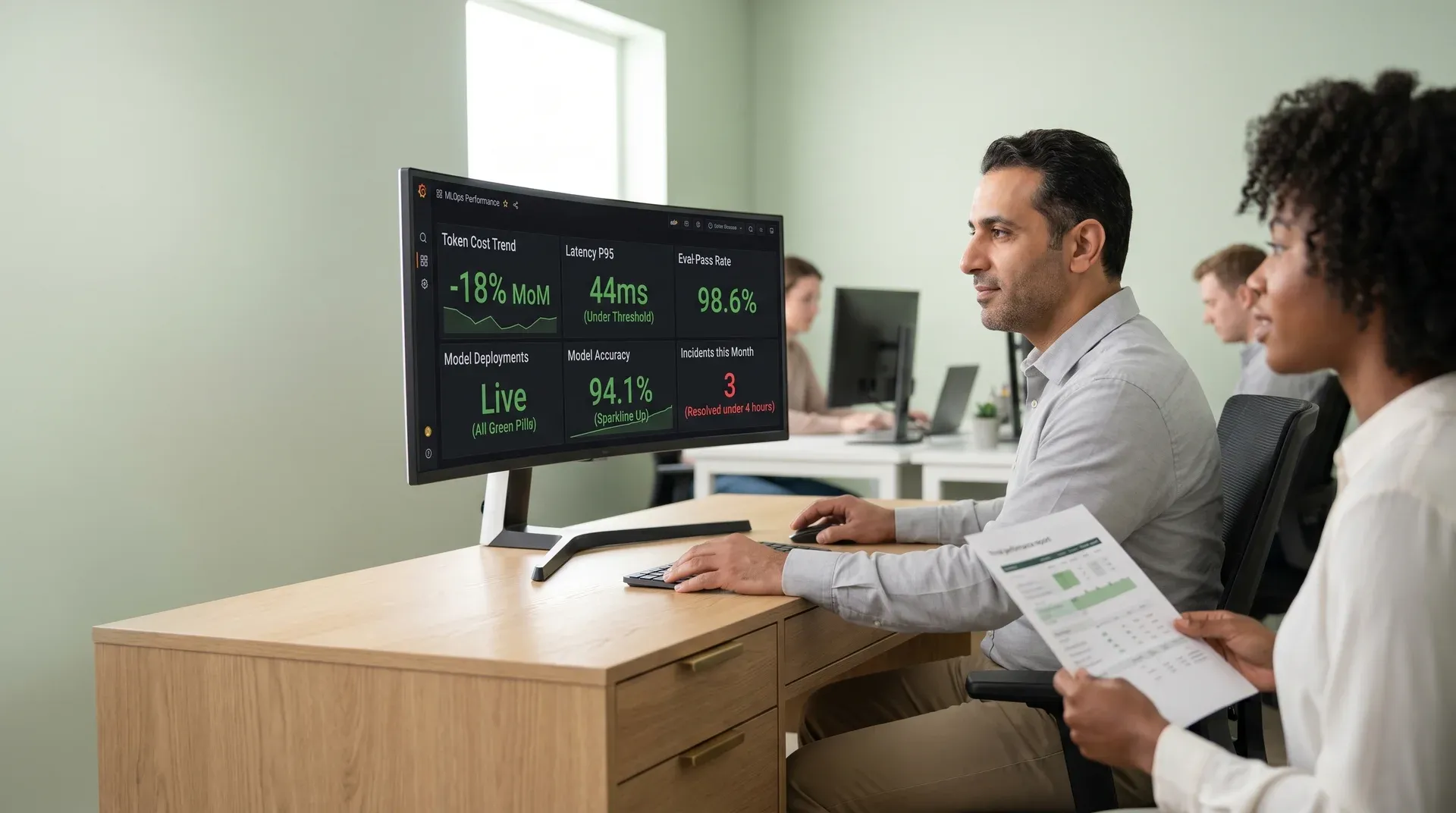
Your AI Stack, Always In View
The managed services platform your team stops worrying about
Every model you run gets a health score, a service level agreement, and a dedicated response team. You see everything. You approve priorities. We handle the rest.
Every model has a live health score
Accuracy, latency, and drift thresholds are tracked continuously. When a model crosses your agreed threshold, your team receives a prioritized alert before any user sees degraded output.
- Real-time accuracy and latency tracking across all models
- Configurable drift sensitivity aligned to your risk tolerance
- Automated retraining triggers when performance crosses thresholds
Incidents resolved before your users notice
Your service level agreement defines response and resolution times for each severity level. Every incident is owned by a named engineer, tracked to closure, and documented with root cause and corrective action.
- Named response times: Critical under 30 minutes, High under 2 hours, Medium under 8 hours
- Full incident lifecycle owned by one team, not three
- Post-incident documentation and root cause analysis on every Critical and High ticket
Monthly performance reviews with your team
Each month you receive a performance report covering model accuracy trends, infrastructure efficiency, incident history, and the next cycle's improvement priorities. Your sign-off takes one meeting.
- Accuracy and cost-per-inference trends across all managed models
- Proactive improvement roadmap prioritized by business impact
- Infrastructure cost optimization surfaced in every quarterly review
Delivery Approach
From signed scope to first incident resolved in 7 days
Day 1System audit and
baselineWe map every model,
integration, and service level agreement gap before touching anything in production
Days 2 to 4Monitoring setupAlert thresholds,
health checks, and incident routing configured to your specifications
Day 5Handover and
go-liveYour team reviews the
dashboard, approves thresholds, and we take over the watch
OngoingMonthly improvement
cyclePerformance report,
improvement priorities, and next sprint plan delivered at month-end
Service Scope
Every capability your AI stack needs, always improving
Your scope is defined before any work starts. You see the line items, the service level agreement, and the team assigned to your account before you sign a thing.
Model performance management
Continuous accuracy monitoring, drift detection, and retraining orchestration across every model in your production stack. You define the thresholds. We enforce them around the clock.
Monitoring
Automated + human review
Retraining
Scheduled + trigger-based
24/7 incident response
One team owns detection, triage, resolution, and post-incident documentation. Critical issues get a named engineer within 30 minutes.
Critical response< 30 minutes
94% resolved
within service level agreement window
Infrastructure optimization and cost control
Most enterprise AI deployments overprovision by 30 to 40 percent in the first year. Your managed services scope includes a quarterly infrastructure review that surfaces unused capacity, inefficient compute routing, and cost reduction opportunities.
Compute
optimizationMulti-cloud
routingCapacity
planningCost
attribution
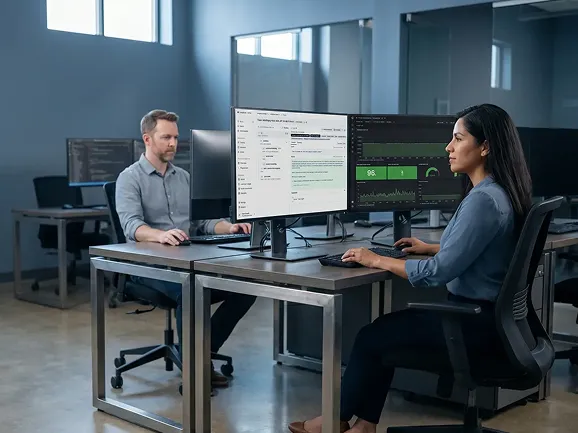
Compliance and security alignment
Model governance documentation, audit trail maintenance, and security posture reviews aligned to your regulatory requirements. SOC 2, GDPR, and sector-specific controls in scope from day one.
- SOC 2 alignment
- GDPR documentation maintained
- Model audit trail in scope
Continuous improvement cycles
Monthly sprint cycles deliver model updates, feature enhancements, and operational improvements on a predictable schedule. You never have to ask when the next improvement is coming.
Monthly
Performance report
Quarterly
Infrastructure review
Annual
Architecture review
Client Proof
What managed AI operations deliver in practice

Company
Parsons Kellogg
Promotional ProductsA major provider of promotional products and branded merchandise operating across 30 e-commerce storefronts with over one million active inventory items.
The problem
No unified visibility across 30 stores, over one million inventory items, and multiple backend platforms. Manual processes, fragmented integrations, and limited analytics slowed every operational decision and constrained warehouse capacity.
The outcome
$14M$90M
Annual revenue scaled after AI-powered operations transformation
Automation and unified AI reporting eliminated manual warehouse workflows, improved decision-making speed, and gave leadership real-time visibility across all 30 storefronts. The AI platform is now a competitive asset, not an operational burden.
Architecture and Governance
The platform that watches your AI, so you do not have to
Three operating layers run behind every client engagement. Each layer has dedicated tooling, documented service level agreements, and a named team member accountable for its performance.
Data ingestion and pipeline monitoring
Input quality tracking, schema drift alerts, and pipeline health across all data sources feeding your models.
Click to expand
Model intelligence and optimization
Real-time performance scoring, A/B evaluation, retraining orchestration, and model registry governance across all active versions.
Click to expand
Layer 3
Response, governance, and compliance
Incident ownership, service level agreement enforcement, audit trail maintenance, and compliance documentation as an always-on operational layer.
Click to expand
99.94%
Platform uptime
< 30 min
Critical incident response
24/7
Monitoring coverage
Monthly
Improvement cycle cadence
Why Redefine
Where most managed AI providers stop short
Most providers in this category offer broad monitoring without sharp qualification, clear scope, or proof tied to actual delivery outcomes. Here is where the difference shows up in practice.
Other managed AI
partners
Generic monitoring
dashboards not mapped to your service level agreement or risk tolerance
Alert
thresholds set to defaults, not your operational context
Ticket queues with
shared support teams, not a dedicated account team
Incidents
join a queue alongside dozens of other clients
Proof-light: case
studies reference engagement size, not delivery outcomes
No
before/after accuracy, cost, or uptime metrics in published work
Compliance
documentation treated as an add-on, not a core deliverable
Audit trail
and governance docs are a billable extra
No qualification:
scoped for anyone, optimized for no one
Broad service
catalog dilutes specialist depth
Redefine AI managed services
Alert thresholds
configured to your service level agreement, risk profile, and model type before go-live
Every model
has a documented health definition from day one
Named dedicated team
on your account from contract to renewal
One channel,
one escalation path, one accountable lead
Case studies show
accuracy deltas, uptime improvements, and cost reductions
Real numbers
tied to the exact service you are buying
Audit trail,
governance docs, and compliance alignment included in base scope
Regulatory
readiness is a deliverable, not a line item
Sharpened
qualification: we confirm fit before scoping, not after onboarding
If we are not
the right partner, we tell you in the first call
Common Questions
Answers to the questions that slow the decision
These are the questions that come up in almost every evaluation. If yours is not here, ask it directly in the brief form below.
Your scope is defined in the engagement brief before you sign. The standard scope covers 24/7 model health monitoring, drift detection and alerting, automated and scheduled retraining, incident management with named service level agreement response times, infrastructure optimization reviews, compliance documentation maintenance, and monthly performance reporting. Extended scope items like new model development, architecture redesign, or additional platform integrations are scoped separately.
A standard onboarding for a system with documented architecture takes 5 to 7 business days from signed scope to active monitoring. Day 1 covers a full system audit and baseline. Days 2 through 4 cover monitoring setup and alert threshold configuration. Day 5 is handover and go-live. Complex migrations or undocumented legacy systems take longer. We confirm the timeline before you commit.
Standard tiers are Critical (response within 30 minutes), High (within 2 hours), Medium (within 8 hours), and Low (within next business day). Platform monitoring uptime is 99.94%. These are contract commitments, not aspirational targets. Your specific thresholds for each model are documented and agreed before go-live.
Drift thresholds are set per model based on your acceptable accuracy range. When a model crosses a threshold, the alert fires to our team and your designated contact simultaneously. We investigate the cause, assess whether retraining or rollback is the right action, and execute with your approval on any production change. You retain final say on every deployment. Automated retraining pipelines handle routine cadence. Human review applies to every Critical trigger.
No. Managed services integrates with your existing stack: AWS, Azure, GCP, or on-premise deployments. The system audit in week one maps your current architecture and identifies integration points. Infrastructure changes are recommended in quarterly reviews as improvements, not as prerequisites to starting. You do not need to replatform to benefit from active monitoring and management.
Traditional IT managed services monitors infrastructure availability: is the server up, is the network stable, is the application responding. AI managed services monitors whether your models are delivering accurate, reliable outputs. A server can be fully operational while a model silently degrades. Your business outcome depends on model quality, not just uptime. The tooling, the skill set, and the service level agreement structures are fundamentally different disciplines.
Is This The Right Fit?
Who this engagement is built for
Good fit
- Enterprises with one or more deployed AI models running in production today
- Chief technology officer or chief information officer teams spending more than 20 percent of engineering capacity on model maintenance and fire-fighting
- Organizations with compliance or security obligations tied to AI outputs (financial services, healthcare, regulated industries)
- Teams ready to redirect senior engineering time toward new AI capability development
Not the right fit
- Organizations still evaluating whether AI belongs in their operations at all. You need AI consulting services before managed services
- Startups with no deployed AI models, seeking initial build and deployment capability
- Teams that want full in-house ownership of AI operations and are building internal machine learning operations capability actively
Not sure where you fall? Tell us your situation and we will be direct with you. Start the conversation
Start The Conversation
Book your AI strategy call
Tell us what your team is currently managing manually. We scope the engagement, confirm fit, and deliver a line-by-line proposal within 3 business days.
Scoped before work starts · line-by-line pricing · no commitment to receive a proposal
Call within 48 hours
Of brief submission
Proposal in 3 days
Line-by-line scoped
140+ projects delivered
Proven track record
Your data stays yours
No vendor lock-in
form
Brief received
We will review your situation and reach out within 48 hours to schedule your AI strategy call. A scoped proposal follows within 3 business days.
Ready When You Are
Your AI systems deserve a team that runs them full time
Get a scoped proposal that shows exactly what we monitor, what your service level agreement looks like, and what the engagement costs. No commitment. No pitch.
Submit briefcall within 48 hoursproposal in 3 daysmonitoring starts within 1 week of sign-off