AI Migration Services
Your legacy chatbot costs more than an AI agent migration
Legacy chatbots deflect tickets. AI agents resolve them. We migrate your chatbot infrastructure to autonomous agents with full handover, risk controls, and a go-live plan your team can trust.
40+
AI builds completed
12 weeks
Average time to live agent
60%
Escalation reduction on average

Why Teams Switch
The old way escalates. The new way resolves.
Legacy chatbots were built to deflect. They match keywords and route tickets. An AI agent is built to complete work. It reads context, calls systems, and closes the loop without a human in the middle.
AI Agent (Post-Migration)
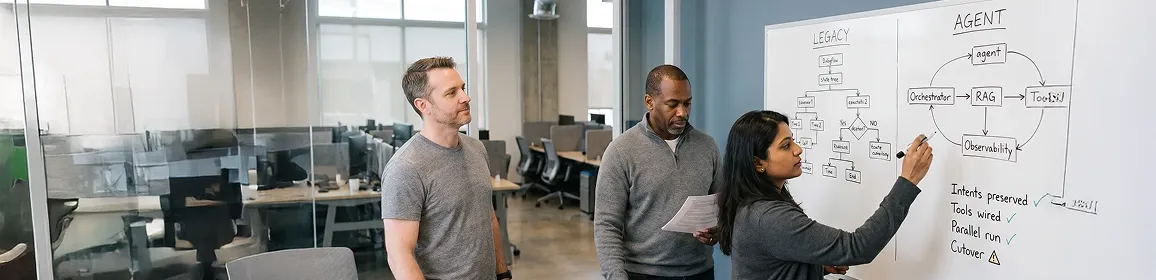
Understands intent, asks clarifying questions, and selects the correct action path from a toolset you define.
Connects to your systems. Reads a customer relationship management record. Submits a refund. Updates a ticket. Sends a confirmation. End-to-end.
Escalates only when the issue genuinely requires human judgment. Escalation drops to under 20% within one sprint cycle.
Knowledge is stored in a retrieval layer. Policy updates propagate automatically. No script rewrites required.
Legacy Chatbot
Matches keywords. Misses intent. Routes to a human when anything falls outside a preset script.
Cannot query a system, submit a form, update a record, or take any action. It talks. That is all.
Escalation rates stay above 45% even after months of tuning. The cost shifts to your human support queue.
Maintenance never ends. Every product change, policy update, or workflow tweak breaks the script tree.

Why Switch Now
Every day your legacy chatbot runs, this is happening
These figures are estimates based on industry averages for a 500-seat enterprise support team. Your actual numbers will vary. The direction will not.
Escalations Today
0
Manual escalations created by your chatbot today, requiring a human agent to resolve
Agent Hours Burned
0
Human support hours spent on tickets an AI agent could have resolved without escalation
Labor Cost
$0
Estimated weekly support labor cost attributable to chatbot escalations that an AI agent prevents
Counters are running in real time. These are conservative estimates for a 500-seat support team at an average agent cost of $28 per hour.
Migration Investment
Scoped before work starts
Line-by-line pricing delivered in your migration plan. No commitment needed to receive a proposal. Most migration projects scope between $18,000 and $64,000 depending on integration surface, toolchain complexity, and agent job count.
Scoped before work startsLine-by-line pricingNo commitment to receive a plan
What the Plan Includes
A migration blueprint you can take to finance and engineering
Every scoped plan maps your current chatbot to agent jobs, integrations, and cutover risk so leadership sees cost, timeline, and dependency in one place.
- Intent and escalation map from your live bot
- Recommended agent jobs, tools, and guardrails
- Parallel-run and cutover sequence with rollback
- Week-by-week milestones aligned to your team capacity
Request Your Migration Plan
Submit briefcall within 48 hoursplan in 3 days
Migration Path
From legacy chatbot to live AI agent in 12 weeks
We run a structured five-phase process. Your existing chatbot keeps running in production until your AI agent has passed parallel testing and your team has signed off on every job.
1
Week 1 to 2
Discovery audit
We map every intent, escalation path, and system your chatbot touches. You receive an audit report showing which jobs an agent can own versus which require redesign.
2
Week 3 to 4
Agent design
We define agent jobs, tool schemas, and guardrails. You approve the architecture before a single line of production code is written.
3
Week 5 to 10
Build and test
We build the agent, wire integrations, and run synthetic and live-traffic tests. You review sprint demos every two weeks with annotated resolution logs.
4
Week 11 to 12
Parallel running
Your legacy chatbot and the new AI agent run side by side on live traffic. We compare resolution rates, escalation rates, and response accuracy before you commit to cutover.
5
Week 13+
Go-live and monitor
Your AI agent goes live. We hand over observability dashboards, escalation thresholds, and documentation. Your team runs it. We remain on call for the first 30 days.
Sample agent resolution log, post go-live
What this log represents
End-to-end traces your team can audit
Every line ties to a tool call or policy decision. That is the difference between a legacy chatbot transcript and an agent runbook: you see what happened, how long it took, and when a human was required.
- ResolvedAgent completed the job inside guardrails without handoff.
- EscalatedHigh-impact or low-confidence path, routed with reason code for review.
- LatencySub-second reads, multi-second writes when systems round-trip.
During build and test (weeks 5 to 10) you receive annotated logs like this every sprint so product, support, and engineering align on what is ready for parallel run.
09:41:03Order #ORD-88124, refund eligibility checkResolved1.2s
09:43:17Account password reset, identity verified via SSOResolved0.8s
09:51:04Billing dispute, requires manual review, contract clause 4.2Escalated2.1s
09:54:22Subscription downgrade, retention offer applied, confirmedResolved1.9s
09:58:11Shipping estimate request, carrier API queried, ETA returnedResolved0.6s
Resolution rate 82%Escalation rate 18%Average response 1.3sHuman hours saved today 14.2 hours
Risk Controls
Every migration risk has a named mitigation
You hear the same objections on every AI migration. We have addressed all of them before. We build the controls into the delivery plan, not as afterthoughts.
Hallucination guardrails
Every agent job has a defined confidence threshold. Below that threshold the agent escalates rather than guesses. We log every escalation so you can tune thresholds over time.
Knowledge isolation
Your agent only accesses data within the permission boundary you set. We implement role-based scoping at the retrieval layer before connecting any live system.
Human-in-the-loop controls
For actions above a defined impact threshold (refunds over $200, account closures, policy exceptions) the agent surfaces a human approval step before proceeding. You set the thresholds. We wire the approvals.
- Approval gates per action type
- Escalation reason logged per ticket
- Override commands for edge cases
- Full audit trail for compliance review
Parallel running period
Your legacy chatbot stays live in production during testing. We never force a cold cutover. You compare resolution rates side-by-side and only cut over when you are satisfied.
Full code ownership
You receive every file, schema, prompt, and configuration on handover. No lock-in to a proprietary platform. Your engineering team can extend, redeploy, or move the agent independently.
Agent Architecture
What replaces your chatbot is a real system
Click any component to see what it does in your production environment.
Orchestrator
Routes the user intent to the correct agent job and manages multi-step conversation state.
Powered by your choice of GPT-4o, Claude Sonnet, or Gemini 1.5 Pro. We benchmark all three on your actual intent distribution before recommending a model.
Knowledge layer (RAG)
Retrieves relevant policies, product specs, and procedures from your internal knowledge base at query time.
We ingest your existing documentation (Confluence, Notion, SharePoint, PDFs) and build a vector store. Updates propagate automatically when source documents change.
Tool layer
Structured functions that allow the agent to call your customer relationship management, ticketing system, ERP, or custom API endpoints.
We define tool schemas during the design phase. Each tool has input validation and error handling. The agent cannot call a tool outside the approved schema.
Observability
Full trace logging per conversation. You see every step the agent took, every tool call made, and every escalation trigger.
Delivered as a dashboard your team owns. We integrate with your existing monitoring stack (Datadog, Grafana, CloudWatch) or provide a standalone Langfuse instance.
Client Proof
A legacy platform migration that unlocked scale
B2B PlatformPromotional Products
The Client
A B2B promotional products distributor operating complex catalogs, customer-specific pricing, and approval-based purchasing workflows across enterprise accounts.
The Problem
Their legacy platform could not support complex B2B workflows or scale efficiently. Inventory syncing was unreliable, catalog pages loaded slowly, and customer approvals were manual. System data was fragmented across their ordering, customer relationship management, and marketing tools, creating operational bottlenecks that grew worse with every new account they onboarded.
The Solution
A complete platform rebuild using a decoupled headless architecture powered by Node.js and Next.js. Real-time inventory and pricing synced directly from their ERP. A custom approval and access control system replaced all manual onboarding steps. Every integration was designed to operate without manual intervention.
The Result
0
reduction in manual operations frictionThe new platform delivered faster performance, reliable live inventory, and a smooth B2B purchasing and approval experience. The architecture now supports scalable growth, marketing initiatives, and future system enhancements without rework.
See AI Case StudiesWhy Redefine
What a dedicated migration team delivers
Most partners sell AI consulting broadly. We run a dedicated migration practice. That changes what the deliverable looks like and what happens on go-live day.
| Capability | Typical partner | Redefine |
|---|---|---|
| Dedicated legacy chatbot migration practice | ||
| Parallel running period before cutover | ||
| Human-in-the-loop approval gates built in | Add-on | |
| Full code and data ownership on handover | ||
| Cost-of-staying analysis before sign-off | ||
| Observability dashboard delivered on handover | Add-on | |
| Fixed-scope pricing before work starts |
Common Questions
Real questions from chief technology officers and chief information officers
Your existing chatbot stays in production throughout the migration. We run the AI agent alongside it during a parallel testing period (weeks 11 and 12). You only cut over when your team has reviewed resolution logs, compared escalation rates, and signed off. There is no forced switch or downtime window.
Every agent job has a defined confidence threshold. When the agent's confidence in an action falls below that threshold, it escalates to a human rather than proceeding. We log every escalation reason so you can review what caused them and tune the threshold over time. The knowledge layer uses retrieval-augmented generation, which grounds responses in your actual documentation rather than model memory.
We have run migrations from Dialogflow (CX and ES), IBM Watson Assistant, Amazon Lex, Microsoft Bot Framework, Intercom, Drift, and fully custom rule-based chatbots. The migration approach is platform-agnostic. What matters is mapping your existing intents, escalation paths, and system integrations, not the source platform.
Across a full 12-week migration, your team contributes 2 to 3 hours per week. That includes one bi-weekly sprint review (60 minutes), async feedback on agent behavior samples, and a final quality assurance sign-off session. We handle every build, integration, testing, and deployment step. You do not need to manage developers, write agent prompts, or coordinate quality assurance independently.
You receive the complete codebase, all configuration files, agent prompt schemas, tool definitions, knowledge base structure, and an observability dashboard. We run a structured handover session with your engineering team, document every operational procedure, and remain on call for the first 30 days post-go-live at no additional cost.
Is This Right For You
Who this migration is built for
This is for you if
- Your chatbot escalation rate is consistently above 30% and your support team spends more than 20 hours per week on tickets the chatbot handed off
- You have at least one documented API or system the agent should be able to query or update on the user's behalf
- Your chief technology officer or a senior engineer can commit 2 to 3 hours per week to sprint reviews and async feedback for 12 weeks
- You want to own the output and run the agent independently after handover, not depend on a vendor platform
This is not for you if
- You need a simple FAQ bot or keyword-routing upgrade. That is a chatbot improvement, not an agent migration. We can refer you to the right scope.
- Your compliance environment prohibits any external API calls or data retrieval from systems outside a fully isolated on-premise stack with no cloud egress
- You are expecting a fully automated migration with no internal review cycles. Agent quality requires your team's domain knowledge at each sprint checkpoint.
Not sure which side you are on? Tell us your situation and we will be straight with you.
Start Your Migration
Get a scoped migration plan
Tell us what your chatbot currently cannot handle. We review your situation, build a line-by-line migration plan, and send it within 3 business days. No commitment required.
- Response within 48 hours
- Migration plan in 3 business days
- 40+ AI builds completed
- You own all code and data on handover
Form
Brief received
We will review your situation and send a scoped migration plan within 3 business days. Expect a call from our team within 48 hours.
Response within 48 hours
Plan in 3 business days
40+ AI builds completed
You own all code on handover

Your legacy chatbot migration starts with a plan
We scope your migration before any work begins. You receive a line-by-line plan with timelines, integration points, and cost of inaction analysis. Then you decide.
Sprint 1 begins within 1 week of sign-off
No waiting list, no 6-week onboarding. Your discovery audit starts as soon as the scope is agreed.
Your existing chatbot never goes dark unexpectedly
We run parallel before we cut over. Your users never notice a break in service.