How much does a process audit cost?
It depends on how many processes and systems we review.
We agree on the scope and set the price before any audit work starts.
Expert-led process audit
Find the gaps in how work gets done. We map your key processes and give you a ranked fix list. Redefine Innovations helps operations and finance leaders, with developers, ERP engineers and analysts on one team.
Parsons Kellogg: manual reporting time fell 58% (a Dynamics 365 and Power BI build). The audit is a written report; a short scoping call comes first.
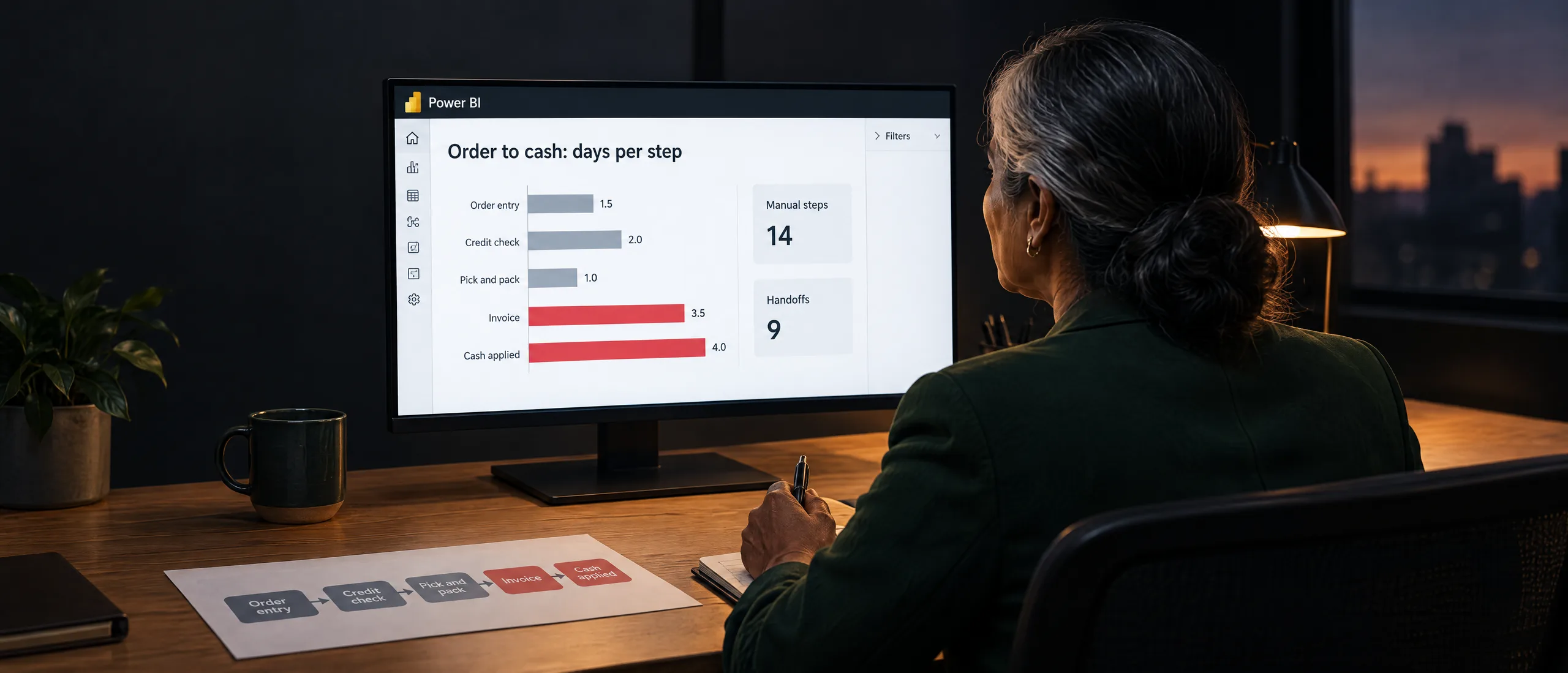
See where work waits, which steps are done by hand, and what to fix first. One written audit. Ongoing process work is our business consulting service.
Get your written Process Audit.
Uncover slow and manual steps, with a ranked fix list.
Client results
What changed when we fixed process and system gaps. These were builds, not audits.

Your process audit
Map the work first. Then fix it.
Manual reporting time
-58%
Parsons Kellogg, once reports went live in Power BI.
Inventory accuracy
99.0%
Parsons Kellogg, with Dynamics 365 at the core.
Manual data entry
-80%
MAXIMUM, once listings came from one feed.
Places to update a price or stock count
Sources: Parsons Kellogg and MAXIMUM case studies.
Short answer
Updated
A process audit is a written review of how work moves through key processes, such as order to cash, procure to pay, inventory and reporting. Redefine Innovations maps these processes for COOs, CFOs and operations leaders. We find manual steps, delays, rework and system gaps. Then you get a ranked list of fixes, with system and automation options.
Most teams buy a new tool to fix a slow process. If the process is not mapped first, the new tool copies the same delays. The audit maps each step, so every gap is plain to see.
Then each gap is ranked by its cost to you. You see which fix to make first, and which system it touches.
Pick by what you need to know
What your audit covers
Need help with the tools first? See our technology stack assessment, or all consulting services.
One team
Gaps sit between people, systems and data. One team sees all three.
Four vendors
Strategy firm
Plans and advice
Systems integrator
Links the tools
Software developer
Builds the apps
ERP or data partner
Runs ERP and data
Your team
Holds the handoffs
4
Redefine
Strategy
One plan
Systems
One map
Software
One build team
ERP data
One source
Analysts
One audit
Your team
One owner
1
Every audit starts where the work happens: at the desk, in the system, step by step.

Manual work calculator
Enter your own numbers to see the hidden cost of manual steps in your process.
Your numbers
This result is an estimate from your own numbers: people x hours a week x 52 x hourly cost. The hours line assumes 70 percent could be automated.
Problems we find
Each problem has a fix. Each one links to the service that fixes it.
Work done by hand holds back growth.
Data sits in silos, so people copy it by hand.
Teams spend hours on the same tasks each week.
Steps do not fit the systems you run.
Work runs one way, while goals point another.
An engineering mindset for business change
Redefine Innovations is an engineering company that does consulting. Developers, ERP engineers and analysts work on one team, so a fix reaches your systems and data, not just a slide.
Typical
Advice on slides
The report lists ideas, but none of them point to a system or a data source.
Consultants leave after the report
Someone else has to build the fix, so the reasons behind it get lost.
[!] Where most fixes stall
Done when the deck is sent
Nobody owns each fix, and problems wait for the next review.
Redefine
Fixes tied to your systems and data
Each fix names the system, report or data it changes, so you can act on it.
The same team can build the fix
The developers and ERP engineers who ran the audit can build and run the fix.
Same people, start to finish
An owner and a done-when line
Every fix has an owner. Measures are tracked, and drift is flagged early.

How Redefine works
A clear way to improve your processes.
Five stages guide your process audit. Each stage builds on the one before, so the report rests on how your work really runs.
You get a written audit with a ranked fix list. A scoping call comes first.
Why this approach matters
Start here
We map your key processes to find manual steps, handoffs and weak spots in your systems.
You receive Current process map
Choose what matters
We rank each gap by its impact. We would not start with a new system purchase: the process is mapped before a tool is chosen.
You receive Ranked fix list
Do the work
We hand over clear recommendations built on your data, with quick fixes and longer term steps laid out.
You receive Written audit report
Check the result
We check each change against your data to see that it did what it was meant to do, and suggest changes where needed.
You receive Check steps for each fix
Keep improving
We track the measures named in the audit, so drift shows up early and your team can act.
You receive Measurement plan
A detailed audit report: process maps, ranked fixes, steps to improve and how each fix is checked.
Case study / connected operations
Parsons Kellogg
Parsons Kellogg sells promotional products and corporate apparel across many storefronts. This was a build project, not a process audit.

Result
Reporting and stock
Manual reporting time
-58%
Inventory accuracy
99.0%
Source: Parsons Kellogg case study.
01 / Challenge
Inventory and order data sat in separate systems and stores, so people kept them in line by hand.
02 / Diagnosis
Each store and system kept its own copy of stock and orders.
03 / Action
Dynamics 365 ERP and CRM as the core, APIs for data flows, Power BI reports and a headless store.
04 / Result
Inventory accuracy reached 99.0%.
Your Process Audit
A written report that maps your key flows and ranks every fix. Then we walk your team through it, and you decide to act in-house or with Redefine.
Redefine
Confidential
Prepared for: your company
Business Process Audit Report
Contents
Business Process Audit Report
Your company
Biggest delay
Invoice to cash
Your report shows where work waits, which steps are done by hand, and which fix to make first.
Where work waits in order to cash
Fix first
Ranked #1
Priority
High
Do in this order
Map Fix Measure
Questions
Clear answers before you ask for your Process Audit.
It depends on how many processes and systems we review.
We agree on the scope and set the price before any audit work starts.
It depends on the scope and how ready your team is.
We plan interviews and data access around your pace, and set the dates in the scoping call.
The ones that matter most to how you run. Most teams pick order to cash, procure to pay, inventory or reporting.
We help you choose and rank them first. See business consulting services
We keep it light. Interviews are short and set at times that suit your team.
We only read your systems, so nothing in them changes.
Read-only access or data exports from your ERP, finance and reporting tools. Process documents help too.
Access rules are agreed and written down before work starts.
Developers, ERP engineers and analysts, working as one team.
The same team can help you build the fixes if you choose to go ahead. See ERP consulting services
The REDEFINE Method is Redefine Innovations' business-first framework for identifying business constraints, prioritizing improvements, delivering appropriate solutions, verifying outcomes, and sustaining improvements.
It has five stages: Diagnose, Prioritize, Deliver, Prove and Improve. Read the REDEFINE Method
Your Process Audit
See where your processes stand. You get a written audit with a ranked list of what to fix first.

Tell us which processes feel slow today. We read every request.