Ship a web app that works like a native app
Offline-ready. Installable. No app store required. Redefine builds PWAs that land on your customer's home screen and load in under a second — on every device.
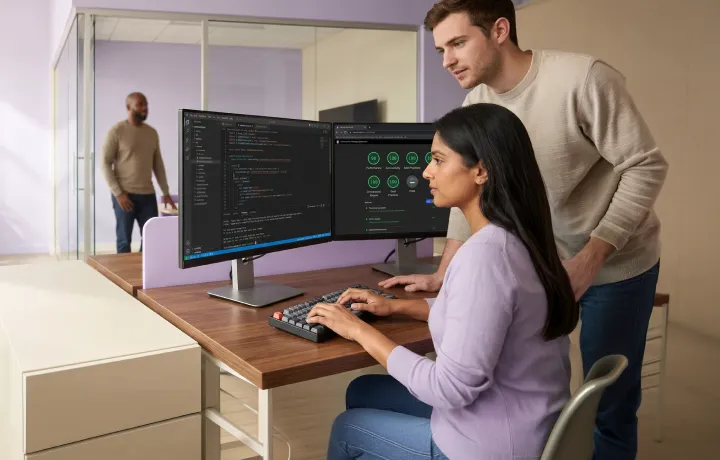
Core Web Vitals
Your mobile experience is bleeding revenue right now
Every second of load time costs you customers. Every app-store approval cycle costs you time. Every platform update breaks something you paid to build.
Separate iOS and Android codebases. Two teams, two budgets, two bug queues.
App store approval takes 3 to 14 days. A broken update? Roll back and wait again.
52% of users abandon a site that takes more than 3 seconds to load on mobile.
Offline support requires a native SDK. No network — no content. Customers bounce.
Push notifications need native permission flows and a separate notification server.
One codebase runs on iOS, Android, and desktop. Ship once, reach everyone.
Deploy a fix in minutes. No approval queue. No waiting. Your service worker updates silently.
Sub-second load on repeat visits. Service worker caches assets before the user blinks.
Offline mode keeps your app usable on the subway, in a warehouse, or on bad hotel wifi.
Push notifications through the Web Push API. No separate server. No native SDK cost.
Pain · Merchant on phone, frustrated with slow mobile checkout

From brief to live PWA in 6 to 8 weeks
Click any phase to see what happens, what you receive, and what your team needs to do (hint: very little).
Discovery and Audit
Days 1 to 5
Architecture and Design
Days 6 to 14
Core Build
Days 15 to 35
Quality Assurance and Lighthouse
Days 36 to 45
Deploy and Handover
Days 46 to 56
Phase 01 • Discovery and Audit
We audit what you have. We map what you need.
We review your existing site or app for performance, offline capability, and PWA readiness. You get a written audit document and a scoped proposal before any code is written.
You receive: Audit document • Scoped proposal • Architecture diagram
Phase 02 • Architecture and Design
Service worker strategy. App shell. Manifest config.
We define your caching strategy, design the app shell, configure the web manifest, and set up your push notification infrastructure. User experience screens for review before development begins.
{
  "name": "Your PWA",
  "short_name": "YourApp",
  "display": "standalone",
  "start_url": "/",
  "theme_color": "#111517",
  "icons": [
    { "src": "/icon-192.png",
      "sizes": "192x192" },
    { "src": "/icon-512.png",
      "sizes": "512x512" }
  ]
}
You receive: Figma screens • manifest.json • caching strategy document
Phase 03 • Core Build
Service worker. Offline cache. Push. Install prompt.
The full PWA stack: service worker with cache strategies, background sync, push notification hooks, install prompt logic, and your application programming interface layer. Weekly demo calls. You see working software, not slide decks.
You receive: Weekly sprint demos • staging URL • dev branch access
Phase 04 • Quality Assurance and Lighthouse
We do not ship until Lighthouse hits 90+.
Every page, every device, every network condition. We run automated Playwright tests, manual device testing on real iOS and Android hardware, and a final Lighthouse audit. Score drops below 90 — we fix it before launch.
Final Lighthouse Results
98
Performance
100
Accessibility
100
Best Practices
100
PWA Score
You receive: Lighthouse report • device test matrix • quality assurance sign-off document
Phase 05 • Deploy and Handover
Live. Documented. Yours to run.
CI/CD pipeline, deployment to your infrastructure or CDN, and a full handover pack. You get the code, the docs, and a 30-minute walkthrough. No lock-in.
You receive: Full source code • CI/CD config • handover walkthrough call
Every capability. Zero native tax.
A Redefine PWA is not a thin wrapper. It is a full-stack web experience with native-class capabilities — built to the same standards as the web apps at Apple, Google, and Twitter.
Offline-first architecture
Your app works without a network connection. Content is cached via service worker using the right strategy per resource type: cache-first for assets, network-first for data.
Push notifications
Reach your users even when your app is not open. Web Push API with full subscription management, segmentation support, and iOS 16.4+ compatibility baked in.
Installable to home screen
Custom install prompt with your branding. No app store. Installs in one tap. Runs in standalone display mode — full screen, no browser chrome, exactly like a native app.
Sub-second performance
App shell cached on first visit. Repeat loads feel instant. We target LCP under 1.5s and a Lighthouse performance score of 90 or above — measured on real devices, not emulated environments.
Secure, API-connected, scalable
HTTPS enforced. Background sync for offline-queued actions. Full REST or GraphQL application programming interface integration. Auth flows, protected routes, and role-based access built to production standards.
Need a broader web application rather than a focused PWA? See our web application development service or our mobile app development service for fully native builds.
48
Projects completed
90+
Average Lighthouse score
6 to 8
Weeks to live PWA
3
Day proposal turnaround
The PWA stack we ship
Every layer below is production-configured, not demo-grade. Click a node to see what lives at that layer.
Browser / Device
Your PWA runs in any modern browser — no download required. On iOS and Android it can be installed directly to the home screen from Safari or Chrome, launching in standalone mode with your splash screen and icon.
Real results. Real platform. Real app.
What they do
A real estate platform showcasing property listings and agent information — built for iOS and Android, and optimized for high user engagement.
The problem
The platform had no dedicated mobile application. Listings and agent details were only accessible via browser. The team needed a cross-platform app with a custom scanning feature, secure payment integration, and strict app store compliance — without two separate native codebases eating the budget.
How we solved it
We built a cross-platform application using a single shared codebase — new features for listing browsing, agent profiles, and a custom scanning interaction. Secure payment gateway integration, push notifications, and app store optimization for both iOS and Android.
Result
Increased visibility and user engagement within 60 days of launch across both iOS and Android platforms
What typical dev shops get wrong about PWAs
What they do
Add a service worker as an afterthought
A single cache.addAll() call at the end of a project is not PWA architecture. It does not handle updates, background sync, or offline-first data flow.
What they do
Test on desktop emulators only
Offline mode behaves completely differently on a real iPhone with Safari than it does in Chrome DevTools. We test on physical devices — not simulated environments.
What they do
Skip the performance budget
A PWA that scores 58 on Lighthouse is not a PWA — it is a slow website with a manifest file. Performance is architecture, not optimization. We build for 90+ from day one.
Looking at other custom development services? See our full development services hub.
What buyers ask before they sign
Most PWA projects ship in 6 to 12 weeks from signed scope, depending on complexity. A focused MVP with offline mode, push notifications, and install prompt is typically 6 to 8 weeks. Enterprise builds with third-party integrations, auth flows, and complex application programming interface surfaces add 2 to 4 weeks.
Yes. Modern iOS Safari supports service workers, install prompts, and offline caching. Push notifications on iOS require iOS 16.4 or later with the web app added to the home screen. We build and test across both platforms on real devices for every build we ship.
A PWA runs in the browser and can be installed to a device home screen without going through an app store. Native apps are compiled per platform and distributed via the App Store or Google Play. PWAs ship faster, cost significantly less to maintain across platforms, and reach users on any device with a modern browser.
Yes. A PWA is a web app and is fully crawlable and indexable by Google. Performance improvements — faster load times, improved Core Web Vitals scores — typically improve organic search rankings. We follow Google's PWA best practices and test for crawlability before launch.
A focused PWA project with offline mode, push notifications, and install prompt starts around $18,000 to $28,000. Enterprise builds with advanced integrations, auth flows, application programming interface layers, and custom caching strategies range from $40,000 to $80,000. Every project is scoped line by line before any work starts — no surprise overruns.
A PWA is the right call when
Good Fit
You want a mobile app but don't want two separate native codebases to maintain
Your users are on mobile and your current site loads too slowly to convert them
You want push notification capability without paying for native push infrastructure
Your users work in low-connectivity environments — field teams, warehouses, traveling
You need to ship fast — 6 to 8 weeks versus 5 to 9 months for a native app
Not the Right Tool
You need deep native device access: Bluetooth, NFC, complex camera features, or ARKit
App store distribution is a strategic requirement — you want App Store browsing and ratings to drive organic discovery
Your product needs heavy background processing (GPS tracking, audio recording) that web application programming interfaces do not fully support
Not sure? Tell us your situation and we'll be direct with you about whether a PWA fits.
Get a line-by-line proposal for your PWA in 3 days
No commitment. No pitch. Submit your brief, we review your setup, and you get a scoped proposal with phases, deliverables, and a fixed price — before any work begins.
Submit your brief
Describe your current setup and what you need the PWA to do
Call within 48 hours
We review your audit and ask two or three targeted questions
Scoped proposal in 3 days
Line-by-line pricing, phases, and a fixed delivery timeline
Sprint 1 starts within 1 week of sign-off
No waiting. Build begins as soon as scope is approved
Brief received
We will review your situation and send a scoped proposal within 3 business days. Expect a call within 48 hours.
Submit brief → call within 48 hours → proposal in 3 days → Sprint 1 within 1 week of sign-off