React Native App Development Company
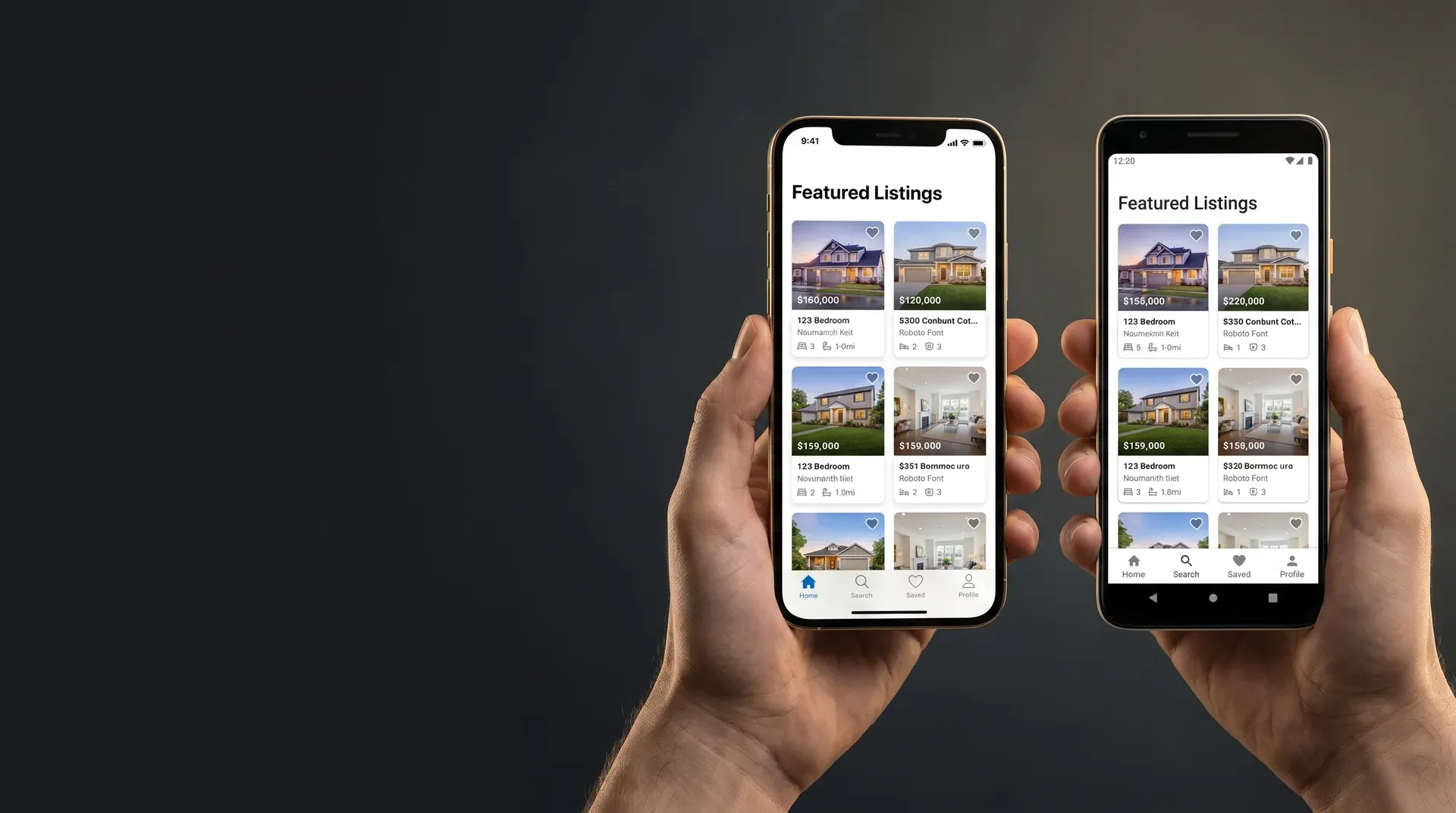
React Native App Development. One Codebase. Two App Stores.
We build React Native apps that ship simultaneously to iOS and Android from a single TypeScript codebase. Native UI components, Expo EAS deployment, and 85 percent or higher test coverage on every delivery.
iOS
App StoreGoogle
PlayExpo EASTypeScript
iOS
9:41
Featured Listings
Home
Search
Saved
Profile
3 bed • 2
bath • 1,840 sqft
Schedule Viewing
One codebase
synced
Android
9:41
Featured Listings
Home
Search
Saved
Profile
3 bed • 2
bath • 1,840 sqft
Schedule Viewing
The Native Development Tax
Building native iOS and Android separately doubles everything except your shipping date.
Building Native Separately
0
separate codebases to maintain
iOS in Swift,
Android in Kotlin
0x
the engineering cost
two full mobile
teams, two release cycles
Every bug,
fixed twice. Every feature, built twice.
Platform parity is
never guaranteed
Android
ships 4 to 8 weeks after iOS. Always.
Half your users
wait for features
With React Native
0
shared TypeScript codebase
with native
modules where you need them
0%
code shared between iOS and Android
business logic,
state, navigation, API calls
Same day
iOS and Android App Store release
Expo EAS Build
submits both simultaneously
0%
faster delivery versus dual native teams
without
sacrificing native UI feel

The Real Cost of Waiting
Every day you maintain two native mobile teams, this is what it costs you.
Based on two mid-senior mobile engineers at $150k each versus one React Native team. The counter starts when you scroll here and runs for as long as you read.
Native iOS + Android Teams
$0
accumulated since you started reading
2 engineers x
$150k per year = $300k per year = $0.95 per minute
React Native Single Team
$0
accumulated since you started reading
1 engineer x
$150k per year = $150k per year = $0.48 per minute
Cost Difference (React Native Savings)
$0
saved per minute by choosing React Native
$150k per year
difference = $0.47 per minute = $12.86 per day
Counter starts on scroll entry. Resets on page reload. Annual cost spread over minutes for illustration.
React Native Development Capabilities
Native performance. Cross-platform delivery. One team shipping to both stores.

Cross-platform native UI from a single TypeScript codebase
React Native renders real native UI components, not a web view. iOS users see UIKit components. Android users see Material Design components. Both respond to the gestures, animations, and accessibility features that users on each platform expect.
Native
UIKit (iOS)Material
Design (Android)TypeScript
shared
// One component, two native UIs
export const PropertyCard =
() => {
return (
<View style={styles.card}>
<Image source={listing.photo}
/>
<Text style={styles.title}>
{listing.address}
</Text>
</View>
);
};
Renders native on iOS and Android
iOS build #247
main branch · 3m 14s
Android build #247
main branch · 4m 52s
Both builds
submitted to app stores simultaneously
Expo EAS deploys to both stores simultaneously, without Xcode or Android Studio on your machine
Expo EAS Build handles code signing, certificates, and app store submission for both iOS and Android from a single command. No Mac required for Android builds. No Windows required for iOS. Your continuous integration and delivery pipeline triggers a build on git push and both stores receive the submission at the same time.
Quality assurance and test automation services →Over-the-air updates ship new JavaScript to users without an app store review
Expo Updates lets you push JavaScript changes directly to users' devices without submitting a new binary to the app stores. Bug fixes and content updates ship in minutes, not weeks. Native code changes still require a full submission, but most product iterations do not touch native code.
App
Store review: 1 to 3 days for native changes. Over-the-air update: live in minutes for JavaScript
changes.
# Push JavaScript update, no app store review
$ eas update --message "Fix checkout flow"
Publishing update...
iOS: 23,847 devices updated (2m 14s)
Android: 31,204 devices updated (2m 31s)
Rollback: eas update --rollback
Stack.Navigator
Tab.Navigator
HomeScreen
SearchScreen
ModalStack
PropertyDetail
Tab.Navigator
HomeScreen
SearchScreen
ModalStack
PropertyDetail
myapp://listing/8291
Opens PropertyDetail directly
Deep link working
Opens PropertyDetail directly
Deep link working
React Navigation handles tab bars, stack navigation, and deep links with native-quality transitions
Navigation feels native on both platforms because React Navigation drives each transition with native gesture handlers and reanimated worklets. Deep links open the correct screen directly from push notifications, marketing emails, or web URLs. We configure universal links (iOS) and app links (Android) as part of every build.
Mobile app development services →Client Result
A real estate platform needed mobile reach on iOS and Android simultaneously. We shipped both at once.
Platforms Shipped
0
simultaneous app store launches
Code Sharing
0%
shared between iOS and Android builds
Features
Multi-platform
optimization, user behavior analytics, app feature development
Real
EstateHomes
and Lands
The problem
Homes and Lands needed a secure, high-performance mobile application for iOS and Android that showcased property listings and improved accessibility and competitiveness in the real estate market.
What we delivered
- Simultaneous iOS and Android launch
- User behavior analytics integration
- Application optimization and performance

What this means for your project
Real estate apps need property search, map integration, push notifications for price drops, and offline access for areas with poor cell coverage. These are the exact native capabilities React Native handles without compromising the cross-platform build.
Mobile app development services →
React Native works for
- Marketplace and listing apps
- Software as a service companion apps
- E-commerce and retail apps
- Communication and messaging apps
- Content and media apps
Why Redefine for React Native
Three claims most React Native agencies cannot back up.
01
We ship iOS and Android on the same day. Not iOS first, Android whenever.
Expo EAS Build compiles both binaries in parallel and submits to the App Store and Google Play simultaneously. The scheduling constraint is Apple's review queue (typically 1 to 3 days), not your engineering team. Both platforms are always on the same version, with the same features, on the same release cycle. Platform fragmentation in your user base stops the day you launch with us.
iOS app development services →02
React Native, not Cordova or Ionic. The performance gap is not a debate.
Cordova and Ionic render your UI inside a WebView. React Native renders real native UI components. The difference is visible to users: 60 frames per second gesture animations, platform-native scroll physics, hardware keyboard support, screen reader accessibility, and haptic feedback all require real native components. We use React Native with Expo exclusively and have never shipped a WebView-based "mobile app" for production use.
Android app development services →03
Expo EAS eliminates your build infrastructure. You focus on features, not build
servers.
Managing iOS certificates, provisioning profiles, Android keystores, and build machines is full-time infrastructure work before you ship a single feature. Expo EAS handles all of it in the cloud. Your team pushes code, the build triggers, and within 10 minutes both binaries are ready for store submission or internal distribution. We set up EAS build profiles, update channels, and rollback procedures as part of every engagement.
Common Questions
What chief technology officers ask before a React Native engagement.
React Native lets one team build an app that runs on both iOS and Android from a shared codebase. You get native UI components, not a web view wrapper. The practical advantage: one team, one codebase, simultaneous release to both app stores. Building native iOS and Android separately doubles your team size, timeline, and maintenance burden for every feature you ship.
For almost every application category, yes. React Native uses the same native UI components as Swift and Kotlin apps. The new React Native architecture removes the bridge bottleneck from older versions. Performance-critical code can be written in native modules and called from React Native. Most users cannot tell the difference between a well-built React Native app and a native one. Learn more in our mobile app development services overview.
A production-ready React Native app with authentication, a data feed, push notifications, and app store deployment typically takes 12 to 20 weeks. A simpler minimum viable product with 3 to 5 screens takes 6 to 10 weeks. Timeline depends on backend complexity, third-party integrations, and the number of custom native modules required. We scope before we commit to a number.
We default to Expo managed workflow because Expo EAS Build handles code signing, certificates, and app store submissions without managing native build infrastructure. For apps requiring deep native modules not supported by Expo, we use bare React Native with the Expo modules layer. The decision is based on your feature requirements, not our preferences.
React Native engagements typically run between $50,000 and $250,000 depending on the number of screens, backend complexity, third-party integrations, custom native modules, and whether the scope includes Expo EAS infrastructure setup. We scope before we quote. See our React Native pricing guide for detail.
Is This a Good Fit?
Who we build well for, and who we do not.
Good Fit For
- Teams that need iOS and Android simultaneously without running two engineering streams.
- Startups and scale-ups with a defined API or backend already in place.
- Products that ship new features more than once per quarter and need over-the-air delivery speed.
- Existing web teams that want to extend a JavaScript or TypeScript codebase to mobile without rebuilding from scratch.
Not a Fit If
- Your app requires heavy real-time graphics, game rendering, or augmented reality with custom metal shaders.
- You are pre-revenue with no product definition and need discovery work before a build scope exists.
- You need an app in fewer than 6 weeks from kick-off with no existing design or backend infrastructure.
- Your primary requirement is deep Bluetooth low energy peripherals or medical-grade device APIs with no Expo support.
Not sure? Tell us your situation and we'll be straight with you. Go to the intake form →
Book a React Native Strategy Call
Tell us about your mobile app project.
We respond within two business days. No commitment. No pitch.
Form
Submit brief → call within 48 hours → proposal in 3 days → Sprint 1 starts week 2
Brief received.
We will review your mobile app project and send a scoped proposal within 3 business days.