Shopify A/B Testing Services
Replace guesswork with tested proof
Every change you make to your Shopify store is a hypothesis. Redefine runs structured split tests that validate those hypotheses with statistical confidence, then deploys winners that compound your revenue month over month.
95%
statistical confidence
required before calling a winner
3x
revenue lift from structured
Shopify testing programs
14
days
from audit kickoff to first
live experiment running

Brands whose Shopify stores are tested by Redefine
Narragansett BeerCorporate GearGameday GearCore PickleballEyeglasses123
$70K
additional monthly revenue unlocked by optimization (Narragansett Beer)
First month post-launch lift
29.3%
of all conversions attributable to optimized email and lifecycle flows
Gameday Gear email conversion rate optimization engagement
20%+
year-over-year revenue growth sustained through continuous Shopify optimization
Microphone Madness year-over-year compound
51.2%
open rate on optimized post-purchase sequences after experimentation
Gameday Gear Klaviyo results
The Testing Gap
Making changes without testing is a coin flip with your revenue
Most Shopify stores ship design and copy changes based on opinion. Structured split testing replaces that pattern with measurable proof.

Current state for most Shopify stores
Changes deployed based
on gut feel or senior opinion
No data validates the change. You will
not know if it helped or hurt until the next quarterly review.
Tests stopped early
because a trend looks good
Underpowered experiments create false
confidence. Changes deployed too early cause regressions that erode revenue over months.
No prioritized backlog,
so high-value tests never get built
Teams test what is easy, not what is
worth testing. The product detail page and checkout stay broken because they feel harder to touch.
Test results reported
in activity format, not revenue format
You see what ran, not what it was worth.
The program cannot justify its own budget.
Redefine structured testing program
Every change starts
with a hypothesis ranked by revenue impact
Audit data, heatmaps, and session
recordings score every opportunity before any development work begins.
95% confidence required
before any winner is called
Tests run to full statistical power. No
early celebrations, no premature deployments that cause revenue regression.
A new experiment goes
live every 2 to 4 weeks
Velocity compounds. Each winning variant
raises the baseline for the next test, creating accelerating returns over time.
Monthly revenue
attribution report, every engagement
You see exactly which test generated
which revenue lift. The program pays for itself with the first significant win.
Live Experimentation
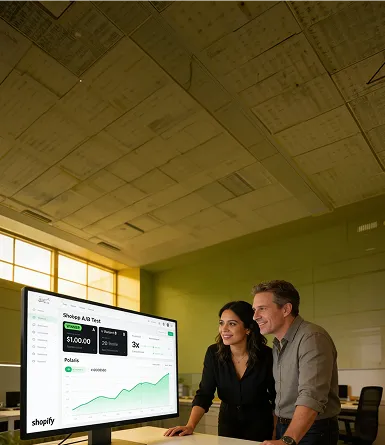
Watch a Shopify A/B test run in real time
This is what your experimentation dashboard looks like when Redefine is running your program. Every test is live, tracked, and attributed to revenue before a decision is made.
Active tests
3
Visitors in tests
0
Revenue attributable
$0
Average confidence
0%
Product Detail Page: Add to cart button prominence
2.41%
3.18%
+31.9%
97%significant
Winner
Checkout: Express pay placement A/B
61.2%
65.8%
+7.5%
78%
Running
Homepage hero: value proposition copy
1.87%
2.04%
+9.1%
54%
Collecting
Next: Cart drawer, upsell tile position variant, queued to launch when Checkout test completes
Priority #1Simulated data for illustration. Your actual dashboard reflects your store's live experiments, real traffic, and statistically verified results.
Shopify Split Testing Services
Every kind of Shopify experiment your store needs
Redefine runs the full range of Shopify experimentation types. Each service is matched to the funnel layer with the highest revenue leverage for your current store maturity.
0%
average product detail page lift
Product Detail Page Split Testing
Product detail pages are the highest-leverage testing surface. Redefine tests hero image sequencing, price anchoring, trust badge placement, and variant selectors against your live traffic.
0%
average checkout lift
Checkout Optimization Tests
Express pay placement, field count reduction, trust signals at payment step, and upsell timing. Checkout tests deliver the fastest revenue per test of any Shopify experiment type.
0%
average homepage lift
Homepage and Hero Tests
Value proposition framing, hero image selection, social proof placement, and primary call to action wording. These tests improve the quality of traffic you send downstream to product detail pages and cart.
0%
average review conversion lift
Social Proof and Review Tests
Star rating position, review snippet length, verified buyer badges, and photo review versus text-only. Trust signals are often tested later but produce outsized product detail page conversion gains.
0%
average landing page lift
Landing Page Split Testing
Paid traffic landing pages, campaign-specific pages, and collection landing pages. Tests include layout, headline, proof placement, and call to action design to improve cost per acquisition directly.
0%
average cart average order value lift
Cart and Upsell Experimentation
Cart drawer layout, upsell tile design, cross-sell recommendation position, and cart abandonment triggers. These tests compound conversion rate gains with average order value gains in the same funnel layer.
Client Proof
Structured testing that tripled a brand's revenue
NB
Narragansett Beer
Direct-to-Consumer
Beverage BrandRegional craft beer brand with a strong heritage identity expanding their direct-to-consumer channel on Shopify through data-driven optimization.
Revenue unlocked
$0
additional monthly revenue
in the first month post-optimization
Revenue lift
0x
total revenue multiplier
from the full digital transformation program
Email revenue share
0%
of monthly revenue driven by
post-optimization email flows
The challenge
Disconnected systems across point of sale, ecommerce, and customer data were limiting visibility into performance. The Shopify store needed conversion and user experience improvements, while marketing lacked the advanced segmentation and predictive insight to capitalize on existing customer demand.
What we built
A unified digital strategy across analytics, commerce, payments, and marketing. Power BI was integrated with Toast, Shopify, and VIP to centralize data and provide real-time reporting. Secure payment gateways were implemented with Stripe and PayPal. The Shopify store received full user experience optimization. Klaviyo advanced segmentation and predictive flows were built to turn customer data into recurring revenue.
Key insight
Centralizing analytics across all sales channels was the unlock that made optimization possible. Without unified data, you cannot run experiments. You cannot measure what you cannot see.
Why Redefine
What most Shopify testing agencies skip
Running A/B tests and running a structured experimentation program are two different things. The difference shows up in your results after six months.
Revenue-impact ranking before any test design
Most testing partners build the test first and measure impact after. Redefine ranks every opportunity by estimated revenue impact before a single test is scoped, so your velocity goes to the highest-return experiments first.
Shopify-native variant builds, not JavaScript overlays
Test variants built with overlaid JavaScript create Core Web Vitals failures and speed regressions that distort your results. Redefine builds variants in Liquid and Shopify 2.0 sections so test performance matches production performance.
Monthly revenue attribution, not activity reports
You receive a monthly statement that answers one question: how much revenue did this program generate this month? Test activity, win rate, and projected annual value are all included. The program justifies its own budget every month.
95% confidence threshold enforced on every experiment
Most agencies call winners at 80% or when a stakeholder gets impatient. Redefine requires 95% confidence before any variant goes to full traffic. This prevents false wins that regress revenue after deployment.
Conversion rate optimization and user experience development in the same team
Separating experimentation strategy from implementation creates multi-week handoff delays. Redefine's conversion rate optimization strategists and Shopify developers work in the same sprint, so the time from hypothesis to live test is measured in days, not months.
Loser analysis included, not just winner celebration
Failed experiments generate the most useful learning. Redefine documents every loss with a root cause analysis that feeds back into the next hypothesis. Your backlog improves with every test cycle, winner or not.
Common Questions
Shopify A/B testing questions answered
A reliable split test requires at least 1,000 transactions on the page being tested per month. For checkout tests, that means 1,000 checkout initiations. For product detail page tests, 1,000 add-to-cart events. Stores below this threshold benefit more from Redefine's qualitative research and direct implementation approach, which uses session data, heatmaps, and user surveys to inform changes without formal splitting.
A test with adequate traffic typically reaches 95% confidence in 2 to 6 weeks depending on traffic volume and the size of the effect. Tests on high-traffic pages like homepages and product detail pages complete faster. Checkout tests take longer because they rely on completed purchases rather than page interactions. Redefine sets the minimum sample size and duration before any test launches so you know the expected timeline upfront.
Redefine works with Convert, VWO, Google Optimize where still appropriate, and Neat A/B for Shopify-native testing. The platform choice depends on your store's traffic volume, checkout complexity, and existing analytics stack. For Shopify Plus stores, Redefine uses checkout extensibility to run server-side checkout experiments without front-end performance impact.
Yes. Redefine runs experimentation programs on stores built by any agency or in-house team. The audit process evaluates your existing codebase, theme structure, and analytics setup before designing variants. No migration or rebuild is required to start testing.
A/B testing compares one variant against your control across your full traffic. Multivariate testing tests multiple elements simultaneously using factorial design to find the best combination. Multivariate tests require significantly more traffic to reach confidence, so Redefine recommends them only for pages with 10,000 or more monthly interactions. Most Shopify stores start with A/B tests and graduate to multivariate once the program matures.
Start Your Testing Program
Your next test could be worth $10K a month. Let Redefine find it.
Book a free 30-minute A/B testing strategy call. Redefine will review your store, identify your three highest-value test opportunities, and estimate the revenue impact before you commit to anything.
No commitment. No pitch.

form
Brief received.
We will review your store and send a scoped proposal within 3 business days.
48-hour response
Opportunity snapshot sent
95% confidence
No early winner calls
14 days to first test
From kickoff to live
Shopify-native builds
No JavaScript overlay hacks