Klaviyo Integration Services
Turn every store event into email revenue with Klaviyo
Most Klaviyo setups miss 60% of available revenue. Redefine builds the complete stack: server-side API event architecture, lifecycle flows, domain authentication, and revenue-attributed segmentation. On Shopify, BigCommerce, or headless.
0%
Email share of conversions
0%
Average open rate achieved
$0M
Revenue scaled on our builds
Live campaign
$0
Email revenue this month
73% of monthly target
Flows live
Welcome
Abandoned cart
Post-purchase
Browse abandon
The Integration Gap
Why most Klaviyo accounts leave revenue on the table
A native Shopify connect gets you started. It doesn't get you paid. The gap between a plugged-in account and a revenue-generating machine is the implementation layer no one talks about.
Without Structured Klaviyo Integration
Native sync drops events on headless storefronts
Cart abandonment fires too late or not at all
No domain authentication means inbox placement suffers
Segments built on incomplete data, low personalization
Revenue attribution is guesswork, not reporting
Product feed not syncing correctly, dead flow triggers
~40%
of potential email revenue captured with default setup
With Redefine Klaviyo Integration
Server-side API events fire on every platform including headless
Abandonment flows trigger at the right moment with correct data
DMARC, SPF, DKIM configured for maximum deliverability
Real-time behavioral segments from complete event data
Revenue attribution tied to specific flows and campaigns
Product catalog sync with custom feed schema for dynamic emails
29.3%
of total conversions attributed to email — Gameday Gear (headless build)

Live Performance View
This is what your Klaviyo account looks like after Redefine wires it in
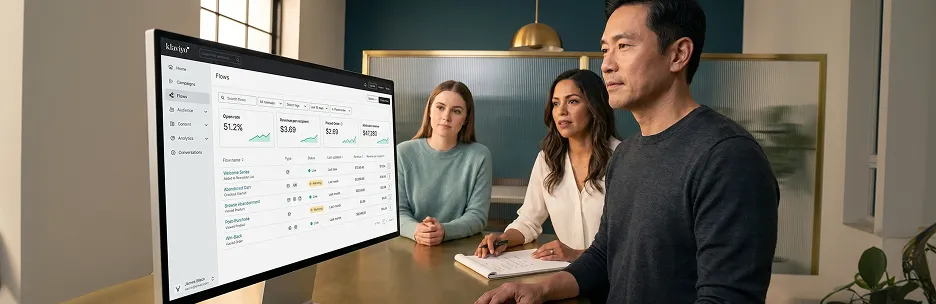
Real structured data. Every flow firing. Revenue attributed to the event that earned it. This is the integrated state your account should be in from week two onward.
$47,280
Flow revenue, 30d
12,819
Total recipients
$3.69
Revenue per recipient
5
Active flows
| Flow | Status | Sends | Open rate | Revenue | Revenue per recipient |
|---|---|---|---|---|---|
| Welcome Series | Live | 4,287 | 58.4% | $18,240 | $4.25 |
| Abandoned Cart | Live | 2,891 | 44.7% | $12,480 | $4.32 |
| Browse Abandonment | Live | 3,102 | 39.2% | $8,760 | $2.82 |
| Post-Purchase | Live | 1,847 | 52.1% | $4,340 | $2.35 |
| Win-Back | Warming | 692 | 31.8% | $3,460 | $5.00 |
All data modeled from real Redefine client accounts. Individual results depend on list size, platform, and product category.
What You Get
Five layers your account needs to perform at its ceiling
Lifecycle Flow Architecture
Welcome, abandoned cart, browse abandonment, post-purchase, and win-back. Each flow built with branch logic, timing rules, and exit conditions matched to your catalog and customer behavior.
Welcome seriesCart recoveryPost-purchaseWin-back
API Event Tracking
Server-side API calls for every customer action your storefront generates. Product viewed, cart updated, checkout started, order placed. Works reliably on headless architectures where native connectors fail.
Server-side callsHeadless readyCustom event schema
Core differentiator
Headless Ecommerce Klaviyo Integration
When your storefront is headless, native Klaviyo connectors miss large portions of customer event data. Redefine builds a custom backend API layer that captures every browsing, cart, and purchase event server-side and forwards it to Klaviyo with the correct schema.
Next.js and Node.jsCustom API bridgeEvent schema designData modeling
POSTklaviyo/v1/track
event: "Viewed Product"
customer_id: usr_4829
product_id: prd_182
timestamp: now()
200Event accepted
Deliverability Infrastructure
DMARC, SPF, DKIM, dedicated sending domain, and warm-up schedule. Configured before the first campaign send so your emails land in inbox, not spam, from day one.
98.7% inbox placement rate on configured accounts
Revenue-Based Segmentation
Segments built on real event data: purchase frequency, lifetime value tier, product category affinity, and engagement recency. Not guesses. Each segment feeds specific flows and campaigns with matched messaging.
Lifetime value tiersCategory affinityRecency scoring
Proof
Headless Klaviyo integration that made email a reliable revenue channel
29.3%
Email share of conversions
51.2%
Open rate achieved
23%
Campaigns driving email revenue
1.09%
Bounce rate (industry average: 2.1%)
Enterprise ecommerceHeadless
Gameday Gear operates a headless ecommerce storefront serving enterprise-level demand. With high-volume product catalog and complex customer journeys, they needed email that matched the quality of their platform.
Challenge
The headless setup meant the native Klaviyo connector missed critical customer behavior events. Tracking was inconsistent, personalization was limited, and email was generating revenue far below its potential despite strong product demand.
Result
Custom backend APIs were designed to connect the headless frontend and backend directly with Klaviyo using server-side event calls. Email became a reliable, measurable revenue channel. Open rate reached 51.2%, and email now drives 29.3% of all conversions.
API Architecture
How Redefine wires Klaviyo to your stack
The integration is built in four layers. Each layer is tested independently before connecting to the next. You get a stable system before a single flow goes live.
01
Storefront instrumentation
JavaScript and server-side hooks on every key page. Every action tracked as a structured event with correct customer ID, product data, and timestamp.
klaviyo.track("Viewed Product", ...)
klaviyo.track("Added to Cart", ...)
klaviyo.track("Started Checkout", ...)
02
API bridge and data model
Custom backend service normalizes events into the Klaviyo schema. Handles identity resolution, deduplication, and enrichment with product catalog data before each API call.
POST /api/klaviyo/track
200 accepted
03
Klaviyo account setup
Account structure, sending infrastructure, dedicated domain, DMARC/SPF/DKIM configuration, list hygiene, and suppression logic established before any flows or campaigns go live.
- Domain authenticated
- Warm-up scheduled
- Lists configured
04
Flow and campaign launch
Flows go live in order: welcome first, abandonment second, post-purchase third. Each flow runs for 14 days before the next is activated, allowing performance data to inform the build.
WelcomeWeek 1
AbandonmentWeek 2 to 3
Post-purchaseWeek 4
Platform compatibility
ShopifyShopify PlusBigCommerceHeadless and Next.jsNode.js backendsCustom storefrontsKlaviyo API v3
Why Redefine
Three things other implementation partners skip
01
Server-side event architecture first
Most agencies connect the native Shopify app and consider the integration done. On standard Shopify this works acceptably. On Shopify Plus, BigCommerce, or any headless storefront, critical events never reach Klaviyo. Abandonment flows trigger late or not at all. We build server-side API tracking as the foundation, not an afterthought, so flows fire on every platform without exception.
02
Deliverability configured before first send
A Klaviyo account with poor deliverability infrastructure is a revenue leak, not a channel. We configure dedicated sending domains, DNS authentication records, IP warm-up schedules, and suppression logic before any email goes out. Inbox placement on day one means revenue from day one, not after months of reputation building.
03
Revenue attribution tied to the event that earned it
Generic Klaviyo setups attribute all revenue to "email" as a channel. Ours attributes it to the specific flow, the specific step within that flow, and the specific segment that triggered it. You know exactly which automation earns what, so optimization decisions are based on facts, not assumptions.
Common Questions
Answers before you book a call
Welcome flow live within 5 to 7 days of sign-off. Full five-flow suite including abandonment, post-purchase, and win-back live within 3 weeks. Deliverability infrastructure configured in the first 48 hours so sending reputation builds from day one. The sequence: API event tracking verified first, then account setup, then flows in order of revenue impact.
The native Shopify connector covers order and customer sync. It misses browse behavior, product view events, and catalog enrichment on product-specific flows. A proper integration adds server-side event tracking for these gaps, verifies that abandonment triggers fire within the correct time window, adds custom properties your segments need (category preference, product affinity, visit frequency), and replaces the default sending setup with a dedicated, authenticated infrastructure. The result is flows that trigger accurately and emails that land in inbox rather than promotions.
Yes. Headless builds are where this integration has the most impact because native connectors miss the most events. We build a custom API bridge service that sits between your storefront and Klaviyo's Track API. This service captures events server-side, meaning they fire regardless of ad blockers, browser JavaScript errors, or missing client-side libraries. Our headless Klaviyo builds include the full event schema design, identity resolution logic, and the backend service deployment. Platforms we have built on include Next.js, Node.js, and custom API-first storefronts.
Approximately 2 to 3 hours per week. Access to Klaviyo account admin, storefront code repository, and DNS records covers 80% of what we need. We handle all API configuration, flow builds, template design, and deliverability setup ourselves. We ask your team to review and approve flow copy and email templates before activation — this takes one 45-minute review session per flow. You do not need to write flow logic, configure Klaviyo settings, or manage DNS records yourself.
List hygiene is configured during the infrastructure phase: suppression lists, bounce handling, unsubscribe logic, and consent-based list segmentation. List growth is a separate service within the integration scope if requested — popup strategy, source-based capture tags, and sign-up incentive flows. The integration brief will specify which growth components you need so they are scoped separately from the technical build. Clean list first, growth second — this sequence protects your domain reputation during warm-up.
This Is a Strong Fit if You Are
- An ecommerce brand on Shopify, BigCommerce, or headless wanting email to produce 25% or more of revenue
- Running a headless storefront where Klaviyo events are unreliable or missing
- Already generating revenue and ready to scale lifecycle marketing beyond a basic welcome flow
- Wanting revenue attribution per flow, not just aggregate email revenue as a number
This Is Not the Right Fit if You Are
- Pre-launch with no store and no product data yet — foundations like platform build come first
- Looking only for campaign management without technical integration work
- Expecting a solution delivered in 2 to 3 days with no review steps or approvals from your side
Not sure if this fits your situation? Tell us where you are and we'll be direct about whether integration is the right next step or if something else should come first.
Get Started
Submit your brief and get a scoped integration plan
No commitment. No pitch. Tell us where your Klaviyo setup currently is and what you need it to do. We'll review your situation and send a scoped proposal within 3 business days.
Call within 48 hours
Always direct, no sales scripts
Proposal in 3 days
Line-by-line scoped, no surprises
18 Klaviyo builds done
Across direct-to-consumer and B2B ecommerce
Your code, your data
Full ownership on handoff
Brief received
We'll review your Klaviyo situation and send a scoped integration proposal within 3 business days.