Power BI Implementation Services
From spreadsheet chaos to one trusted dashboard
Power BI implementation in 8 weeks, not 8 months
Scoped data sources, modelled semantic layer, and the first three executive dashboards live, governed, and adopted by your team. One fixed-scope engagement. No drift. No retainer creep.
Submit your brief → discovery call within 48 hours → scoped plan in 10 days → first dashboard live by week 4
0
Implementations shipped
0
Average weeks to live
0
Percent on time and on scope

The 18 Month Dashboard Problem
Most Power BI rollouts stall before the chief financial officer ever opens a report
We signed off on Power BI a year ago. Finance still exports to Excel every Monday because nobody trusts the numbers in the portal. The licenses are sunk cost.

Chief Financial Officer, mid-market manufacturer
220 employees · 6 entities · named anonymised at request
0
Percent adoption gap
of Power BI licenses sit unused inside companies six months after rollout, per industry surveys.
0h
Per finance head per week
spent stitching exports, reconciling totals, and answering the same Monday morning numbers question.
$0k
Average sunk cost
on a half-finished Power BI rollout before a competent partner is brought in to finish it.
After Implementation With Redefine
Finance closes the books with one validated dashboard. Operations sees inventory and throughput on the same numbers as the warehouse floor. The chief executive officer opens one workspace and sees the entire business. The Monday morning Excel email stops.
The Implementation Playbook
From signed statement of work to first dashboard live in 8 weeks
Five phases, named owners, real dates. Click any phase to see the deliverables, the artefacts, and the live mock of what your team sees that week. The track auto-advances every 4 seconds.
1
Week 1 · 5 days
Discovery and source mapping
Source list, key performance indicator catalogue, access
plan, signed scope.
2
Week 2 to 3 · 10 days
Semantic model and extract, transform, load build
Star schema, Power Query flows, validated Data Analysis
Expressions measures.
3
Week 4 to 5 · 10 days
Report design and Data Analysis Expressions
Three executive reports built against the semantic layer.
4
Week 6 · 5 days
User acceptance testing, gateway, and governance
Row-level security rules, workspace structure, on-prem
gateway live.
5
Week 7 to 8 · 10 days
Rollout, training, and handover
Adoption sessions, runbook, 30-day hypercare window.
Implementation live console
Source inventory
12 sources scopedDynamics 365 Business Central
OData · 42 tablesSalesforce Sales Cloud
REST · 18 objectsSQL Server on-prem · ERP legacy
Gateway neededSharePoint Excel files · Financial Planning and
Analysis
14 workbooksHubSpot marketing
Connector test
Output for week 1
Signed source catalogue, ranked key performance
indicator list (top 18), and an access plan signed by
information technology.
Semantic model build
14
Dim tables
5
Fact tables
62
Data Analysis Expressions measures
Power Query: 38 transforms builtpassed
Refresh time (full load)04:12
Incremental refresh windows7 days
Reconciliation against enterprise resource planning
totals100% match
Output for week 3
Star schema, documented measures, refresh schedule, and
validated totals against the enterprise resource
planning general ledger.
Executive scorecard · April
Refreshed 04:12 ago
Revenue
$4.82M
+12.4% year over year
Gross margin
38.1%
+1.8 points
Operating expense
$1.34M
+4.2%
Revenue by region
North America$2.94M
Europe, Middle East, and Africa$1.21M
Asia Pacific$0.67M
Output for week 5
Three executive reports: Finance summary, Sales
pipeline, Operations throughput. Live and validated.
User acceptance testing and governance check
On-prem gateway cluster live
Row-level security rules8 roles set
Workspace structure (Dev / UAT / Prod)deployed
User acceptance testing sign-off (finance,
operations, sales)2 of 3
Refresh schedule (6:00 / 12:00 / 18:00)scheduled
Output for week 6
Governed environment ready for company-wide rollout.
Audit trail, security, and refresh under your control.
Rollout dashboard
Active users
96
+38 this week
Adoption rate
81%
target 75%
Training session 1 · Finance team (12
attendees)complete
Training session 2 · Sales managers (18
attendees)complete
Training session 3 · Operations (14 attendees)complete
Runbook published · 28 pageslive
30-day hypercare windowday 7 of 30
Output for week 8
Trained users, signed handover, runbook, and 30 days of
hypercare to catch anything that surfaces in real use.
Your team's time investment across the full 8 weeks is typically 2 to 3 hours per week: one data validation call, async sign-off on report layouts, and a final user acceptance testing session. We handle data modelling, Data Analysis Expressions, extract-transform-load, gateway setup, and publishing.
What Ships In The Implementation
Seven deliverables. Fixed scope. Your team owns the output on day 57.
Every Redefine Power BI implementation lands these seven artefacts. The rail auto-scrolls in a loop. Hover to pause. Nothing here is a placeholder for a future statement of work.
01
Source inventory and key performance indicator catalogue
A ranked list of every system that feeds the model, the 18 key performance indicators that matter, and the owner of each metric.
Deliverable · PDF + Excel
02
Star-schema semantic model
Dimensional model built for performance and clarity. Documented, version-controlled, and yours.
Deliverable · PBIP / Git repository
03
Power Query extract, transform, load flows
Repeatable transforms with documented logic. Incremental refresh configured where it matters.
Deliverable · M code + diagrams
04
Three executive reports
Finance summary, sales pipeline, and operations throughput. Designed for the decisions, not the data dump.
Deliverable · PBIX files
05
Gateway and refresh setup
On-premises data gateway clustered for high availability. Three scheduled refreshes daily, monitored.
Deliverable · Configured Azure tenant
06
Governance and row-level security rules
Row-level security per role, workspace lifecycle (Dev / UAT / Prod), audit trail enabled.
Deliverable · Policy document
07
Adoption training and runbook
Three live training sessions, recorded. A 28-page runbook your team can use without us.
Deliverable · Video + PDF + 30-day hypercare
What Your Team Does
- Attend one 60-minute data validation call per week
- Sign off on report layouts async (Loom or Figma)
- Grant access to source systems via your information technology process
- Attend the final user acceptance testing session and adoption training
What You Do Not Do
- Write Data Analysis Expressions, M code, or fight Power Query
- Configure the on-premises gateway or workspace pipelines
- Reconcile totals against the enterprise resource planning general ledger
- Write training documentation or the runbook
Client Outcome
A 220-person manufacturer went from 9 Excel exports to one Power BI workspace in 7 weeks

Industrial manufacturing220 employees6 operating entitiesDynamics 365 Business Central + SQL legacy
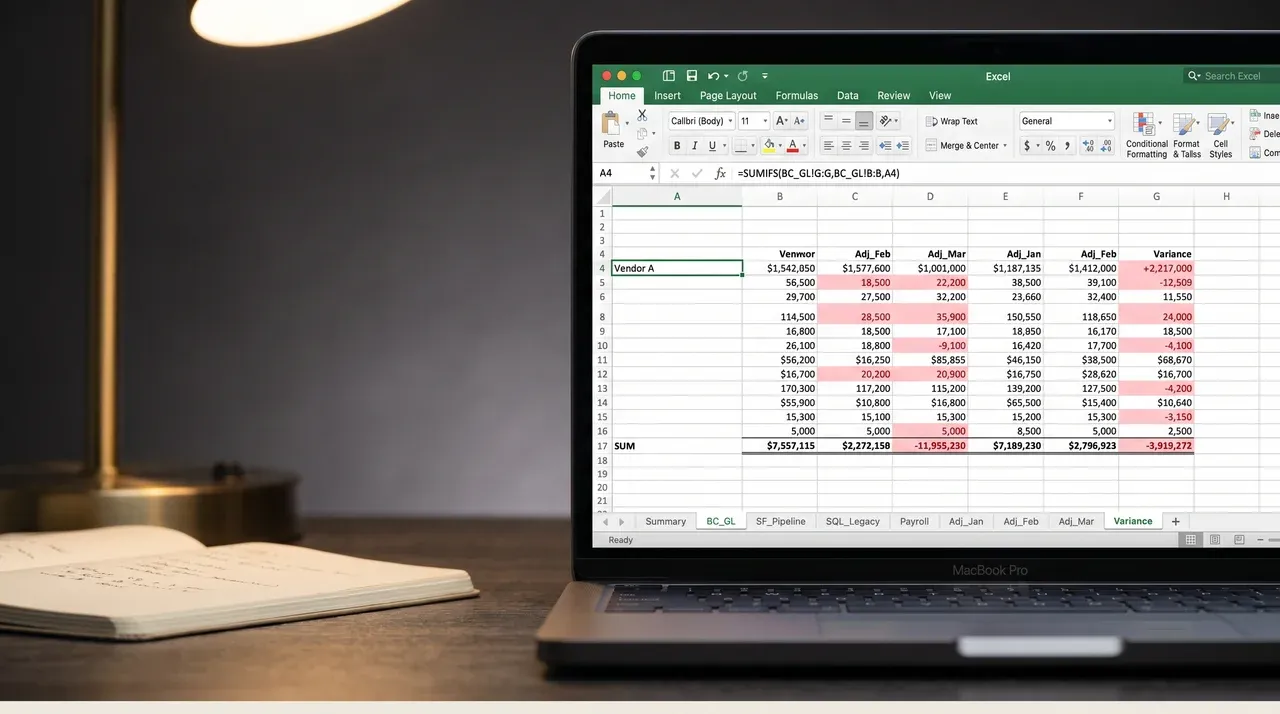
A North American component manufacturer ran finance close on nine separate Excel exports from Business Central, two legacy SQL warehouses, and a payroll system. Power BI licenses had been bought 11 months earlier. Nothing was live.
Problem state · before
- Nine separate Excel exports stitched manually every Monday
- 11 hours of finance team time per week on reconciliation
- Chief financial officer numbers did not match plant manager numbers
- Board pack assembled in PowerPoint screenshots
- $184k spent on the previous failed rollout
Result state · after
- One Power BI workspace, three executive reports, daily refresh
- Finance team time on reporting cut from 11 hours to under 90 minutes
- Plant and chief financial officer read from the same validated semantic model
- Board pack auto-generated from Power BI service
- Implementation completed 1 week ahead of the 8 week plan

0
Weeks to live
0%
Reporting time saved
$0k
Annual analyst cost recovered
0%
License utilisation after 90 days

"The Monday morning Excel email stopped on day 49. That is the day Redefine paid for itself. The next four years are upside."
Chief Financial Officer · identity withheld at client
request · reference available on scoping call
Why Redefine Over The Default Partner Network
Three things that are different. Everything else is table stakes.
Claim One
Fixed scope. Fixed price. Fixed week eight.
Every implementation lands on a signed scope with seven named deliverables and a fixed week-eight handover. No time-and-materials drift. No "discovery extension" that becomes the project. If we miss the date, we eat the overrun.
Signed scope before week 1
Weekly burn-down dashboard
Change requests priced in writing
Week 8 handover or we cover overrun
Claim Two
You own the build on day 57. Not us.
The semantic model, Data Analysis Expressions measures, Power Query flows, and runbook ship in your Git repository and your Azure tenant. Your business intelligence analyst can extend, edit, or rebuild without a single phone call to us. The default partner billing model rewards opacity. Ours rewards handover.
PBIP source format, not binary PBIX only
Documented Data Analysis Expressions with comments
Tabular Editor and Best Practice Analyzer pass
28-page runbook your team can read
Claim Three
Built by senior engineers. No offshore handoff.
Every Power BI implementation is delivered by Microsoft-certified senior engineers (PL-300 and DP-600 minimum). No bait-and-switch staffing. The person on your scoping call writes the Data Analysis Expressions in week three and runs the training in week eight.
PL-300 and DP-600 certified
6+ years on enterprise Power BI
Same named engineer across all 8 weeks
Direct line, not a ticket queue
Cost Of Staying Put
Every month you delay implementation costs more than the implementation.
Three Power BI license seats sit unused. Finance burns 9 hours a week on Excel exports. A senior analyst spends 60% of their year on reconciliation, not analysis. That is real money.
$0k
average annual cost of inaction
for a 200-person company with stalled Power BI, calculated
across unused licenses, full-time equivalent reconciliation
time, and decision latency.
Implementation Pricing
Scoped before work starts. Line-by-line. No commitment to receive a proposal.
Three implementation shapes that cover 90% of mid-market and enterprise rollouts. The shape gets refined on the scoping call. The line items are in writing before you sign.
Shape 1
Departmental rollout
from $38k
6 to 8 weeks · one team · 3 reports
- 1 to 3 source systems
- 3 executive reports
- Power BI Pro workspace
- 30-day hypercare
Most Chosen
Shape 2
Cross-functional implementation
from $74k
8 to 10 weeks · 3 teams · 7 reports
- 4 to 8 source systems with on-premises gateway
- 7 reports across finance, sales, operations
- Row-level security and workspace pipelines
- 60-day hypercare with named engineer
Shape 3
Enterprise platform rollout
from $148k
12 to 16 weeks · Fabric / Premium · full platform
- Microsoft Fabric or Premium capacity
- Lakehouse, semantic models, paginated reports
- Tenant-level governance and adoption framework
- 90-day hypercare with weekly steering call
Every shape is priced line by line on the scoping call. See the full Power BI implementation cost guide.
Plan Your Implementation
Submit your brief → call within 48 hours → scoped proposal in 3 days → Sprint 1 begins within 1 week of sign-off
Related Power BI Services
The neighbouring engagements people pair with implementation
Service root
Power BI services
The full Power BI service catalogue and how it fits together.
Before implementation
Power BI consulting
Roadmap, source audit, and key performance indicator framework before a build starts.
Adjacent service
Power BI development
Report-by-report build for teams with their own model in place.
After implementation
Power BI managed services
Continuous operation, releases, and service level agreement after the rollout lands.
Before implementation
Power BI audit services
A 10-day audit of an existing rollout that has stalled or drifted.
Recovery
Power BI rescue services
Take over a failed implementation and ship it inside 90 days.
Integration
Power BI and Dynamics 365
Wire Power BI to Business Central, Sales, and Finance and Operations cleanly.
Industry
For manufacturing
Plant throughput, overall equipment effectiveness, and multi-entity finance roll-up.
Industry
For financial services
Regulated reporting, row-level security by entity, anti-money laundering and risk dashboards.
Use case
Finance close acceleration
Close the books in five days instead of fifteen with one model.
Use case
Sales pipeline visibility
A pipeline dashboard the chief revenue officer trusts on a Monday morning.
Questions Chief Financial Officers And Information Technology
Leads Ask Before Signing
What people really want to know before committing to an implementation
Most failed Power BI rollouts fail in discovery, not in build. We arrive on day one with a tested scoping framework, a signed source inventory by day five, and a frozen key performance indicator list by day seven. The actual model and report build sits inside a five-week window because everything before it is decided and signed. The other partner ran discovery as billable hours; we run it as a fixed-fee front load.
No. Week one of the implementation includes an audit of the existing model. Roughly 60% of the time we keep two-thirds of the structure and rebuild the parts that block reliability. If the existing model is sound, the implementation skips to week three and finishes ahead of the eight-week mark.
The on-premises data gateway handles legacy SQL Server back to 2008 directly. For older boxes, we extract to a staging schema via SQL Server Integration Services or a Python pipeline. The discovery week ranks each system by data quality and access friction so you know on day five exactly which sources land in the first model and which sit in a phase two backlog.
Two to three hours per week from your business sponsor, two hours per week from your information technology lead for access and gateway setup, and one hour per week from each department head whose reports we are building. The heaviest week is user acceptance testing (week six) at approximately five hours per business sponsor.
If the delay is on our side (engineering, design, gateway setup), we cover the overrun at our cost. If the delay is on the client side (delayed access, missing user acceptance testing sign-off, scope expansion), we extend at a pre-agreed weekly rate that is in the statement of work. In both cases the burn-down dashboard makes the cause visible weekly, so there are no surprises.
You get everything. PBIP source files in your Git repository, semantic model in your Azure tenant, Power Query M code documented, Data Analysis Expressions measures commented, gateway configuration documented, and a 28-page runbook. The default partner billing model keeps source files opaque. Ours puts them in your hands on day 57.
Yes, and we prefer to. Approximately 40% of our implementations include knowledge transfer to a named internal business intelligence analyst as a deliverable. They join the daily standups, see the build happen, and own the model the day after handover. It also accelerates the build because we have a person inside who clears access and decisions fast.
Is Redefine Right For Your Power BI Implementation
We are honest about who we are not for
The first call ended with Redefine telling us we were not ready. They wanted us to clean the source data first and come back in 60 days. No other partner did that. We came back.

Vice President Finance, regional retail group
After year-one Power BI engagement
Right Fit If
- You have 100 to 2,000 employees and at least one enterprise resource planning system
- The chief financial officer sponsors the project, not information technology alone
- You want to own the build, not be locked into a retainer
- Budget is between $40k and $200k for the implementation
Not The Right Fit If
- You want time-and-materials with no fixed end date
- Source data quality is unknown and unaddressed
- You are a 10-person team needing a single chart
- The buyer wants a tool reseller, not a delivery partner
Not sure? Tell us your situation and we will be straight with you.
Start Your Implementation Scoping
Book The Scoping Call. No Commitment. No Pitch.
Tell us about your data, the systems you have, and the dashboards you wish existed. We will send a scoped, line-by-line proposal in three business days. You read it. If it does not fit, you walk.
Submit your brief → call within 48 hours → scoped proposal in 3 days → Sprint 1 begins within 1 week of sign-off
Your team's time investment across a full build is typically 2 to 3 hours per week, one sprint review, async feedback on deliverables, and a final user acceptance testing sign-off. We handle everything else.
Call within 48 hours of your brief
Scoped proposal in 3 business days
140 implementations shipped
You own the code on day 57
Call within 48 hours · scoped proposal in 3 business days · first dashboard live within 4 weeks of sign-off.
Brief received.
A senior engineer (not a sales representative) will review your situation and send a scoped, line-by-line proposal within three business days. If we are not a fit, we will say so on the call and recommend who is.