Your website gets traffic. We turn that traffic into revenue.
Most redesigns make a site look better. They do not make it convert better. Redefine runs behavioral research before we design anything. We find where your visitors drop off. We fix it. Every layout decision traces back to your data, not to our design preferences.
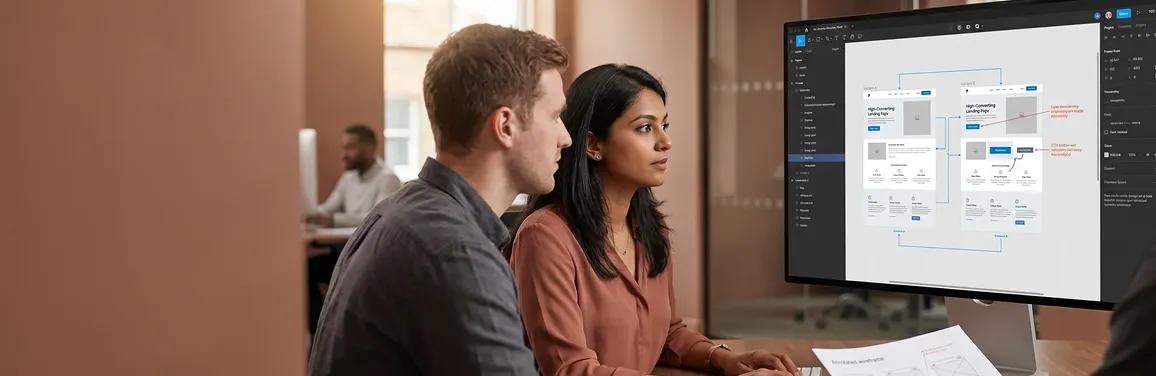
You have traffic. Your site is losing the sale every single day.
96%
of your visitors leave without buying
Average ecommerce conversion rates sit under 3%. You are paying for clicks. Your site is sending them away.
1 Second
of load delay cuts conversions by 7%
Page speed is a revenue variable. Most agencies track awards. We track what your load time costs you per month.
70%
of redesigns produce zero conversion lift
Because they start from aesthetics, not from your visitors' data. The page looks different. The problem stays.
What clients tell us before they hire us
"We just redesigned the site six months ago. It looks better. Our conversion rate is the same. We have a beautiful website and the same problem."
That is not a design problem. That is a process problem. When behavioral research does not come first, a redesign changes the look without removing the friction. The page is different. The drop-off is not.
Design starts from brand decks and competitor sites. Not from your visitor data.
CTA placement is a gut call. Not a funnel decision.
The site launches. The agency closes the project. Nobody measures the conversion rate.

Five phases. Every one designed to lift your conversion rate.
Research comes first. Design comes second. Code comes third. Every step in that order, on purpose.
CRO Research
Strategy and Architecture
UX and Visual Design
Build and QA
Launch and Optimize
We research your site before we design anything
We analyze your existing site with heatmaps, session recordings, and funnel data before we open a design tool. This tells us exactly where visitors drop off and why. Your redesign is built from your data. Not from what worked for a different brand's audience.
- Heatmap and session recording analysis
- Funnel drop-off and exit page mapping
- CRO audit with friction points ranked by revenue impact
- A/B testing hypothesis bank
Top friction points by impact
33% of users exit at product detail page. No scarcity, no social proof above fold.
72% cart abandonment. No guest checkout. Form fields poorly ordered.
Mobile users bounce 40% faster than desktop at collection level.
Every page gets a conversion goal before a wireframe exists
We map what each page must achieve and the path that gets visitors there. Navigation structure, page hierarchy, and CTA flow are resolved at this stage. Wireframes start from a strategy. Not from a blank canvas or a template.
- Conversion-goal mapping per page
- Navigation restructured for buyer intent
- CTA hierarchy and micro-conversion paths defined
Designs built from your behavioral data, not our design preferences
Every layout decision comes from the CRO research. CTA placement, trust signal position, social proof layout, and visual hierarchy are all data decisions. We test the full design as an interactive Figma prototype before development begins.
- Data-driven CTA placement and trust signal hierarchy
- Interactive Figma prototype for full journey testing
- Component library with all states for clean developer handoff
ABOVE FOLD: Product image + price + trust badges + primary call to action
ZONE 2: Reviews summary (social proof, star rating visible)
ZONE 3: Product description (benefit-led, not feature-led)
STICKY: Add to cart persistent on scroll (mobile)
Fast, trackable code from the first commit
Page speed, Core Web Vitals, A/B test tooling, and analytics tracking are built into the sprint. Not added later as a fix. A fast site and a high-converting site are the same site.
- Core Web Vitals pass before launch
- A/B testing infrastructure live at launch
- Analytics event tracking and schema markup QA'd pre-launch
Launch is the start of optimization, not the end of the project
After launch, we run A/B tests against the hypotheses from Phase 1. We measure your conversion rate, your revenue impact, and what to improve next. The site gets better after launch. That is built into the scope.
- Post-launch A/B testing against Phase 1 hypotheses
- 30-day conversion rate and revenue impact review
- Optimization roadmap your team owns from day one
Fixed-scope pricing
Line-by-line proposal in 3 business days. No hourly surprises.
Five deliverables. Each one moves your conversion rate forward.
We audit your current site before any design begins. Heatmap findings, session recording patterns, funnel drop-off data, and CRO hypotheses come together in one ranked document. Your designer works from this report, not from a blank brief.
Every layout element in the wireframes is justified by a CRO hypothesis. CTA placement, trust signal position, navigation structure, and form layout are decided at wireframe stage. Visual design does not start until you approve the wireframes.
Pixel-level visual design with a clickable Figma prototype covering every primary conversion path. You test the full purchase journey before a developer writes a line of code. Delivered with a full component library and developer specs. No interpretation gaps.
Core Web Vitals performance targets are set in Sprint 1 and hit before launch. Analytics event tracking, schema markup, and A/B test tooling are part of the build. We do not retrofit performance after launch.
After launch, we run A/B tests built from the Phase 1 hypotheses. At 30 days, you get a conversion rate and revenue impact review. You own the data and the optimization roadmap. That holds whether or not you keep working with us.
Conversion-focused web Design that took a brand from $1M to $3.8M
Before
$1M
Annual revenue when Off Grid Knives first engaged Redefine
After 3 years
$0
Annual revenue. 3.8x growth driven by CRO-led design, faster page speed, and email automation.
Primary driver
CRO-First Design
Behavioral research identified the highest-impact friction points. Fixing them moved the conversion rate. Revenue followed.

Off Grid Knives
Outdoor and tactical · BigCommerce + KlaviyoOff Grid Knives sells tactical knives and outdoor gear direct-to-consumer on BigCommerce, Amazon, and other channels.
The problem
Traffic was growing. Revenue was not. No systematic CRO, no performance optimization, no structured email program. The brand had the audience. The site was losing the sale.
The outcome
Annual revenue grew from $1 million to $3.8 million over three years
CRO-led redesign and page speed improvements lifted conversion rates and repeat purchase behavior
Klaviyo email automation added a consistent revenue channel across the customer lifecycle
What you get from a CRO-first agency that most web agencies never deliver
Behavioral research before design
Your data shapes the layout
Design starts from mood boards and competitor sites
Heatmaps, funnel data, and a CRO hypothesis bank before Sprint 1 begins
A/B test infrastructure at launch
Testing ready when traffic arrives
Sold as a retainer after the project closes
A/B test tooling live on launch day, not bolted on later
Core Web Vitals before launch
Page speed pass before visitors arrive
Speed issues billed as change requests after go-live
LCP, CLS, and mobile PageSpeed scored before the site goes live
Post-launch conversion review
You measure what the redesign actually did
Project closes at launch. No outcome report.
Conversion rate, revenue impact, and A/B test results at 30 days
Fixed-scope pricing
No surprise bills
You pay per revision. Costs drift.
Line-by-line proposal in 3 days. No scope change without a written amendment.
What serious buyers ask before hiring a CRO web design agency
A standard agency starts from aesthetics, brand guidelines, and competitor sites. A conversion-focused agency starts from your data: where visitors exit, where they slow down, and what your funnel shows about drop-off. Every design decision is justified by evidence. The outcome is measured after launch, not assumed at sign-off.
A full project, covering CRO research, wireframes, visual design, development, and post-launch optimization, runs 10 to 16 weeks. A focused high-impact page redesign runs 6 to 8 weeks. Timeline is fixed in the proposal before Sprint 1. It does not change without a written amendment.
Yes. The CRO approach works on any platform. The research and UX design phases are platform-agnostic. Development runs on whatever platform your brief names. Most projects are on Shopify or BigCommerce. Custom React and headless builds are available.
That depends on your current conversion rate and traffic volume. Here is a realistic example: a site at 1.5% conversion moving to 2.2% on 10,000 monthly visitors earns 70 additional conversions per month. At a $50 average order value, that is $3,500 more revenue each month from the same traffic. We do not guarantee specific numbers. We do guarantee that every design decision comes from your behavioral data and the post-launch result is measured.
Fixed scope. We read your brief, scope the work by number of pages and platform, and send a line-by-line proposal in 3 business days. No hourly billing. No scope creep charges without a written change order. Submit your brief and get the proposal with no commitment.
Your brief today. Your proposal in 3 days. Work starts in a week.
Tell us your current conversion rate and where visitors drop off. We return a fixed-scope, line-by-line proposal in 3 business days. No obligation.
Call within 48 hours
A senior CRO designer reviews your brief and calls to understand your site, your audience, and your conversion goals
Scoped proposal in 3 days
Phase-by-phase breakdown with timeline and fixed investment. You decide whether to proceed.
Sprint 1 in 1 week
CRO research and behavioral analysis begin the week you sign off
Your team commits 3 to 4 hours per week. One sprint review. One feedback round. One sign-off call. Everything else, we own.

Your conversion rate can be higher. Start with a free proposal.
Tell us your current conversion rate and where visitors drop off. We return a fixed-scope proposal in 3 days. You decide after that.