Conversion-focused web design services
Web design that turns your site traffic into measurable revenue
A beautiful website that does not convert is a branding project, not a business asset. Redefine builds conversion-focused web design from behavioral research up: your visitors' friction points are mapped before a pixel is designed, and every layout decision is traced back to a conversion outcome.
100+ conversion-focused projectsData before design, always
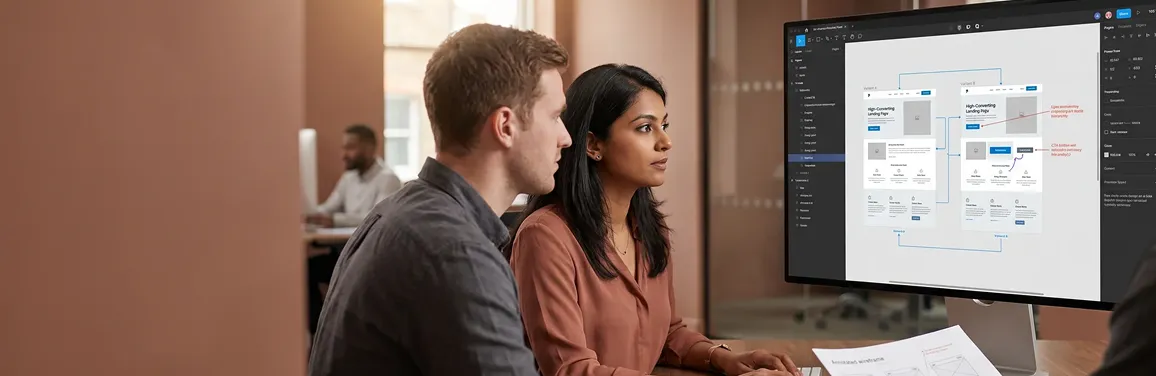
The cost of design without conversion research
Your site already gets traffic. The problem is what happens next.
96%
of visitors leave without converting
The average ecommerce conversion rate is under 3%. Most of your paid traffic is funding someone else's remarketing.
1s
of page load delay reduces conversions by 7%
Speed is a conversion variable, not a performance nice-to-have. Most agencies optimize for awards, not page weight.
70%
of web redesigns do not improve conversion rates
Because they start from aesthetic preferences, not behavioral data. The page changes. The conversion rate does not.
What teams tell us before engaging Redefine
"We just redesigned the site six months ago. It looks better but our conversion rate is the same. Now we have a beautiful website and the same problem."
That is not a design problem. It is a conversion rate optimization-first process problem. When conversion research does not precede design, a redesign changes the aesthetics without changing the friction. The visitor's journey looks different. It feels the same.
Design starts from brand guidelines and competitor inspiration, not from your visitors' behavior data
Call to action placement and copy are decided by gut feel, not by funnel analysis showing where users abandon
The site launches, the agency invoices, and the conversion rate question goes unanswered

Conversion-focused web design process
Five phases. Every decision traced to a conversion outcome.
Click any phase to see what happens in that stage and what deliverable it produces. Research comes before wireframes. Wireframes come before design. Every sequence is deliberate.
Conversion Rate Optimization Research
Strategy + Information Architecture
User Experience/User Interface Design
Build + Quality Assurance
Launch + Optimize
Conversion rate optimization research and behavioral analysis
We analyze your current site before touching a design tool. Heatmaps, session recordings, funnel analysis, and analytics audit tell us exactly where visitors abandon and why. Your redesign will be based on your data, not on what worked for someone else's audience.
- Heatmap and session recording analysis
- Funnel drop-off and exit page analysis
- Conversion rate optimization audit with prioritized friction inventory
- Conversion hypothesis bank for A/B testing
Top friction points by impact
Product page: no urgency signalHigh impact
33% of users exit at product detail page. No scarcity, no social proof above fold.
Checkout: 4-step frictionHigh impact
72% cart abandonment. No guest checkout. Form fields poorly ordered.
Mobile navigation: deep 3-tap patternMedium impact
Mobile users bounce 40% faster than desktop at collection level.
Conversion strategy and information architecture
Before any design is made, we map every page's conversion goal and the flow that leads to it. Navigation structure, page hierarchy, and call to action progression are all resolved at the information architecture stage so the wireframes start from a strategy, not from a template.
- Conversion-goal mapping per page type
- Navigation and page hierarchy restructured for buying intent
- Call to action hierarchy and micro-conversion paths
HomepageGoal: Collection browse
Collection pageGoal: Product detail page click-through
Product detail pageGoal: Add to cart
Cart + CheckoutGoal: Purchase
Conversion-focused user experience and user interface design
High-fidelity designs where every layout decision is derived from the conversion rate optimization research. Call to action placement, trust signals, product hierarchy, social proof positioning, and visual hierarchy are all decided by behavioral data, not by visual preference. The designs are tested as an interactive Figma prototype before development starts.
- Data-driven call to action placement and trust signal hierarchy
- Interactive Figma prototype for stakeholder validation
- Figma component library with all states for developer handoff
ABOVE FOLD: Product image + price + trust badges + primary call to action
ZONE 2: Reviews summary (social proof, star rating visible)
ZONE 3: Product description (benefit-led, not feature-led)
STICKY: Add to cart persistent on scroll (mobile)
Development with performance and conversion rate optimization built in
Page speed, Core Web Vitals, structured data, and A/B test tooling are built into the development sprint, not retrofitted after launch. A conversion-focused website is a fast website: these are the same project.
- Core Web Vitals optimized before launch (not after)
- A/B testing infrastructure configured at launch
- Schema markup and analytics event tracking quality assured pre-launch
LCP (Largest Contentful Paint)1.8s: Pass
CLS (Cumulative Layout Shift)0.03: Pass
Mobile PageSpeed score91: Pass
A/B test tracking verified
Live
Launch and post-launch conversion optimization
Launch is not the finish line for a conversion-focused engagement. Post-launch, we run A/B tests against the hypotheses identified in the conversion rate optimization research phase, measure conversion impact, and iterate. The site improves after launch, not just at it.
- Post-launch A/B testing against conversion rate optimization hypotheses
- 30-day conversion rate and revenue impact review
- Iterative optimization roadmap handed to your team
Overall conversion rate1.8% to 2.7% (+50%)
Product detail page add-to-cart rate14% to 21% (+50%)
Cart abandonment72% to 61% (-11pts)
3 A/B tests queued: next optimization sprint
Conversion-focused web design pricing
Scoped before work begins. Line-by-line proposal in 3 days.
What a conversion-focused engagement delivers
Every deliverable tied to a conversion outcome
A documented analysis of your current site's friction points, ranked by conversion impact. Includes heatmap findings, session recording patterns, funnel drop-off data, and a prioritized list of conversion rate optimization hypotheses. This is the brief your design will be built from.
Heatmap analysisFunnel auditConversion rate optimization hypothesis listPriority ranking by revenue impact
Wireframes where every layout element is justified by a conversion hypothesis. Call to action placement, trust signal position, navigation depth, and form structure are all resolved at wireframe stage before any pixel of visual design. Client approval gate before high-fidelity design begins.
All primary page typesMobile-first layoutAnnotated call to action hierarchyStakeholder approval gate
Pixel-perfect user interface with an interactive Figma prototype covering all primary conversion paths. Test the full purchase journey before development begins. Component library with all states delivered for developer handoff: no interpretation required.
Interactive prototypeComponent libraryDeveloper specsDark + light + mobile variants
Built for Core Web Vitals from the first commit, not optimized after launch. Analytics event tracking, schema markup, and A/B test tooling are configured as part of the sprint: not discovered as missing after the site is live.
Core Web Vitals-firstA/B test infrastructureAnalytics event trackingPre-launch quality assurance scorecard
Post-launch A/B testing run against the hypotheses built in the research phase. 30-day conversion impact review with a documented iteration roadmap. Your team owns the data and the next round of improvements regardless of whether you continue working with Redefine.
A/B test execution30-day conversion rate reviewRevenue impact reportOptimization roadmap
Client result
From $1M to $3.8M in three years through conversion-focused web design
Starting point
$1M
Annual revenue before conversion-focused ecommerce overhaul
3-year result
$0
Annual revenue. 3.8x growth driven by store performance and user experience improvements.
Conversion driver
User Experience
Store performance and user experience improvements drove higher conversion rates and customer satisfaction

Off Grid Knives
Outdoor and tactical · BigCommerce + KlaviyoOff Grid Knives is a direct-to-consumer tactical knife and outdoor gear brand selling across BigCommerce, Amazon, and other digital channels, competing in a highly saturated outdoor goods market.
The problem
The existing digital presence limited growth to a static revenue base. Store performance, user experience, and conversion optimization had not been applied systematically. The brand needed an integrated approach to convert its growing traffic base into measurable revenue across all channels.
The outcome
Annual revenue scaled from $1 million to $3.8 million within three years
Store performance and user experience improvements drove higher conversion rates and customer satisfaction
Klaviyo email automation and Amazon channel integration supported consistent multi-channel revenue growth
How conversion-focused agencies compare
What a conversion-focused web design agency includes that most web agencies skip
Capability
Typical web agency
Redefine
Conversion rate optimization research before design starts
Behavioral data drives the layout brief
Rarely
Design begins from aesthetics and competitor inspiration
Always
Heatmaps, funnel analysis, and hypothesis bank before Sprint 1
A/B test infrastructure at launch
Testing configured before traffic arrives
Sometimes extra
Offered as a retainer add-on after launch
Built in
A/B test tooling configured as part of the development sprint
Core Web Vitals pre-launch
Page speed optimized before going live
Post-launch fix
Performance issues found after launch, billed as change requests
Pre-launch quality assurance
LCP, CLS, and mobile speed scored and documented before launch
Post-launch conversion review
Measured impact, not assumed impact
Rarely included
Site launches. Project closes. No outcome measurement.
30-day review
Conversion rate, revenue impact, and A/B test results reviewed 30 days post-launch
Fixed-scope pricing
No hourly surprises or open retainers
Hourly or retainer
Time-and-materials billing; revision fees accumulate
Fixed scope
Line-by-line proposal in 3 days. No scope creep without amendment.
Common questions
Questions buyers ask about conversion-focused web design services
A standard web design agency starts from aesthetics, brand guidelines, and competitor benchmarking. A conversion-focused agency starts from your visitors' behavior: where they exit, where they slow down, and what call to action hierarchy your funnel analysis suggests. The design decisions are justified by data, not by visual preference. The outcome is measured post-launch, not assumed.
A full engagement covering conversion rate optimization research, wireframes, user interface design, development, and post-launch optimization runs 10 to 16 weeks depending on site complexity. A focused redesign of specific high-impact pages runs 6 to 8 weeks. Timeline is agreed in the proposal before Sprint 1 and does not change without a written amendment.
Yes to all three. The conversion-focused approach applies regardless of platform. The conversion rate optimization research and user experience design phases are platform-agnostic. Development is executed on whichever platform your brief specifies. Most engagements are on Shopify or BigCommerce, but custom React and headless builds are available.
Results depend on your current conversion rate, traffic volume, and the quality of the conversion rate optimization research findings. A site with a 1.5% conversion rate moving to 2.2% on 10,000 monthly visitors is an additional 70 conversions per month, which at a $50 average order value is $3,500 monthly. We do not promise specific percentages because that depends on your data. We do promise that the design decisions will be justified by your behavioral research, and the post-launch outcome will be measured.
Fixed-scope billing. We scope the engagement based on your brief: number of pages, platform, and research scope, and return a line-by-line proposal in 3 days. No hourly billing and no scope creep charges without a written amendment. Submit a brief and receive a scoped proposal with no obligation.
Is this the right service?
When a conversion-focused web design agency makes the most impact
Good fit
- Ecommerce brands with traffic that is not converting at expected rates for the category
- Teams that just ran a redesign and saw no conversion lift, and want to understand why
- B2B and direct-to-consumer brands spending on paid acquisition but losing visitors at the landing page or checkout
- Companies that want post-launch A/B testing and outcome measurement built into the engagement
Not a fit
- Teams that want a visual refresh with no interest in analytics review or behavioral research
- Sites with fewer than 1,000 monthly visitors: not enough data for behavioral research or A/B testing
- Businesses where design decisions will be made by committee preference rather than behavioral data
Not sure? Tell us your situation and we will be straight with you.
Submit your brief
Get a conversion-focused web design proposal in 3 days
Tell us your current conversion rate, where users drop off, and what a 1% lift in conversion rate would mean for your monthly revenue. We scope from there and return a proposal in 3 business days.
Call within 48 hours
A senior conversion rate optimization designer reviews your brief and calls to understand your site and audience
Scoped proposal in 3 days
Phase-by-phase breakdown with timeline and investment. No obligation to accept.
Sprint 1 within 1 week of sign-off
Conversion rate optimization research and behavioral analysis begin the week you sign
Your team's time investment across a full build is 3 to 4 hours per week: one sprint review, async feedback on deliverables, and a final quality assurance sign-off. We handle everything else.
Form
Call within 48 hours · proposal in 3 days · Sprint 1 within 1 week of sign-off
Response within 48 hours
Proposal in 3 days
100+ conversion projects
Data-first on every build

Ready when you are
Submit a brief. Get a conversion web design proposal. No commitment. No pitch.
Tell us your current conversion rate and where users abandon your funnel. We scope the conversion-focused engagement and return a proposal in 3 days.