
CloudFront
8ms
EC2
12ms
Lambda
Serverless
EKS
Kubernetes
S3
11 9s durability
RDS Aurora
99.99% SLA
AWS cloud migration services company
AWS cloud migration that lands in production. Not just in a plan.
We move your workloads to Amazon Web Services with a Landing Zone built before workload 1, Terraform for every resource, and zero-downtime parallel-run cutovers. EKS, RDS, S3, Lambda, CloudFront. Architecture decisions documented before provisioning.
AWS regions supported
us-east-1us-west-2eu-west-1ap-southeast-1+ all AWS regions
The Infrastructure Inflection Point
Click to see what the same environment looks like before and after AWS migration.
Not a concept diagram. A representative snapshot of what we migrate away from and what we build. Click the card to flip between the two states.
Current state (before)
Click to flip
Manual server provisioning
6 weeks to deploy new capacity. Ops team fires
tickets. Hardware sitting idle 60% of the time.
Single-region deployment
Full outage when the datacenter fails. RTO of 4 to 12
hours. No automated failover.
Monolithic application deploy
Every deploy requires a maintenance window. Teams
dread release day. 2am rollback war stories.
Cost: fixed regardless of demand
Same OpEx at 5 users and 50,000 users.
Over-provisioned always. Scaling requires procurement
approval.
Pain metrics (typical)
6 wk
to provision new server capacity
4 hr
average recovery time from outages
60%
average server utilization (the rest is waste)
After AWS migration
Click to flip back
Terraform-managed EKS clusters
New capacity in 8 minutes via Horizontal Pod
Autoscaler. All environments reproducible from repo.
Multi-AZ with automated failover
99.99% SLA. AZ failure transparent to users. RDS
Multi-AZ and Route 53 health checks fire
automatically.
Rolling deployments via CodePipeline
Zero-downtime deploys. Blue-green rollout with
automated rollback on health check failure.
Pay for what you use, scale on demand
Reserved instances for baseline, spot for bursts,
Lambda for events. 40 to 60% cost reduction in year 2.
AWS metrics (year 2)
8 min
to scale capacity via auto-scaling
0 hr
planned maintenance windows after migration
50%
infrastructure cost reduction with right-sizing
Click anywhere on the card to flip between states
AWS Migration Process
From discovery to production on AWS in 12 to 16 weeks. Click each phase.
Every workload follows the same 5-phase migration process. Each phase delivers something in your AWS account before the next one starts. Select a phase to see what it produces.
Phase 1 of 5 • Weeks 1-2
Discovery and migration readiness assessment
We catalog every workload: OS, runtime, dependency graph, network flows, data volumes, compliance requirements, and performance baselines. Every integration point is documented. The output is a workload migration profile and a prioritized migration backlog that prevents mid-project surprises.
🔍 Workload inventory (OS, runtime, deps)
🗺 Dependency graph per workload
📋 Migration backlog with wave plan
💰 AWS cost model per workload
Workload inventory
WLapi-gatewayECS readyWave 1
WLpostgres-v12RDS readyWave 1
WLworker-serviceRefactor neededWave 2
WLfile-storageS3 readyWave 1
14 workloads assessed • Wave 1 starts Week 5
Phase 2 of 5 • Weeks 3-4
AWS Landing Zone build
A governed multi-account AWS environment is built before workload 1 moves. VPC design, subnet layout, IAM permission boundaries, security groups, CloudTrail logging, GuardDuty, and AWS Config rules are all in place and version-controlled in Terraform before migration begins.
🏗 Multi-account structure (prod, staging, dev)
🌐 VPC with public, private, isolated subnets
🔐 IAM, GuardDuty, CloudTrail, Config
📜 All resources in Terraform, zero click-ops
module "landing_zone" {
source = "./modules/aws-lz"
regions = ["us-east-1", "eu-west-1"]
enable_guardduty = true
enable_config = true
vpc_cidr = "10.0.0.0/16"
}
Plan: 47 to add, 0 to change, 0 to destroy.
Apply complete! Resources: 47 added.
Phase 3 of 5 • Weeks 5-12
Workload migration with parallel validation
Workloads migrate in wave order. Each workload runs in parallel on both environments during validation. Route 53 weighted routing shifts 5%, 25%, 50%, then 100% of traffic. A tested rollback is in place before any traffic shifts. Data migrations run dry-run first with byte-for-byte validation.
🔄 Parallel-run per workload before traffic shift
🏹 Route 53 weighted routing (5-25-50-100)
🔧 Tested rollback before production shift
api-gateway traffic distribution
On-premises (source)0%
AWS ECS (target)100%
Wave 1 complete: api-gateway, postgres-v12, file-storage • 0
errors
Phase 4 of 5 • Weeks 13-14
AWS cost optimization and right-sizing
After 30 days in production, AWS Cost Explorer and CloudWatch data shows the real utilization profile. We right-size EC2 and RDS instances, purchase Reserved Instances for baseline load, configure spot for burst workloads, and set up AWS Budgets with spend alerts.
💰 Right-sizing from 30-day CloudWatch data
📈 Reserved Instance purchases for baseline
⏰ AWS Budgets and spend alerts configured
Before optimization
$8,400
monthly AWS spend
After optimization
$4,200
monthly AWS spend
50% cost reduction via right-sizing + Reserved Instances
Phase 5 of 5 • Weeks 15-16
Runbook delivery and team handover
Your team receives a complete Terraform codebase, architecture decision record, CloudWatch dashboard configuration, on-call runbook with incident playbooks, and a handover session. We do not disappear at go-live. The 30-day stabilization period catches edge cases your team was not exposed to during testing.
📜 Architecture Decision Record (ADR)
📊 CloudWatch dashboards and alert rules
📋 On-call runbook with incident playbooks
99.97%
Uptime (30d)
12ms
p99 latency
0
P1 incidents
All alerts green • Team handover complete • On-call runbook
active
AWS Services We Migrate To
The right AWS service for each workload. Not the most familiar one.
Value stack · cloud engineer reviewing AWS console with EKS cluster map on large monitor

Replace: cloud engineer reviewing AWS EKS cluster map on monitor, natural side light, side profile · 1200×400
⎈
Container orchestration
EKS and ECS
We containerize workloads with Docker and orchestrate on Amazon EKS or ECS depending on your team's Kubernetes experience and workload requirements. EKS for complex multi-service applications; ECS for simpler container workloads without the operational overhead.
DockerHPAHelm
🗄
RDS and Aurora
Automated backups, Multi-AZ, read replicas, and point-in-time recovery — none of which you manage. RDS for standard workloads; Aurora for high-throughput applications that need MySQL or PostgreSQL compatibility at cloud scale.
0%
Multi-AZ SLA
Storage and CDN
S3 and CloudFront
S3 for object storage with 11 nines durability and lifecycle policies. CloudFront for global CDN with sub-10ms latency at edge. Static assets, user uploads, and media files all migrate to S3 before compute workloads move.
⚡
Serverless and queuing
Lambda and SQS
Background jobs, webhook processors, and event-driven tasks migrate to Lambda. SQS decouples services for resilience and burst handling. Pay per execution, no idle infrastructure costs.
🔄
CI/CD and IaC
CodePipeline and Terraform
AWS CodePipeline with CodeBuild for CI/CD. All infrastructure provisioned in Terraform. Environments are reproducible in under 15 minutes. No manual console changes in production.
Client Result
SaaS platform modernized on AWS EKS: monolith to microservices, zero unplanned downtime post-launch.
Deploy frequency after
0x
faster releases
From weekly to multiple deploys per day with zero-downtime
rolling updates on EKS
Post-launch uptime
0%
unplanned downtime eliminated
Multi-AZ EKS cluster with automated failover and health checks
from day one
Infrastructure costs year 2
0%
reduction vs year 1
Right-sizing, Reserved Instances, and spot for burst workloads
driving ongoing savings
Proof · SaaS product team reviewing AWS EKS monitoring post-migration, all-green metrics
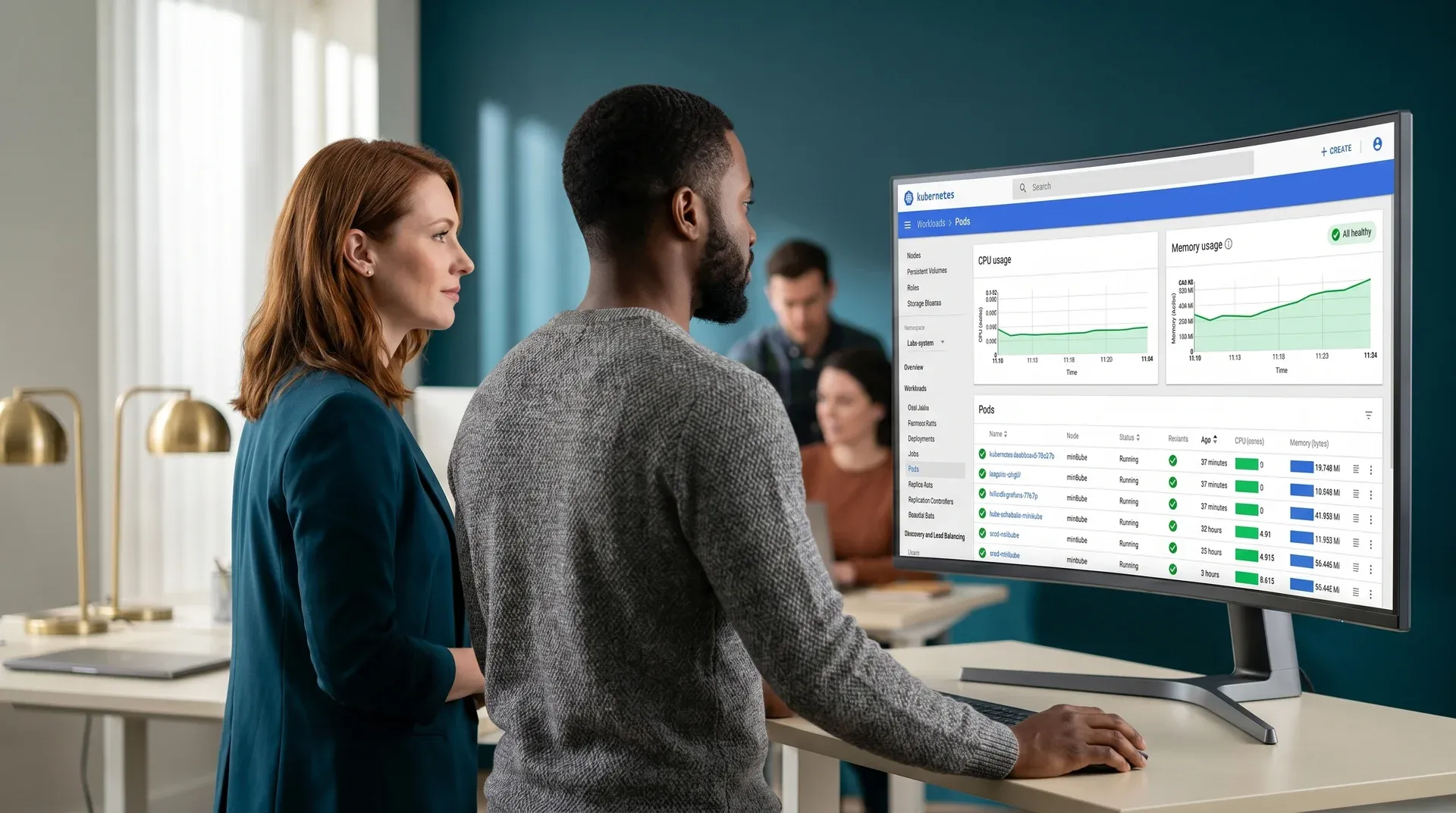
Replace: product manager and engineer reviewing all-green EKS monitoring post-migration, natural office light, over-shoulder wide · 1200×400
SaaS / B2B PlatformAWS Cloud-Native Migration
A SaaS and B2B platform required modernization of a legacy monolithic application to improve scalability, reliability, and deployment speed. The existing monolith caused slow-release cycles, frequent outages, and limited scalability. Deployment processes were tightly coupled, making it difficult to introduce new features or scale reliably as usage increased.
The application was re-architected using a microservices design and containerized with Docker. Kubernetes on AWS EKS was implemented for orchestration, scaling, and service resilience. CI/CD pipelines were built to support automated testing, rolling updates, and zero-downtime deployments. Core services including APIs, authentication, and databases were refactored to support independent scaling and improved fault tolerance.
AWS EKSDockerCodePipelineTerraformMicroservices
Why Redefine for AWS Migration
Three things every AWS migration needs that most partners skip.
01
Landing Zone first
A governed AWS environment before workload 1 moves
Migrating without a Landing Zone creates governance debt
that multiplies with every new workload.
We build the account structure, VPC design, IAM, CloudTrail,
and Config rules before any workload migrates. Your AWS
environment is governed from day one, not patched six months
after go-live.
02
Terraform for everything
Zero portal-click resources in production, ever
A resource that was clicked into existence cannot be
recreated reliably under pressure.
Every EC2, RDS, EKS cluster, S3 bucket, security group, and
IAM role is in Terraform and version-controlled. Your
environment can be reproduced from the repo in under 15
minutes. We enforce this from Sprint 1.
03
Rollback before cutover
Rollback is tested and confirmed before production traffic moves
Most migration outages happen because the rollback plan was
never tested.
We test the rollback path for every workload before shifting
any production traffic. If the rollback cannot be completed
in under 5 minutes, traffic does not shift. You validate the
rollback, then we proceed.
Common Questions
What engineering leads ask before an AWS cloud migration.
An AWS cloud migration starts with a 2-week discovery and
assessment that maps workloads, dependencies, and compliance
requirements. A Landing Zone is built in your AWS account
before any workload moves. Workloads migrate in priority order
using parallel-run validation and Route 53 weighted routing
for traffic cutover. See the
5-phase migration process above for
a detailed view.
We migrate to EC2, EKS, ECS, RDS, Aurora, S3, Lambda, API
Gateway, CloudFront, ElastiCache, and SQS depending on
workload requirements. Service selection is documented in the
architecture decision record before provisioning. We do not
choose services based on familiarity bias.
Yes. All AWS infrastructure is provisioned using Terraform or
AWS CloudFormation. No manual console resource creation in
production. Every environment is reproducible from the
repository. See the
Landing Zone phase above for an
example of the Terraform output.
We use parallel-run patterns where the source environment
stays live throughout. Traffic is shifted incrementally using
Route 53 weighted routing at 5%, 25%, 50%, then 100%. Each
increment is validated before the next. A tested rollback plan
is defined for every workload before production traffic moves.
An AWS Landing Zone is a pre-configured, governed
multi-account AWS environment defining account structure, VPC
design, IAM, security controls, and cost allocation before any
workload migrates. Without a Landing Zone, workloads
accumulate governance debt that is expensive to remediate at
scale. We build the Landing Zone before migrating workload 1.
Book an AWS Migration Assessment
Tell us about your AWS migration project.
We respond within two business days. No commitment. No pitch.
Form
48 hours
Response
100%
Terraform IaC
0
Portal click-ops
Tested
Rollback first
Pre-footer · cloud infrastructure team reviewing AWS CloudWatch all-green dashboard post-migration
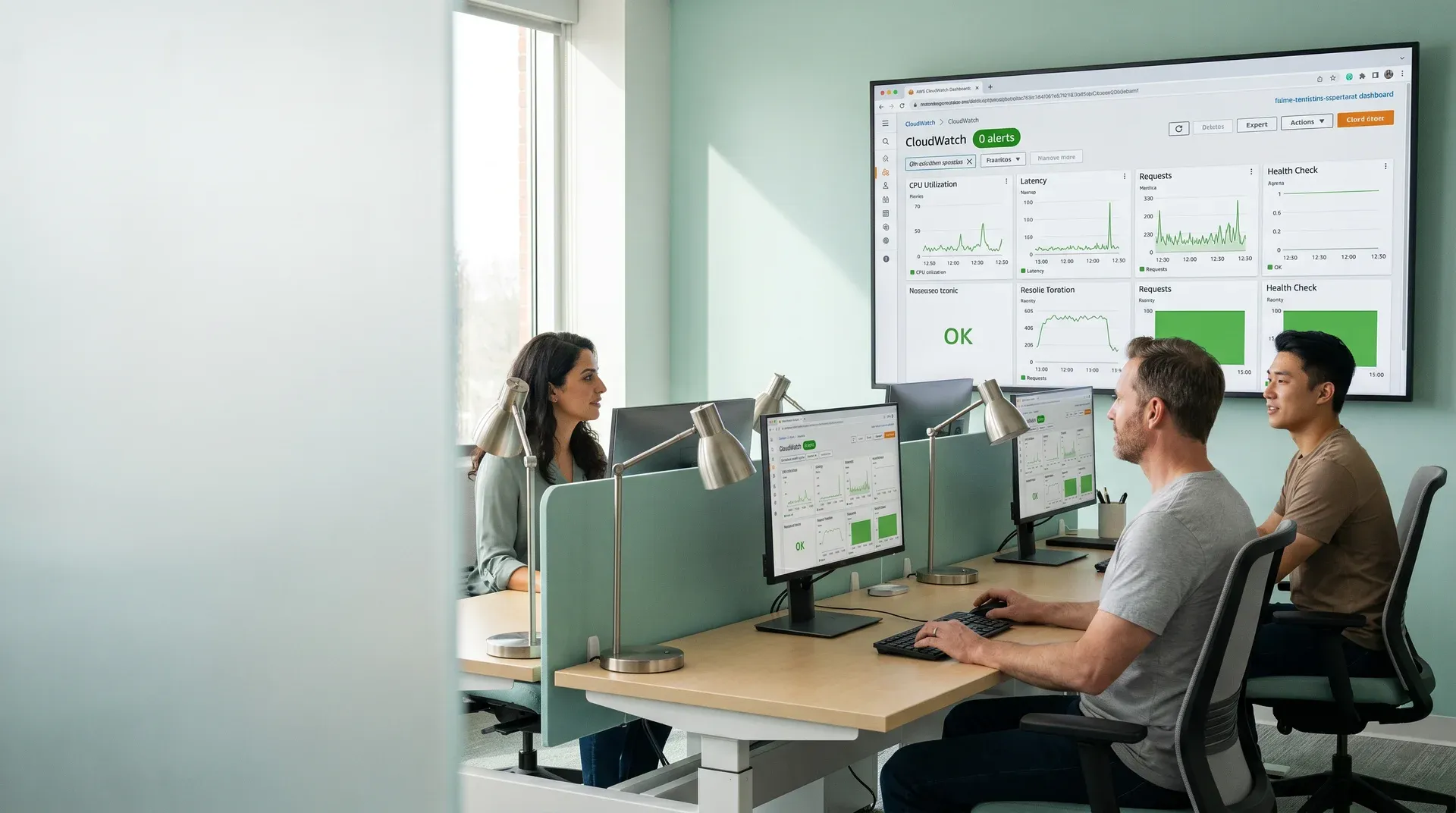
Replace: cloud team reviewing all-green CloudWatch dashboard post-migration, natural window light, wide behind-shoulder · 1200×400