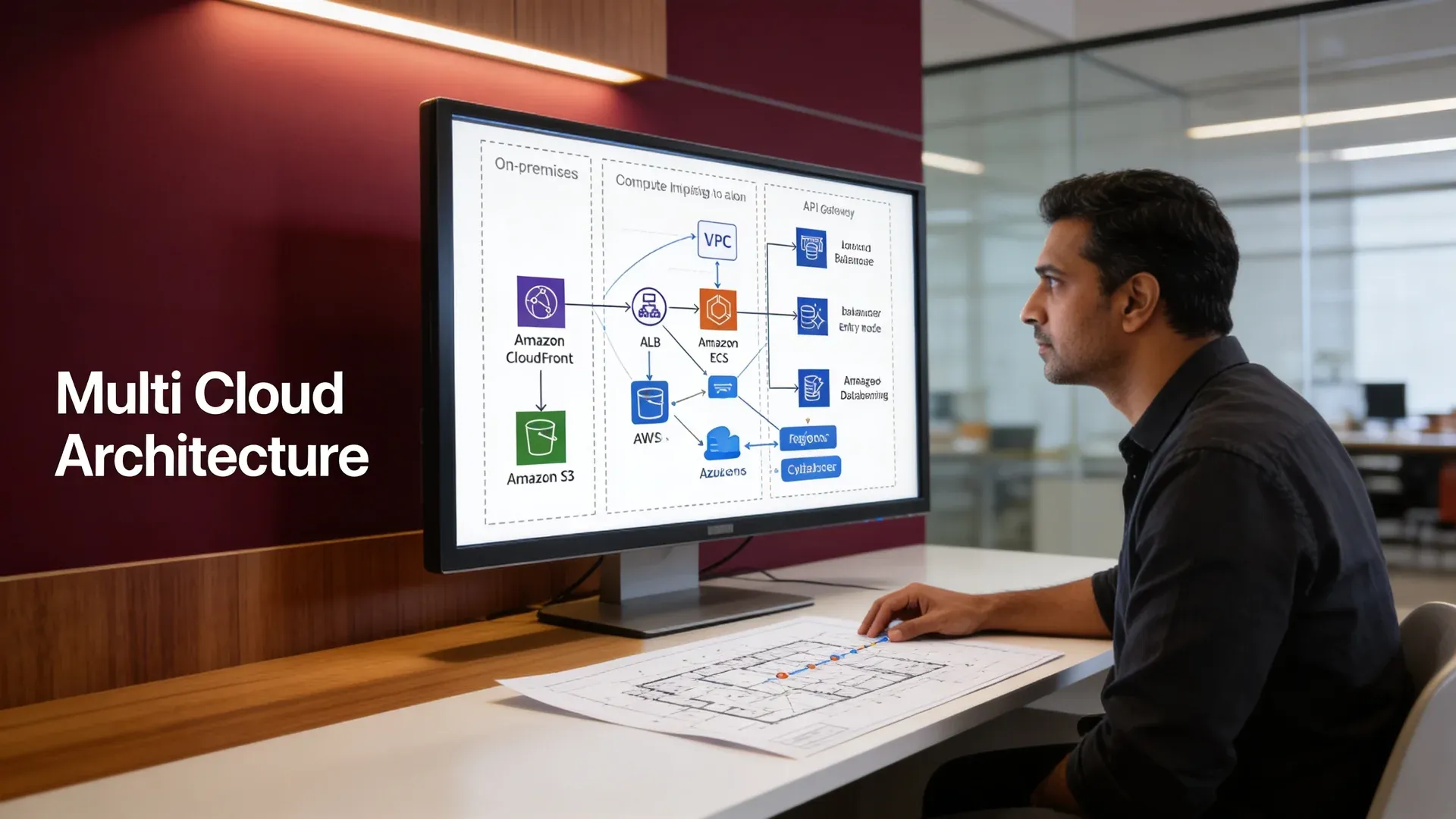
Cloud operations engineers monitoring live migration dashboard in dark atmospheric data center environment
Zero-Downtime Cloud Migration

A Cloud Migration Company.
Before Your Users Notice.

Your users never see the migration. Your team gets a CI/CD pipeline, cloud-native architecture, and code ownership on delivery day. We have migrated live streaming platforms with zero seconds of user disruption.

Zero downtime migrationsAWS · Azure · GCPCI/CD included in every migrationIaC on delivery
The Infrastructure Decision You Face

Every week your team runs on-premises infrastructure is a week that compounds your migration cost.

The left column is where you are. The right column is what teams reach after cloud migration.

Your on-premises infrastructure today
Capacity planning requires 6-month procurement cycles
Hardware orders take months. By the time servers arrive, your traffic projections have changed. You over-provision or under-build.
Scaling requires a project, not a configuration change
Peak traffic events expose the ceiling. Scaling requires infrastructure procurement, rack installation, and network configuration.
Disaster recovery is a binder on a shelf, not a tested process
Disaster recovery plans exist. They were written in 2019. Nobody has tested failover since. Recovery time is unknown until it is needed.
Security patches deployed manually, tested in production
Patch management is a monthly window. Emergency CVEs wait for the next maintenance cycle. No automated scanning in the pipeline.
Infrastructure costs are fixed regardless of usage
You pay for peak capacity at 3am on a Tuesday. Idle hardware still draws power, still requires maintenance, still consumes real estate.
After cloud migration
Capacity scales in minutes with a configuration change
Auto-scaling policies respond to real traffic. Adding capacity takes a configuration update, not a procurement request.
Peak traffic events handled without incident response
Load tests define the scaling policy. Traffic spikes trigger auto-scaling before users notice. No emergency war rooms.
Disaster recovery tested automatically every 30 days
Automated failover tests run on a schedule. Recovery time is a measured number, not an estimate. Recovery time objective and recovery point objective are documented and proved.
Security scanning runs in every build, not in maintenance windows
Dependency vulnerabilities surface in the CI/CD pipeline build log. CVEs are closed in hours, not at the next maintenance window.
Infrastructure costs track with actual usage
Pay for what runs. Scale down outside peak hours. Reserved instances for predictable workloads. Spot instances for batch jobs.

Pain · IT team at overcrowded on-premises server room

Cloud operations specialist reviewing healthy post-migration CloudWatch monitoring dashboard, calm and satisfied, in a clean modern office
Cloud Migration Strategies

Cloud migration consulting starts here: not every workload needs the same migration approach. Your strategy depends on what you are moving and where you are going.

Select a migration strategy below to see how we approach it, what it delivers, and when it is the right choice.

Strategy 01
Rehost (Lift and Shift)
Move workloads to the cloud with minimal changes. Fastest path to cloud infrastructure. Captures immediate savings on hardware, colocation, and maintenance contracts.
Strategy 02
Replatform (Lift and Optimize)
Migrate workloads with targeted optimization. Replace self-managed databases with managed cloud services. Reduce operational overhead without a full re-architecture.
Strategy 03
Refactor / Re-architect
Redesign applications to be cloud-native. Microservices, serverless, and containerized workloads. Maximum cloud benefit. Highest initial investment, highest long-term return.
Strategy 04
Hybrid Cloud Bridge
Maintain a phased coexistence of on-premises and cloud. Migrate in waves. Validate each wave before the next. Legacy systems decommissioned on proven migration, not on a schedule.
Rehost Migration: Workload Inventory
WORKLOAD
SOURCETARGETSTATUS
Auth Service
VMware ESXAWS EC2Live
API Gateway
Bare MetalAWS EC2Validating
Postgres DB
Bare MetalRDS AuroraIn progress
Media CDN
AkamaiCloudFrontScheduled
Migration progress2 of 4 live
Replatform: Optimization Recommendations
Self-managed
PostgreSQL on EC2
Patching overhead: 8 hours/month
Managed service
Amazon RDS Aurora
Patching overhead: 0 hours/month
Annual savings estimate
$84,000DBA overhead eliminated
Refactor: Architecture Blueprint
Legacy monolith
Monolithic App Server
Single Postgres DB
Bare metal CDN
Cloud-native target
Kubernetes (EKS)
Aurora + ElasticSearch
CloudFront + S3
Hybrid Bridge: Traffic Routing Dashboard
65%
On-premises
35%
Cloud
Cloud percentage grows with each validated migration wave. On-premises decommissioned only after cloud is proven in production.
Cloud Migration Capabilities

Five capabilities your team gains before they log into the new cloud environment for the first time.

Assessment first
Cloud Strategy and Readiness Assessment

A complete inventory of your workloads, dependencies, data flows, and compliance requirements before migration planning begins. Every workload is classified by migration strategy: rehost, replatform, refactor, or retire. The assessment produces a risk-ranked migration plan with phase-by-phase timelines and cost projections. No migration work begins without it.

Zero disruption
Zero-Downtime Migration Architecture

Live cutover methodology using real-time data replication and parallel traffic routing. The new cloud environment receives live traffic before the old one is decommissioned. Users never experience a migration.

Cost control
FinOps and Cloud Cost Optimization

Right-sizing analysis, reserved instance planning, spot instance strategy for batch workloads, and cost allocation tagging. Most teams reduce cloud spend by 25 to 40 percent in the first 90 days after migration with proper FinOps governance.

Security and trust
Security, Compliance, and Identity Architecture

Cloud IAM design, VPC network architecture, encryption at rest and in transit, compliance-ready infrastructure for GDPR, SOC 2, PCI, and HIPAA where applicable. Security is designed into the cloud architecture before any workload migrates, not reviewed at the first audit. Penetration testing and vulnerability scanning included post-migration.

SOC 2 readyGDPR compliantPCI-DSS architectureHIPAA-ready
Cloud-Native CI/CD

Every migration includes a CI/CD pipeline. Your team ships code differently on day one.

Cloud migration is not just moving workloads. It is changing how your team ships software. We design and implement the full CI/CD pipeline as part of every migration, not as an add-on.

Pipeline design and implementation
GitHub Actions, GitLab CI, or your preferred tooling. Every commit triggers the full pipeline.
Automated testing gates
Unit, integration, and smoke tests run before any deployment reaches staging or production.
Security scanning in every build
Dependency vulnerability scanning, container image scanning, and SAST checks run on every pull request.
Infrastructure as Code (IaC)
Terraform or Pulumi defines every cloud resource. Environments are reproducible. No configuration drift.
GitOps deployment model
ArgoCD or Flux syncs cluster state from Git. Rollback is a revert commit. Nothing is deployed manually.
Observability and alerting stack
Metrics, logs, and distributed traces configured from day one. On-call playbooks delivered with the pipeline.
Get CI/CD Pipeline Included in Your Migration
The CI/CD infinity loop
Click any stage to see what ships inside it
💻 Code 🔨 Build 🧪 Test 🔧 Stage 🚀 Deploy 📊 Monitor
Code

Branch protection rules, required review approvals, and PR templates configured from day one. Feature flags and environment variable management set up before the first commit to the new cloud environment.

Tools configured
GitHub / GitLabBranch policiesFeature flagsSecrets management
Build

Containerized build environments ensure reproducible artifacts. Docker multi-stage builds minimize image size. Build cache configured for fast iteration.

Tools configured
Docker multi-stageGitHub ActionsBuild cacheECR / Artifact Registry
Test

Unit, integration, and smoke tests gate every pipeline run. Dependency vulnerability scanning (OWASP, Trivy) runs on every container image. Failed security scans block deployment to staging.

Tools configured
Jest / PyTest / Go testTrivy scanOWASP DependencySonarQube
Stage

Staging environment runs on production-equivalent cloud infrastructure. Environment parity eliminates the "works in staging, fails in prod" problem. Manual approval gate before production deployment.

Tools configured
Terraform workspacesK8s namespacesApproval gatesSmoke tests
Deploy

GitOps-driven deployment using ArgoCD or Flux. Cluster state is reconciled from Git. Rolling deployments with zero downtime. Automatic rollback on error rate threshold breach.

Tools configured
ArgoCD / FluxKubernetes rollingBlue/green deployAuto-rollback
Monitor

Metrics, logs, and distributed traces from day one. Dashboards pre-configured for key service health indicators. PagerDuty or OpsGenie on-call routing configured with escalation policies. Runbooks delivered with the pipeline.

Tools configured
Prometheus / GrafanaDatadog / SentryPagerDutyRunbooks
Cloud Provider Support

We migrate to AWS, Azure, and GCP. Click a provider to see service coverage.

Amazon AWS
EKS, RDS, CloudFront
Microsoft Azure
AKS, Cosmos DB, CDN
Google Cloud
GKE, Firestore, Cloud Run
Service category
AWS
Azure
GCP
Container orchestration
EKS
AKS
GKE
Managed database
RDS Aurora
Cosmos DB
Cloud Spanner
Serverless compute
Lambda
Azure Functions
Cloud Run
Infrastructure as Code
Terraform
Terraform
Terraform
Disaster recovery
Multi-region
Multi-region
Multi-region

Proof · Cloud operations team monitoring live migration

Cloud operations team monitoring live migration dashboard with calm focused expressions in modern office environment
Client Result. OTT and Media Streaming Enterprise Cloud Migration

Live production traffic migrated. Zero user disruptions. Zero data inconsistencies.

Zero
user disruptions during migration of live streaming infrastructure
Real-time
CDC pipelines maintained data consistency across multiple NoSQL systems throughout transition
Serverless
data pipelines on GCP reduced operational overhead and eliminated database maintenance windows
The organization

An enterprise OTT and media streaming platform with live production traffic that could not tolerate any user-facing disruption. Data was distributed across multiple NoSQL systems with complex schemas and high write volumes. Traditional migration approaches were unsuitable. Zero downtime and data consistency were mandatory requirements throughout the full migration.

What we delivered
Zero-downtime migration architecture on Google Cloud Platform
Real-time change data capture pipelines replacing legacy NoSQL databases with Firestore
Serverless data pipelines eliminating operational overhead from database maintenance
CI/CD pipeline and observability stack delivered alongside the migration
Why Teams Choose Redefine for Cloud Migration

Three commitments that separate a cloud migration agency from an expensive infrastructure move.

01
We migrate without maintenance windows or user-facing downtime.

Our migration architecture runs the cloud environment in parallel before the old one is decommissioned. Users continue using the system throughout the migration. There is no maintenance window announcement. There is no dark weekend. We have migrated live streaming platforms, financial transaction systems, and SaaS products with zero production disruptions.

02
The CI/CD pipeline is a first-class deliverable, not an afterthought.

Most cloud migrations move workloads and hand back the keys. Your team still deploys the same way. We build the CI/CD pipeline, observability stack, infrastructure as code, and GitOps model alongside the migration. Your team ships code differently on day one in the new cloud environment. Not six months later when you hire another contractor.

See legacy modernization services →
03
Every migration is reversible. Nothing is irreversible until it is proven.

We design each migration phase so that if something unexpected happens in the cloud environment, traffic routes back to the original infrastructure without data loss. The rollback path is tested before the cutover path. This is not a safety blanket. It is what allows us to run migrations without maintenance windows and without fear.

Enterprise software services →
Common Questions

What CTOs and engineering leads ask before engaging.

Cloud migrations typically run 8 to 24 weeks depending on the scope, number of workloads, and migration strategy. Lift-and-shift migrations of well-documented systems can complete in 8 to 12 weeks. Re-architecture engagements run 16 to 28 weeks. Every engagement starts with a 2-week assessment that maps every workload and produces a risk-ranked migration plan before any build work begins. See our pricing guide for phase-by-phase breakdown.
Yes. We design migrations so users never notice. Using real-time change data capture pipelines and parallel-run architecture, the new cloud environment receives live traffic before the legacy infrastructure is decommissioned. We have migrated live streaming platforms, financial transaction systems, and SaaS products with zero production disruptions.
We migrate to AWS, Microsoft Azure, and Google Cloud Platform. For organizations requiring multi-cloud resilience, we design multi-region architectures that distribute workloads across providers. Provider selection is driven by your compliance requirements, existing tooling, and cost profile. We do not have a default provider preference or a commercial arrangement that influences recommendations.
Yes. Every cloud migration engagement includes full CI/CD pipeline design and implementation. Teams should ship code differently after migration, not just run the same workloads in a different location. We implement automated build, test, and deploy pipelines using GitHub Actions, GitLab CI, or your preferred tooling, with infrastructure as code and GitOps deployment models.
Cloud migration engagements typically run between $80,000 and $400,000 depending on workload count, migration strategy, compliance requirements, and CI/CD complexity. The assessment phase (weeks 1 to 2) is priced separately and produces the migration plan that informs the full engagement price. We scope before we quote. See our pricing guide.
Is This the Right Engagement?

We are direct about fit before any commitment is made.

🚀
Good fit
You are running production workloads on-premises or in a legacy hosting environment and the costs, scale limitations, or operational overhead are blocking growth
Zero downtime is a non-negotiable requirement. Your system cannot go offline and your users cannot be asked to wait during a maintenance window
You want the CI/CD pipeline, IaC, and observability stack delivered alongside the migration, not as a separate engagement 6 months later
Your team has an internal technical stakeholder who can approve architecture decisions and participate in weekly migration reviews
You have compliance requirements (SOC 2, GDPR, PCI, HIPAA) and need them addressed in the cloud architecture from the start
🚫
Not a fit
You need a simple lift-and-shift of a small personal project or low-traffic website. Below $50,000 in total scope, our process adds overhead that outweighs the benefit.
You need the migration completed in less than 4 weeks. The assessment alone takes 2 weeks. Compressed timelines eliminate the risk assessment that prevents outages.
You are not ready to commit to Infrastructure as Code and CI/CD. Running the same deployment process in the cloud as you run on-premises captures only 20 percent of the value.
Your organization does not have an internal technical stakeholder who can make architecture decisions. Migrations require frequent technical judgment calls that cannot wait for agency responses.

Not sure? Tell us your situation and we will tell you honestly whether migration makes sense right now.

Book a Technical Strategy Call

Hire cloud migration experts. Tell us about your infrastructure.

We review every brief and respond within two business days. No commitment. No pitch.

Form
48 hours
Response time
3 days
Proposal scoped
Zero
Downtime migrations
100%
Code ownership
Brief received.

We will review your infrastructure and send a scoped migration proposal within 3 business days.

Get on a call with us to see how we can help you

Get a Quote