Stop guessing. Get the stack your project actually fits.
The wrong technology choice costs 6 to 18 months of rebuilding. Redefine evaluates your GMV, team capacity, and integration load, then recommends the precise stack before you spend a dollar on development.
Enterprise / Custom
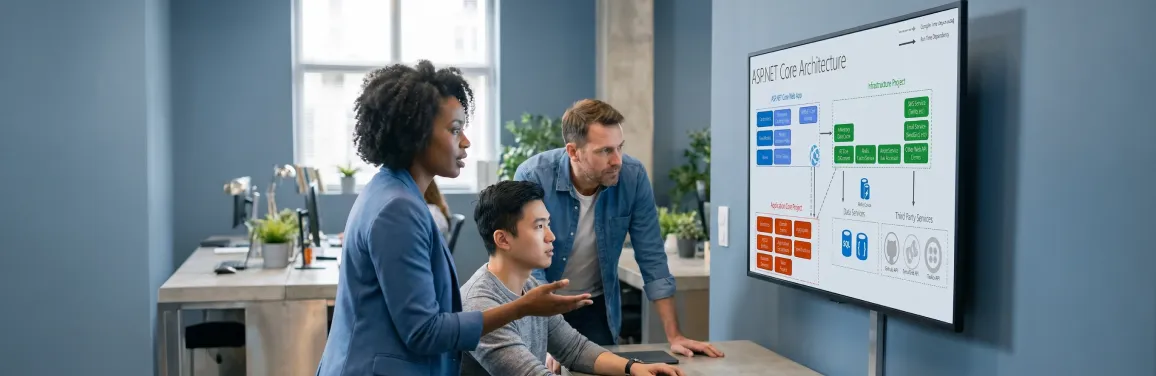
Most teams get trapped by a stack they outpace in 12 months
The pattern repeats. A team picks the tool the last developer knew. The project ships. Six months later, those choices become load-bearing walls you cannot move without a full rebuild.
Picking Shopify for a $40M B2B platform because "that is what we know" costs 18 months of workarounds and then a full rewrite.
Your competitor's headless replatform worked for them at $5M GMV. Your $500K GMV project does not need that operational surface area yet.
A Kubernetes microservices setup on AWS does not fix a Shopify store's abandoned cart rate. It adds six months and $200K to a problem a theme upgrade solves in two weeks.
No README. No architecture diagram. No rationale. Just a repo with 14 undocumented third-party integrations and a Slack thread that says "ask Jake" (Jake left in 2022).
DTC under $5M GMV and shipping fast? Shopify. B2B with purchase approvals and ERP sync? Node.js headless. High-catalog velocity with global traffic? Next.js on Vercel edge. The decision criteria are clear when you map the revenue model first.
A headless React stack maintained by a one-developer team is a liability. Redefine scopes to what your team can own 90 days after handover, not what reads well in a proposal.
Every Redefine engagement closes with architecture diagrams, dependency maps, and a decision log. The next developer you hire reads it on day one and ships without asking questions.
The scoping process models your next 18 months of revenue, team size, and catalog growth. You get a foundation that holds when you double. No rebuild required.
Pick the project that looks like yours.
Each project type below shows you the recommended stack, the build timeline, and what your team will not have to manage after handover.
Shopify for DTC brands that need to ship fast and sell immediately
Shopify's managed infrastructure takes hosting, payments, and PCI compliance off your team's plate permanently. Redefine builds performance-optimized custom themes, wires Klaviyo and GA4 for day-one analytics, and installs the app stack that matches your fulfillment model. You focus on acquiring customers. The platform handles the rest.
When page speed and design control both matter to your conversion rate
Next.js on Vercel's edge network hits sub-second time-to-first-byte for visitors anywhere in the world. Redefine decouples your frontend from Shopify or BigCommerce — you get pixel-level design control and 95+ Lighthouse scores while the commerce platform handles orders, inventory, and checkout exactly as before. Your merchandising team never touches code.
B2B platforms with ERP sync, approval workflows, and real purchase complexity
Off-the-shelf platforms stall on multi-step purchase approvals, contract pricing, and live ERP inventory. Redefine builds Node.js service layers that connect directly to Microsoft Dynamics, SAP, or your custom ERP. Every API is typed and documented. Your procurement team and purchasing managers can place orders with live pricing and inventory, without manual reconciliation between systems.
Custom web apps with no platform limits and no vendor lock-in
Internal tools, SaaS platforms, booking systems, and customer portals that do not fit a standard platform need full-custom development with a codebase your team can own. Laravel's structured MVC pattern and Vue's reactive frontend give any developer you hire a readable, extensible system on day one. No proprietary layers. No dependency on a single vendor to make changes.
Mastery at every layer of the stack
Frontend code that passes 95+ Lighthouse and holds that score in production
React, Next.js, and Shopify Liquid themes built with Core Web Vitals as a hard requirement from Sprint 1. Every component ships tested on mobile, on slow 3G, and on real production traffic. Google rewards fast-loading pages. Customers stay on them. Both outcomes show up in your revenue numbers.

Platform fit based on your revenue model, not our agency certification
Shopify, BigCommerce, and headless APIs each perform differently at different GMV levels and catalog types. Redefine maps your product data model, checkout complexity, and integration load before naming a platform. The recommendation follows the analysis. The analysis is not written to fit a platform we prefer.
Backend code the next developer you hire can extend without a handholding call
The developer you hire in 12 months reads the architecture documentation and ships in a day, not a sprint. Node.js and Laravel backends at Redefine use typed interfaces, separation of concerns, and documented decision rationale. No tribal knowledge. No black-box dependencies.
Integration documentation that ships on handover day, not six months later
Klaviyo, GA4, Google Shopping feeds, Avalara, ERP connectors, and payment gateways wired with typed API clients, error handling, and retry logic. Every integration closes with documentation your team can read, extend, and hand to a new hire without Redefine in the room. The code and its context travel together.
A B2B distributor migrated from legacy PHP to headless Node.js and eliminated 12 manual processes

A B2B ecommerce operator with complex purchase approval workflows, live inventory requirements, and an ERP that needed to talk to the customer-facing catalog in real time.
The legacy platform could not handle multi-step purchase approvals, ERP-connected pricing, or catalog loads at B2B scale. Inventory syncing broke under volume. Customer approval queues were manual. Data lived in three systems with no single source of truth.
Complete rebuild on headless Node.js and Next.js. The frontend was redesigned for large B2B catalogs with fast navigation. Real-time inventory and pricing sync directly from Microsoft Dynamics. A typed API layer routes approvals, quotes, and orders without manual intervention.
- Order-to-approval cycle time cut significantly with automated routing
- Live inventory and pricing from Microsoft Dynamics, no manual sync
- Internal teams work from a single data source, not three fragmented systems
Line-by-line technology breakdown. No commitment required to see the numbers.
- Stack choice complexity and number of layers
- Third-party integrations and ERP connectors
- Documentation and handover requirements
Every Redefine proposal includes a cost-of-wrong-stack estimate showing what a rebuild costs in 18 months if the architecture is outgrown. You see the risk before you decide. Most clients find the comparison shifts the conversation from "can we afford this?" to "can we afford not to do it right?"
See technology stack pricing details →The numbers Redefine writes into every project brief from Sprint 1
These targets come from real Redefine-built projects. Every new engagement starts with a performance brief that sets these as contractual targets, not aspirational goals. Scope and infrastructure affect final numbers, but the direction is non-negotiable.
What this means: pages load before a customer's attention moves on.
What this means: global shoppers see the page before they decide to leave.
What this means: checkout and order operations feel instant.
What this means: the app stays fast and testable as your team adds features.
Your stack should be chosen by the people building it, not by the platform they are certified to sell
Most technology partners have a preferred platform. They are good at it, certified in it, and motivated to recommend it. Redefine does not have a preferred platform. The analysis comes first. The recommendation follows.
What to ask before choosing a technology stack partner
Redefine maps five inputs before any recommendation: your current GMV and 18-month growth model, your team's technical capacity after handover, the number and complexity of third-party integrations, your catalog and checkout complexity, and your timeline and budget constraints. The stack recommendation follows from those inputs, not from a partner certification or a preferred vendor relationship.
Yes. Redefine scopes incremental migration paths that keep your current platform running while the new stack is built in parallel. You do not go dark. The migration is sprint-by-sprint, with a feature-parity checklist before cutover. Common migration paths include Shopify theme to headless, legacy PHP to Node.js plus Next.js, and WordPress commerce to Shopify or BigCommerce.
Stack consulting is a two to three day scoping engagement that maps your current architecture, documents every integration, identifies technical debt and risk, and produces a written recommendation with rationale for each technology choice. You get an architecture diagram, a risk register, and a build brief your team or any other partner can execute. It is not a six-week discovery process.
Either arrangement works. Your team's documentation access is guaranteed from day one because Redefine ships architecture diagrams and decision logs alongside the code. Your internal developers are never locked out of what was built, even if Redefine is handling the entire build. Redefine also takes specific layers, such as the API layer or data integrations, while your internal team owns the frontend. The same documentation standard applies regardless of the split.
Redefine scopes every engagement before any commitment. Within three business days of receiving your brief, you get a line-by-line proposal with a technology breakdown, timeline by sprint, and a fixed price. There is no time-and-materials billing, no open-ended retainer, and no surprise invoices. The proposal also includes a cost-of-wrong-stack analysis showing the rebuild cost if a different architecture is chosen and outgrown in 18 months. The cost-of-wrong-stack estimate is unique to each project. It models the rebuild cost — developer hours, migration downtime, and lost velocity — if the recommended architecture is outgrown in 18 months. Most clients say this comparison reframes the conversation from price to risk.
Describe your project. Receive a stack recommendation in 3 business days.
Tell us what your platform cannot handle today, or describe the application you need to build. Redefine returns a recommended technology stack, delivery timeline, and fixed-scope pricing in three business days. No commitment. No pitch call before you have the numbers.
- A Redefine architect reviews your brief and calls within 48 hours
- You receive a recommended stack, timeline by sprint, and fixed pricing in 3 days
- If you approve the proposal, Sprint 1 starts within 1 week
Call within 48 hours • proposal in 3 days • Sprint 1 within 1 week of sign-off
Brief received.
Your platform details are in. A Redefine architect will call within 48 hours to confirm scope. Your stack recommendation, timeline, and fixed pricing arrive within three business days. You decide what happens next.