Your Next Laravel Application, Architected Right From Sprint One
Laravel development company specializing in custom CMS platforms, B2B SaaS backends, and API-first web applications. We build with Eloquent ORM, structured MVC, and CI-enforced test coverage. Your team understands the codebase in year three because we document every architectural decision at handoff. Related work spans PHP Development, Custom Software Development, Web Application Development, and SaaS Development.

Your PHP app works. Until it doesn't.
Five patterns that ship fast in month one and turn into engineering crises in month six. The right column shows exactly what a Laravel-first build prevents.
Your app breaks at 1,000 concurrent users
No caching layer, no queue system, no horizontal scaling plan. One traffic spike turns into customer churn and an emergency all-hands.
Raw SQL queries mean 4-hour debugging sessions
No ORM, no query logging, no N+1 detection. Every performance issue takes an engineer off product work for half a day.
Every developer wrote auth differently
Token logic in 6 places. Password reset in a file no one remembers. Security gaps found by an auditor, not you.
Background jobs fail silently at 2am
Cron jobs with no retry logic, no monitoring, no alerts. Users notice before you do.
Third-party integrations take weeks, not days
No API standard, no resource layer, no documented contracts. Each new integration costs two weeks of engineering time you could spend on product.
Laravel Octane + Redis caching handles millions of requests
Horizontal scaling architecture documented before sprint one. Traffic spikes become a dashboard metric. They stop being the reason your phone rings at midnight.
Eloquent ORM with eager loading eliminates N+1 permanently
One method call. No blind SQL. Query performance profiled in every sprint review so slowdowns surface before users feel them.
Laravel Sanctum and Passport handle auth in hours
API token auth, session auth, OAuth2: standard, tested, and documented before the first feature ships. No custom auth code means no custom auth vulnerabilities.
Laravel Horizon + Redis queues with visual monitoring
Failed jobs surface instantly. Retry policies set. Alerts fire before users notice. Your on-call engineer sleeps.
API Resources + OpenAPI spec cut integration time from weeks to days
Versioned routes, documented resources, consistent error responses. Third parties read the spec. Nobody guesses how your API works.

"We inherited a PHP application with 40,000 lines in a single controller. Rewriting it with Laravel took 6 weeks. Debugging the original would have taken years." — Senior Engineer, Redefine project team
The same feature. Before and after Laravel.
Toggle between the raw PHP version and the Laravel version of the same user profile feature. The performance counter is live. The code differences map directly to the five failure patterns in the section above.
This is illustrative code modeled on real Redefine client work. Actual results vary by project scope and starting codebase condition.
Every layer of a production Laravel application, built right.
raw SQL queries — ever — on a Redefine Laravel project
Eloquent ORM handles every database interaction. Type-safe queries and relationships defined once in your models mean your developers spend time on features, not debugging SQL.
SELECT * WHERE id = $idinjection risk
User::find($id)safe, typed, chainable
Artisan CLI: one command, zero boilerplate
Model, controller, migration, factory, policy, and test generated in under a second. No inconsistency between files. No forgotten test class. Developers move faster because the structure is already there.
Security built in by default, not added later
CSRF protection on every form. Auto-escaped output in Blade. SQL injection prevented at the framework level by Eloquent. Rate limiting applied per route. Your auditor finds nothing because there is nothing to find.
- CSRF tokens everywhere
- Parameterized queries only
- Policy-based authorization
- Route-level rate limiting
Background jobs with monitoring, retry logic, and zero silent failures
Emails, webhooks, and batch processing run off the request cycle. Retry policies, dead letter queues, and a real-time Horizon dashboard mean your on-call team knows about failures before users do.
Illustrative data based on a typical Redefine Laravel deployment.
API-first architecture with versioned resources and auto-generated docs
Laravel API Resources give every endpoint a consistent, versioned JSON structure. OpenAPI spec generates from route definitions, so documentation is always current. Third-party integrations drop from weeks to days.
- Versioned API routes (/v1/, /v2/)
- Consistent JSON error responses
- OpenAPI docs auto-generated
"data": {
"id": 42,
"name": "Jane Smith",
"orders_count": 14,
"links": {
"self": "/api/v1/users/42"
}
},
"meta": {"version": "v1"}
}
Also in the Redefine stack:
US Emblem's enterprise CMS. Rebuilt. Now owned by their team.
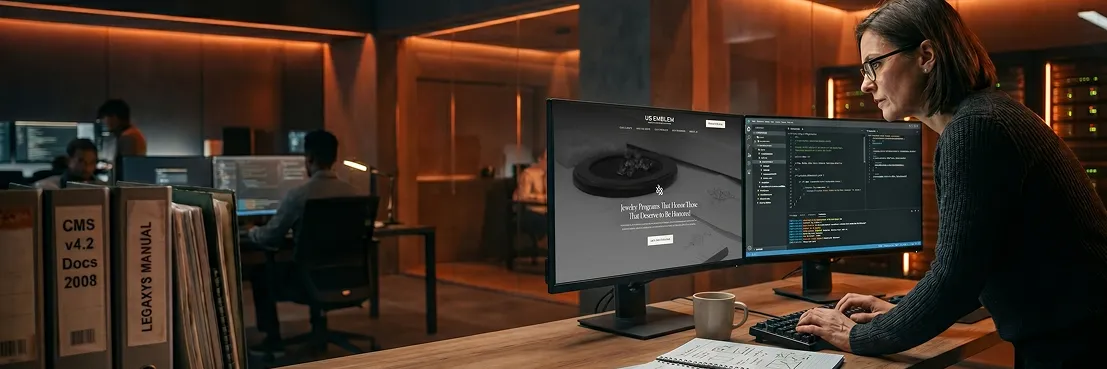
US Emblem
Enterprise Emblem and Promotional Products
US Emblem served enterprise and government buyers with a broad product catalog. Their existing site had no mobile experience that worked, no content management their marketing team could use without a developer, and no visual hierarchy that helped buyers find what they needed. Enterprise prospects left without converting.
Enterprise buyers leaving before inquiring. Three-day wait for developer help on every content update. No mobile experience that converted.
integrated Laravel deliverables built and handed off with full documentation
The marketing team now publishes and updates content without any developer involvement
Enterprise and government buyers navigate the full product catalog without assistance
The site loads and converts on mobile, on every device type
US Emblem's website is now their primary sales channel for long-term enterprise accounts
Delivered: User Experience Design + Laravel PHP Development + CMS Architecture + Content Structure + Enterprise Web Design
Why Redefine-built Laravel applications outlast typical PHP agency work.
Click any row to see why each decision matters. These are not style choices. They are architectural decisions that determine whether your application survives year three.
| Decision | Typical PHP agency approach | Redefine |
|---|---|---|
| Architecture pattern | Procedural / ad-hoc | Laravel MVC + Service Layer |
| In procedural PHP, business logic, database queries, and display code live in the same file. As the project grows, any change risks breaking something else. Laravel MVC with a service layer separates those concerns. Features get added. Regressions do not. | ||
| Database layer | Raw SQL / no ORM | Eloquent ORM + migrations |
| Raw SQL is both an injection risk and a maintenance burden. Eloquent provides parameterized queries by default, relationship definitions that scale, and database migrations that your entire team can version-control. | ||
| Authentication | Roll-your-own | Sanctum / Passport out of box |
| Custom auth code is where security vulnerabilities live. Laravel Sanctum handles API token auth, SPA auth, and mobile auth. Passport handles full OAuth2. Both are audited, maintained, and updated with every Laravel release. | ||
| Background jobs | Cron + hope | Horizon queues + monitoring |
| Cron jobs have no retry logic, no monitoring, and no visibility. Laravel Horizon provides a real-time dashboard, retry policies, and dead-letter queues. You know about failures before users do. | ||
| API design | No standard | API Resources + OpenAPI spec |
| Without API Resources, JSON structure changes break third-party integrations with no warning. Laravel API Resources decouple your database schema from your API contract. OpenAPI spec is generated from route definitions so documentation is always current. | ||
| Testing approach | Manual / none | PHPUnit + CI-gated coverage |
| PHPUnit feature tests and unit tests are written alongside every feature. A minimum test coverage threshold is set in CI. PRs below the threshold do not merge. You ship knowing every critical path is tested. | ||
| Security posture | Developer-dependent | CSRF, XSS, SQLi by default |
| In raw PHP, security depends on whether the developer remembered to sanitize. In Laravel, CSRF protection is on every form automatically. Blade escapes output automatically. Eloquent prevents SQL injection automatically. Security is the default, not a checklist item. | ||
| Codebase documentation | README if lucky | ADR + docblocks + wiki |
| Architecture Decision Records capture every significant choice and why it was made. PHPDoc blocks are written for every public method. A project wiki covers onboarding, deployment, and contribution conventions. Your team can own this codebase without us present. | ||
The questions buyers ask before hiring a Laravel development company.
Architecture choices, migration paths, and security questions that matter more than framework selection. Here is what removes the uncertainty before sprint one.
No commitment required to receive a proposal. Scoped before work starts. Line-by-line pricing.
A Laravel discovery sprint delivers a full architecture document, data model, and sprint plan. You see every line item before signing anything.
Laravel development consulting that tells you the truth.
Select the cards that fit your project. The fit score updates as you go. If you are not sure, send your situation and we tell you directly, at no cost.
Not sure which side you land on? Send us your situation and we will tell you directly whether Laravel is the right call before you scope anything.
Building a custom CMS, web application, or SaaS backend
Complex workflows, custom business rules, and a database at the center. Needs to grow without breaking.
Existing raw PHP codebase that needs structure and security
Messy inheritance, raw SQL, or security vulnerabilities found in an audit.
Need a RESTful or GraphQL API backend for a frontend team
API-first build where documentation, versioning, and consistency matter.
Application that processes background jobs, webhooks, or batch data
Automated tasks that cannot fail silently: order processing, email delivery, data imports, third-party webhook handlers.
Not the right match if:
Your total project budget is under $8,000
A clean Laravel architecture takes real engineering time. We are happy to point you to the right resource for smaller budgets.
You need a simple WordPress or static site
Laravel is the wrong tool for a basic content site. We will tell you what is faster and cheaper for that use case.
Tell us what you are building. We scope the Laravel architecture before you commit.
Submit a brief. Receive a scoped proposal in 3 business days with line-by-line pricing. No commitment required to get the proposal.
Submit your brief
Describe the problem and what the application needs to do. A Laravel architect reads it personally.
A Laravel architect calls within 48 hours
Not a sales rep. An engineer. We ask about data model, security requirements, and integration surface.
Scoped proposal in 3 days
Architecture plan, Eloquent data model sketch, sprint schedule, and line-item pricing.
Sprint 1 within 1 week of sign-off
Architecture sprint. You see the full data model and route map before line one of app code.
Your brief is with us.
A Laravel architect will review your project and reach out within 48 hours to set up a technical call. The scoped proposal follows within 3 business days.