Angular Applications That Ship Fast and Stay Maintainable
We build Angular enterprise apps for VP Engineering teams who need component architecture their developers can own, state management that scales past 10 concurrent engineers, and bundle performance that never degrades in CI. Your codebase works the day you receive it and the day you hire your fifth developer.

Most Angular builds start clean. Six months in, they don't.
The framework is solid. The architecture decisions made in the first two weeks are what break you. Toggle between what most agencies ship and what we enforce.
State managed 4 different ways in the same app
BehaviorSubjects, services, local state, and component inputs all holding the same data. Three developers, four opinions on where state lives.
Default change detection on every component
Entire component tree rerenders on every event. Dashboard grinds to a halt at 50 rows.
No shared component library
Every feature team builds the same button, card, and modal from scratch. Inconsistency ships with every pull request.
Angular version upgrade deferred indefinitely
"We'll handle that in Q3" becomes a 3-sprint ordeal with no clear owner two years later.
Bundle shipped unprofiled
2.4MB initial bundle. First contentful paint at 4.8s on a mid-range connection. Mobile visitors leave.

"We spent 6 weeks refactoring a service layer that should have been designed once. Every sprint had
rework in it."
—
VP Engineering, mid-market SaaS company (name withheld at client request)
See the architecture. Not just a description of it.
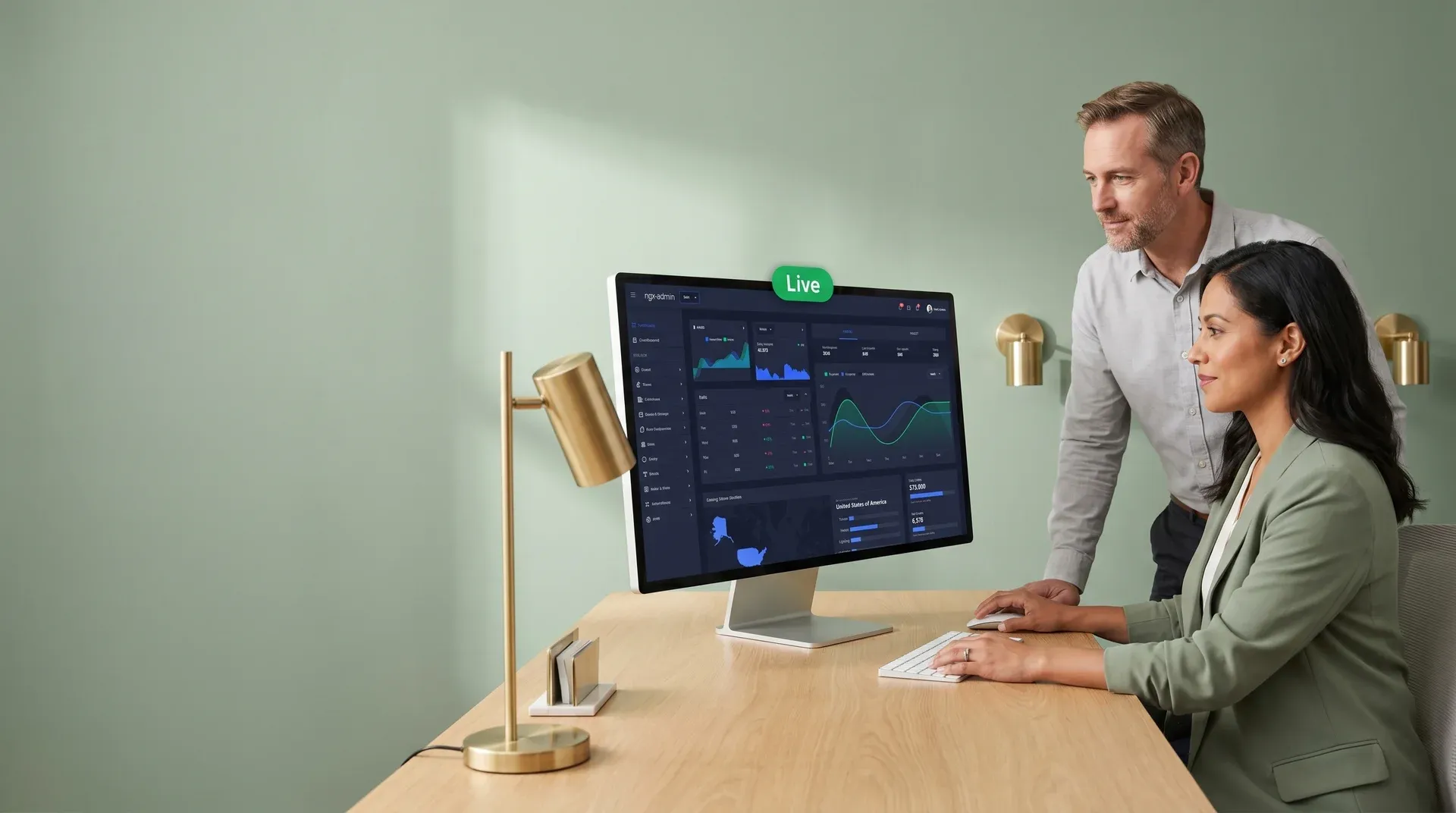
This is what a production Angular app looks like when we build it. Click any component in the tree to inspect its change detection strategy and selector bindings. Run the build pipeline and watch ESLint, tests, performance budgets, and staging deploy execute in sequence. The performance panel shows real bundle size, FCP, and test coverage numbers, not targets.
Click any component. Run the pipeline. Every number you see is from a real production configuration.
Six practices we enforce. One codebase that doesn't fight you.
shared component library per project
Reusable Angular components with strict TypeScript typing, documented in Storybook, consumed across every feature module. Your designers and developers share the same source of truth. Built once — each team gets it the same way.
implemented with full DevTools integration
Predictable state with actions, reducers, effects, and selectors across every feature module. No ad-hoc service spaghetti. Every state change is traceable, debuggable, and visible to every developer on the team.
FCP under 1.5s on every production build, gated in CI
OnPush by default, lazy-loaded routes, deferred modules, and Core Web Vitals monitored from sprint 1. Performance budgets fail the pipeline before a slow page ships. Your users see fast pages. Your SEO scores hold.
12+ enterprise API patterns documented per engagement
Angular HTTP client configured with interceptors for auth, retry logic, error boundaries, and real-time WebSocket sync. SAP, Salesforce, REST, and GraphQL supported out of the box.
test coverage gated on every module
Unit tests in Jasmine/Karma, end-to-end in Playwright, and visual regression in Chromatic. Every pull request blocked below 90%. Not just a number you report.
AngularJS to modern Angular in one engagement
Upgrade roadmap, incremental migration strategy with feature-flagged module replacement, and zero-downtime deployment. You stay open for business throughout.
Need a different frontend stack? We build on:
Five disconnected systems. One platform. Real-time, live.
previously isolated systems unified into one real-time data architecture
Business-to-Business Promotional Products Platform
Operational bottleneck: manual approval workflows, unreliable live inventory, zero system cohesion.
Complete platform rebuild · headless architecture
- Enterprise resource planning and Salesforce integration delivering real-time sync
- Scalable growth without future replatforming
- Marketing and system enhancements can be added without architecture changes
Skipped by most Angular agencies. Enforced on every project here.
The gap is not about Angular knowledge. It is about discipline. These are the decisions that separate a codebase that scales from one that needs a rewrite in 18 months.
The questions you should ask any Angular development firm before you sign.
Angular projects fail for the same reasons. Here are the answers that separate a vendor who can handle your complexity from one who can't.
Scoped before work starts. Line-by-line pricing. No commitment to receive a proposal.
An Angular discovery sprint produces a fixed-price scope document. You see every line item before signing anything.
Enterprise admin dashboards, B2B portals, real-time data applications, SaaS product frontends, and internal tooling. The right signal is complexity: role-based access, data-heavy views, shared state, and teams that need to scale past 10 concurrent developers. That is where Angular earns its cost and Redefine earns its role. See our Technology Stack for the full picture.
An architecture sprint takes 2 weeks. A full-featured enterprise Angular application runs 12 to 24 weeks depending on module count, integration surface, and whether we are building from scratch or extending an existing codebase. You get a week-by-week delivery plan before sprint 1 begins.
Both. For existing codebases, we start with a code audit that maps architecture debt, change detection issues, state inconsistencies, and upgrade blockers. That audit becomes the sprint backlog. You see the full picture before we touch a line of code. Request an Angular code audit to start.
Greenfield projects start on the latest stable Angular version. For existing codebases, we assess the current version, map the incremental upgrade path, and execute migration within the engagement scope. We do not recommend AngularJS (v1) for new development — if you are on v1 and need to migrate, that is its own engagement. See the migration section above.
OnPush change detection is enforced on every component from sprint 1. Performance budgets are set in the Angular build configuration and fail the continuous integration pipeline when breached. We run Lighthouse profiles on every pull request merge. Core Web Vitals targets are agreed before build starts, not measured after launch.
You own everything. Code is committed to your repository throughout the engagement. Storybook is deployed to your infrastructure. Architecture decision records are maintained in your project wiki. At handoff, your team receives the codebase with full documentation, no lock-in, and no dependency on Redefine to operate it.
Select what describes your project. We will be direct about fit.
These are the situations where Angular architecture makes sense and where we do our best work. The last two are disqualifiers. We include them because your time matters.
Not sure where you land? Tell us your situation. We will give you a straight answer before you spend time on a proposal.
Building an enterprise SPA with complex state
Role-based dashboards, real-time data feeds, multi-module applications with shared state across teams.
Existing Angular codebase that needs a senior architect
Performance degradation, state inconsistencies, or team capacity gaps on a live production application.
Modernizing from AngularJS to Angular 17+
Incremental migration, no full rewrite, zero downtime during the transition.
Building a product that needs a shared Angular component library
Multiple teams consuming the same components across feature modules without rebuilding them per sprint.
We are probably not the right match if:
You need a basic marketing site or static landing page
Angular is the wrong tool for that. We will tell you so and suggest a better path.
Your total Angular budget is under $15,000
Enterprise-grade Angular architecture and testing takes real engineering time. We cannot compress it without compromising the outcome.
Describe your project. Get a scoped plan in 3 business days.
No commitment. No pitch. We review your brief and send line-by-line pricing within 3 business days. Every line item is justified before you sign a thing.
Submit your brief
3 minutes. Tell us the problem, not the solution.
Technical call within 48 hours
With an Angular architect, not a sales representative.
Scoped proposal in 3 days
Architecture plan, sprint schedule, line-item pricing.
Sprint 1 begins within 1 week of sign-off
Architecture sprint. You see the component map before line 1 of production code.
Call within 48 hours · proposal in 3 days · Sprint 1 within 1 week of sign-off