Google Cloud infrastructure
your engineering team can
own and run.
Redefine builds on BigQuery, Cloud Run, Firestore, GKE, and Pub/Sub. Every resource is Terraform. Every architecture decision is documented. Your team inherits infrastructure it can extend and debug without calling us.

Infrastructure that works after we leave
Every architecture decision is in writing. A new engineer on your team can read the runbook, deploy a change, and not call us. That is the point.
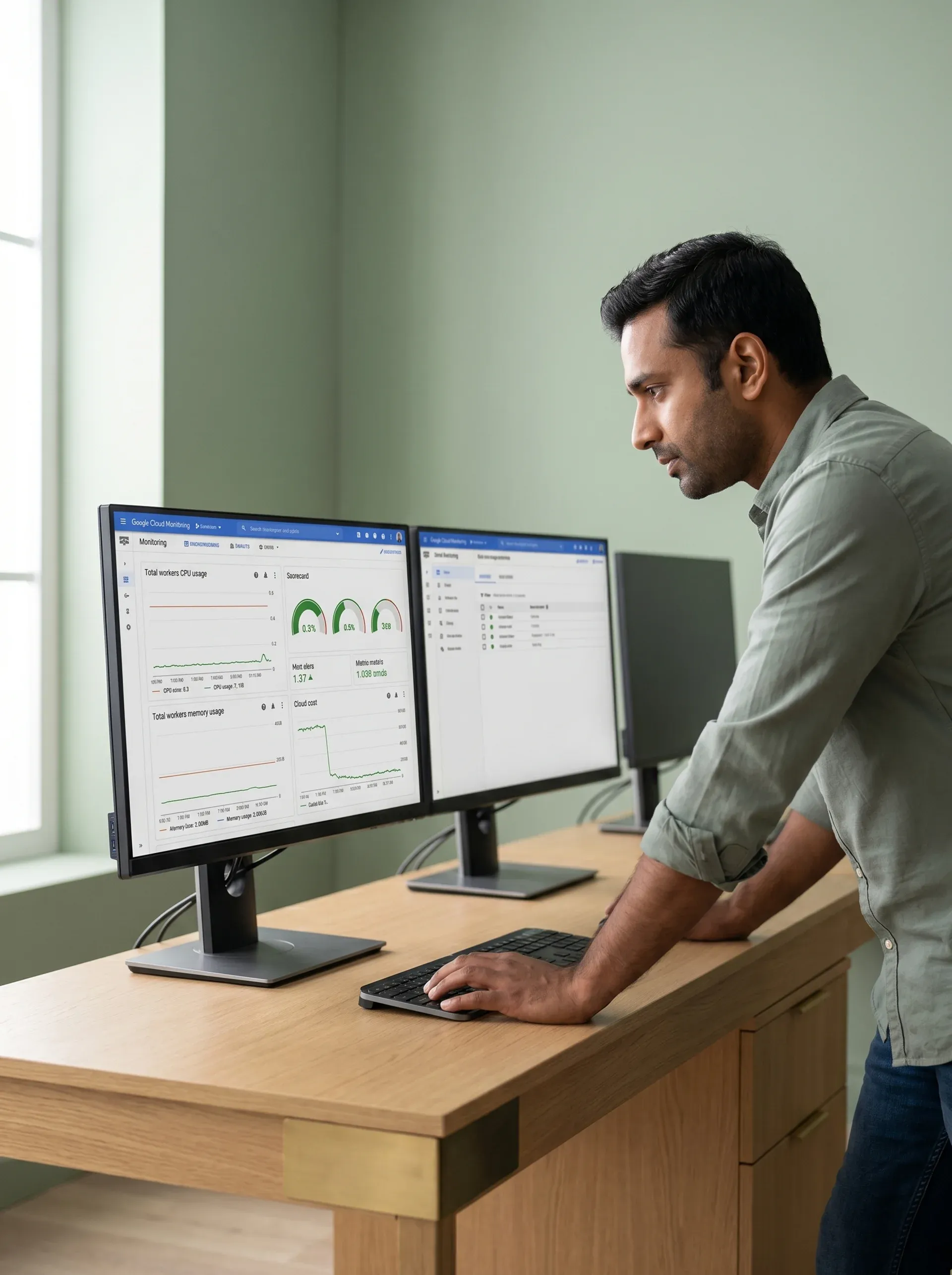
Most GCP bills carry 30% in waste. We find it before we touch your infrastructure.
Ungoverned resources, over-provisioned databases, dev environments running all weekend, and no cost allocation by team. The bill climbs. The business value does not. These are the four waste categories we see in every google cloud development audit.
40% of VM spend goes to instances below 10% CPU. That compute serves no workload.
Persistent disks survive server deletion. No job runs on them. The bill does not stop.
Non-production environments that mirror production capacity every hour of the weekend.
Cross-region data transfer costs that vanish with Cloud CDN and proper routing rules.
Redefine reviews your GCP billing export in the first deliverable of every engagement. You see the exact waste before we write a single line of Terraform.
Five GCP services. One team that engineers all of them.
BigQuery: from raw data to revenue decisions
We design your data model, build ETL and ELT pipelines, configure partitioned and clustered tables, and set up cost-optimized slot reservations. BigQuery ML runs your models inside the warehouse. Looker Studio and dbt sit on top. Your analysts run queries. Your finance team reads dashboards. Your data warehouse costs less than your current setup.
order_date, product_id,
SUM(revenue) AS total_revenue,
COUNT(DISTINCT customer_id) AS unique_buyers
FROM `redefine-prod.analytics.orders`
WHERE order_date >= DATE_SUB(CURRENT_DATE(), INTERVAL 90 DAY)
GROUP BY 1, 2
ORDER BY total_revenue DESC
Cloud Run: containers that cost nothing when idle
Stateless microservices that scale to zero between requests and spin up in milliseconds. We handle cold-start optimization, traffic splitting for blue-green releases, and VPC peering for internal service communication. You pay only for what runs. A service that gets zero traffic at 3am charges you nothing.
Firestore: real-time NoSQL with zero-downtime migration
Document schema design, composite index strategy, and Firestore rules security model built for your access patterns. We migrate from MongoDB or Datastore using change data capture pipelines via Dataflow. Production stays live. Users see nothing during the cutover. Your data arrives in Firestore without a maintenance window.
"id": "8821fa",
"email": "[email protected]",
"plan": "enterprise",
"mrr": 4800,
"created": Timestamp(2024-03-12)
GKE: Kubernetes built right the first time
We design your cluster for Autopilot or Standard mode based on your workload and your team's Kubernetes experience. Helm chart management, Horizontal Pod Autoscaler, Workload Identity, and node pool cost tuning are Sprint 1 outputs. Continuous delivery runs through Cloud Deploy. Your cluster ships production-ready, not production-approximate.
Pub/Sub: event pipelines that never lose a message
Topic and subscription design with exactly-once delivery. No duplicate order events. No silent failures. Dead-letter queue configuration catches what fails and holds it for retry. Dataflow integrates for streaming analytics. Eventarc triggers Cloud Run services on events. Your system processes events at any volume without manual intervention.
Six engineering capabilities. One team that owns all of them for Google Cloud development.
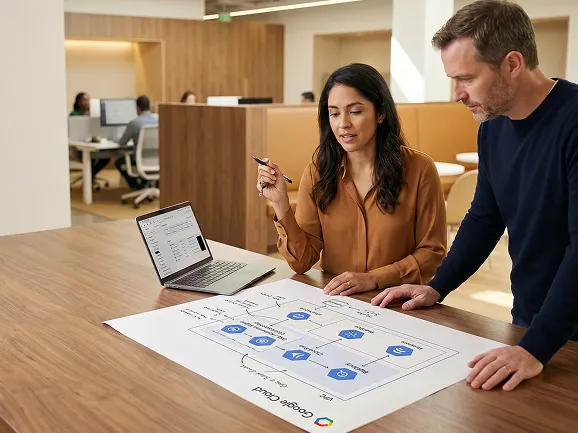
Architecture first
Every GCP engagement starts with an architecture document. Not a Jira backlog. Not a kickoff call. A written document with diagrams, data flows, and a cost model that you approve before we touch your infrastructure.
Zero downtime. A live OTT platform. Two NoSQL databases migrated to Firestore.

OTT Media Streaming Platform
Enterprise Streaming Infrastructure
A live OTT streaming platform requiring migration of complex NoSQL data across multiple systems, where any downtime would directly interrupt active users and revenue.
Data was distributed across MongoDB and Amazon DocumentDB with complex schemas and high write volumes. Traditional migration approaches required maintenance windows. Zero downtime was a hard requirement from the business, not a preference.
Live streaming infrastructure. High write volumes. Complex multi-system NoSQL schemas. Any downtime directly impacts paying subscribers.
downtime. Change data capture pipelines via Google Dataflow continuously replicated writes from MongoDB and DocumentDB into Firestore. The application read from the old databases during migration. Traffic switched at the load-balancer layer once Firestore lag dropped under one second. The old databases stayed live as rollback targets for 72 hours. Subscribers streamed without interruption.
Cutover happened at the application layer. The data layer never went offline.
The platform now has a single source of truth in Firestore, ready to scale with subscriber growth.
What makes a Google Cloud specialist different from an agency that also does GCP.
Real questions from engineering teams before they start a GCP project.
Service selection, migration risk, and cost governance are usually the blockers. Here are direct answers with no sales framing.
Architecture sprint first. Nothing is built until you approve the plan.
The sprint produces an architecture document, GCP cost model, service selection rationale, and migration plan. You review and approve before Sprint 2 starts.
Cloud Run is the right choice for stateless HTTP services with spiky or unpredictable traffic, and for teams that should not be managing Kubernetes day-to-day. GKE fits stateful workloads like message queues and databases, services that need sidecar containers, and teams with existing Kubernetes experience who need fine-grained scheduling control. We document this decision in the architecture sprint with written rationale. If your team disagrees with the selection, we revise before any code is written.
Change data capture pipelines via Google Dataflow continuously replicate writes from MongoDB to Firestore. The application reads from MongoDB while this runs. When Firestore lag drops below one second, we switch read and write targets at the load-balancer layer. MongoDB stays live as a rollback source for 72 hours. No maintenance window. No user-visible interruption. This is the same method used in the OTT streaming case study on this page.
We configure budget alerts per project and per service with escalation to Slack and email, all set up before the project ends. Committed use discounts are applied to any workload running continuously. Dev and staging environments use scheduled shutdown scripts to scale to zero outside business hours. The Terraform codebase includes cost allocation tags per team or feature. A cost runbook documents the monthly review your team runs after the engagement closes.
Terraform exclusively, using the official Google Cloud provider. Google Cloud Deployment Manager is GCP-proprietary and creates a lock-in that limits your future options. Terraform is multi-cloud compatible, actively maintained by the community, and your team can reuse the same tooling if you expand to AWS or Azure. We isolate GCP-specific resources into dedicated modules. Terraform state is stored in Google Cloud Storage with bucket locking enabled to prevent conflicts.
GCP's sustained use discounts apply automatically (up to 30% off on-demand for Compute Engine) without requiring upfront commitment. BigQuery's per-query pricing is lower than Redshift for sporadic analytics workloads. Cloud Run's scale-to-zero pricing eliminates idle compute costs entirely. Egress pricing on GCP is generally competitive. We do not advise choosing GCP on cost alone for steady-state compute-heavy workloads where AWS Reserved Instances with longer commitments win. The architecture sprint includes a cost comparison for your specific workload profile.
Is Redefine the right Google Cloud development team for your situation?
We are direct about fit. Engineering teams with basic GCP setups often benefit more from Google's own documentation than from a custom engagement. If your situation is below, we should talk.
Not sure? Describe your GCP situation and we will be direct about the right approach for your team.
Your GCP bill climbs every month but your traffic and feature count do not
Ungoverned resource provisioning, idle compute, and no cost allocation by team are the usual causes. We find the waste in the billing export before writing any code.
You need to migrate a live production system to GCP without a maintenance window
Change data capture pipelines and parallel-run architecture require dedicated GCP engineering experience.
Your GCP infrastructure was built with click-ops and has no Terraform or infrastructure as code
Reconstructing state into Terraform without disrupting production is a specialist task.
You need high availability with defined RTO and RPO targets for a regulated environment
Multi-region GCP setup with automated failover and tested recovery processes for SOC 2, HIPAA, or PCI DSS compliance requirements.
Probably not the right match if:
You need a basic GCP project setup and a single Cloud Run service deployed
Google Cloud documentation and a junior GCP engineer handle this in an afternoon.
Total project budget under $10,000
An architecture sprint, Terraform build, and full documentation is a minimum 3-to-4 week engagement. That has a real cost. We are not the right fit for sub-$10K scopes.
Get a written GCP architecture proposal. Describe your challenge first.
No commitment. No sales call. You get a written architecture approach, service selection rationale, and GCP cost model in 3 business days.
Submit your brief
Describe the GCP services involved, your current state, and the goal. Add a billing screenshot if you have one. That screenshot speeds up the cost review.
Architecture call within 48 hours
A GCP-certified engineer calls within 48 hours. We ask about your infrastructure, IAM setup, data volumes, and migration constraints. No generic discovery script.
Written architecture proposal in 3 days
Service selection with written rationale, architecture diagram, cost model by service, migration approach, and sprint plan. In writing.
Sprint 1 within one week of sign-off
Architecture sprint: Terraform structure, IAM design, VPC topology, and cost model. Every resource approved before anything is provisioned.