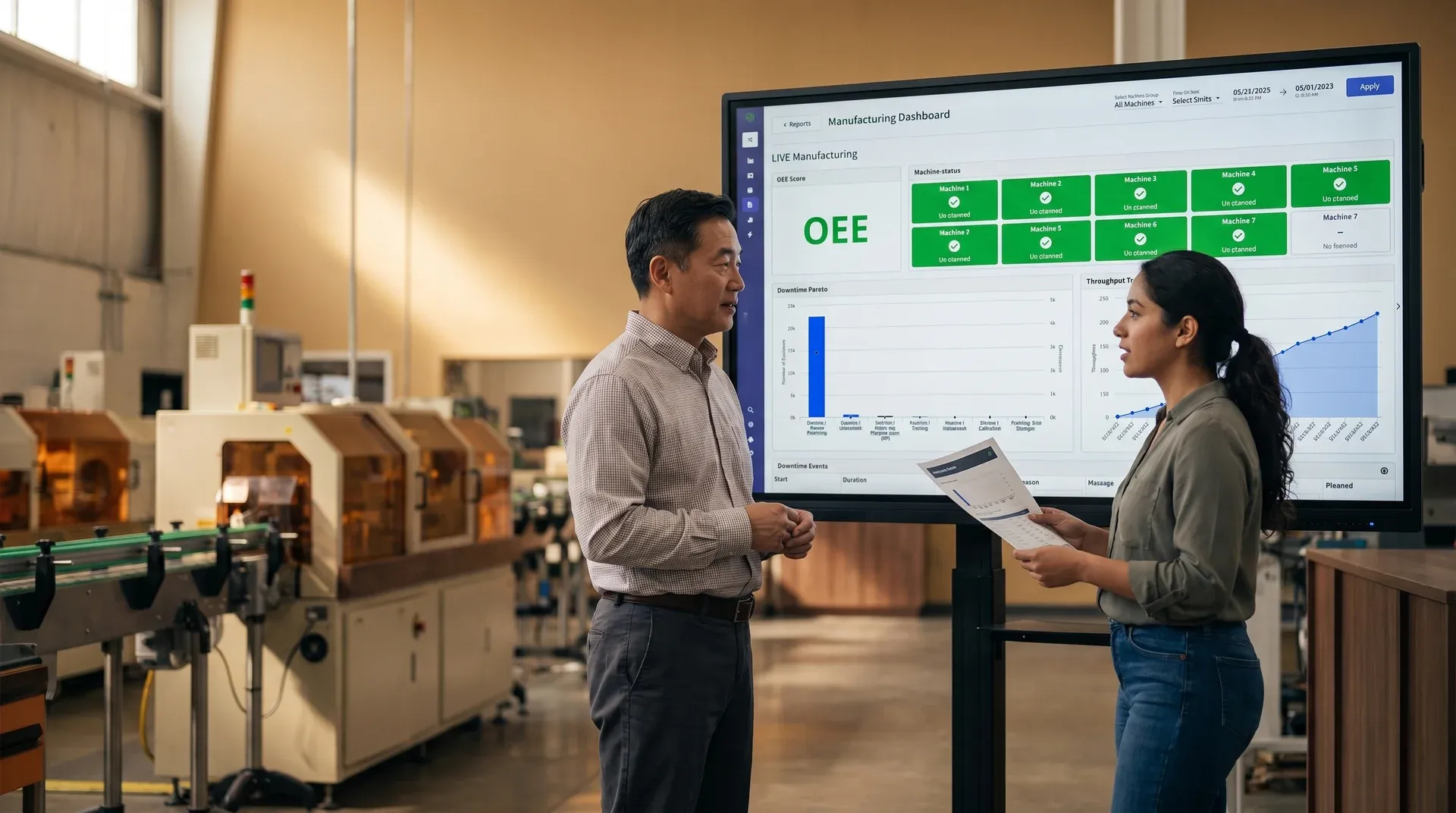
Manufacturing software development company
Custom Manufacturing SystemsManufacturing software
that connects your ERP,
shop floor, and data.
We build ERP integrations, MES platforms, IoT data pipelines, and OEE dashboards that replace the Excel tracking your shop floor still runs on. SAP, Oracle, Dynamics 365, and custom MES from Sprint 1.
Live production dashboard • Plant floor
OEE Score
0%
Units / Hour
0
Lines Active
0/0
Defect Rate
0%
Shift Output
0
The Manufacturing Data Problem
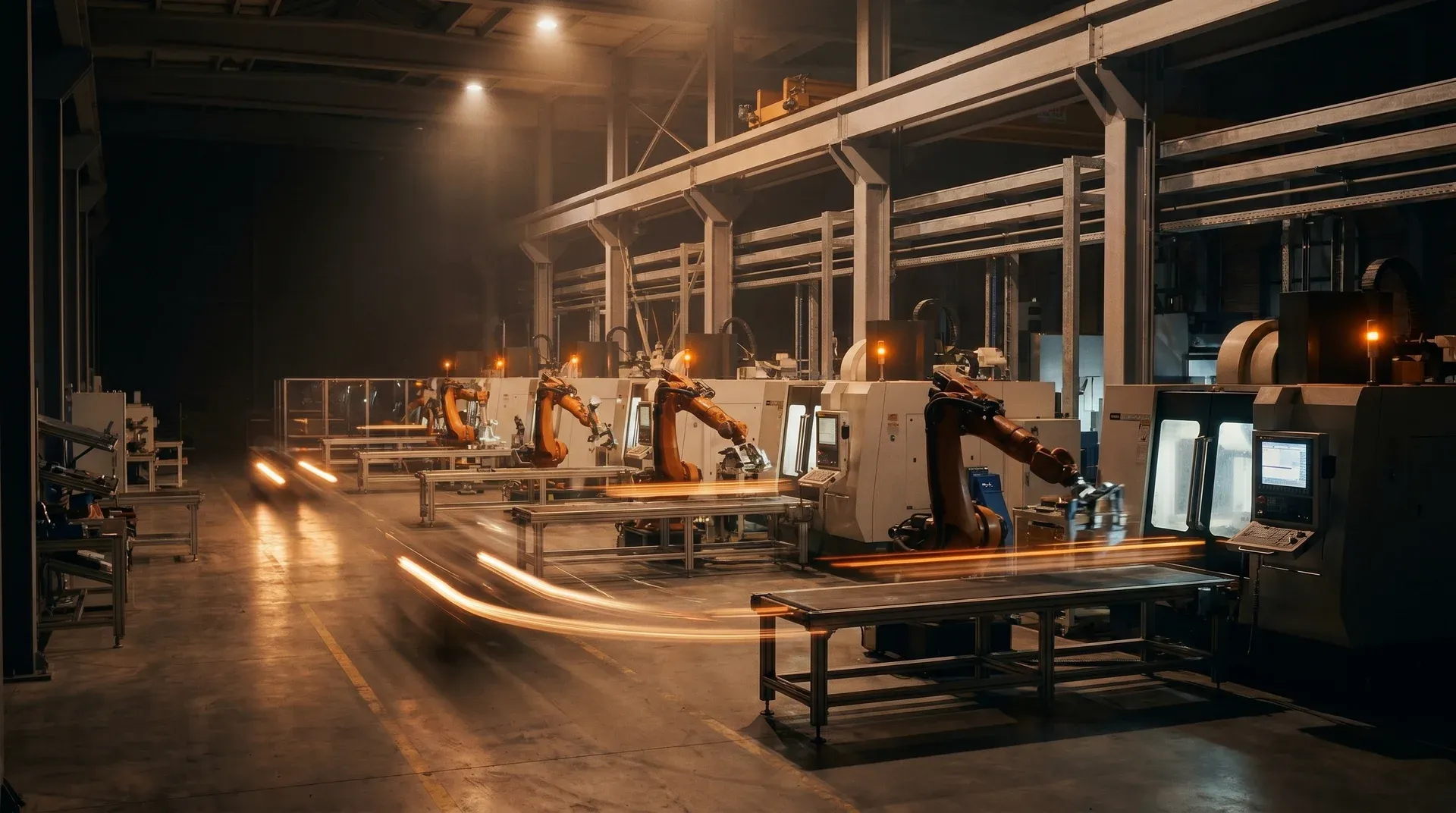
Most manufacturers run their shop floor on Excel. Their ERP does not know what their machines are doing.
What most manufacturers live with
- Production data in spreadsheets that are 24 hours out of date
- ERP that shows inventory quantities without showing why they are wrong
- Machine downtime discovered hours after it starts
- Production orders that do not sync with actual shop floor status
Old way
Machine downtime recorded on paper by the operator, typed into
Excel at end of shift
New way
Machine sends OPC-UA stop event in real time. Dashboard alerts
the supervisor in 90 seconds.
Old way
Inventory reconciliation takes 3 days each month. Results are
still inaccurate.
New way
ERP captures raw material consumption at the batch level in
real time. Inventory is always accurate.
Old way
Production manager guesses capacity. Sales promises delivery
dates that the shop floor cannot meet.
New way
MES feeds live capacity and work-in-progress data into the
ERP. Sales quotes delivery dates from actual production data.
Manufacturing Operations Center
This is what your factory floor looks like when every system is connected.
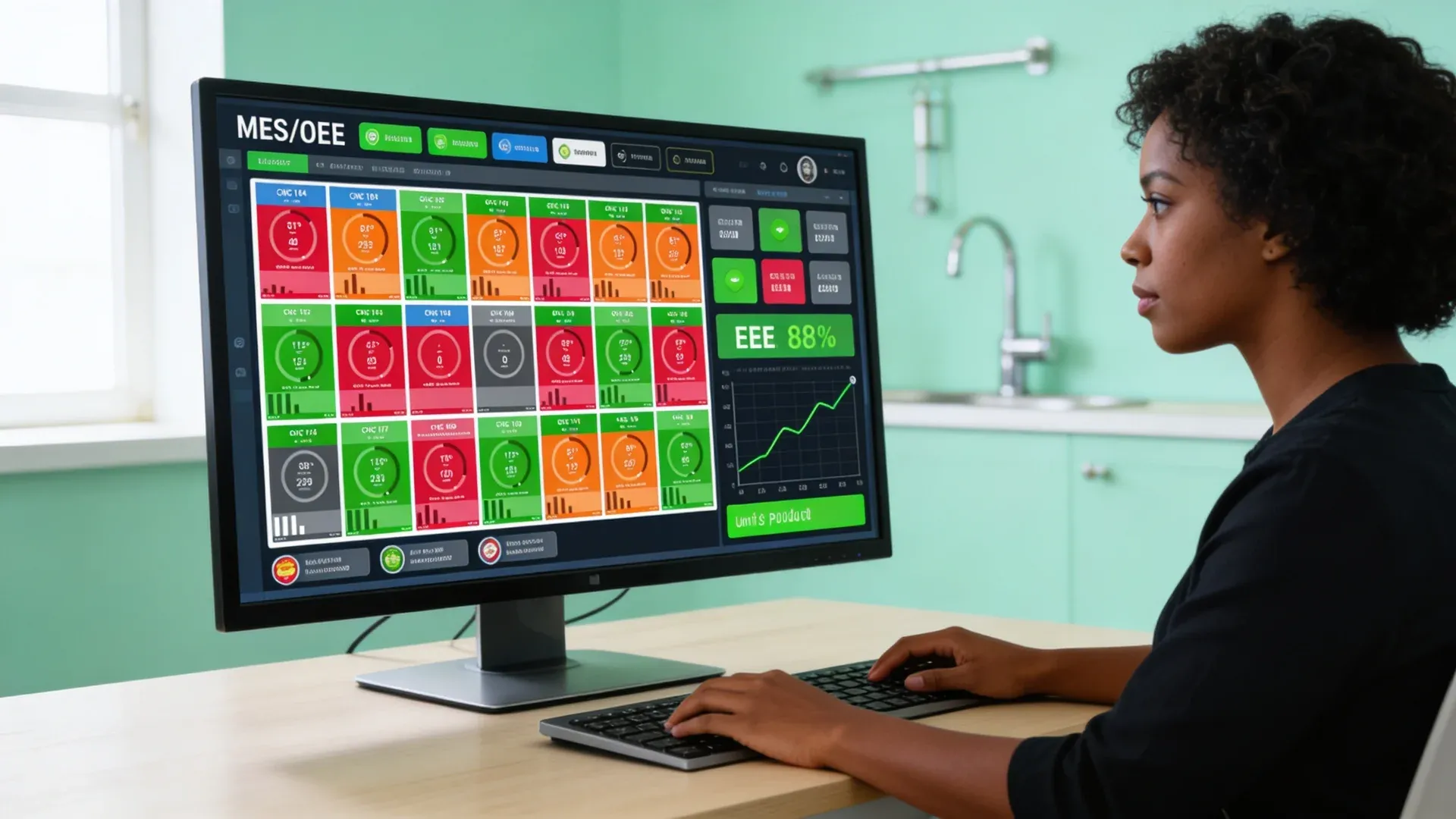
Real-time OEE, machine health, production throughput, and inventory delta, all from a unified platform that talks to your ERP, machine sensors, and shop floor operators simultaneously. All metrics are live examples of what we build.
Plant OEE
0%
Units Produced
0
Defect Rate
0.0%
ERP Sync
Live
Production Line Status
RUNNING
Line A-01
847 units/hr
RUNNING
Line A-02
912 units/hr
MAINT
Line B-01
Scheduled PM
RUNNING
Line B-02
766 units/hr
RUNNING
Line C-01
1,024 units/hr
STOPPED
Line C-02
Jam detected
RUNNING
Line D-01
889 units/hr
RUNNING
Line D-02
943 units/hr
OEE Breakdown
Availability0%
Performance0%
Quality0%
Live Alerts
02:14 agoLine C-02: jam detected • operator notified
18:45 agoLine B-01: PM scheduled • window confirmed
31:02 agoShift A handover complete • 7,842 units
ERP Sync • SAP S/4HANA
Production Orderssynced 8s ago
Inventory Movementssynced 12s ago
BOM Confirmationsqueued (3)
Quality Recordssynced 4s ago
Manufacturing Software Capabilities
Four systems. One connected manufacturing platform.

We connect custom manufacturing software to your existing ERP before writing a single custom data object. SAP via BAPI calls and OData endpoints. Oracle via REST APIs and database connectors. Dynamics 365 via Power Automate and direct API. The ERP data model is mapped in discovery so the integration does not fight the existing system.
SAP S/4HANAOracle CloudDynamics NAV/365
API development
services →
POST /sap/bapi/BAPI_GOODSMVT_CREATE
Authorization: Bearer sap-oauth-token
Content-Type: application/json
200 OK • GoodsMovement created • synced to MES
3 BOM confirmations queued • retry in 30s
OPC-UA for direct machine connectivity where the equipment supports it. MQTT for lightweight sensor telemetry at scale. Time-series databases (InfluxDB, TimescaleDB) for storing and querying high-frequency production events. Data architecture is sized for your actual machine count and sensor frequency before any infrastructure is provisioned.
OPC-UA ServerMQTT BrokerInfluxDB / TimescaleDB
ns=2;s=Line_A01.SpeedActual847 units/hr
ns=2;s=Line_A01.TempActual78.4C
ns=2;s=Line_A01.StatusRUNNING
50ms polling interval • writing to InfluxDB • 2.4k
events/min
A custom MES connects your production orders from the ERP to the actual work happening on the shop floor. Operator touchscreen interfaces for production start, stop, and quality recording. Real-time work-in-progress tracking, BOM consumption at the unit level, and automatic reporting back to the ERP after each production run.
.NET • PythonTouchscreen operator interfacePostgreSQL • Redis
Active Work Order
WO-24-8472 • Part A12B
Target: 500 units • Produced: 347 • 69.4%
CONFIRM UNIT
LOG DEFECT
OEE is the product of Availability, Performance, and Quality. Measuring it requires capturing machine stop events, actual versus target cycle times, and reject counts. We build OEE dashboards that pull these values from machine sensors or operator inputs and calculate OEE per line, per shift, and per plant. Shift handover reports, downtime Pareto analysis, and trend views included.
Real-time OEEShift reportsDowntime Pareto
94.2%
Availability
91.8%
Performance
98.6%
Quality
85.3% OEE
World class benchmark: 85%+
Client Result
Phoenix Flexibles: Excel and manual tracking replaced with integrated ERP across finance, inventory, and production.
Manufacturing • Packaging
Phoenix Flexibles
Environmentally friendly flexible packaging manufacturer.
Rapid growth from 2010. Excel-based operations across finance,
inventory, and production.
ERP IntegrationDynamics NAVEXIM

The problem
Phoenix Flexibles relied heavily on manual data entry using Excel for finance, inventory, and production tracking. The lack of system integration caused inefficiencies, data inaccuracies, and limited visibility into resource utilization. These issues affected production planning, inventory control, and decision-making, while also complicating export documentation and compliance with international trade requirements.
- Excel-based finance, inventory, and production data with no integration
- Inaccurate inventory caused production planning failures
- Export documentation handled manually, compliance risk on international trade
What we delivered
Microsoft Dynamics NAV was implemented as a centralized ERP to unify finance and inventory management. The ERP was integrated with production to capture raw material consumption at unit and batch level. An EXIM module was installed for export-import documentation and statutory compliance. Sales and quotation workflows were automated to reduce manual error and improve response time to customers.
Result
0%
reduction in manual data entry across finance, inventory, and
production after ERP go-live
Why Manufacturing Buyers Choose Redefine
Three things we do that most software companies cannot do in a factory.
ERP-first architecture
01
We map your ERP data model before writing a single custom object
Most developers learn your ERP mid-project. We scope the
BAPI calls, OData endpoints, and data contracts in Week 1.
This prevents the most common manufacturing integration
failure: a custom system that was built against the wrong
ERP data model and requires months of rework.
Shop floor literacy
02
OEE, BOM, work-in-progress, and OPC-UA are not concepts we look
up. They are our starting vocabulary.
We build the discovery phase around manufacturing domain
questions, not software questions. Bill of materials,
production routing, shift patterns, and quality tolerance
specifications are documented before Sprint 1.
Generic developers spend your time learning the
manufacturing domain. You pay for their education.
IoT patterns we have built before
03
High-frequency time-series data from machines is not a general
programming problem
OPC-UA subscriptions, MQTT topic hierarchies, time-series
database schema design, and backpressure handling for
dropped packets are challenges we have already solved.
We scope your sensor frequency, retention requirements, and
alert latency targets in discovery. The architecture is
defined before writing any code.
Common Questions
What plant managers and engineering leads ask before an engagement.
We build ERP integration layers, Manufacturing Execution Systems, IoT sensor data pipelines, OEE dashboards, warehouse management systems, and production planning applications. We connect custom software to SAP, Oracle, Dynamics 365, and other ERP systems your shop floor already uses. See the live dashboard above for an example of what the connected platform looks like.
Yes. We integrate with SAP via BAPI calls and OData services, Oracle via REST APIs and database connectors, and Microsoft Dynamics 365 via Power Automate and direct API. We map the ERP data model in discovery before writing any custom objects so the integration does not fight the existing system structure.
We use OPC-UA for machine connectivity where the equipment supports it, MQTT for lightweight sensor telemetry, and time-series databases like InfluxDB or TimescaleDB for storing and querying high-frequency production data. The data architecture depends on your machine count, sensor frequency, and whether you need real-time alerting or batch analytics.
OEE is Overall Equipment Effectiveness: Availability times Performance times Quality. In software, this requires capturing machine runtime and downtime events (Availability), actual versus target cycle time per unit (Performance), and defect and reject counts (Quality). We build OEE dashboards that calculate these values per line, per shift, and per plant from machine sensor data or operator inputs.
A standard ERP integration connecting a custom MES or analytics application to SAP or Oracle typically takes 12 to 16 weeks. Timeline depends on the number of integration endpoints, data volume, whether the ERP is on-premises or cloud, and the complexity of domain-specific data transformations. We scope before we quote.
Book A Manufacturing Architecture Call
Tell us about your manufacturing software project.
We respond within two business days. No commitment. No pitch.
Form
Submit brief → call within 48 hours → ERP-scoped proposal in 3 days → Sprint 1 starts within 1 week of sign-off
48 hours
Response time
3 days
Scoped proposal
OPC-UA
MQTT and IoT
You own the code
Full handoff