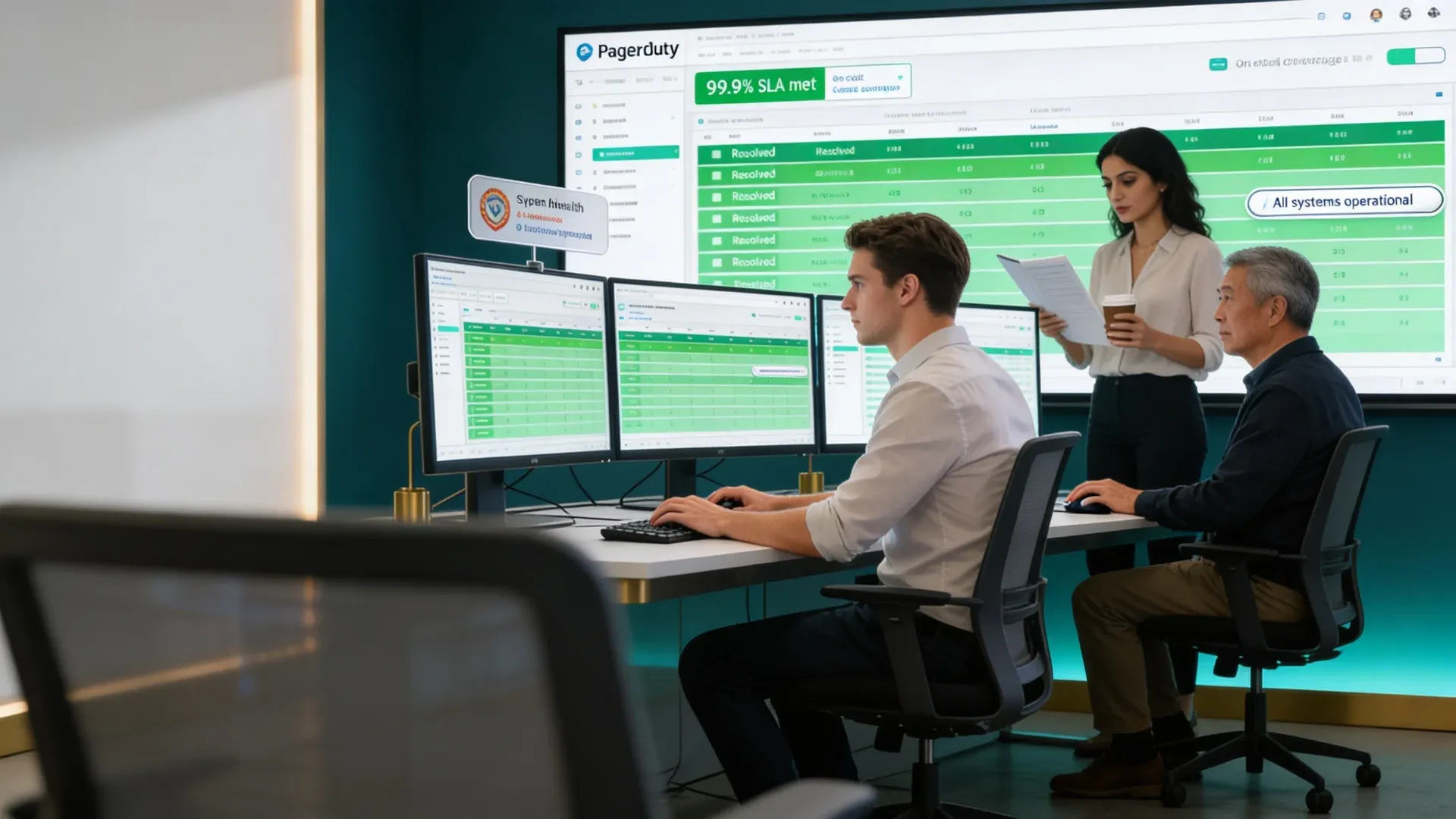
Response times in writing. Named engineers. Automatic credits when we miss.
Your contract names the exact response window. A named engineer knows your codebase before the first incident. When we miss the window, a credit hits your next invoice. You never have to ask.
Best-effort support makes you wait and wonder. SLA based support tells you exactly when it is fixed.
See what slow support is actually costing your business each month.
Move the sliders to match your situation. The calculator compares your current cost against what an SLA plan would have contained it to.
Your current setup
No hourly billing. No surprise charges. One fixed monthly rate.
Three tiers. One fixed monthly rate. Everything agreed in writing before day one.

Best for stable internal apps with low incident frequency. Every bug and support ticket gets a contractual response window. Business hours only.
Built for revenue-generating apps. When your platform goes down at 6 p.m., a named engineer responds within 4 hours. 24-hour resolution, 16 hours a day.
For apps where every hour of downtime costs money. Engineers on call 24/7. Response in 60 minutes. Resolution in 4 hours. No exceptions.
Four-platform e-commerce stack. Zero SLA breaches. 99.9% uptime across the engagement.
An e-commerce business ran across Shopify, Amazon Marketplace, Facebook Commerce, and Klaviyo. Integration incidents meant hours of manual diagnosis. No engineer was assigned. No resolution time was committed. Every outage cost revenue, and nobody could say how much or when it would end.
We took over support for the full integration stack under a Priority SLA. Every incident received a response within the contracted window. Order management automation cut the manual workload. All four platforms synchronized securely. Zero SLA breaches, from day one through the full term.

Three commitments that separate SLA based support from a standard retainer.
Most support retainers have SLA language. Few have financial consequences for missing it.
When the SLA log records a missed window, a credit applies to your next invoice. No dispute. No request form. No back-and-forth. The log triggers it.
A 1-hour SLA means nothing if the engineer spends 45 minutes reading your README.
Before the SLA activates, the assigned engineer reviews your architecture, integration map, and known risk areas. When an incident arrives, they are already in context.
Most retainers tell you what was done. We show you every timestamp — report time, response time, resolution time, and whether the SLA held.
Standard clients receive a monthly log. Priority clients receive it weekly. Critical clients have daily access. Every number is yours to verify.
What buyers ask before they commit to an SLA plan.
Tell us what you are running and what breaks most often. We scope an SLA plan within 48 hours.
You see the plan and the fixed monthly rate before anything is agreed. Most buyers have an SLA scoped in 2 to 3 business days from first contact.
Brief submitted → SLA scoped in 48 hours → contract agreed 3 days before start → coverage on day one
We will scope your SLA plan and send you the proposed contractual windows and fixed monthly rate. If you have a question before then, reply directly to our confirmation email.