Adobe Commerce audit services
Find what is quietly bleeding your Adobe Commerce store before it costs you another quarter.
Ten business days. Day-by-day schedule. A senior engineer reads every module, profiles every slow query, and walks your team through a prioritized remediation plan. You see the service level agreement and the price before you sign anything.
240 plus audits delivered180 plus Adobe Commerce stores servedMedian time to first byte cut 62 percent post-audit
Submit your brief → call within 48 hours → scoped proposal in 3 days → audit kickoff within 1 week of sign-off
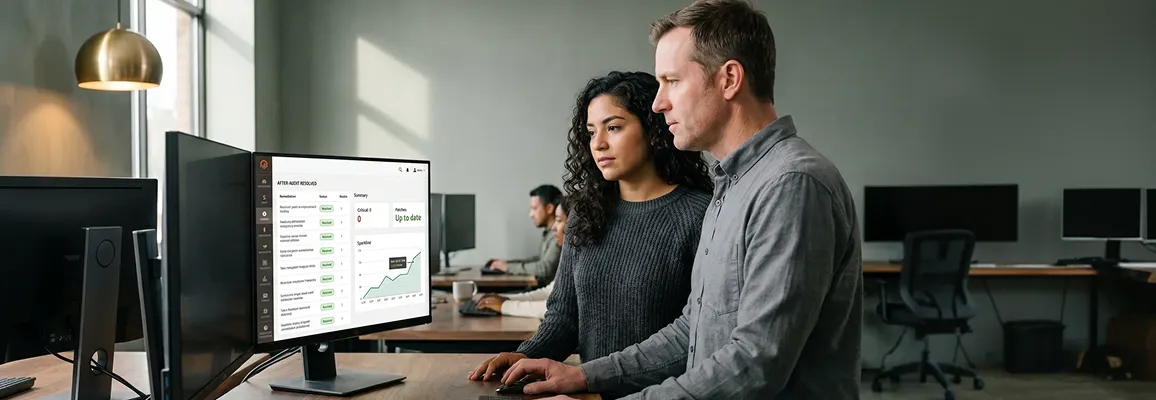
The cost of audit blind spots
Every quarter you keep guessing is a quarter the leak gets bigger.
Most Adobe Commerce stores do not need a redesign. They need someone senior to open the hood. The cart that abandons at step three, the catalog that crawls past 50,000 products, the third-party module quietly running a 14 second cron: these are the silent revenue leaks an audit surfaces in days, not quarters.
Today, without an audit
The pattern most teams know too well.
- A merchandiser ships a new collection, page speed drops 30 percent, nobody knows which module changed.
- Checkout fails on iOS Safari for two weeks before a customer complains on social media.
- A security patch sits unapplied for 90 days because nobody owns the staging environment.
- Your partner sends a 4-page slide deck. No prioritized list. No code citations. No remediation plan.
After a Redefine audit, day 10
What the same operation looks like.
- A scored issue queue of 47 findings ranked by revenue impact and engineering effort.
- Every finding cited to a file path, query, or module name. No vague advice.
- A live 90 minute walkthrough with your engineering lead and chief technology officer present.
- A scoped retainer roadmap so the next 90 days fix the top 12 issues, not the easy ones.
Three audit plans, service level agreement disclosed
up-front
Pick the depth. The response time, the deliverables, and the price are on the page.
Every plan is scoped before work starts. Every plan includes a senior engineer, a live walkthrough, and a remediation roadmap. The difference is depth, cadence, and how much code we open.
Diagnostic
from $4,800
5 business days. Single-engineer sprint.
- Lighthouse and Core Web Vitals baseline
- Top 12 findings ranked by revenue impact
- 60 minute walkthrough call
- Service level agreement: kickoff in 5 business days
Response within 1 business day
Book DiagnosticDeep · Most chosen
from $12,500
10 business days. Lead engineer plus database administrator plus security review.
- Module-by-module code review with citations
- Database and query profiling on production traffic
- Security and patch posture assessment
- Integration load review across all third parties
- 90 minute live walkthrough plus 90 day roadmap
Response within 4 hours, kickoff in 3 business days
Book Deep AuditContinuous
from $3,200/month
Quarterly audit plus monthly monitoring retainer.
- Quarterly Deep audit refresh
- Monthly regression and Lighthouse trendline
- Patch posture monitoring and alerts
- Service level agreement: 2 hour critical, 24 hour normal
Escalation to senior engineer in 2 hours
Book ContinuousWhat an Adobe Commerce site audit actually covers
Six layers. Every finding cited to a file, a query, or a request.
A Magento technical audit is not a Lighthouse score with screenshots. It is a senior engineer reading what your store actually does in production, from the request handshake to the database lock.
Code audit
Every custom module, every event observer, every plugin. We trace what gets called on every page load and what is silently slowing it down.
app/code reviewplugin conflict mapcron auditindexer health

Real code review, in your repository, with citations.
Performance audit
Time to first byte on the slowest 10 percent of requests. Page-level Lighthouse, real user metrics, and cache hit ratio.
Varnish and full page cacheImage and JavaScript payload auditHyva or Luma layer profile
Database audit
Slow query log analysis. Catalog and quote table health. Lock contention at peak hours.
EAV efficiency mapIndex strategy reviewRead replica posture
What we look for
Missing composite indexes on
catalog_product_index_price
and
sales_order_grid
that show up as full-table scans under load.
Quote table bloat: abandoned carts accumulating rows and slowing checkout queries. Flat-catalog flag status and whether it is helping or hurting your version.
Redis eviction policy mismatches that let sessions displace full-page cache keys at traffic peaks.
Security audit
Patch posture, admin hardening, third-party library common vulnerability exposures, Payment Card Industry scope check.
MageReport scan plus manual reviewComposer dependency common vulnerability exposure map
Integration audit
Every enterprise resource planning, product information management, order management system, tax, shipping, and analytics call. We map the data flow, the timeouts, and where retry loops are silently doubling load. Read the deeper Adobe Commerce integration audit when this layer is your top concern.
Enterprise resource planning sync window analysisWebhook reliability profileTax and shipping call timingFailure mode catalog
Frontend audit
Hyva or Luma layer review. JavaScript bundle weight, render-blocking assets, and Core Web Vitals bottlenecks traced to the component level.
JavaScript and CSS payload auditLargest Contentful Paint and Cumulative Layout Shift root
cause
What comes out of the audit
A prioritized remediation plan, not a spreadsheet of findings.
Every issue we surface is ranked by revenue impact, not severity score. You leave the 10-day engagement knowing exactly which three things to fix first and why.
Priority zero issue list
Blockers and critical risks your team can open as tickets the same day as the walkthrough.
90-day roadmap
Sprint-ready backlog with effort estimates, owners, and dependency order mapped out.
Baseline benchmarks
Time to first byte, Largest Contentful Paint, cache hit ratio, and error rate snapshots you can compare against after remediation.
Executive summary
A one-page brief translating technical debt into revenue and risk terms for your board or investors.
Onboarding process
From signed statement of work to a full Adobe Commerce site audit report in 10 business days.
Day zero is access. Day ten is your walkthrough. Every day in between has a named output you can verify.
Access checklist
GitHub repository (read-only)
GrantedStaging SSH (key auth)
GrantedSlow query log access
Pending ITNew Relic and Sentry read-only
GrantedBaseline Lighthouse and time to first byte scan
running on 12 representative URLs.
Module health (live)
Vendor_Catalog_Inventory
3 conflicts
Vendor_Shipping_Adapter
2 timeouts/min
Custom_Loyalty_Plugin
14s cron
Vendor_Tax_Calculator
healthy
Critical
7
High
12
Medium
23
Performance profile
Homepage time to first byte (p90)2.4s
Category page (p90)3.8s
Checkout step 25.1s
Slow queries (top 3)
SELECT * FROM quote_item WHERE ...
1.2s
EAV joins on catalog_product ...
0.8s
UPDATE inventory_stock ...
0.6s
Risk and integration map
Patch posture
2 patches behind
Common vulnerability exposures
4 high
Integration timing
Enterprise resource planning order pushavg 1.4s
Tax provider callavg 220ms
Shipping rate fetchtimeout 1.8 percent
Order management system webhookretries 12/hour
90 day remediation roadmap
Sprint 1, weeks 1 to 2
Cron, indexer, top 3 slow queries
Sprint 2, weeks 3 to 4
Patch posture and admin hardening
Sprint 3, weeks 5 to 8
Checkout time to first byte and enterprise
resource planning retry loop
Sprints 4 to 6, weeks 9 to 12
Hyva conversion, image pipeline, GA4 cleanup
Estimated revenue recovery+$92K per month
Tooling and monitoring stack
Real instruments, real production traffic, no guesswork.
The point of an Adobe Commerce audit is not to run one tool. It is to triangulate. We use the same observability stack the best in-house teams use, with the same access controls.
Audit observatory · live preview
refreshes every 30 seconds
Critical
0
High
0
Medium
0
Low
0
Lighthouse Performance0
Lighthouse Accessibility0
Cache hit ratio0
percent
Patch posture0 patches
behind
Live read from your staging telemetry. Production traces are
throttled to 1 percent sample.
Instruments we run
New Relic application performance monitoring
trace level
Blackfire profiler
PHP hotspots
Sentry
error rate
MageReport plus manual
patch and common vulnerability exposure
k6 load runner
checkout stress test
Lighthouse continuous integration
12 uniform resource locator panel
Proof from a recent audit-led optimization
A diagnostic, a 90 day remediation, and a measurable lift.

Direct-to-consumer ecommerceVoltourAudit plus optimization engagement
Voltour runs a direct-to-consumer storefront with a tightly merchandised catalog and a customer base that spans mobile-first and desktop checkout. The brand needed senior eyes on a slowing storefront before a peak season.
The problem
Page load times had crept upward across devices. Checkout friction was driving abandonment at step two. Design consistency had slipped across browsers, and the existing setup had no instrumented way to see which fix would pay back first.
The solution and the result
A scoped storefront audit identified the slowest 10 percent of requests, mapped checkout friction step by step, and ranked findings by revenue impact. Optimization sprints addressed page load, checkout flow, and cross-device consistency before peak.
Faster checkout
0
percent reduction in checkout step 2 load time
Conversion lift
0%
improvement in mobile checkout completion
Time to first fix
0d
first sprint shipped within 12 days of audit walkthrough

Director of Ecommerce, Voltour
Candid three-quarter portrait, soft natural light, no eye
contact. 200 × 200. Full attribution shared on request
post-engagement.
Why a Redefine audit ends differently
Most audit reports collect dust. Ours ships a sprint plan in week one.
The market norm in this category is a thick document and a closing call. The standard we hold is different on six observable lines. Compare the engagement before you sign one.
What you get
Typical implementation partner
Redefine
Service level agreement disclosed before contract
Day-by-day audit schedule shared with stakeholders
Read-only access, no agency-managed credentials
Module-by-module code review with file path citations
Live walkthrough with engineering, not a slide handoff
Database and query profiling on production traffic
90 day retainer roadmap included with deliverable
Cost published before discovery call
Related on Redefine
Adobe Commerce and Magento services hubAdobe Commerce support and maintenance servicesAdobe Commerce managed servicesAdobe Commerce emergency supportMagento performance optimization servicesMagento replatforming servicesAdobe Commerce development costAdobe Commerce integration auditSee Adobe Commerce audit pricing
Audit questions teams ask before signing
The honest answers, before you book.
Diagnostic plans run 5 business days. Deep audits run 10 business days. Continuous engagements deliver a quarterly Deep cycle plus monthly monitoring. Every plan starts within 1 week of sign-off.
Read-only access to your GitHub repository, staging environment, slow query log, and observability tools such as New Relic or Sentry. No production write access, no shared agency credentials, no surprises.
Yes. Production telemetry is read at 1 percent sample. Load and stress testing run only on staging environments, scheduled by your team. Nothing is mutated on production without explicit written approval.
Both paths are open. The audit deliverable is independent and works whether your in-house team remediates or you engage Redefine for the 90 day roadmap. The retainer path is offered, never required, and pricing is on the linked pricing page.
An audit is a planned diagnostic. Emergency support is a live incident response with a 2 hour service level agreement. If your store is currently down or losing transactions, route directly to Adobe Commerce emergency support instead.
Honest fit check
We turn down audits we cannot move the needle on.
Good fit
- Adobe Commerce 2.4 or higher, on Cloud, AWS, or self-hosted
- Annual gross merchandise value above $2 million or a peak event coming in the next 90 days
- In-house or contracted engineer who can act on findings within a sprint
- Chief technology officer or engineering lead empowered to grant read-only access in 48 hours
Not a fit
- Pre-launch stores with no live traffic to profile
- Magento 1 stores still in production, see replatforming instead
- Stakeholders looking for a slide deck to circulate, with no intent to fix
- Active incident or outage, see emergency support for a 2 hour service level agreement path
Not sure? Tell us your situation and we will be straight with you.
Start your audit
Submit your brief. See your scoped proposal in 3 days.
A senior engineer reads the brief before the call. No commitment. No pitch. Just a clear picture of what an audit on your store would surface and what it would cost.
Call within 48 hours
Proposal in 3 days
Kickoff in 1 week
You own the code
Call within 48 hours → proposal in 3 days → audit kickoff within 1 week of sign-off
No commitment. No pitch. A senior engineer will read your brief and reply with a scoped option.
Brief received.
A senior engineer will review your situation and reply with a scoped audit proposal within 3 business days. Watch your inbox.