Amazon agency for BigCommerce brands
Your BigCommerce catalog is ready for Amazon. We make the channel work
Amazon pay-per-click management, listing optimization, and account management built for brands that run BigCommerce as their primary channel. Your direct-to-consumer operations do not change. Your Amazon revenue does.
Submit your BigCommerce store → call within 48 hours → Amazon channel proposal in 3 days
0
Brands served
BigCommerce
Partner platform
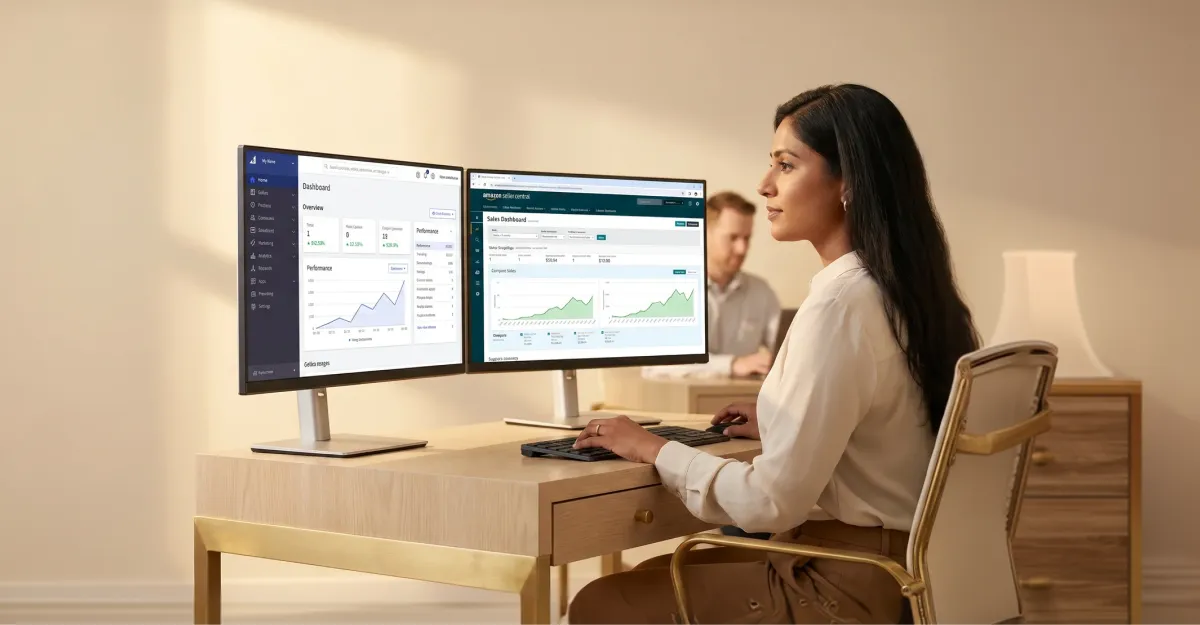
The BigCommerce to Amazon problem
BigCommerce brands that manage Amazon in-house spend more time on operations than on growth
See what changes when a BigCommerce brand stops managing Amazon manually and lets a dedicated Amazon agency handle the channel.
Your team handles Amazon manually
- Listing copy written by your BigCommerce team: the same team managing product pages, email, and pay-per-click on your direct-to-consumer site.
- Amazon pay-per-click campaigns set up at launch and rarely reviewed. Total advertising cost of sales creeps as search terms drift and negative keyword lists go stale.
- Pricing on Amazon is reactive. You notice it is wrong after a repricing bot has already undercut your BigCommerce price.
- Account health issues surface as Amazon suppression notices, not as early-warning signals from someone monitoring the dashboard daily.
Account health score147 (At Risk)
Order defect rate1.8% (above threshold)
Total advertising cost of sales (30 day)31% (target: 18%)
Listing suppressions4 active
Redefine manages Amazon for your BigCommerce brand
- Amazon listing copy is written by specialists who understand how Amazon's algorithm ranks copy differently from BigCommerce search engine optimization.
- Amazon pay-per-click campaigns are reviewed weekly. Negative keywords added from search term data, bids adjusted by placement performance.
- Amazon pricing is monitored against your BigCommerce floor. Your minimum advertised price policy is enforced before competitors drive a race to the bottom.
- Account health is monitored daily. Suppression risks are resolved before they become suppression notices.
Account health score297 (Excellent)
Order defect rate0.04%
Total advertising cost of sales (30 day)14% (target: 18%)
Listing suppressions0 active

BigCommerce and Amazon unified reporting
See your BigCommerce and Amazon channels in one live performance view
This is what your monthly performance review looks like when Redefine manages your Amazon channel alongside your BigCommerce store. All metrics updated in real time, all attribution separated by channel.
This month: combined revenue
$0
BigCommerce + Amazon · 30 days
BigCommerce
$0
Amazon
$0
Amazon pay-per-click performance
Total advertising cost of sales0%
Return on ad spend0x
Click-through rate0%
Account health
0
ExcellentActive suppressions0
Open policy alerts0
Daily monitoringActive
ASINProductSessionsConversion rateRevenue
B08XY4D001Outdoor Knife 4in1,28412.4%$8,420
B08XY4D002Camping Knife Set89211.1%$6,140
B08XY4D003EDC Folding Knife7438.2%$4,860
B08XY4D004Fixed Blade Hunter6219.8%$4,290
B08XY4D005Bushcraft Knife Pro5186.1%$3,180
What Redefine manages for BigCommerce brands
Five Amazon channel services built for brands that run BigCommerce
Your BigCommerce catalog structure, pricing discipline, and brand standards are the foundation. We build the Amazon channel on top of what already works.
Amazon catalog setup from your BigCommerce product data
We use your existing BigCommerce product catalog as the source of truth for Amazon listings. Stock keeping units, descriptions, and category assignments are mapped to Amazon's taxonomy, then enhanced with Amazon-specific keyword research before any listing goes live.
- Stock keeping unit-to-ASIN mapping and new ASIN creation
- Amazon-specific title, bullets, and backend keyword research
- Category and browse node optimization
Amazon pay-per-click management with total advertising cost of sales targets set against your BigCommerce margins
Your BigCommerce store's margin data informs your Amazon total advertising cost of sales target. We structure campaigns so that Amazon pay-per-click spend is always measured against the margin available in your product line, not against Amazon's industry averages.
- Sponsored Products, Sponsored Brands, and Sponsored Display campaigns
- Weekly search term review and negative keyword management
- Monthly total advertising cost of sales and return on ad spend reporting against agreed targets
Platform expertise
We know BigCommerce. We know what breaks when you add Amazon on top of it.
Inventory sync, pricing conflicts, order routing between fulfillment methods, and brand registry requirements all behave differently when you run BigCommerce alongside Amazon. We have managed this integration for dozens of brands and know where the friction points are before you hit them.
Inventory sync strategy between BigCommerce and Amazon FBA or Fulfilled by Merchant
Minimum advertised price enforcement across both channels without suppressing your own BigCommerce listings
Brand Registry setup if not already enrolled, unlocking A+ content and Brand Store features
Order routing recommendations to prevent cannibalization of your BigCommerce Prime-eligible inventory
Amazon search engine optimization and listing optimization
Amazon's A9 algorithm ranks product listings based on keyword relevance, conversion rate, and sales velocity. Your BigCommerce search engine optimization strategy does not transfer directly. Amazon requires its own keyword research, title structure, and backend field discipline.
- Amazon keyword research separate from your BigCommerce search engine optimization strategy
- A+ content and Brand Store design that reuses your BigCommerce brand assets
- Ongoing listing refresh as search term data reveals new keyword opportunities
Amazon account management and health monitoring
Your BigCommerce store runs on your servers. Your Amazon account runs on Amazon's rules, and Amazon can suspend your listing or account without warning. Daily monitoring, proactive policy compliance, and fast response to account health alerts keep your Amazon channel running.
- Daily account health score monitoring and alert response
- Listing suppression resolution before it impacts your Amazon revenue
- Policy compliance review before new products are listed on Amazon
BigCommerce to Amazon success story
BigCommerce brand reaches $3.8M on Amazon, alongside, not instead of, the direct-to-consumer store

Start
BigCommerce brand, no Amazon presence
Off Grid Knives ran a custom BigCommerce store with strong direct-to-consumer revenue and a disciplined search engine optimization strategy. Amazon had not been tried due to the complexity of selling regulated knife products in a marketplace with strict compliance requirements.
Phase 1
Catalog mapped, Amazon listings built with category-specific compliance
BigCommerce product data was used as the source for Amazon listing copy, with Amazon-specific keyword research layered on top. Category compliance for regulated products was built into every listing before go-live.
Phase 2
Amazon pay-per-click launched with total advertising cost of sales targets calibrated to BigCommerce margins
Sponsored Products and Sponsored Brands campaigns launched with total advertising cost of sales targets derived from the brand's existing margin data. Auto-to-manual keyword harvest pipeline established from day one to accelerate organic rank.
Outcome
$1M direct-to-consumer brand reaches $3.8M combined revenue in three years
Amazon channel added significant incremental revenue without cannibalizing BigCommerce direct-to-consumer sales. BigCommerce store continued to grow during the same period, proving that Amazon and direct-to-consumer growth are not in opposition when managed correctly.
Client
Off Grid Knives
What they do
Premium manufacturer of high-quality camping and outdoor knives operating on BigCommerce for direct-to-consumer sales, in a regulated product category with strict Amazon marketplace compliance requirements.
The challenge
Scaling Amazon revenue in a competitive market while navigating strict advertising limitations for knife products. Amazon's compliance requirements for knife listings are significantly more complex than standard product categories, a barrier that had prevented the brand from listing on Amazon independently.
Result
$0M
Annual revenue, up from $1M at engagement start. Amazon channel added alongside BigCommerce direct-to-consumer, not instead of it.
BigCommerce integration
BigCommerce catalog structured Amazon listings with category-compliant copy, image sequences, and backend keywords. Brand assets reused across both channels.
Amazon channel services
Amazon Store, A+ content design, Sponsored Products campaigns, and search engine optimization all contributed to sustained organic and paid revenue growth on the Amazon channel.
Why Redefine
What a BigCommerce-fluent Amazon agency delivers that a generic Amazon agency does not
Your BigCommerce product data is used as the catalog foundation, not rebuilt from scratch
Generic Amazon agencies ask you to provide product data in their format. We work directly with your BigCommerce export format and map it to Amazon's taxonomy, reducing the onboarding burden on your team significantly.
Your BigCommerce margin data sets the Amazon total advertising cost of sales target, not a generic industry benchmark
A total advertising cost of sales target based on a 15% industry average is meaningless if your BigCommerce product margins are 40% or 8%. Your actual unit economics determine what is achievable on Amazon. We build every pay-per-click target from that data.
Your BigCommerce brand assets are reused in A+ content and Brand Store design, not rebuilt
Your existing brand photography, copy style, and product positioning already exist inside your BigCommerce theme and product pages. We use that as the brand brief for Amazon A+ content and Brand Store design rather than starting from a blank template.
Amazon channel performance is reported in relation to BigCommerce direct-to-consumer, not as a standalone number
The measure of success for a BigCommerce brand on Amazon is combined channel performance, not Amazon revenue in isolation. Your monthly report shows Amazon contribution to total revenue alongside BigCommerce performance, so you see the full picture.
Common questions
What BigCommerce brands ask before adding Amazon
Not when managed correctly. The evidence from multi-channel brands consistently shows that Amazon and direct-to-consumer grow together when pricing and brand architecture are consistent. The risk of cannibalization is real when Amazon is priced below your minimum advertised price or when your Amazon listings do not reinforce your BigCommerce brand identity, but both of those are management decisions, not inevitabilities. The Off Grid Knives result we share on this page is exactly this: $1M direct-to-consumer grew to $3.8M combined revenue, with Amazon adding to the total rather than replacing it.
The inventory strategy depends on whether you use Amazon FBA, Amazon Fulfilled by Merchant, or both. BigCommerce's native inventory management does not automatically sync with Amazon Seller Central. You need either a direct application programming interface integration or a third-party feed management tool (which some BigCommerce plans include natively). We help you decide which approach fits your catalog volume and fulfillment setup, and recommend whether FBA or Fulfilled by Merchant serves your product type and margins better. We do not pick a strategy based on what is easiest to manage. We recommend what is right for your products.
For a catalog of 10 to 50 stock keeping units, the timeline from onboarding to first live listings is 3 to 5 weeks. This includes onboarding call, brand registry confirmation (if not already enrolled), catalog audit, keyword research, copy writing, image review, and listing submission. Amazon's listing review process adds 1 to 5 business days between submission and live status. Larger catalogs or restricted product categories add time for category approval and compliance documentation. We give you a specific timeline in the proposal after reviewing your catalog.
No, but Brand Registry is strongly recommended for any brand with a trademark. Without Brand Registry, you cannot access A+ content, Brand Store features, Sponsored Brands campaigns, or full counterfeit protection. If you do not yet have Brand Registry, we help you apply as part of the onboarding process. Most applications are approved within 2 to 4 weeks of trademark registration confirmation. We scope work under both scenarios: what we can do without Brand Registry and what becomes available once you have it.
The minimum that makes active pay-per-click management economically viable is $2,000 to $3,000 per month in Amazon ad spend. Below that level, the data volume from search term reports is too thin for meaningful optimization. For BigCommerce brands launching on Amazon for the first time, we recommend a phased approach: launch with limited pay-per-click while organic rank builds, then scale spend as conversion data accumulates. The right starting budget depends on your product category, competition level, and margin structure. We cover this in the proposal.
Is this the right engagement?
Which BigCommerce brands are the best fit for Amazon channel management
Strong fit
- Your BigCommerce store generates $500k or more per year and you want to add Amazon as a second significant revenue channel without rebuilding your operations.
- You have a registered trademark or are in the process of registering one. Brand Registry is achievable before or shortly after engagement starts.
- You sell products you manufacture or own exclusively, not resale or dropshipped products where price control is limited.
- You are already on Amazon with an unmanaged account and your total advertising cost of sales is above 20% or your account health score is below 250.
Less obvious fit
- You resell third-party branded products without exclusive distribution rights. Amazon is likely already crowded with those ASINs and price control is limited.
- Your BigCommerce store is not yet generating consistent revenue. Establishing direct-to-consumer traction first is a stronger foundation before adding Amazon channel complexity.
- Your products are in Amazon-restricted categories (certain medical devices, firearms, specific consumables) that require approval processes your current timeline does not support.
Not sure which situation fits? Tell us your BigCommerce revenue, product type, and whether you have Brand Registry and we will be direct about what makes sense.
Get your Amazon channel proposal
Tell us about your BigCommerce store and Amazon goals
Tell us your BigCommerce annual revenue, catalog size, and what your Amazon situation looks like today. We will scope an Amazon channel proposal within 3 business days.
Brief received
We will review your BigCommerce store and Amazon situation and send a scoped channel proposal within 3 business days.
Submit BigCommerce brief → call within 48 hours → Amazon channel proposal in 3 days
Response in 48 hours
Proposal in 3 days
120+ brands served
BigCommerce fluent
Amazon agency for BigCommerce brands
Your BigCommerce store already has what Amazon needs. We make the channel work.
Amazon pay-per-click, listing optimization, account management, and catalog setup built for brands that run BigCommerce. No commitment. No pitch. Amazon channel proposal in 3 days.
No commitment. No pitch. Proposal in 3 days → Amazon launch within 5 weeks of sign-off.
BigCommerce brand on AmazonActive
Amazon revenue (month over month)+38%
Total advertising cost of sales14% (target: 18%)
BigCommerce direct-to-consumer revenue+12% (no cannibalization)
Account health297 (Excellent)