
Launch every brand and market from one BigCommerce account
One back end runs every storefront. Each gets its own domain, currency, catalog rules, and pricing. Redefine architects and builds the setup. Your ops team manages it all from a single login.
One store was never designed for your whole portfolio
Growing brands cram multi-brand, multi-region, or multi-buyer strategies into one storefront. The workarounds break at scale. Here is what that costs, and what multi-storefront fixes.

2 to 8 brands in your portfolio each need their own URL, design, and catalog slice, but you need centralized inventory and order management.
Entering new geographies requires local currency, language, tax logic, and payment methods, without duplicating your entire product database.
Trade buyers and consumers need completely different pricing tiers, checkout flows, and account management, on one shared inventory and ERP.
A consumer-facing store and a trade-only portal with minimum order quantities, account application, and net payment terms should not share the same front end.
Licensees or franchisees get their own storefront with scoped catalog access and regional shipping rules while brand governance stays central.
GDPR consent, VAT compliance, age verification, and restricted product categories differ by region. Each storefront enforces its own ruleset.
Pick your scenario. See exactly what you get.
Select your scenario below. The architecture, scope, and day-one control change with each one.
2 to 8 brands, one back end, full isolation
Each brand gets its own domain, theme system, navigation, and product slice. Promotions, pricing, and content are brand-specific. Inventory and orders stay centralized so your ops team runs one admin for all brands.
- Isolated domain and theme per brand
- Per-brand price lists and promotions
- Shared inventory and order management
- Phased rollout: one brand at a time
One catalog, many markets, correct locale on every front
Each regional storefront runs its own currency, language, tax logic, payment methods, and shipping zones. Products and inventory stay central. Search engine optimization authority builds market by market with correct hreflang and separate sitemaps.
- Local domain and hreflang per market
- Tax and VAT rules per storefront
- Regional payment gateway configuration
- Localized promotions and shipping zones
| Storefront | Currency | Tax | Status |
|---|---|---|---|
| US: Consumer | USD | Avalara | Live |
| UK: Consumer | GBP | VAT 20% | Live |
| EU: Consumer | EUR | VAT OSS | Live |
| CA: Consumer | CAD | GST+PST | Staging |
| AU: Consumer | AUD | GST 10% | Planned |
Two buyer journeys. One platform. Zero compromise.
Your B2B storefront has account-based pricing, quote workflows, net terms, and approval gates. Your B2C storefront has consumer checkout, promotions, and cart abandonment flows. Both share your product catalog and inventory in real time.
- Account-based pricing on B2B storefront
- Separate checkout flows per buyer type
- Shared inventory with real-time sync
- Gated B2B access with account approval
Trade and retail pricing, never shown to the wrong buyer
Your trade storefront is completely gated. Minimum quantities, volume discounts, account applications, and net payment terms live there. Your retail storefront runs clean consumer pricing and promotions. Both draw from one product database.
- Trade account application and approval
- Volume and quantity break pricing
- Minimum order enforcement per storefront
- Net 30 and invoice payment on trade front
| Storefront | Price | Min qty | Payment |
|---|---|---|---|
| Retail store | $49.00 | 1 | Card, BNPL |
| Trade 6 to 24 units | $38.00 | 6 | Net 30 |
| Trade 25 or more units | $31.00 | 25 | Net 30/60 |
What your team controls after we build it
Catalog governance and product scoping
You assign each storefront its own product scope. Some get the full catalog. Others get a brand slice, a regional subset, or a gated trade assortment. Prices and availability override per storefront without duplicating a single record.
Locale, currency, and tax configuration
Each storefront gets its own currency, locale URLs, meta data, and tax rules. We configure Avalara or native BigCommerce tax per region. We map local payment gateways and shipping zones. Every market stays compliant with no cross-storefront bleed.
Storefront governance and access control
Your central brand team controls the master catalog, pricing logic, and integration rules. Regional or brand-level teams get scoped admin access to manage their storefront content, promotions, and shipping without touching other storefronts. Every governance rule is documented before go-live.
Phased rollout and go-live planning
Redefine sequences your storefront launches so each one ships clean. The first storefront builds the architecture baseline. Subsequent storefronts launch on top of it in 3 to 6 week sprints. Every storefront goes through staging, QA, and sign-off before it touches traffic.
One control plane. Every channel.
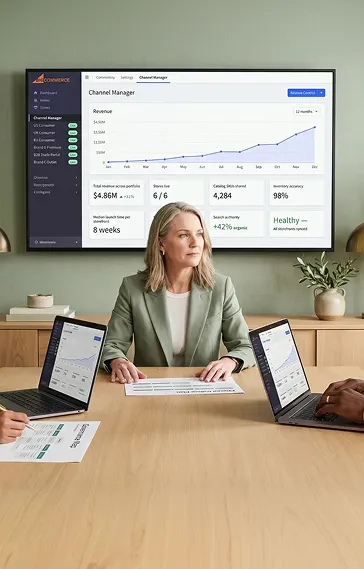
BigCommerce multi-storefront pulls storefront management, integrations, and order flows into one admin layer. Your ERP, 3PL, and email platform connect once. Every storefront shares those connections. You build and maintain one integration stack, not one per store.
From 30+ disconnected store locations to one unified commerce platform
From under $14M to over $120M annually after platform unification and multi-store architecture.
30 or more physical and digital retail locations unified under one back end with real-time inventory.
Inventory items centrally governed, visible across all locations and digital channels.
30+ store locations ran on disconnected back ends. There was no unified inventory, reporting, or digital presence. Manual reconciliation consumed entire ops teams and capped growth at the regional level.
One platform consolidated every location under a single catalog, order system, and analytics layer. We integrated real-time inventory, automated workflows, and digital marketing. Revenue scaled fast with no added headcount.
Three things most agencies skip on multi-storefront projects
Most implementation partners build the storefront. Fewer document the governance. Almost none plan the rollout sequence before writing a line of code.
Governance-first scoping
Before the first line of code, we map who controls what across every storefront. Catalog authority, pricing rules, admin access, and integration ownership get documented and approved. This prevents storefront bleed and cuts post-launch support cost.
Phased sequencing, not a single big bang
Every Redefine multi-storefront project launches storefront one as a clean baseline architecture. Subsequent storefronts inherit that baseline and add their scope in 3 to 6 week sprints. Your first storefront generates revenue while we build the next one. You never wait on a full portfolio build before going live.
SEO architecture built per storefront from day one
Multi-storefront SEO fails when domains share content without correct hreflang, sitemaps, and canonical signals. We configure each storefront's locale URLs, meta data, and technical SEO before launch. We never bolt it on after traffic splits your authority.
BigCommerce multi-storefront FAQ
Answers to the questions your VP Ecommerce, IT lead, and ops director raise in the first architecture conversation.
Yes. BigCommerce multi-storefront lets you share a single product catalog across all storefronts, or assign specific product sets to individual storefronts. You control which SKUs are visible on each storefront and can override pricing, descriptions, and availability per storefront without duplicating catalog data.
BigCommerce supports storefront-level price lists, currency assignments, and channel-specific promotions. Each storefront can show different base prices, tax-inclusive or exclusive pricing, and localized promotions without affecting other storefronts sharing the same product catalog.
A single additional storefront sharing an existing catalog can go live in 3 to 6 weeks. Multi-region launches with locale, currency, tax, and shipping configuration take 6 to 10 weeks. Full multi-brand architectures with separate catalog segments and governance rules range from 8 to 14 weeks depending on brand count and integration scope.
Yes. BigCommerce multi-storefront lets you run a B2B storefront with customer group pricing, quote workflows, and account-based access alongside a B2C consumer storefront from the same back end. Inventory, orders, and product data are centralized while the buyer experience on each front end is completely independent.
Each BigCommerce storefront runs on its own domain or subdomain with its own sitemap, hreflang tags, and canonical signals. Redefine builds region-specific storefronts with correct locale URL structures, hreflang implementation, and localized meta data to avoid duplicate content issues and establish organic authority in each target market.
Honest about who we build for
Multi-storefront is a real architecture investment. We do our best work with teams ready to govern it properly.
- Brands with two or more audiences that need fully separate storefronts
- Operations teams willing to define governance rules before the build starts
- Companies entering new regions with local tax, currency, and locale needs
- Enterprises running B2B and B2C channels that currently share a single storefront
- You have a single brand selling to one customer type in one market
- You want to launch a second storefront without any governance planning
- Your timeline requires all storefronts live simultaneously in under 4 weeks
- Your catalog, pricing, and operational processes are not yet stable enough to scale
Not sure where you land? Tell us your situation and we will be straight with you.
Get your multi-storefront architecture blueprint in 45 minutes
In 45 minutes, we map your brand portfolio, set your governance model, and outline a phased rollout. You leave with a documented architecture blueprint. It is yours whether you work with us or not.t.
What are you building?
Brief received
We will review your storefront setup and send a scoped architecture proposal within 3 business days.
Call within 48 hours
We review your brief and map your storefront portfolio
Architecture proposal in 3 days
Governance model, rollout sequence, and line-by-line scope
30 plus storefronts launched
For multi-brand, multi-region, and B2B portfolios
Code ownership
All storefront code and governance docs belong to you