Shopify Mailchimp Integration

Mailchimp Shopify setup that connects your store to the behavioral email program it actually deserves

Redefine connects Shopify to Mailchimp with real-time purchase events, behavioral segmentation, abandoned cart flows, and revenue attribution linked to actual Shopify gross merchandise value, not estimates.

Integration connection status
Shopify store
Active
Redefine API layer
Active
Mailchimp audience
Active
Shopify events delivered today8,421
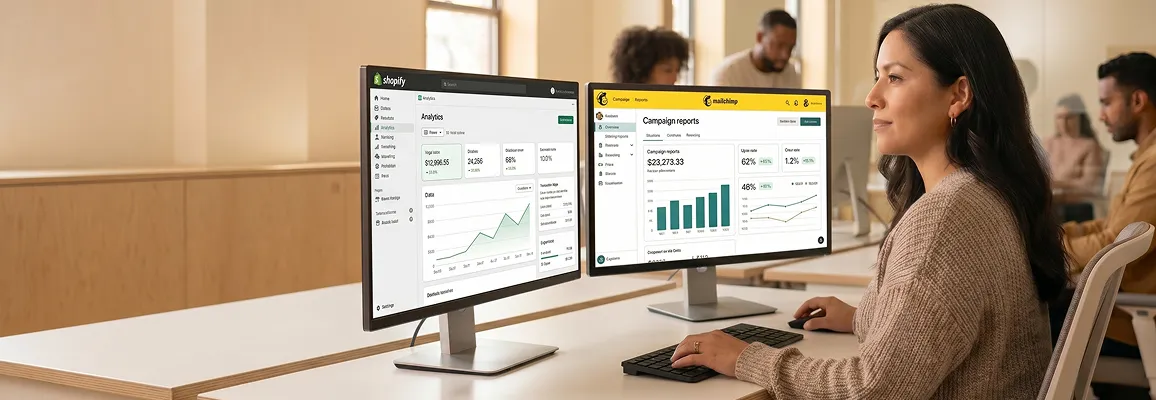
Email marketing professional reviewing Shopify and Mailchimp behavioral campaign analytics on dual screens in bright modern workspace

What a Redefine Shopify Mailchimp integration delivers

Real-time
Shopify order, browse, and cart events reach Mailchimp the moment they fire. No batch schedule delay.
Webhook-driven, sub-second delivery
Behavioral
segments built on lifetime value, purchase frequency, product categories, and last order. Updates on every Shopify event.
Segments reflect today, not last quarter
Server-side
event capture that works on headless Shopify, custom frontends, and multi-device sessions. No missed abandonment.
Backend API, not browser-only tracking
Monitored
health with dead-letter queues and error alerting. Silent failures never reach your automation flows.
Failures caught before you notice them
The native app gap

See what changes when Shopify data actually reaches Mailchimp

Toggle between the two states to see the real difference between Mailchimp with basic list sync and Mailchimp with a Redefine custom integration.

Mailchimp: Campaign Builder
Send to
All subscribers (4,218)
No purchase-based filtering available. Everyone gets the same email.
Personalization
First name onlyPurchase historyProduct viewed
Automation triggers
Subscribe · Unsubscribe
No Shopify browse, cart, or purchase triggers available
Revenue attribution: estimated from clicks only, not verified Shopify orders
4,218 subscribers get the same newsletter regardless of purchase history
Your best customer and a subscriber who never purchased get identical content. Open rates and unsubscribes suffer.
Browse abandonment and cart recovery flows never trigger for most of your traffic
Browser-only tracking on headless Shopify misses device switches, ad blockers, and sessions where the pixel does not fire.
Revenue in Mailchimp reports is estimated, not actual Shopify gross merchandise value
Mailchimp attributes revenue based on clicks. Actual campaign revenue in your Shopify dashboard is often 3x different.
Mailchimp: Redefine integration active
Send to
High-LTV buyers · Last purchase < 30d · Category: Apparel (847)
Personalization (Shopify-powered)
First nameLast product viewedLTV tierCart contents
Active Shopify event triggers
shopify_order_placed → post-purchase
shopify_cart_abandoned → recovery
shopify_product_viewed → browse flow
Revenue attribution: $18,200 verified from Shopify orders this month
847 high-LTV buyers get a campaign built around their actual purchase history
Lifetime value, product category, and last purchase date from Shopify power the segment. It updates on every new order automatically.
All browse and cart events captured server-side, including on headless Shopify storefronts
Events fire from the Shopify backend before they reach any browser. Your abandonment flows trigger for every session, every device.
Revenue attribution shows actual Shopify order values, not click-based guesses
Order lookup logic traces Mailchimp sends back to verified Shopify gross merchandise value. Your campaign reports show real numbers, not inflated estimates.
Ecommerce marketer reviewing connected Mailchimp campaign powered by Shopify purchase and behavioral data with revenue climbing
Built for your store type

See how your Shopify Mailchimp sync works for your specific email program

Select your store type. The integration scope, capabilities, and Mailchimp mock panel update to match your specific use case.

Turn high-traffic sessions into email revenue

Your TikTok and paid social drives thousands of sessions. Without a Shopify integration, Mailchimp cannot see who browsed what. Your abandonment flows never fire for the majority of that traffic..

  • Browse abandonment: server-side, all devices
  • Post-purchase flows from real order events
  • Lifetime-value-based segmentation updating on each order
Direct-to-consumer benchmark
54%
open rate on server-side browse abandonment flows

Segment wholesale accounts by real purchase behavior

Your wholesale buyers need completely different email treatment than direct-to-consumer customers. But without Shopify data, Mailchimp treats them the same. Account-level segmentation requires Shopify order and tag data to be present in Mailchimp in real time.

  • Account-level segments from Shopify customer tags
  • Purchase order history and account lifetime value synced as merge fields
  • Net-terms renewal sequences triggered by order date
Business-to-business segment accuracy
Real-time
account membership updates on every Shopify order event

Send renewal emails when they are actually due, not on a fixed calendar

Fixed-date renewal reminders miss the actual renewal window for most subscribers. When Shopify subscription events drive Mailchimp triggers, your lifecycle flows fire at exactly the right moment in each subscriber's cycle.

  • Subscription renewal events trigger Mailchimp flows
  • Plan tier and billing cycle mapped to merge fields
  • Churn risk segments from recency and engagement data
Subscription retention
91%
renewal rate for cohorts using event-triggered Mailchimp lifecycle
Mailchimp automation: Direct-to-consumer browse abandonment (Shopify-powered)
Browse Abandonment: Active
Trigger: shopify_product_viewed (via Redefine server-side API)
Fire condition: No purchase within 1 hour of view
Email 1 · 1h after view
54.2% open3.1% click
Email 2 · 24h after view
38.1% open2.2% click
Email 3 · 48h after view
21.3% open1.4% click
$18,200 revenue recovered this month from browse abandonment flows
Mailchimp audience: Business-to-business wholesale segment (Shopify account data)
Audience Segment Builder
Segment: B2B Wholesale Accounts
shopify_customer_tag = "wholesale" AND SHOPIFYLTV > $2000
Members248 contacts
Shopify merge fields available
SHOPIFYLTVLASTORDERACCTTYPEORDERS
Last enriched: 41 seconds ago · from Shopify order event
Mailchimp automation: subscription lifecycle (event-triggered)
Subscription Lifecycle Flow: Active
Trigger: shopify_subscription_renewal (day -30)
Personalize by: plan tier, billing cycle, engagement score
Day -30: Heads up email63.1% open
Day -7: Reminder58.4% open
Day +1: Thank you / confirm71.2% open
847 renewal emails this month · 91.2% subscriber retention
Integration scope

Five integration capabilities scoped to your Shopify store and Mailchimp audience

Every capability below is built to your requirements during Discovery. No packaged connector. No generic field map.

01
Real-time order and cart events
Purchase, fulfillment, cart abandonment, and browse events deliver to Mailchimp in real time via webhook. Not a nightly batch job that makes your data 24 hours stale.
02
Customer profile enrichment
Shopify customers sync to Mailchimp contacts with lifetime value, total orders, product categories, customer tags, and last purchase date mapped to merge fields you define during Discovery.
03
Server-side abandonment capture
Product view and cart abandonment events fire from the Shopify backend, not the browser. Your abandonment flows trigger correctly on headless storefronts and for every multi-device session.
04
Revenue attribution to actual gross merchandise value
Order lookup logic traces Mailchimp sends back to verified Shopify order values. Your campaign revenue reports show real gross merchandise value, not click-based estimates inflated 3x or more from reality.
05
Health monitoring and alerting
Dead-letter queues with retry logic and error alerting ship with every integration. Failed Mailchimp API deliveries are captured and surfaced before your flows stop sending without warning.
Client proof

Shopify email marketing integration: abandonment recovered, average order value increased, retention built to scale

Abandonment recovery
Improved
Lifecycle flows wired to real Shopify browse and cart events. Every session captured, every device.
SH
Spite House Studios
Direct-to-consumer Card Game Brand
AOV
Increased
Scalable
Retention built
The integration gap

High TikTok traffic volume drove substantial store visits, but no structured email system existed to capture or recover that intent. Lost revenue from uncaptured browse sessions compounded with every viral content drop that spiked traffic without a corresponding email recovery layer to monetize it.

What Redefine built

A complete integration with Shopify customer, product, cart, and browse events. Lifecycle flows were built for standard, TikTok-specific, and backer audiences. Abandoned cart, browse abandonment, back-in-stock, and exit-intent flows all fired from real Shopify events via server-side API.

Integration outcome

The lifecycle system enabled better capture and monetization of TikTok-driven traffic, improved abandonment recovery, and established a scalable email retention system positioned to scale with the brand as product catalog and social channels grow.

Spite House Studios ecommerce team reviewing improved abandonment recovery and higher average order value from lifecycle email integration
Why Redefine

Three things Redefine Mailchimp integration services do that other integrations skip

Packaged connectors and quick-build setups handle the basics. These are the capabilities Redefine builds that define whether your behavioral email program actually performs.

Point 01

Custom integration scoped to your Shopify store and Mailchimp audience, not a generic connector template

Redefine audits your Mailchimp audience structure, merge fields, custom tags, and Shopify data model during Discovery before writing a line of code. The event schema and field mapping are defined for your specific setup. You are not buying a connector that was built for the median use case and adjusted to fit yours.

Point 02

Every browse and cart abandonment event fires server-side, including on headless Shopify storefronts

Browser-only tracking misses 30 to 40% of abandonment events on multi-device sessions, ad blockers, and headless frontends. Redefine captures browse and cart events from the Shopify backend before they ever reach a browser. Your abandonment flows fire for every eligible session, not just the ones the pixel caught.

Point 03

Dead-letter queues, retry logic, and health monitoring ship with every integration, not as post-launch add-ons

Every failed Mailchimp API delivery is captured in a dead-letter queue, retried with exponential backoff, and surfaced via alert. You discover the failure in minutes, not days. Your flows never stop sending silently while you wonder why engagement dropped. Monitoring is part of the build, not a separate retainer.

Common questions

Mailchimp for Shopify store questions answered

The native app works for basic list sync and standard broadcast campaigns. A custom integration is the right choice when your email program depends on behavioral triggers such as browse abandonment and post-purchase flows, when you run a headless Shopify storefront, when you need custom metafields or order attributes for personalization, or when you want revenue attribution linked to verified Shopify gross merchandise value rather than click-based estimates. Most growing direct-to-consumer brands outgrow the native app within six months.

A standard integration covering purchase events, customer profile sync, browse abandonment, and revenue attribution takes 2 to 3 weeks. Integrations with headless Shopify, custom event schemas, or complex lifecycle flow logic take 3 to 5 weeks. Redefine delivers a specific timeline after the scoping call.

Yes. Redefine builds server-side API integrations that capture events from the Shopify backend, not the browser. Browse abandonment, product view, and cart events are captured correctly on headless Next.js or custom frontends where browser-only tracking misses a significant share of your sessions.

Data scope is defined during the scoping session. Standard sync covers purchase events, customer profiles, order history, lifetime value, product categories, customer tags, and browse and cart events. Custom sync can include Shopify metafields, subscription status, product variant data, multi-currency order values, and any Shopify data accessible via API.

All Redefine integrations include health monitoring, error alerting, and dead-letter queue handling at delivery. Post-launch maintenance retainers cover Mailchimp API version updates, Shopify API changes, and event schema adjustments. Maintenance terms are agreed during the scoping session before the project begins.

Is this integration right for you?

Honest fit-check

Good fit if
  • You send behavioral campaigns, including browse abandonment, post-purchase, or lifecycle, and need Shopify events to trigger them correctly.
  • You run a headless Shopify storefront and browser-only tracking is missing sessions and device switches.
  • Your Mailchimp revenue reports and Shopify dashboard show very different numbers and you want attribution you can trust.
  • You have a growing audience with meaningful purchase history that Mailchimp currently cannot see or use for segmentation.
Not a fit if
  • You send one monthly newsletter to your full list and have no plans to build behavioral or lifecycle flows.
  • You do not yet have an active Mailchimp audience or are just starting to collect email subscribers.
  • You need a live integration in under 48 hours with no Discovery session or schema review.
  • Your email provider is not Mailchimp. We also build Klaviyo and HubSpot integrations if that is a better fit.

Not sure? Tell us your situation and we will be straight with you. Book a free 30-minute scoping call.

Start your integration

Your Mailchimp flows should know exactly what your Shopify customers do.

Book a free 30-minute scoping call. Redefine plans your Mailchimp Shopify setup, reviews your audience setup and Shopify store, maps the events and merge fields you need, and delivers a scope and timeline before you commit to anything.

No commitment. No pitch.

Confident ecommerce marketing director reviewing Shopify Mailchimp integration results and behavioral email revenue attribution in modern office
What your scoping call covers
1
Mailchimp audience and Shopify data audit
Your audience structure, merge fields, and Shopify data model reviewed before scope is written
2
Event schema and merge field mapping
Every Shopify event and data field mapped to your audience's merge fields and tags
3
Integration scope and go-live timeline
Technical approach, deliverables, and launch date in writing before you commit
form
Reply within 48 hours
Same-day on urgent briefs
Proposal in 3 days
Line-by-line, no surprises
60+ integrations built
Shopify email platforms
You own the code
Full handoff, no lock-in

Get on a call with us to see how we can help you

Get a Quote