UPS Shipping Integration
Every order ships on time when your systems talk to UPS directly
Real-time rates. Automated labels. Live tracking updates pushed to your customers and your warehouse team. No copy-pasting. No rate surprises. No missed pickups.
42 shipping integrations completed for ecommerce and logistics teams
Submit your brief → call within 48 hours → scoped proposal in 3 days → Sprint 1 begins within 1 week of sign-off
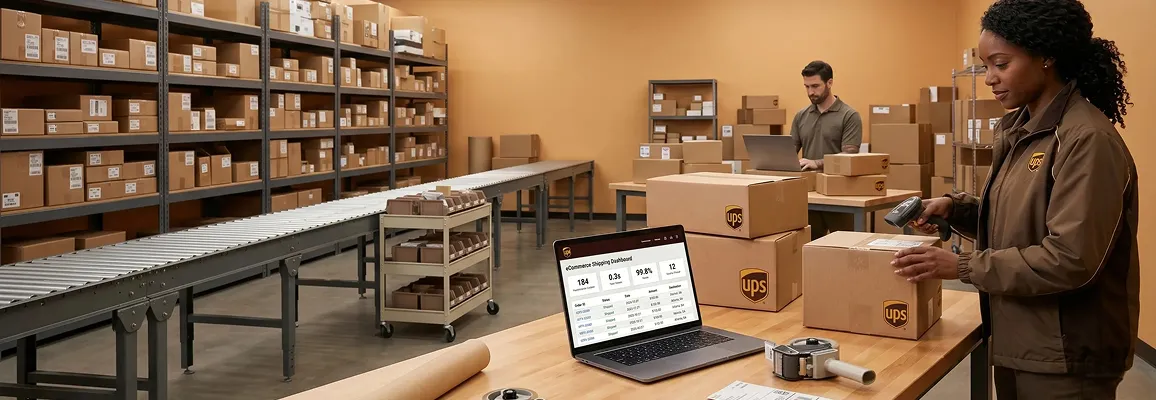
Hero: warehouse operations team scanning packages
Average label generation
0.3s
Rate accuracy
99.8%
The Real Cost of Manual Shipping
Your team is losing hours every day to shipping tasks your systems should handle
Rate mismatch
12%
of shipments leave with the wrong rate applied when rates are looked up manually or cached from yesterday's table
Wasted hours
14h
per week spent copying tracking numbers from carrier portals into order management screens across platforms
Support tickets
WISMO
"Where is my order" tickets spike when tracking updates take 24 hours to reach your customer-facing systems
Pain: operations lead reviewing shipping errors on screen

After integration
Rates pulled live from UPS at checkout. Your customer sees the real cost. Your margin stays intact.
Labels generated the moment an order is confirmed. No one opens the UPS portal.
Tracking events flow to your order management system, your customer email, and your support dashboard in real time.
How Your Data Flows
Your systems, connected to every UPS API endpoint you need
Click any node below to see the data objects, events, and error handling built into each connection point.
Order Created
Ecommerce platform or order management system
Address Validation
UPS Address Validation API
Rate Shopping
UPS Rating API
Label Generation
UPS Shipping API
Tracking and Webhooks
UPS Tracking API + Webhooks
Eventorder.created
Order ID#ORD-2024-8847
Items3 SKUs, 2.4 kg
Ship toAustin, TX 78701
Priority2-day delivery
Order payload maps to UPS shipment request. Address, weight, dimensions, and service level auto-populated from your ecommerce platform or order management system.
Input123 Main St, Ste 4B
Validated123 MAIN ST STE 4B
ClassificationCommercial
Confidence
Bad addresses caught before label generation. Reduces return-to-sender shipments and surcharges for residential versus commercial misclassification.
UPS Ground
3 to 5 business days
UPS 2nd Day Air
2 business days
UPS Next Day Air
1 business day
Real-time rate comparison at checkout. Negotiated account rates applied automatically. No stale rate tables.
Tracking1Z999AA10123456784
ServiceUPS Ground
Label formatZPL (thermal)
Generated in0.28s
Label sent to printer queue
ZPL, PNG, and PDF label formats supported. Multi-package shipments handled in a single API call.
Delivered
Austin, TX · 2:14 PM
Out for delivery
Austin, TX · 7:38 AM
In transit
Dallas, TX · 11:02 PM
Picked up
Warehouse · 4:30 PM
Webhook-driven events pushed to your order management system, customer notification system, and support dashboard simultaneously.
Full UPS API Surface
Seven API connections that cover your entire shipping operation
Rating and Time-in-Transit
Pull negotiated account rates and estimated delivery windows for every service level at checkout or during batch processing. Your customers see accurate costs. Your finance team sees accurate margins.
Ground2nd Day AirNext Day AirSurePostInternational
Label Generation
ZPL, PNG, and PDF labels created programmatically. Multi-package shipments in a single call. Thermal printer compatible.
Tracking and Webhooks
Real-time tracking events via UPS webhooks. Every status update pushed to your order management system, notification system, and support tools within seconds.
Address Validation
Catch bad addresses before shipping. Classify residential versus commercial to apply correct surcharges and avoid return-to-sender costs.
Scheduled Pickup
Book carrier pickups from your warehouse or retail locations. Cutoff times, driver instructions, and pickup confirmations flow into your order management system so dispatch always matches reality.
Returns Management
Generate return labels on demand. Customers print, pack, and drop off. Return status flows back to your order management system for automated refund processing.
International Paperless Invoice
Customs forms, commercial invoices, and harmonized codes submitted electronically. Fewer delays at the border. Faster international delivery.
Connected Systems
We connect UPS to the systems your team already uses
Your UPS integration plugs into your ecommerce platform, enterprise resource planning, warehouse management, and order management systems. These are the most common pairings we build.
Ecommerce
Shopify, BigCommerce, Adobe Commerce
Rates at checkout, labels on fulfillment, tracking in customer accounts
Enterprise Resource Planning
Shipping costs posted to general ledger, landed cost calculations, fulfillment status synced to sales orders
Order Management and Warehouse Management
Custom order management system, third-party warehouse management system, multi-warehouse routing
Automated warehouse selection, batch label generation, and pick-pack-ship workflows triggered by order events
Value: fulfillment center packing station close-up

Proof
Real integration results from ecommerce operations teams
Case study: Eyeglasses123 multi-channel operations

Client
Ecommerce / EyewearEyeglasses123 is an online retailer selling branded sunglasses and eyeglasses across Shopify and external marketplaces.
Problem
Rapid growth across multiple marketplaces created operational friction. Inventory sync was manual. Returns processing was slow. Order fulfillment could not scale without automation.
Solution and Result
Custom integration framework connecting Shopify with marketplaces and fulfillment partners. Automated restocking alerts, real-time order tracking, and consolidated sales data across all channels.
$6M
Annual revenue scaled through integrated multi-channel operations
Why Redefine
Three things other integration partners get wrong with shipping APIs
They build the connection but skip error handling
Most integration partners ship a working API connection and move on. When UPS returns a rate error, an address exception, or a timeout during peak volume, their integration fails silently. Your warehouse team discovers the problem when the labels do not print.
Every Redefine UPS integration ships with structured error handling, retry logic, fallback routing, and alerting. When something breaks, your team knows immediately and the system recovers automatically.
They treat shipping as a feature, not a system
Shipping touches your checkout, your warehouse, your finance team, and your customer support queue. Treating it as a standalone plugin means data stays siloed. Tracking never reaches the customer relationship management system. Shipping costs never post to the general ledger.
We map UPS data flows end-to-end across every system in your stack. The integration is one project, not six disconnected API calls.
They walk away after go-live
UPS updates their API. Your ecommerce platform ships a new checkout flow. Your enterprise resource planning system adds a warehouse. Shipping integrations require ongoing maintenance that typical project-based partners do not provide.
Redefine offers managed integration support. When UPS ships API version changes, we handle migration. When your systems evolve, your shipping integration evolves with them.
Common Questions
What ecommerce and logistics teams ask before starting
We connect UPS APIs to any ecommerce platform (Shopify, BigCommerce, Adobe Commerce), enterprise resource planning (NetSuite, SAP, Dynamics 365, QuickBooks), warehouse management system, order management system, and custom applications. Every integration is built to your specific data flow requirements, not a one-size-fits-all connector.
Most UPS integrations go live within 2 to 4 weeks. Simple rate and label connections ship faster. Complex multi-warehouse routing or returns management builds take closer to 4 weeks. Your scoped proposal includes exact timeline milestones.
Yes. We integrate the full UPS API surface including returns management, address validation, time-in-transit estimates, and international paperless invoicing. You choose which endpoints your operation needs. We build them all as one connected system.
Your integration includes monitoring, alerting, and our managed support retainer. When UPS ships API updates, we handle version migration and regression testing so your shipping never stops. You never need to scramble an internal developer to fix a broken label endpoint.
Yes. We audit your current integration, document gaps and fragile points, and rebuild it on a supported architecture with proper error handling, monitoring, and documentation. No shipping downtime during the transition.
Get Started
Tell us about your shipping operation
Describe your current setup and what you need from a UPS integration. We will review your situation and send a scoped proposal within 3 business days.
Pre-footer: developer configuring API endpoint
Call within 48 hours · proposal in 3 days · Sprint 1 within 1 week of sign-off
48-hour response
Proposal in 3 days
42 integrations shipped
You own the code
Your shipping operation should run itself
Stop copying tracking numbers. Stop looking up rates manually. Stop fielding "where is my order" tickets your systems should answer automatically.
No commitment. No pitch. Just a clear picture of what your UPS integration should look like.
Related integration services