Conversion Rate Optimization Services
Stop losing revenue
Stop losing revenue
your traffic already earned
Redefine runs A/B testing, user experience audits, and funnel optimization for ecommerce brands turning traffic into revenue. We find where visitors drop off and fix it with data, not guesses.
$0M+
Revenue driven via conversion rate optimization
0x
Average revenue growth
0
Ecommerce stores optimized
The Conversion Gap
Your store has a traffic problem and a conversion problem. Fix the conversion one first.
Most ecommerce growth advice tells you to spend more on ads. Before you do that, close the gap between the visitors already arriving and the revenue you should be capturing from them.
0%
Global average ecommerce conversion rate
Most ecommerce stores convert below this. If you are at 1 to 2 percent, you are leaving money on the table at every traffic level.
0%
Of carts abandoned before purchase
Nearly 7 in 10 customers who add items to their cart never complete the purchase. That is not a traffic problem, it is a friction problem.
0
To form a first impression
A visitor decides whether to stay or leave within 3 seconds of landing. If your page does not immediately show them what they came for, they bounce.
1pt
Conversion rate improvement = 50%+ revenue growth
Moving from 2% to 3% conversion rate on a store with 10,000 monthly visitors and a $90 average order value means an additional $9,000 in monthly revenue.
“
We had 80,000 visitors a month and barely 1.4% were buying. That is 78,880 people leaving every month without spending a dollar.
The situation most ecommerce brands bring to us, traffic is not the problem.
78,880
Visitors lost monthly
2.8x avg
Conversion rate lift after conversion rate optimization engagement
Revenue Opportunity Calculator
See exactly how much revenue a better conversion rate unlocks for your store
Adjust the sliders to match your store. The right panel updates live with what a conversion rate optimization engagement could realistically return.
Your current store metrics
Monthly unique visitors
15,000 visitors
1K500K
Current conversion rate
1.8% conversion rate
0.3%5%
Average order value
$85 average order value
$20$800
Target conversion rate (after conversion rate optimization)
3.2% conversion rate
0.5%8%
A realistic conversion rate optimization target is 50 to 100% improvement on your current conversion rate, achieved over 3 to 6 months of structured testing. The default target of 3.2% is conservative for a store starting at 1.8%.
Revenue opportunity
Your current monthly revenue
$22,950
Projected monthly revenue
$40,800
Monthly revenue gain
+$17,850
Annual revenue gain
+$214,200
Additional orders per month
+210 orders
This projection assumes no increase in ad spend. The same traffic, optimized. Every gain is pure margin improvement.
No commitment. No pitch. Call within 48 hours.
What The Service Includes
Four disciplines, one revenue outcome: more buyers from the same traffic
Conversion rate optimization is not one thing, it is a system of overlapping disciplines. We run all four together because each one feeds the next.
01 / Heatmap + Session Analysis
See exactly where your visitors lose interest and leave
We install session recording, click heatmaps, and scroll depth tracking across your highest-traffic pages. Every drop-off point becomes visible before we write a single hypothesis.
- Click density mapping on product detail pages, cart, and checkout
- Scroll depth analysis to find content that goes unseen
- Session replay review of the 100 most-abandoned journeys
- Rage-click and error detection to surface broken experiences
Product Image Gallery
Product Title
Add to Cart Button, 34% click rate
Reviews Section, 18% scroll depth
34%
Add to Cart
67%
Gallery hover
18%
Reviews reach
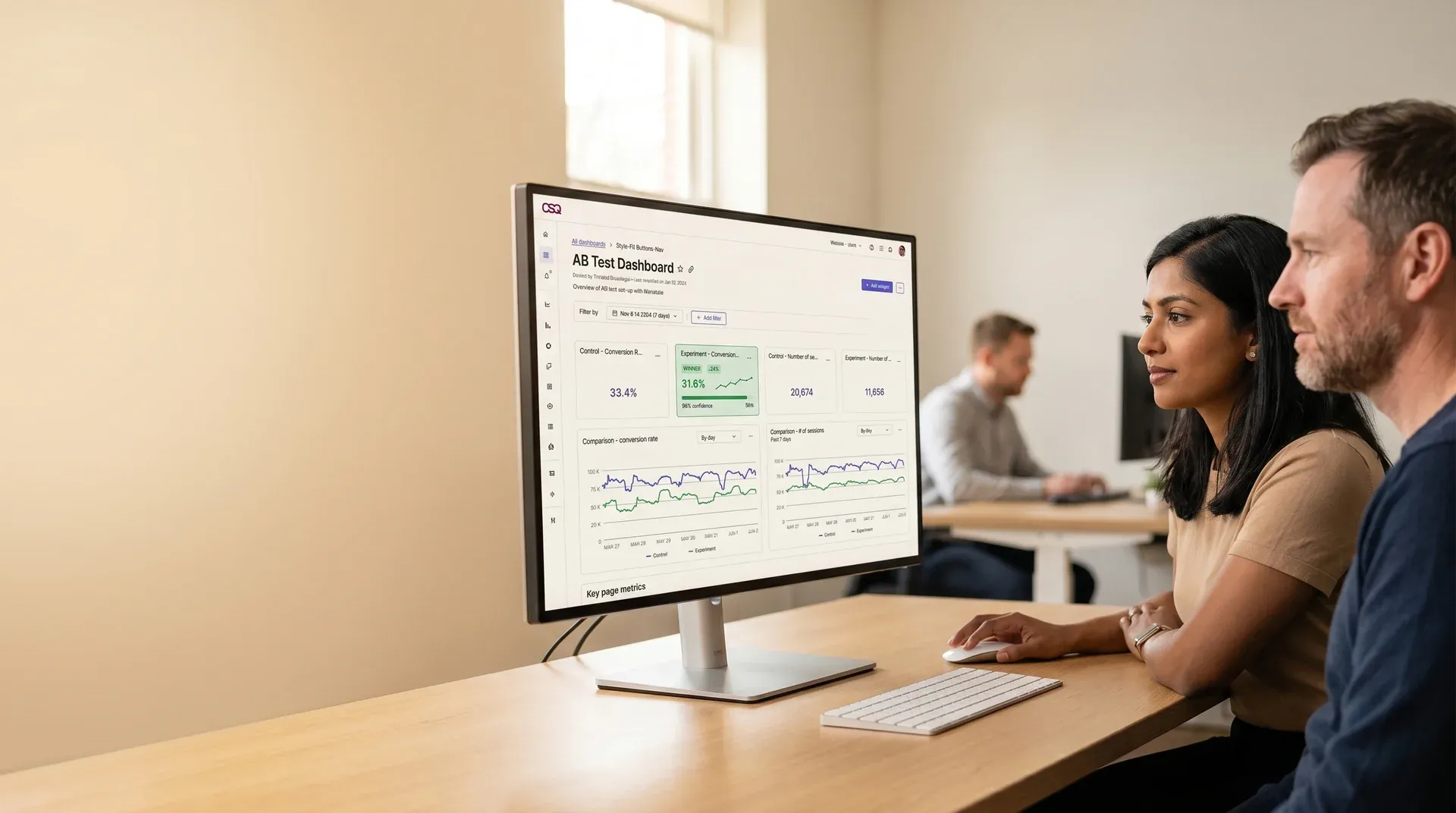
02 / A/B Testing Architecture
Every change is tested before it ships permanently to your store
We build, run, and analyze A/B tests across your highest-impact pages. No hypothesis goes live without a test behind it. No winner ships without statistical confidence above 95%.
- Call-to-action copy, placement, and colour tests on product detail pages
- Checkout flow tests: field order, trust signals, progress indicators
- Social proof placement: above fold, below call to action, inline
- 95%+ statistical confidence required before any test closes
Product Detail Page Call-to-Action Copy + Color Test
Day 14 of 21 · 6,820 visitors
Running
Test progress (14/21 days)
Control A
"Add to Cart"
1.8%
Conv. rate
Variant B
"Get It Today"
3.4%
Conv. rate
Variant B leading
Confidence: 91%
Projected winner: +89% conversion rate lift if trend holds
03 / Funnel Audit + User Experience Redesign
Fix the friction points your visitors hit before they even see your call to action
Every store has a funnel. Most stores have never measured where exactly customers drop out of it. We map each stage, quantify the drop-off rate, and prioritize fixes by revenue impact.
Landing Page100%
Product Page62%
Add to Cart28%
Checkout Start14%
Purchase9%
Biggest drop: Add-to-cart to checkout (-50%). Fix priority: HIGH

Proof
From stagnant conversion rate to $120 million in annual revenue.

Corporate branded apparelHeadless ecommerceUser experience / User interface
Client
Corporate Gear
The Problem
A large-scale corporate branded merchandise platform had traffic and product demand, but site architecture, user experience patterns, and lack of data-driven testing were suppressing conversion at every funnel stage. Personalization was limited. Existing analytics could not surface actionable testing hypotheses. Revenue growth had plateaued despite increasing traffic.
The Approach
Continuous user experience testing, session analysis, and data-driven optimization were implemented across the platform. Personalization layers were added. A/B testing infrastructure was built and run across the highest-traffic landing and product pages. Every sprint produced a tested hypothesis, a winner, and measurable revenue attribution.
The Result
$0M+
in annual revenue, scaled through continuous conversion rate optimization and user experience optimization
- Significant increase in website traffic, lead generation, and conversion rates through data-driven optimization
- Improved personalization and usability strengthened customer engagement and loyalty
- Continuous testing and real-time optimization drove sustainable revenue growth to over $120M annually
Attribution note
Revenue outcome driven by conversion rate optimization, user experience optimization, and personalization work, the three disciplines at the core of Redefine's ecommerce conversion rate optimization service.
Why Redefine
Not the only conversion rate optimization agency. Built completely differently from the rest.
Typical conversion rate optimization agencies run templates. We start with your actual visitor data. The three principles below are why results differ.
90
Days of data before a single recommendation
Your data first. Never a template hypothesis.
Every engagement starts with 90 days of session recording, heatmap data, and funnel analysis before we suggest a single change. Most agencies write recommendations from industry blogs. We write them from your actual visitor behavior.
95%
Confidence required before any test closes
No change ships without statistical proof it works.
Every A/B test runs until we reach 95% statistical confidence. We do not call early winners. We do not let gut feeling override data. If a test needs 28 days to be conclusive, it runs 28 days. Your store does not get worse changes shipped to it.
$X
Revenue attributed to every single experiment
You see the revenue number every change generated.
Every closed experiment ships with a revenue attribution report: how much the control generated, how much the winner generated, and the monthly revenue gain from shipping the winner permanently. You always know what conversion rate optimization is worth to you.
Common Questions
Questions before you get your audit
Real reasons brands wait on conversion rate optimization. Real answers. The audit covers anything we miss here.
Get My Conversion Rate Optimization AuditNo commitment. No pitch. Call within 48 hours.
Conversion rate optimization on an ecommerce store involves identifying where visitors drop off in the purchase journey and systematically fixing those points through structured testing. In practice, that means heatmap and session recording analysis, A/B testing on product pages, cart, and checkout flows, copy and user experience changes validated by data, and revenue attribution on every experiment. It is not one project, it is an ongoing optimization cycle that compounds over time.
The first 30 days are data collection and audit, we are watching your visitors, mapping your funnel, and writing hypotheses. The first tested winner ships in weeks 5 to 8. Compounding results (multiple experiments stacked) become visible between months 3 and 6. If you are expecting a new checkout button to triple your revenue in week 2, conversion rate optimization is not the right service yet, but if you want systematic, permanent improvement to your store's conversion over a full engagement, that is exactly what this delivers.
Meaningful A/B tests require enough traffic to reach statistical significance within a reasonable timeframe. The minimum we work with is 5,000 monthly unique visitors to the page being tested, below that, tests take too long to reach 95% confidence. Most of our clients have between 10,000 and 200,000 monthly visitors. If you are below 5,000, the heatmap and funnel audit work still applies, but full A/B testing infrastructure should wait until traffic grows.
Yes, for winning test variants to ship permanently, we need to implement changes in your theme or codebase. For Shopify stores, that means collaborator access. For headless or custom builds, we work through your existing deployment pipeline. We document every change before shipping it and require your approval before any update goes to production. You are never looking at a change you did not review first.
Every closed experiment gets a revenue attribution report: control revenue, variant revenue, statistical confidence level, and the estimated monthly gain from shipping the winner permanently. Weekly progress updates cover active tests, what is being monitored, and what the next hypothesis is. You always know what each experiment is worth, and what the overall conversion rate optimization engagement is returning per month.
Yes, but timing matters. A/B testing requires a stable baseline, if your site is mid-redesign, test results are unreliable. We run conversion rate optimization on your existing store while a redesign is planned, then run a fresh audit on the new design at launch before resuming full A/B testing. If a platform migration is underway, the funnel audit and heatmap analysis are valuable inputs to the new design brief and can be done in parallel.
Is This Right For You?
Is conversion rate optimization the right next step for your store?
Conversion rate optimization is one of the highest-leverage investments in ecommerce, but only when the conditions are right. Here is how to know.
This is the right move if
- You have more than 5,000 monthly visitors and your conversion rate is below 3%
- You are spending on paid ads or search engine optimization but revenue is not growing proportionally with traffic
- Your checkout completion rate is under 60% and you do not know why
- You have had a redesign and your conversion rate did not meaningfully improve after it
- You want to grow revenue without increasing ad spend
- You are comfortable with a 3 to 6 month engagement to see compounding results
This is probably not the right next step if
- Your store has fewer than 2,000 monthly visitors, not enough for statistically valid tests
- Your core problem is traffic, not conversion, search engine optimization or paid ads should come first
- You want a full site rebuild, not optimization of existing flows
- You need results in under 30 days, meaningful tests need at least 2 to 4 weeks to reach confidence
- You are not able to share analytics access or participate in weekly review calls
- Your catalog or pricing changes frequently, which resets test baselines
Not sure where you land? Tell us your situation in the brief below and we will be straight with you about whether conversion rate optimization is the right next move.
Get Your Conversion Rate Optimization Audit
Submit your brief. Get a scoped conversion rate optimization audit in 3 days.
No commitment. No pitch. A real look at where your store is leaking conversion, and what fixing it is worth.
Your team's time investment across a full engagement is typically 3 to 4 hours per week, one sprint review, async feedback on test variants, and a final sign-off on winners. We handle everything else.
Under 5K5K to 20K20K to 100K100K+
Landing pageProduct pagesCartCheckoutNot sure
Brief received
We will review your store situation and send a scoped conversion rate optimization audit within 3 business days. Expect a call first to understand the context.
48 hour response
Call within 2 business days
3-day audit
Scoped proposal delivered fast
40+ stores optimized
Across multiple verticals
No commitment
You own every line of code