Coverage issues in an average unmanaged site: 26% of pages not indexed correctly
Every page your store can rank for should be indexed. Most are not. We fix that.
We audit your Google Search Console account, map every coverage error to its revenue impact, fix the technical issues causing pages to be excluded, and set up monitoring so you never miss a crawl regression again.
$3.8M
client revenue via organic search growth
30 days
from GSC audit to active monitoring
24 hours
service level agreement on critical indexation alert response
Strategy call in 48 hours → GSC audit report in 3 days → fix implementation begins within 1 week

The GSC consulting problem
Manual GSC checking finds problems weeks after they hurt your traffic. Structured monitoring finds them in 24 hours.
Without GSC consulting
Manual, reactiveLogin once a month to check for red
No alerts set up. Issues accumulate between logins. Revenue impact unknown.
Coverage report shows hundreds of errors
No prioritization. Don't know which errors affect high-value pages. Fix randomly.
Ask developer to investigate
Developer is unfamiliar with GSC. Investigation takes 2 to 4 weeks. Problem may be misunderstood.
Fix deployed. No verification.
Pages may still not be indexed. No validation request submitted. Issue may return silently.
Traffic drop noticed in GA4 six weeks later
Revenue impact: 6 weeks of organic traffic lost from unindexed pages. Cause traced back to original coverage error.
Estimated time from issue appearing to fix verified: 10 to 14 weeks. Revenue impact: unquantified.
With Redefine GSC consulting
Automated, proactiveAutomated daily GSC monitoring active
Coverage, performance, and Core Web Vitals checked daily. Any regression triggers a priority alert within 24 hours.
Issues triaged by traffic and revenue impact
Every coverage error mapped to its affected pages, their monthly organic traffic, and estimated revenue at risk. Priority set before any work begins.
Fix scoped, written, reviewed with your dev team
We write the technical fix specification and provide the exact code change. Developer implements. Sprint review confirms correct implementation.
URL inspection submitted. Indexation confirmed.
Every fixed page submitted for recrawl. Indexation status confirmed in GSC before the issue is closed in the sprint tracker.
Weekly report ties indexation to organic traffic
Newly indexed pages tracked in GA4. Organic traffic and revenue attributed to fix. Each sprint closes with measurable impact.
Estimated time from issue appearing to fix verified: 5 to 10 days. Revenue impact: tracked and attributed.
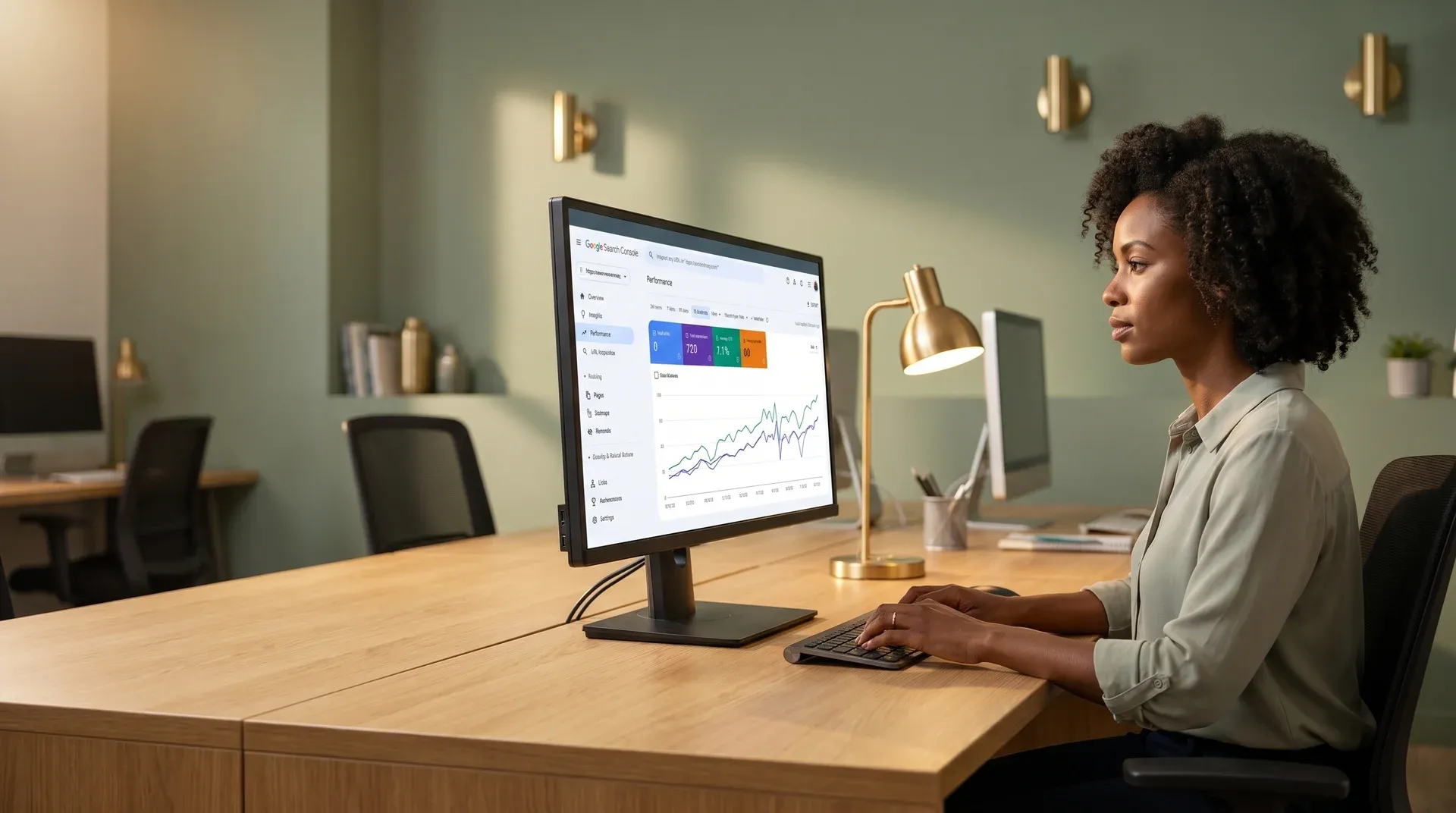
GSC consulting process
From GSC Account Audit to Indexed Revenue in 30 Days.
Your first indexed page improvement happens in Sprint 1. The monitoring system that protects against future regressions is live by Day 30. Click each step to see what the output looks like.
1
Days 1 to 3
Account Audit
Coverage, Performance, Enhancements, Core Web Vitals
2
Days 4 to 7
Issue Mapping
Prioritize by traffic impact: high / medium / low
3
Days 8 to 21
Fix Implementation
Resolve errors, submit URLs, verify indexation
4
Days 22 to 30
Monitoring Setup
Daily alerts, weekly reports, revenue attribution
Error
142
Warning
68
Valid
4,821
Excluded
1,204
Not found (404)87 pagesHigh impact
Redirect error34 pagesHigh impact
Duplicate without canonical68 pagesMedium
Excluded by noindex1,204 pagesReview needed
Audit finding: 121 errors on high-traffic pages identified. Est. organic traffic impact: 2,400 sessions/month
Priority 1: Fix in Sprint 1
404 errors on /collection/* pages1,840 sessions/month lost
Priority 1: Fix in Sprint 1
Redirect chains on product pages560 sessions/month lost
Priority 2: Sprint 2
Duplicate canonical tags400 sessions/month at risk
Priority 3: Sprint 3
Schema markup errorsRich snippet eligibility
Issue mapping complete: 2,800 sessions/month recoverable in Sprint 1 alone
Sprint 1 fix verification: 87 pages submitted for recrawl
/collections/hiking-boots
Indexed
/collections/trail-knives
Indexed
/products/tactical-knife-proCrawling...
/products/kitchen-knife-setQueued
Indexed
64
Crawling
12
Queued
11
All systems nominal: last checked 2 hours ago
Coverage errors
0 new this week
Pages indexed
0
Organic sessions (7 days)
0
Revenue attributed
$0
Sprint 1 result: 87 pages indexed, +2,840 organic sessions recovered, $8,400 revenue attributed
What GSC consulting covers
Four Google Search Console reports. One structured consulting cadence.
Coverage Report
Fix the pages that should rank but aren't indexed.
We audit every status in the Coverage report: Errors, Warnings, Valid with warnings, and Excluded. Each excluded page is evaluated: is it excluded deliberately, or was it excluded by a configuration error that's costing you rankings?
0
avg pages with recoverable indexation issues in unmanaged accounts

Clicks
0
Impressions
0
Click-through rate
0%
Avg. Position
0
best [product] knife890 clicksPos 3.2
buy [product] online340 clicksPos 8.4: opportunity
[product] review120 clicksPos 14: action needed
Performance Report
Find the keywords on page 2 that belong on page 1.
We analyze every query in the Performance report. Keywords ranked 4 to 15 with high impressions and low click-through rate are your fastest organic wins: they're already ranking, just not well enough to click. We identify and prioritize them before your competitors do.
0%
avg click-through rate improvement when position 5 to 12 pages are optimized for search appearance
Core Web Vitals
Performance scores that fail in GSC signal ranking penalties, not just slow pages.
A Core Web Vitals failure in GSC means Google has measured your page experience as poor in the field, not just in a lab test. We identify which URL groups are failing, trace the root cause (LCP image, CLS layout shift, INP interaction), and write the technical fix for your developer to implement.
0
avg URL groups failing Core Web Vitals in ecommerce stores at audit: LCP issues dominate
LCP (Largest Contentful Paint)4.2s: Poor
Target: under 2.5s. Root cause: unoptimized hero image not preloaded.
CLS (Cumulative Layout Shift)0.12: Needs Improvement
Target: under 0.10. Root cause: banner ad slot without reserved dimensions.
INP (Interaction to Next Paint)180ms: Good
Product structured data22 errors
Breadcrumb markup8 warnings
FAQ schemaValid: 0 errors
Review snippetNot detected
Fix Product schema errors to unlock rich snippets in search results: avg click-through rate lift 18 to 24%
Enhancements
Structured data errors block rich snippets and cost you click-through rate without warning.
Product schema errors, breadcrumb warnings, and missing review snippets are all visible in the Enhancements section: but most teams never check. We audit every enhancement type, fix the schema errors, validate the markup, and submit for rich result eligibility. Rich snippets improve click-through rate by 18 to 24% on product pages.
0%
avg click-through rate improvement on product pages after Product schema and rich snippet eligibility restored
Connect GSC consulting to your full search engine optimization strategy
Proof
$1M to $3.8M in three years. Organic search was the channel. GSC was the instrument.
Off Grid Knives · Ecommerce · Outdoors
Before
$0M
After 3 years
$0M
Growth driver
Organic search (primary)
Advertising limitations meant the brand had to rely on organic rankings
Revenue multiplier
0x
Revenue growth in 3 years through organic-first strategy
The Problem
Strict advertising limitations for knife sales prevented paid media spend. Growth had to rely on organic search, email, and social: but the existing ecommerce setup had performance gaps, user experience friction, and no structured approach to search visibility.
The Result
Annual revenue scaled from $1 million to $3.8 million within three years. Improved organic rankings and social media presence delivered sustained traffic growth, positioning Off Grid Knives as a scalable, high-performing brand in a restricted and competitive market.

Why Redefine for GSC consulting
Four things that separate GSC consulting from an occasional account review.
GSC-first, not GA4-first.
Most search engine optimization consultants start with GA4 traffic data and work backwards. We start in GSC: because coverage and indexation errors are the upstream cause that GA4 can't see. Traffic drops show up in GA4 weeks after the coverage error began. We catch the error before the traffic drops.
Every fix verified in GSC before it closes.
We do not mark a fix as complete until the URL Inspection tool confirms indexation, or the Coverage report clears the error from the affected URL group. Most consulting engagements report fixes as deployed. We report them as verified. The difference matters when a fix was deployed but not implemented correctly.
24-hour service level agreement on critical coverage errors.
Daily monitoring with a 24-hour alert service level agreement means a mass indexation drop, a new crawl error spike, or a Core Web Vitals regression triggers a same-day response. Not a monthly review. Organic traffic is revenue: a 24-hour response window treats it that way.
Revenue attribution, not just ranking reports.
Each sprint report connects newly indexed pages to their organic sessions in GA4 and their revenue contribution. You see exactly which pages were fixed, how many organic sessions they recovered, and how much revenue is attributable to those sessions. The return on investment of GSC consulting is measurable, not assumed.
Common questions
What marketing directors ask before starting Google Search Console consulting.
Developers know how to fix what they are told to fix. They are not trained to interpret GSC data: specifically, which errors map to revenue-generating pages, which excluded pages should be indexed, or which Core Web Vitals failure is causing a ranking suppression. The gap is interpretation, prioritization, and fix verification, not the technical implementation itself. GSC consulting provides the interpretation and prioritization layer. Your developer does the implementation. Without someone reading GSC strategically, many issues get fixed in the wrong order or not noticed at all.
Stable traffic with coverage errors means you are maintaining performance despite unindexed pages: not because of them. Those pages represent organic traffic you are not getting yet. On average, 20 to 35% of ecommerce pages with GSC coverage errors would generate additional organic sessions if resolved. Stable traffic is the floor. The ceiling is the indexed traffic you could be receiving but are not. GSC consulting defines and helps you reach the ceiling.
The audit takes 3 to 5 business days. The fix implementation sprint begins immediately after the issue priority mapping is approved. First pages are re-indexed within 7 to 21 days of the fix being deployed, depending on how frequently Google crawls your site. Organic traffic improvements tied to newly indexed pages are measurable within 30 to 60 days. Core Web Vitals improvements that lift ranking signals take 2 to 3 months to show as ranking improvements in the Performance report.
Engagements are scoped after the initial GSC access review and audit output. The scope depends on the number of coverage errors, the complexity of the technical fixes required, and whether ongoing monitoring is needed or a one-time fix sprint is sufficient. You receive a flat-fee proposal after the scoping call: line-by-line, no bundled retainers. No commitment is needed to receive the proposal.
GSC consulting is additive to any existing search engine optimization engagement. Most search engine optimization agencies prioritize keyword research, content, and backlinks: they rarely audit GSC systematically at the URL group level or run daily monitoring. We focus specifically on technical indexation, coverage errors, and Core Web Vitals: the plumbing that determines whether the content your search engine optimization agency creates ever reaches the ranking pool. You can share our fix specifications with your existing search engine optimization agency or developer. We work within whatever team structure you have.
Is this the right engagement?
GSC consulting works when organic search is a meaningful traffic and revenue channel for your business.
Strong fit:
Organic search drives 15% or more of your traffic: enough volume for GSC issues to have a meaningful revenue impact when resolved
Your GSC account shows active Coverage errors, Core Web Vitals failures, or Enhancement warnings: issues that are actively limiting indexation or rankings
You experienced an unexplained organic traffic drop and need to identify the GSC root cause: coverage regression, algorithm update, or technical issue
You recently launched a new site, migrated platforms, or made significant technical changes: GSC verification confirms nothing broke
Probably not the right fit if:
Organic search drives under 5% of your traffic and you have no plans to grow it: GSC consulting return on investment depends on organic traffic volume
You are a brand-new site with minimal content and no Google crawl history: GSC consulting is most effective once Google has established a crawl pattern and baseline performance data
Your core issue is content quality and domain authority: no amount of GSC technical work compensates for thin content or insufficient backlinks
Not sure whether your GSC account has actionable issues? Submit brief access and we will tell you what we find before any engagement begins.
Book a GSC consulting call
Tell us your organic traffic volume, your platform, and what you see in GSC right now.
Strategy call in 48 hours. GSC audit report in 3 days. Fix sprint begins within 1 week of sign-off.
Strategy call in 48 hours
GSC audit report in 3 days
$3.8M organic growth proven
24-hour critical issue service level agreement
What best describes your GSC situation?
Coverage errors showingTraffic dropped unexpectedlyCore Web Vitals failingPost-migration check neededNever properly audited
Strategy call in 48 hours · audit in 3 days · fix sprint in 1 week · No commitment. No pitch.
Brief received.
We will review your site and GSC situation and schedule a consulting call within 48 hours.