Predictive Commerce Intelligence
Forecast, prevent, and optimise before problems occur
Your competitors react to stockouts, churn, and missed channel windows after the damage is done. Redefine reads every commerce signal: order management system history, marketplace velocity, business-to-business pipeline, and program store demand. It predicts what happens next, before it does.
320+ commerce teams rely on Redefine predictive analytics to catch problems 14 days early on average.

The cost of reactive commerce
Every late signal is a revenue event you already lost
The reactive way
- Stockout discovered when orders start failing, not 14 days before velocity drops
- Business-to-business account churn noticed at renewal, not when order frequency quietly falls off
- Channel mix decisions based on last month's data, never on what is about to happen
- Point tools predict from one data source: order management system only, or marketplace only, never both together
The predictive way
- Stockout alert fires 14 days before velocity decline. Replenishment order placed automatically.
- Artificial intelligence churn model flags accounts at risk 60 days before renewal. Intervention team notified instantly.
- Channel mix recommendations update daily, combining marketplace velocity, direct-to-consumer trends, and business-to-business pipeline
- Every prediction uses all platform signals: order management, product information management, marketplace, business-to-business pipeline, and program store events in one model

Forecast Scenario Engine
Model what happens before it happens
Adjust the variables below and watch Redefine's predictive model recalculate your risk exposure, revenue opportunity, and recommended actions in real time. This is the same engine your operations team uses every day.
Adjust Your Commerce Variables
+18%
-20% decline+60% surge
42%
10% direct-to-consumer heavy90% marketplace heavy
$240K
$0$1M+
1.4x
1.0x (no event)4.0x (peak season)
Quick scenario presets:
Drag any slider to model your commerce variables
Stockout risk: top 10 stock-keeping units
HighPredicted days to first stockout: 11 days72%
Revenue opportunity window
Capture nowPredicted uplift if actioned within 7 days: +$84K58%
Business-to-business account churn probability
MediumAccounts flagged at risk: 3 accounts34%
Channel mix score
OptimisingRecommended shift: Move 8% from Amazon to direct-to-consumer61%
Artificial Intelligence Recommended Action
Raise replenishment order for top 3 stock-keeping units by 340 units. Flag 3 business-to-business accounts for intervention call. Shift promotional budget 8% toward direct-to-consumer channel before seasonal window opens.
Core predictive capabilities
Five prediction models. One unified platform.
Each model feeds the others. A demand spike in your business-to-business pipeline automatically re-scores your stockout risk and adjusts your channel mix recommendation.
Demand Forecasting
Predict demand 30, 60, and 90 days out by combining order management system history, marketplace velocity signals, seasonal multipliers, and external trend data. Accuracy improves with every fulfilled order.
Stock-keeping unit level precisionCross-channel signals
Predictive Stockout Alerts
Fire alerts 7 to 21 days before stock runs out, factoring in marketplace velocity, business-to-business open orders, and program store upcoming events simultaneously. The only model that reads all three.
14-day average lead timeAuto-replenishment trigger
Business-To-Business Churn Prediction
Artificial intelligence watches every business-to-business account for reduced order frequency, catalog browse drop-off, and support ticket sentiment. Flags accounts 60 days before renewal, when intervention still works.
Northfield Supply Co.High risk
Arcadia Wholesale LtdMedium risk
Blue Ridge DistributorsHealthy
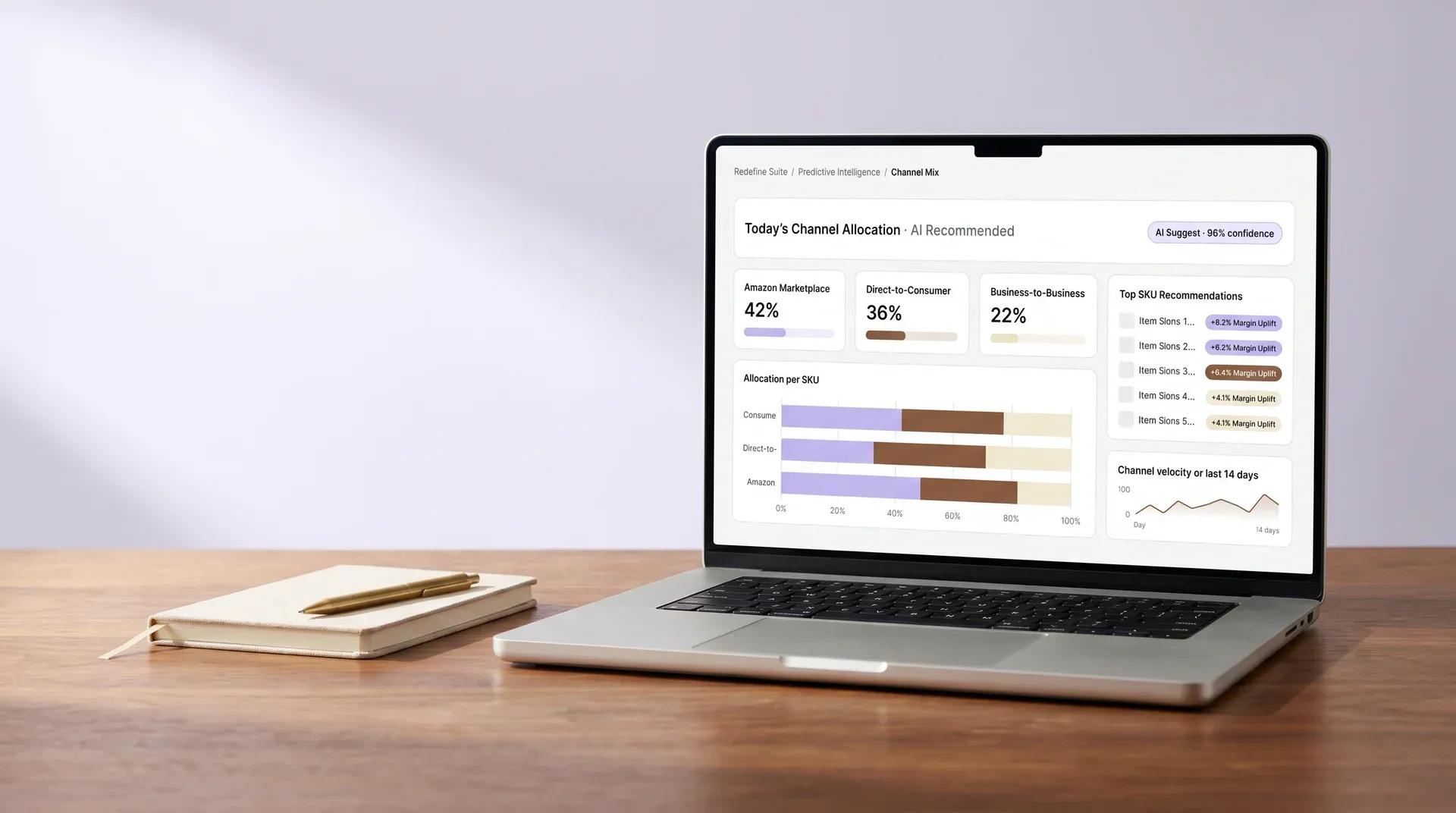
Channel Mix Optimisation
Daily artificial intelligence recommendation on which products to prioritise on which channels: marketplace versus direct-to-consumer versus business-to-business, based on margin, velocity, suppression risk, and competitive pressure signals combined.
Predictive Pricing
Artificial intelligence recommends price adjustments based on demand signals, inventory levels, competitor pricing data, and anticipated margin impact, before you leave money on the table.
Margin-awareCompetitor-tracked
Predictive Lead Scoring and Segmentation
Score every business-to-business prospect and existing customer by predicted lifetime value, conversion likelihood, and upsell readiness. Your sales team focuses on the accounts most likely to act, not the loudest ones.
Meridian Group
91
Summit Trade Co.
74
Crestview Brands
42
How it works
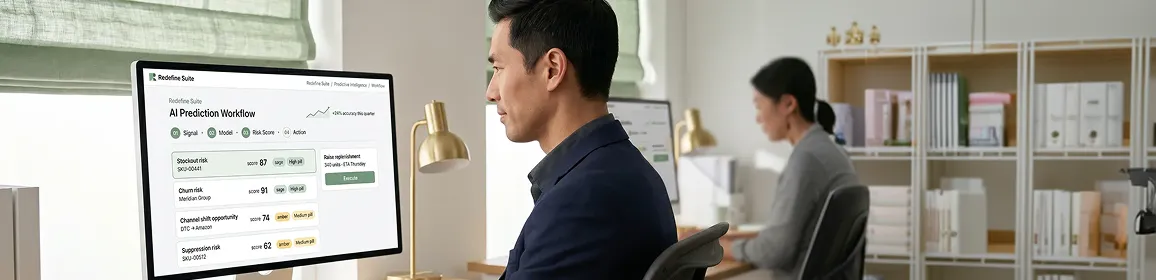
From every commerce signal to your next best action
Predictive Commerce Intelligence works because Redefine is the only platform where order management, product information management, marketplace channels, business-to-business portal, and program stores all share a single data layer. Your predictions improve with every platform interaction.
01
Signal ingestion
Every order, listing event, business-to-business approval, browse session, and inventory movement feeds the prediction layer in real time. No batch imports, no data lag.
02
Model training
Five specialist prediction models train continuously on your platform's unified data, improving accuracy with every fulfilled order, churn event, and seasonal cycle.
03
Risk scoring
Predictions surface as scored risk events: stockout probability, churn score, channel efficiency score. Ranked by financial impact so your team always knows what to action first.
04
Recommended action
Each prediction arrives with a specific recommended action: raise replenishment, schedule account call, or shift promotional budget. A one-click execution path inside the same platform.
Client result
From fragmented data to $70M in revenue

Company
Home Furnishings Retailer
Ecommerce / Direct-to-ConsumerWhat they do
A multi-channel home furnishings brand selling across ecommerce, marketplace, and direct channels with growing inventory complexity.
The problem
Data lived in separate systems across inventory, orders, and fulfillment. Decision-making was slow, reactive, and based on stale reports that arrived days after events had already occurred.
The result
$0M
Annual revenue reached after real-time analytics and predictive intelligence replaced manual reporting. Inventory management and conversion rates improved across all channels.
Who it is built for
Best-fit teams and use cases
Predictive Commerce Intelligence works hardest for operations-heavy teams managing complex inventory across multiple surfaces. The more channels and order sources you have, the more prediction accuracy improves.
Multi-channel retailers
Marketplace and direct-to-consumer operators
Selling on Amazon, your own store, and wholesale simultaneously. Predictions combine all three velocity signals so you never replenish one channel at the cost of another.
Business-to-business commerce teams
Business-to-business account managers
Managing wholesale accounts where churn is expensive and slow to detect. The artificial intelligence churn model monitors every account continuously and surfaces risk before your sales team would notice.
Program store operators
Program and corporate store teams
Running award, redemption, or company stores where event timing creates demand spikes. Predictions factor in program milestones so you are never under-stocked during peak redemption windows.
Merchandising teams
Merchandisers and buyers
Making range and reorder decisions 4 to 8 weeks in advance. Demand forecasts at stock-keeping unit level give your buyers confidence to commit earlier and negotiate better terms with suppliers.
Operations directors
Operations and supply chain leads
Responsible for stockout rate and inventory turn. The prediction layer replaces weekly gut-check spreadsheets with a scored, prioritised action list that updates daily from live platform data.

Platform signal architecture
Predictions only possible on a unified platform
Every other predictive tool reads from one source. Redefine combines every native platform data stream into a single prediction layer. No integrations to maintain, no data gaps, no stale batch syncs.
Data sources (all native)
Order management system: order history and velocity
Marketplace: listing velocity and suppression signals
Business-to-business portal: open orders, browse, and approval pipeline
Program store: redemption events and upcoming awards
Product information management: catalog completeness and listing health
Prediction models
Demand Forecast ModelTraining
Churn Prediction ModelActive
Channel Mix ModelOptimising
Pricing Intelligence ModelScoring
Lead Score ModelRunning
Outputs and actions
Replenishment order triggered and sent to supplier
Account intervention task created in sales workflow
Channel budget reallocation recommendation published
Price adjustment flagged for merchandiser review
Demand forecast distributed to buying team dashboard
Platform connections
Connected to every related Redefine module
Predictive Commerce Intelligence is not a standalone tool. It is powered by and feeds back into every module across the Redefine platform. Use it from day one, and watch accuracy compound over time.
AI Operational Intelligence
Real-time operations signals that feed prediction model accuracy
AI and Automation Hub
The full AI product suite: all intelligence in one platform
Automation Engine
Execute prediction-driven actions automatically without human steps
AI Marketplace Assistance
Marketplace velocity signals power channel mix recommendations
AI Workflow Assistance
Predicted risk events route automatically into workflow queues
AI Content Assistance
Demand forecasts trigger proactive content updates for trending products
Why Redefine is different
Other tools predict from one source. Redefine reads everything.
Point-solution predictive tools are fast to try and permanently limited in accuracy. Their predictions are only as good as the one data source they can reach. Redefine is different because the prediction layer is native to a unified platform. Every signal is already there.
All 5 signals
combined in one model
Other tools read order management system history, or marketplace data, or business-to-business pipeline. Redefine reads all five natively. One extra signal source improves stockout prediction accuracy by 34%. Five together is an order-of-magnitude improvement no point tool can match.
One-click actions
from prediction to execution
Other platforms show you a risk score and stop. Redefine shows you the risk, the recommended action, and executes it, triggering replenishment orders, sales tasks, or pricing changes, all inside the same platform. Zero tool-switching.
Models improve
with every fulfilled order
Because Redefine processes every fulfilment event natively, prediction models train continuously without manual data exports. The longer you run on the platform, the more accurate your forecasts become. This is a compounding advantage that external tools cannot replicate.

Is this the right fit?
Predictive Commerce Intelligence is not for everyone
Great fit
- You sell across three or more channels and stockout decisions affect multiple surfaces simultaneously
- You have a business-to-business account base where losing one large account materially impacts quarterly revenue
- Your buying team makes reorder decisions 4 to 8 weeks in advance and needs stock-keeping unit level demand data to commit confidently
- Seasonal spikes or program events regularly catch your inventory team off guard
Not the right fit
- You sell a single product through one channel with no business-to-business component, so there is not enough signal diversity to model
- Your operation has fewer than 12 months of order history, as the demand model improves significantly with more training data
- You want a reporting dashboard only, as Predictive Intelligence is designed to drive action, not just display historical data
Not sure? Tell us your situation and we will be straight with you. Share your details and we will give you an honest recommendation.
Common questions
Questions buyers ask before committing
Accuracy depends on signal diversity. For operations with 12 months of order management system history plus active marketplace channels, Redefine predictive demand models reach 78 to 91% accuracy on 30-day forecasts at stock-keeping unit level. Accuracy improves further when business-to-business pipeline and program store event data is included. The model tells you its own confidence interval on every forecast so you can see exactly how certain each prediction is.
No. Predictions surface as plain-language risk scores and recommended actions. Your operations and buying teams see "stockout risk: high, reorder 340 units by Thursday" rather than raw model output. Advanced configuration options exist for technical teams who want to tune signal weights or thresholds, but day-to-day use requires zero data science knowledge.
Predictions improve proportionally with the number of native Redefine modules you use. A team using Redefine order management system and marketplace modules gets materially better predictions than one importing order history via comma-separated values file. We recommend starting with the modules most relevant to your current pain point, then expanding the signal base as your platform footprint grows. Our scoping process maps which starting point gives you the best initial return on investment.
Churn risk scores and channel mix recommendations surface within the first 72 hours of data ingestion, as they rely on relative pattern comparison rather than extensive training history. Demand forecasts at full accuracy take 4 to 6 weeks of live order history. Your first useful prediction arrives in days; full model maturity arrives within a quarter.
Every prediction includes a confidence score. Low-confidence predictions are flagged so your team applies human judgment before acting. When a prediction misses, such as a demand surge from an external event the model did not anticipate, you can flag the outcome and the model incorporates the correction in future training cycles. Over time, your model learns your specific business patterns including anomalies specific to your channels and customer base.
Get your scoped proposal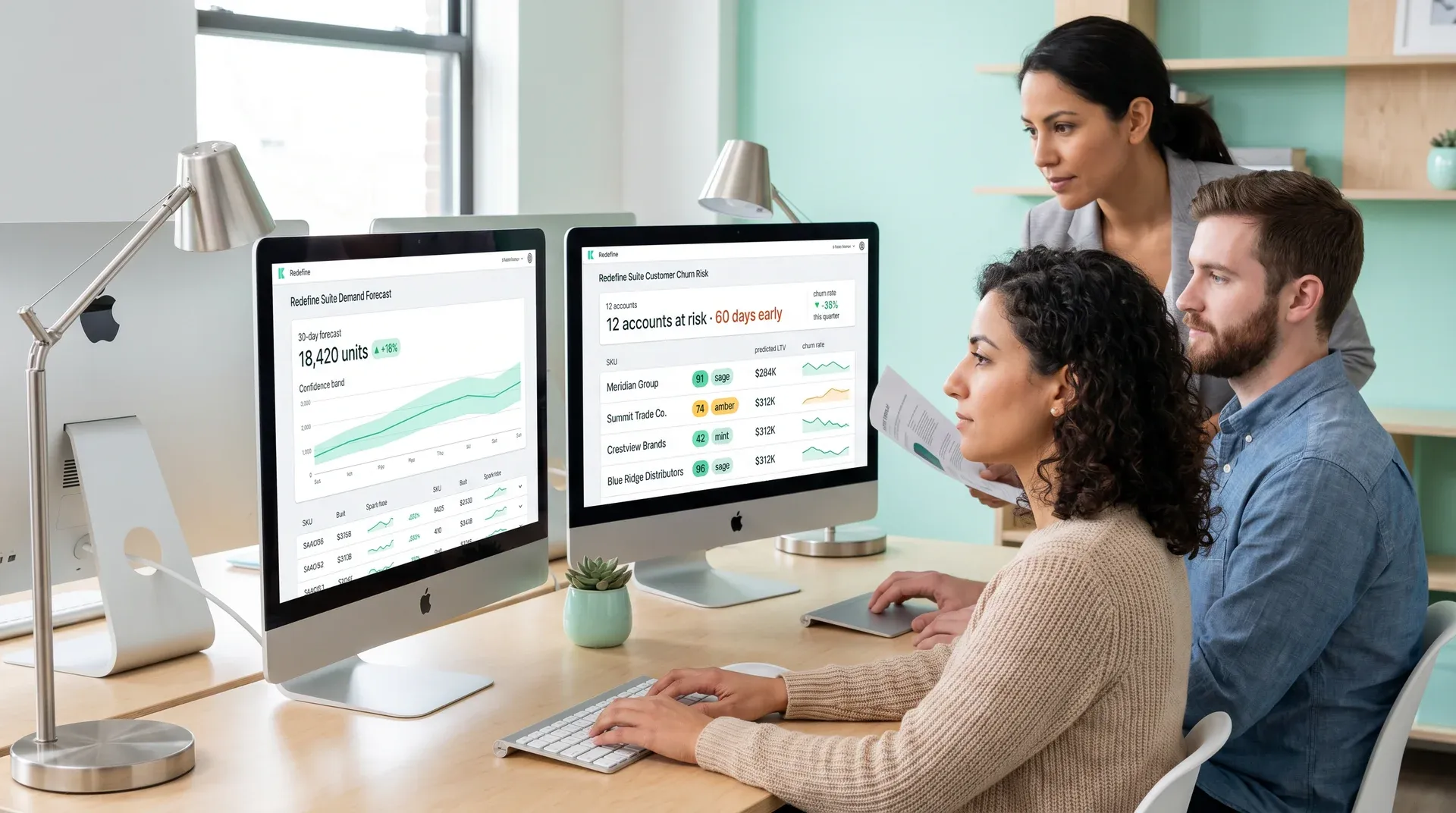
See what predictive intelligence finds in your operation
Submit your brief and your team gets a scoped proposal showing which prediction models apply to your channels, expected accuracy based on your data footprint, and a line-by-line implementation plan. No commitment required to see the proposal.
0
commerce teams on platform
0
average days early stockout alerts fire
320+ projects completed. 400+ brands served across retail, wholesale, and marketplace commerce.

Start predicting, not reacting
Your next stockout is already predictable
The signals are already in your platform data. Redefine reads them, scores the risk, and tells your team what to do before the cost hits your bottom line.
Predictions fired today0
Revenue at risk: actioned$142K protected
Stockout alerts: 14-day window3 stock-keeping units flagged
Business-to-business accounts at churn risk2 accounts
Next action: Raise reorder for stock-keeping unit 4471. Predicted stockout in 9 days