AI and Automation · Core Platform
Module
AI automation that runs your commerce. With humans in control.
Most AI tools suggest. Ours executes. Redefine ships AI agents that enrich product data, rescue suppressed listings, route orders, and answer buyer questions, all grounded in your live product information management record. Every action is reviewable. Every outcome is auditable.
See a working demo · no commitment · 30 minutes on your real data
Pick a task. Watch the AI agent answer.
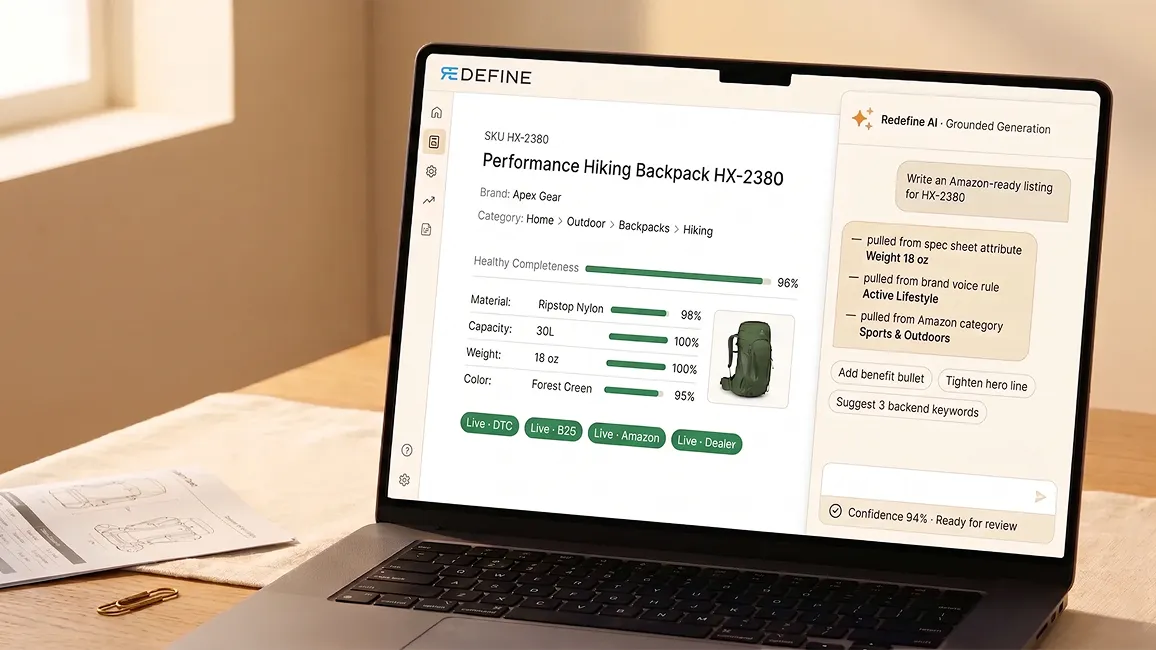
Generate an Amazon-ready listing for SKU
HX-2380
AI output · grounded in product information management record HX-2380
Source of truth: your product information management record No hallucination, no copy-paste
When AI agents run inside the same platform that holds your product data, orders, and channels, the math changes.
0h
Operator hours per week reclaimed from copy and data busywork
0%
Of suppressed marketplace listings auto-fixed before a human notices
0x
Faster product onboarding from supplier sheet to live across channels
0%
Of AI changes captured in an auditable log with one-click revert
Why most ecommerce AI quietly fails
Three reasons your AI tools sit on a shelf. Tap any card to flip it.
Buying AI is easy. Operating it is the hard part. Tap each card to see what breaks, then what we fix.
Pain · Shallow
AI guesses copy from a store name and a category.
It writes pretty paragraphs that contradict your spec sheet, your product identifier master, and your marketplace policy. You catch it. Sometimes.
Tap to see the flipCure · Grounded
Our AI reads your live product information management record before it writes a word.
Every output cites the attribute it pulled from. Brand voice rules apply automatically. If a fact is missing, the AI flags it instead of inventing it.
Tap backPain · Disconnected
AI lives in one tab. Your data lives in seven.
The bot in your content management system does not know your inventory. Your marketplace tool does not know your business-to-business contract pricing. Each one needs a human to bridge the gap.
Tap to see the flipCure · Cross-Module
One agent reaches across product information management, order management, marketplace, and forms.
A single rule can enrich a product, route an order, refresh a marketplace listing, and notify a buyer. No connectors to babysit. No data export to a separate AI tool.
Tap backPain · Ungoverned
AI writes. AI publishes. Nobody knows who approved what.
Brand voice drifts. Compliance lines disappear. When a customer flags a wrong claim, you cannot trace which prompt produced it or when it shipped.
Tap to see the flipCure · Governed By Default
Every AI action passes through a review queue with one-click revert.
Brand voice rules and compliance guardrails apply before publish. Confidence scores flag risky outputs. The audit log answers who, when, and why for every change.
Tap backWhat is inside the product
Six AI and automation modules. One platform. Click any tile.
Each module ships ready, drops into the same data layer, and respects the same governance rules. Pick what you need today, turn on the rest as you grow.

Signature interactive · pick a scenario
You drive the AI agent. Step by step.
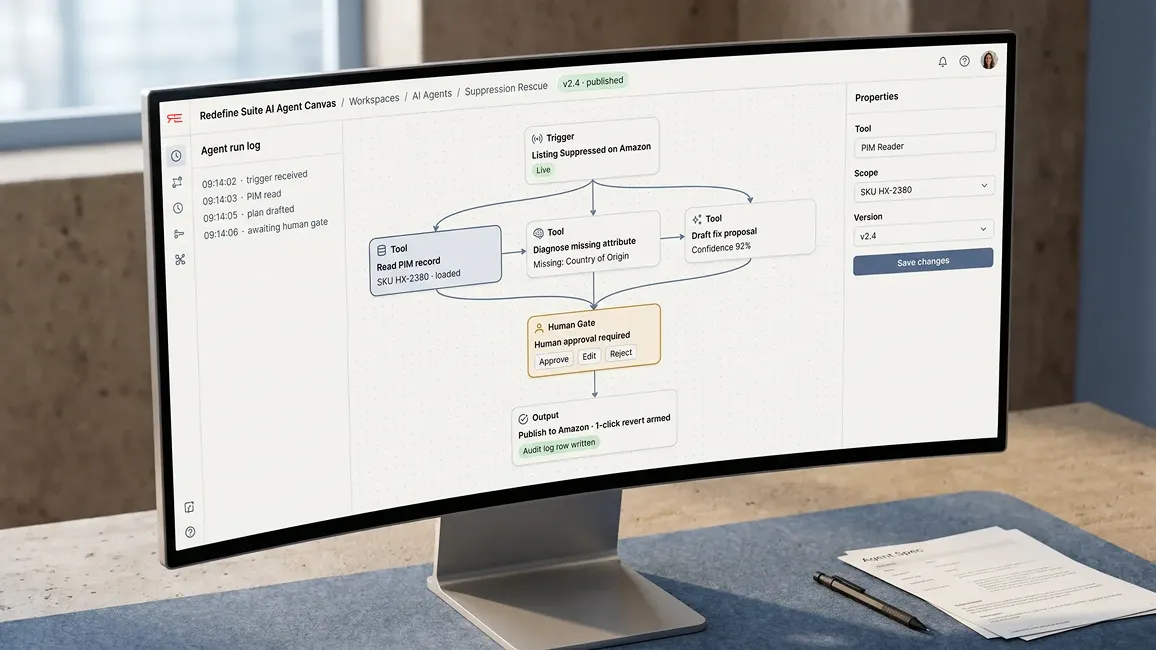
Pick one of three real commerce scenarios. Watch the agent work across product information management, order management, and marketplace. Approve at the human-in-the-loop gate. See what changed.
Step 1
Pick a trigger to send the agent into.
Step 2
Watch the agent walk the workflow.
Detect
Trigger received
Plan
AI drafts the action plan
Execute
Touches product information management, order management, marketplace
Human gate
You approve, edit, or reject
Publish
Changes live, audit log written
Stage 1 of 5 · Detect
Click Run Agent to start the trace.
The agent begins by reading the trigger event and loading the live product information management record before it touches anything else.
Human-in-the-loop gate
The agent has prepared its changes. Confirm before they go live.
Outcome
Agent run complete. Here is what changed.
Where shallow AI breaks
Same scenario. Two very different outcomes.
A supplier sheet lands at 9:14 in the morning. By lunchtime, you need that product live across direct-to-consumer, business-to-business, and Amazon. Watch what each kind of AI does next. Flip the toggle.
Their AI · Single ToolA bolt-on AI assistant in your content management system
Scenario: new product onboarding, sheet to liveIndustries · roles · use cases
One AI agent. Four different conversations.
Buyers, shoppers, sales representatives, and operators all talk to the same agent. Each one gets the answer they need, grounded in the data they are allowed to see. Pick a persona to peek inside.
B2B Buyer · Purchasing Manager
Re-order three months of inventory in one sentence.
A buying assistant that knows your contract pricing, your approval rules, and your last twelve orders.
Every reply grounded in
this account's permissions and live product information management data
Integrations · ecosystem fit
The agent reaches everywhere your data lives.
Every Redefine module exposes the AI agent. Click a node to see what the agent does inside that integration.
AI Agent
Customer outcome · proof
A heavy-equipment dealer cut manual data work and made every part findable.
From a slow site with siloed inventory to a unified, automated platform that syncs enterprise resource planning, marketing, and storefront in real time.
Real-time
Enterprise resource planning-to-storefront inventory sync, replacing manual data handling
100%
Of equipment and parts now visible to customers online
Trigger-driven
Marketing flows now run on inventory and behavior events, not manual schedules
The challenge was a legacy site that could not handle catalog scale, no integration between the storefront, the enterprise resource planning system, and email marketing, and manual processes that created silos. The team rebuilt the storefront on an application programming interface-first headless architecture, integrated it directly with the legacy enterprise resource planning system for real-time equipment and parts sync, and connected Klaviyo at the headless level to fire automated flows on inventory and behavior events. The result is an automated, scalable platform with full inventory visibility, accurate cross-system data, and marketing that runs itself based on what is actually happening in the business.
Explore the rest of the suite

Common questions
Five questions buyers ask before they ship our AI.
Bolt-on AI tools live next to your data. Ours lives inside it. The same agent reads your product information management record, writes the marketplace listing, and routes the order, all from one platform with one permission model and one audit log. No connectors to babysit, no data export to a separate AI vendor, no copy-paste between systems.
Three layers. First, every output is grounded in your live product information management record, so it cannot invent specs. Second, brand voice and compliance guardrails apply automatically before publish. Third, the AI assigns a confidence score and routes anything below your threshold to a human approval queue. You see the proposed change, accept, edit, or reject in one click.
Yes. The automation engine is a visual builder. Pick a trigger (order placed, stock low, listing suppressed, form submitted), pick conditions, pick actions across modules. Save and run. The same builder is used by operations leads, information technology directors, and platform admins. Webhook triggers and application programming interface extension are available for cross-system automation when you need them.
Every AI action writes a row to the audit log: what changed, which agent ran it, which prompt produced it, who approved it, and the timestamp. Each row carries a one-click revert. If a customer flags a wrong product claim, you can trace the full chain and roll back the change in seconds, not days.
The two highest-impact starting agents (catalog enrichment and suppressed-listing rescue) are pre-built and ship configured. Most teams see them running on real data within the first two weeks of platform onboarding. Custom agents using the no-code automation engine typically take a single team afternoon to design, test, and turn on.
Looking for something else? Book a working session and ask in person
Is this a good fit
Know before you book.
We would rather turn away the wrong lead than waste your afternoon. Read both columns honestly.
Good fit when
- You have an active product catalog with 500 or more items and at least one live sales channel.
- Your operations or commerce team spends meaningful time each week on manual data tasks (copy, listings, routing).
- You can dedicate 3 to 4 hours per week of a product owner's time across the onboarding period.
- Compliance, brand voice, or accuracy requirements make ungoverned AI publishing a real risk you want solved.
- You sell across more than one channel (direct-to-consumer storefront, marketplace, business-to-business portal) and want a single agent across all of them.
Not a fit if
- You are looking for a one-time setup with no ongoing governance or automation layer.
- Monthly revenue is under $10,000 or your catalog is still being built from scratch.
- You want every channel managed by one in-house person with no external platform integration.
- You have no existing product data structure or source-of-truth catalog for the AI agents to read from.
- You need everything live within 48 hours with zero onboarding time from your team.
Not sure? Tell us your situation and we will be straight with you.
Ready when you are
See AI and automation in action.
A working session on your real data. Pick the workflow you hate the most. We show you the agent that retires it, end to end, in 30 minutes.
No commitment No pitch Working session, on your data
Start here
Tell us what your team does manually that a system should handle.
Scoped before work starts. Line-by-line pricing. No commitment to receive a proposal.
form
Call within 48 hours · proposal in 3 days · Sprint 1 within 1 week of sign-off
Within 48 hours
First response after brief submission
3 days
Scoped proposal delivered
180+ projects
Commerce automation builds completed
Full ownership
All code and configurations are yours
Brief received.
We will review your workflow and send a scoped proposal within 3 business days. Expect a call within 48 hours to align on priorities.