Live across every commerce channel
One platform.Every channel you sell through.
Business-to-business portals, direct-to-consumer storefronts, dealer networks, marketplaces, and program stores, all connected to one inventory ledger and one enterprise resource planning system.
10 modules native
One inventory ledger
12-week go-live
One service agreement

powered by
Redefine
Commerce
Command CenterLIVE
Business-to-Business
284
Direct-to-Consumer
1,147
Marketplace
632
Dealer Network
93
Program Stores
47
$0
Revenue in reference cases
0
Native in one platform
0
Phased go-live timeline
0
Covering every module
Why Commerce Teams Are Switching
The cost of running channels in silos.
Hover any card to expand the breakdown.
34 hours
Weekly reconciliation
34 hours
Weekly
Finance cannot act without manual data pulls.
Separate commerce, order, and enterprise resource planning systems force spreadsheet reconciliation before every decision. Redefine uses one shared data layer.
4 months
Per new channel
4 months
Per channel
Every
new channel is a custom integration project.
Fragmented stacks average 14 to 18 weeks per channel. On Redefine, new channels are configuration; your team activates them, not a systems integrator.
8 vendors
Per support incident
8 vendors
Per incident
An
oversell means nobody owns the failure.
Commerce blames orders. Orders blames the enterprise resource planning feed. Redefine owns every layer under one service agreement: one escalation path, one resolution.
3 copies
Every product record
3 copies
Per product
Storefront, product data, and enterprise resource planning all drift apart.
Redefine uses one product record feeding every channel simultaneously. No sync jobs. No stale data. One update goes everywhere in seconds.
One Product. Every Surface.
One inventory ledger feeds every channel simultaneously.

10 Native Commerce Modules
Every capability in one connected system.
Select any module to see what it does and what it replaces.
Module 01
Business-to-Business Commerce
Account-specific catalogs, purchase order checkout, approval workflows, and net terms, all pulling live pricing from your enterprise resource planning system. No sales representative needed for routine orders.
Account pricing tiersPurchase order checkoutApproval workflowsNet terms
Explore this module →
Module 02
Direct-to-Consumer Ecommerce
Consumer storefront sharing the same inventory ledger and product catalog as your business-to-business channel. One order anywhere deducts stock everywhere instantly. No batch sync. No oversells.
Shared real-time inventoryNative personalisationHeadless readySplit testing
Explore this module →
Module 03
Dealer and Distributor Portals
Branded portals per dealer or distributor with territory controls and account-level pricing pulled live from your enterprise resource planning system. No manual exports.
Territory access controlAccount-level visibilitySales rep management
Explore this module →
Module 04
Customer-Specific Pricing
Every customer sees their negotiated price at checkout, pulled live from your enterprise resource planning price book. Zero margin leakage from manual pricing errors.
Live enterprise resource planning price
syncVolume tiersContract pricing
Explore this module →
Module 05
Quote to Order Workflows
Customers request quotes, your team responds, and one click converts the approved quote to an order. No email chains, no re-entry, full audit trail.
Online quote requestsOne-click conversionFull audit trail
Explore this module →
Module 06
Procurement and Punchout
Enterprise buyers using SAP Ariba or Coupa punchout directly to your catalog, fill their cart, and return a purchase order to their procurement system automatically.
SAP Ariba punchoutCoupa punchoutAuto fulfilment trigger
Explore this module →
Module 07
Promotions and Merchandising
Configure a promotion once and it applies across your business-to-business portal, direct-to-consumer storefront, and marketplace listings simultaneously.
Cross-channel promotionsBundle pricingCategory merchandising
Explore this module →
Module 08
Multi-Brand and Multi-Region
Multiple brands and regional storefronts from one platform. Each brand keeps its own identity, pricing, and domain. All share one product data layer and enterprise resource planning connection.
Per-brand domainsRegional pricingShared inventory
Explore this
module →
Module 09
Headless Commerce and Application Programming Interfaces
REST and GraphQL application programming interfaces over a fully operational back end. Your developers extend an existing platform, not build every commerce function from scratch.
REST application programming
interfaceGraphQLWebhooks
Explore this module →
Module 10
Customer Account Management
Parent accounts, child accounts, sub-users, spending limits, and approval roles, self-managed by the customer team. Full order history with no sales representative involved.
Account hierarchySpending limitsSelf-serve users
Explore this module →Order Journey
Checkout to fulfilment in one connected motion.
Click any stage to see exactly what Redefine does at that moment.
Stage 1
Customer Order
Any channel
Stage 2
Checkout
Price
verified live
Stage 3
Redefine
Inventory
reserved
Stage 4
Enterprise Resource Planning
Order
record written
Stage 5
Fulfilment
Pick, pack,
ship
Stage 1: Customer Order
Order placed on
any channel. Inventory reserved immediately.
The order enters Redefine through the same application programming interface regardless of channel. Inventory is reserved across every active channel simultaneously the moment the customer checks out, preventing oversells from concurrent orders.
Operations In Sync
Every channel in one view. No reconciliation queue.
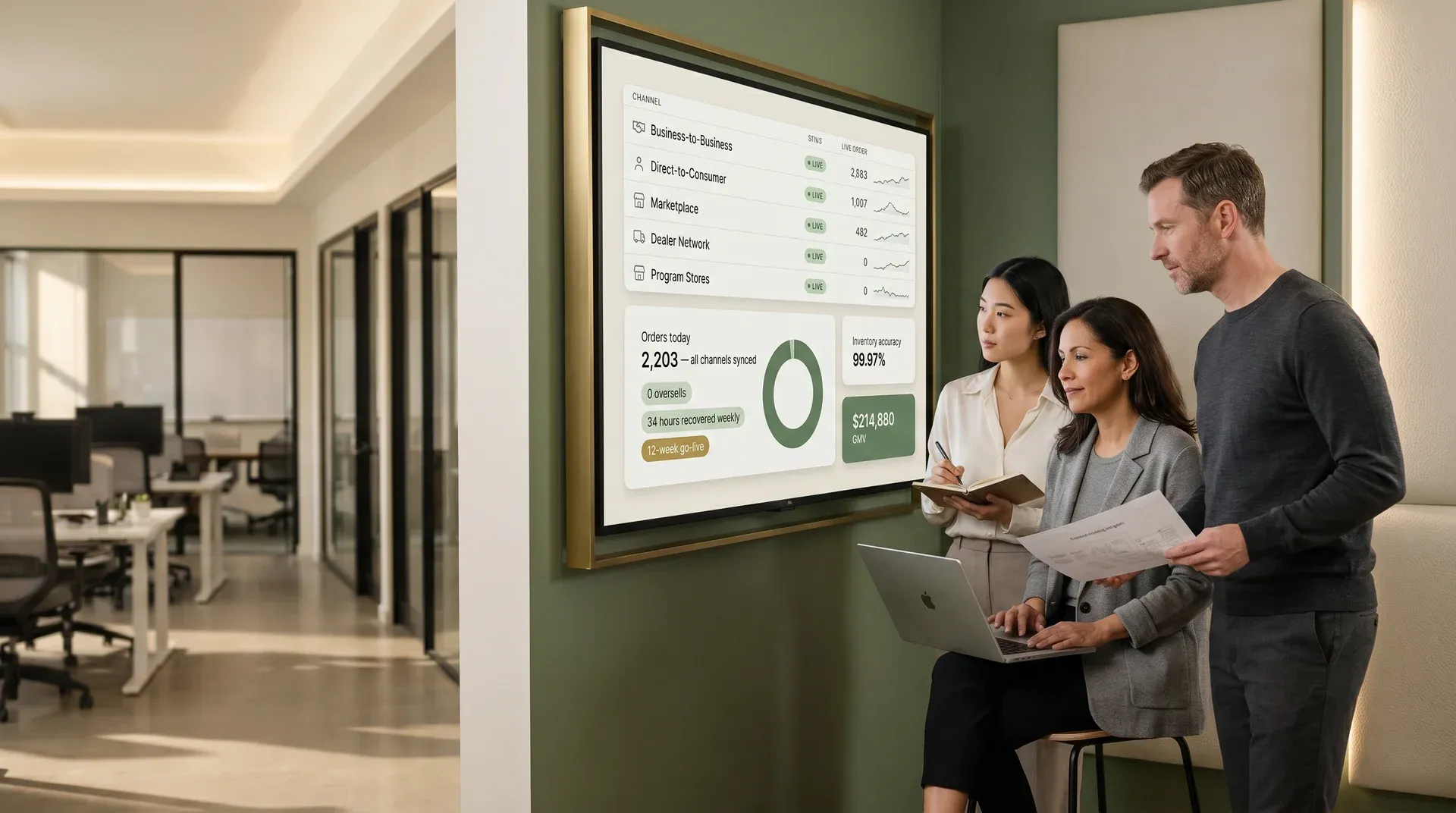
Part
of the Redefine suite:Core Products hub ›Content Management System Platform
›Forms and Workflow Software ›
Enterprise Systems Integration
What data moves, where it goes, why it matters.
Click any row to trace the full data path.
Customer sends
Redefine processes
Enterprise systems receive
Pricing request
"What is my price for this
item?"
Queries enterprise resource planning. Returns account price live.
Enterprise resource planning receives
Zero. Read-only. Enterprise
resource planning remains source of truth.
Order submission
"Place this order for 40
units."
Reserves inventory. Processes payment. Routes to enterprise resource planning.
Enterprise resource planning receives
Confirmed sales order. Invoice
triggered. Fulfilment started automatically.
Shipment update
"Order shipped. Tracking:
1Z999..."
Updates customer history. Sends notification. Closes fulfilment record.
Enterprise resource planning receives
Shipment confirmation. Invoice
event. Order history updated everywhere.
Product update
Enterprise resource planning
updates price or availability.
Syncs to all channels in seconds. No manual export.
Every channel receives
Live price and availability.
No stale data. No sync lag.
Pre-built
connectors for:Microsoft Dynamics
365SAP S/4HANANetSuiteSageInforEpicor
"Revenue scaled from under $14 million to over $90 million. 30 store locations and over one million
inventory items unified on a single platform. The manual processes that had limited our growth for years
were eliminated in the first 90 days after go-live."
Chief Operating Officer
Specialty Retail and Distribution, 30 locations,
1 million or more inventory items
Inside The Dealer Portal
Branded portals per dealer. Live pricing from your enterprise resource planning.

Measured Commerce Outcomes
The transformation in numbers.
Specialty retail and distribution. 30 locations.
From $14M to $90M after unifying 30 stores on one platform.
$14M
Before
$90M+
After Redefine
30
Locations unified
1M+
Inventory items
Business-to-business commerce transformation
Faster performance. Reliable live inventory. Smoother purchasing workflows.
Legacy platform could not support complex business-to-business workflows. The rebuild delivered real-time inventory connected to the enterprise resource planning system and smooth approval workflows at scale.
Headless
ecommerceEnterprise resource planning integration
Consumer commerce at scale
Revenue scaled to over $15M through unified order management across channels.
Global security products operator expanded across marketplaces, unified order management, and deployed data-driven campaigns on one connected platform.
Multi-channelUnified order management
Who This Is For
Redefine serves three leaders simultaneously.
Click any role to see what the platform means specifically for you.
Chief Executive / Revenue Leader
Revenue recovery, margin
improvement, and channel expansion at lower operating cost.
$90M+
Revenue in reference cases
From $14M. Same team. Unified channels.
New channels activate in days, not 4-month integration projects
One service agreement replaces 8 separate vendor contracts
Real-time revenue visibility across all channels in one view
Operations Leader / Vice President of Ecommerce
Inventory accuracy, order
routing without manual decisions, exceptions that resolve themselves.
34 hours
Recovered every week
No
more reconciliation queues or manual routing.
Inventory is one real-time ledger, zero discrepancy across channels
Order routing follows rules your team sets, no manual dispatch queue
Enterprise resource planning sees every order the moment it is placed
Technology Leader / Information Technology Director
One integration surface,
one auth system, and a rollout that does not require a big-bang cutover.
12 weeks
Phased go-live
One
integration. One auth. One security certification.
REST and GraphQL application programming interface, one sandbox, one staging environment
Pre-built enterprise resource planning connectors, go live faster, no custom middleware
Security certification covers all 10 modules under one audit scope
Frequently Asked Questions
Questions buyers ask before they decide.
Yes. Both channels share one product catalog, one inventory ledger, and one enterprise resource planning connection. When a business-to-business order reduces inventory, the direct-to-consumer storefront reflects it in real time. No separate product feeds.
Pricing is pulled live from your enterprise resource planning price book the moment a customer views a product. Changes to price agreements in the enterprise resource planning system propagate to the storefront automatically. You manage pricing in one place.
Phased model. Weeks 1 to 4: data migration and staging sign-off. Weeks 5 to 8: parallel operation with channel-by-channel activation. Weeks 9 to 12: full production cutover. Rollback path remains available throughout. Your existing platform keeps running until you are ready.
No. Three options: use the Redefine front end, connect your existing front end via REST or GraphQL application programming interface, or build a new front end on the application programming interface layer. Redefine has a complete back end; your developers extend, not build from scratch.
Yes. Multi-brand and multi-region is a native module. Each brand keeps its own domain, pricing, language, and identity while sharing one product data layer and enterprise resource planning connection.
One service level agreement covers every module. All 10 modules are the same platform and the same support relationship. One escalation path. No finger-pointing between vendors. Audit logs across every module make root cause analysis faster than any fragmented stack.
Start with your value case
Tell us your stack. We build the case.
Scoped before work starts. Line-by-line pricing. No commitment to receive a proposal.
Form
Call within 48 hours
of submission
Proposal in 3 days
scoped to your stack
90+ projects live
across commerce platform
Full code ownership
delivered at handoff
Ready to see it live?
One session. Every channel.
One session. Every channel.
Your exact use case.
A commerce platform specialist prepares a tailored walkthrough of the specific modules and enterprise connections relevant to your business.
Submit brief → call within 48 hours → proposal in 3 days → platform live in 12 weeks