Omnichannel Controls
Multibrand ecommerce that runs from one unified admin
30Stores. One admin.
0Duplicate catalog updates
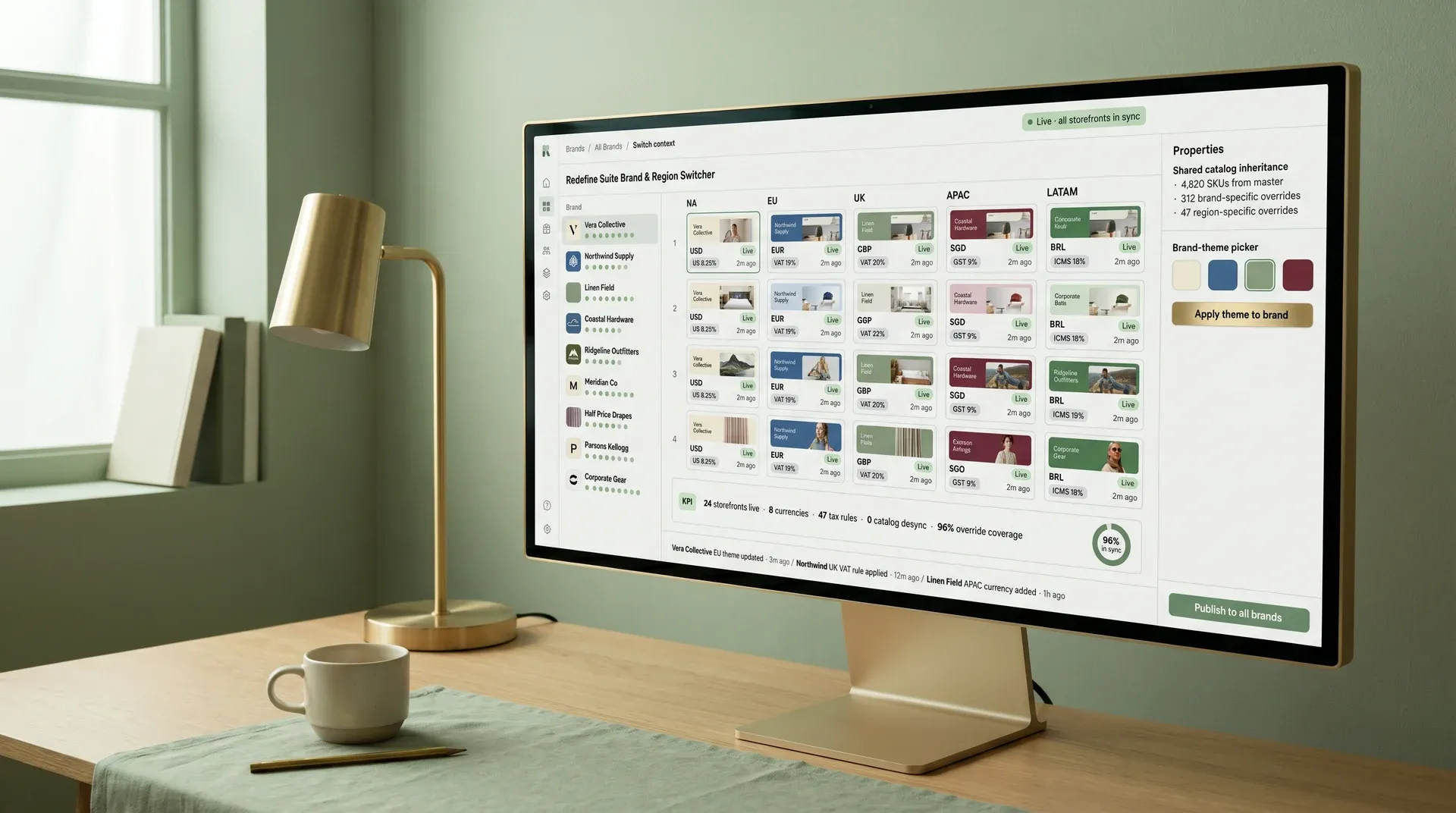
Give each brand its own storefront, pricing, and catalog. Manage all of them from a single control panel without duplicating work or splitting your team across tools.


The problem with fragmented brands
Two ways to run a growing brand portfolio
Most teams reach a point where managing more than one storefront stops being a scale problem and starts being a systems problem.
Fragmented approach
- Duplicate catalog updates across separate systems
- Price changes require logging into each storefront separately
- Inventory oversell risk when channels operate independently
- No consolidated analytics across your brand portfolio
With Redefine
- One catalog, shared or overridden per brand
- Pricing rules apply across all stores in one action
- Real-time inventory unified across every channel
- Consolidated brand performance in one dashboard
Built for your team
Different teams, one platform
Whether you are adding your second storefront or managing dozens of regional stores, Redefine scales with how your business is actually structured.
Configuring brand number 3
Vera Collective
Setup progress3 of 4 steps
Catalog inheritanceShared from
master
Pricing rule setBrand-specific
CurrencyUSD
Inventory poolUnified across all
brands
Platform capabilities
Every control your brands need
These capabilities come standard across every store and brand on the platform. No per-brand add-on licensing required.
Core capability
Centralized catalog management across all channels
Manage one master catalog that every storefront inherits from. Each brand can override product names, images, descriptions, and pricing without creating a separate data record. Changes to the master propagate everywhere automatically.
Master catalogPer-brand overridesCatalog inheritance
Unified inventory visibility
Real-time stock levels across every warehouse, storefront, and channel in one view. Sales on any channel update shared inventory immediately, eliminating oversell risk.
Channel-specific pricing and assortment
Set different price lists and promotional rules per channel, per brand, or per region. One pricing engine drives everything without a separate tool.
Buy online, pick up in store
Connect online storefronts to physical locations across all brands. Buyers see real-time local availability at checkout without leaving the storefront.
Fulfillment
Drop-ship and supplier fulfillment coordination
Route orders directly to suppliers or third-party logistics providers from any storefront. Fulfillment rules apply per brand, region, or product category without manual routing decisions per order.
Third-party logistics
integrationPer-brand routing rules
Customer result
What unified multistore control looks like at scale
Customer
Parsons Kellogg
Promotional products and
branded apparelA major provider of promotional products, corporate apparel, and branded merchandise operating across a large multistore ecommerce footprint.
The challenge
No unified visibility across 30 stores and over one million inventory items. Manual processes slowed decisions and constrained growth. Fragmented integrations between backend platforms meant every operational change required touching multiple systems.
Result
Annual revenue grown to
$90M+
Up from under $14M when the transformation began. Revenue grew through centralized headless architecture, automated operations, and real-time analytics across all 30 stores.
30
Stores unified
1M+
Inventory items
How it was done
- Centralized catalog and inventory across all 30 storefronts
- Headless architecture with deep enterprise resource planning integration
- Real-time reporting across all store and financial data in one dashboard
- Automated warehouse operations eliminating manual restocking workflows
Platform architecture
One platform connects everything
Redefine connects to your existing enterprise resource planning, content management, product data, and marketplace tools through a single application programming interface surface. No middleware, no sync delays.
Enterprise Resource Planning
SAP, NetSuite, Microsoft Dynamics: connected via application programming interface
Product Information Management
Centralized product data with per-brand publishing rules
Content Management System
Per-brand content with a shared template library
Redefine
One application programming
interface surface
Live
Marketplace Channels
Same catalog, published to all channels simultaneously
Inventory and Warehousing
Real-time stock across all brands and warehouse locations
Analytics and Reporting
Consolidated brand and store performance in one dashboard
REST
and GraphQL
Full application programming interface coverage across every
platform module
Webhooks
Event-driven updates push to your systems the moment something
changes
Headless delivery
Application programming interface-first architecture supports
any storefront framework or device target
Why Redefine
Unified wins over patched together
Platforms built for single-brand commerce require new accounts, new integrations, and manual syncing every time you add a brand. Redefine was built for this from the start.
Redefine
- Per-brand product data, content management, and analytics from one admin
- Catalog shared or forked per brand without data duplication
- Pricing rules applied to all stores in one action
- Real-time inventory unified across all channels without sync delays
- Single application programming interface surface, no middleware required
Typical platform
- Separate admin login required for each brand or storefront
- Manual catalog sync between systems each time data changes
- Price updates require repeating the change in every storefront
- Inventory tracked per system, creating oversell risk across channels
- Third-party middleware required to keep storefronts in sync
Best-fit use cases
Multi-brand retailers
Consumer brands managing distinct identities from one operational team. Each brand gets its own storefront and analytics without a separate platform account.
Global brands with regional stores
International operations requiring localized storefronts with shared catalog, centralized inventory, and region-specific pricing and locale configuration.
Manufacturers with dealer portals
Manufacturers running their own direct channel alongside dealer and distributor portals. One product data set, multiple buying experiences tailored per audience.
Frequently asked
Common questions about multibrand ecommerce
Redefine uses a shared catalog layer that every brand inherits from by default. Each storefront can override specific product data, pricing, and content without duplicating the source record. One product entry powers as many branded presentations as you need.
Yes. Each storefront can have its own price list, currency, and promotional rules while drawing from the same catalog and inventory layer. Changes made centrally cascade to all stores, and store-level overrides remain intact.
Redefine maintains a unified inventory record across all storefronts, warehouses, and channels in real time. When a sale happens on any storefront or channel, inventory levels update immediately everywhere, eliminating the oversell risk that comes from managing stock in separate systems.
A typical setup has a master catalog and inventory layer at the platform level, with each brand getting its own storefront configuration, content management, analytics, and pricing. Brands can share fulfillment infrastructure or operate independently, all governed from one admin.
Single-brand platforms require separate accounts, integrations, and manual syncing every time you add a brand. Redefine was built with multi-brand governance as a core architectural feature, so the second and third store inherit everything the first store already configured.
Get started
See every brand, every region, one view
A 30-minute walkthrough shows how your brands would be structured on Redefine. No commitment. No pitch.
Form
Call within 48 hours · proposal in 3 days · Sprint 1 within 1 week of sign-off
Brief received
We'll review your brand portfolio setup and send a scoped proposal within 3 business days. Expect a call within 48 hours.
Response within 48 hours
A multibrand commerce specialist
reviews your brief and calls within two business days.
Scoped proposal in 3 days
Line-by-line scope covering every
brand and region before any commitment. No surprise estimates.
180 projects completed
Across multibrand, multiregion,
and headless commerce rollouts for manufacturers, retailers, and distributors.
You own the code
Full handoff documentation at
sign-off. No vendor lock-in unless you choose it.
Book a walkthrough
See every brand, every region, one view
A 30-minute walkthrough shows how your brands would be structured on Redefine. No commitment. No pitch.