Your marketing team filed 3 developer tickets while you loaded this page
The headless Content Management System wheremarketers take over.
Developers define the content model once. Marketing teams own content forever. Publishing approvals, multi-site, localization, and content governance included.
8 native modules
Any front end
No developer tickets
Content StudioLive
Homepage Hero / English (United
States)
Draft, auto-saved
8 seconds ago, version 12
PreviewSend
for Approval
HEADLINE
Commerce
built for manufacturers
BODY
One platform for
business-to-business portals, direct-to-consumer storefronts, and marketplace channels...
CTA LABEL
Book a Demo
STATUS
Awaiting
Content Lead
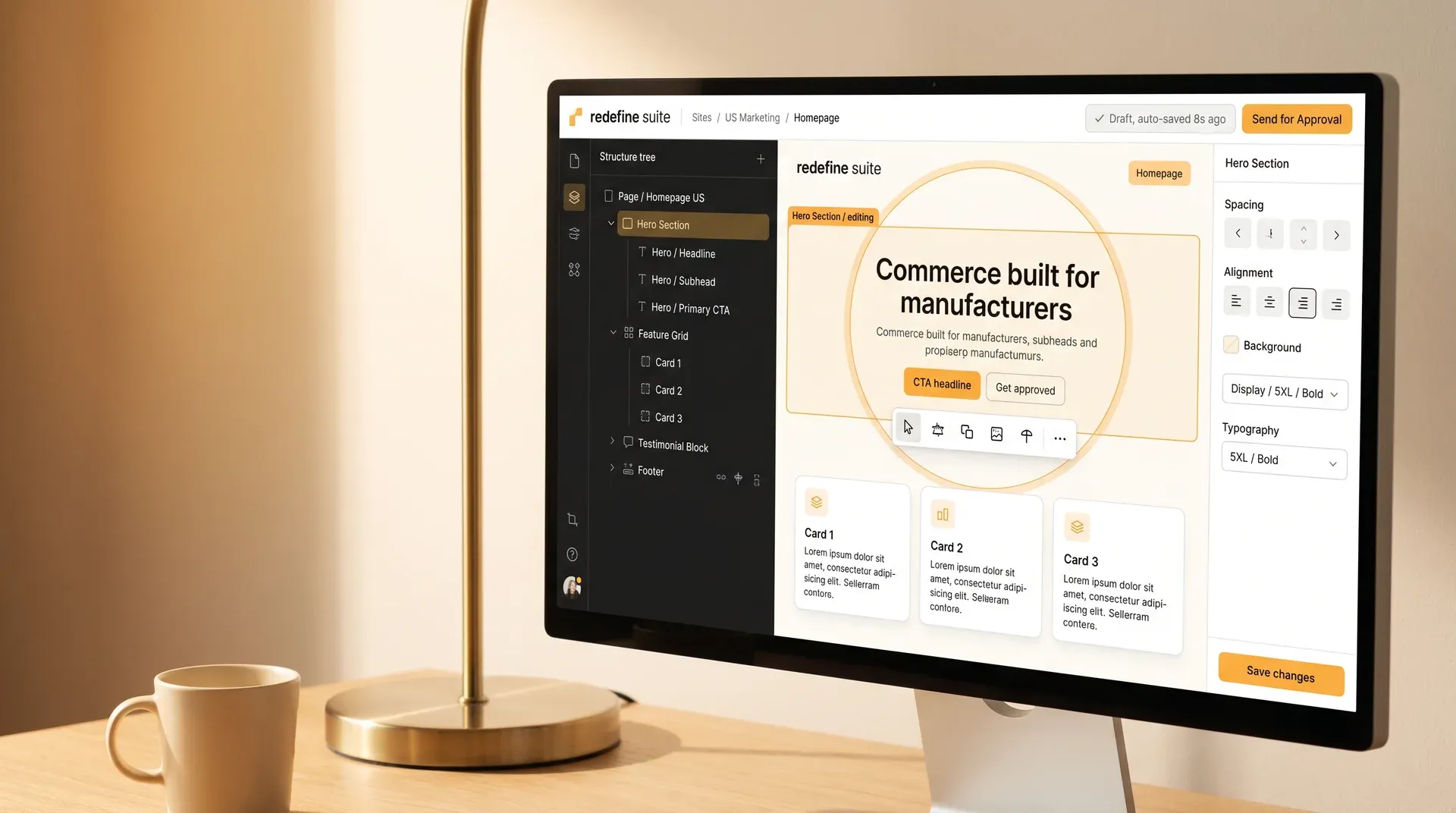
The real cost of your current content management system
Before and after
Drag to see what changes when a marketer needs to edit one headline.
Same task. Same content. Completely different experience. Drag the handle left and right.
Without Redefine
JIRA TICKET #4821 - content update
Assignee: @dev-team
Priority: Medium
Status: In Backlog
Estimate: 3
to 5 business days
Request from
Marketing:
"Please
change the homepage headline from 'Commerce for distributors' to 'Commerce built for manufacturers'.
Also update the subheadline to reflect Q3 campaign language. See attached brief."
Developer time required: 3 to 5 days
File edit, pull request review, staging
deploy, approval, production deploy
With Redefine
VISUAL EDITOR - Homepage Hero
HEADLINE (click to edit)
Commerce built for manufacturers
PREVIEW
Commerce built for manufacturers
One platform for
business-to-business...
Time to live:
45sec
No developer involved. No ticket filed. No
deploy required.
Marketer edits, previews, sends for
approval, publishes directly
340+ hours
Developer hours spent on content per year
3 to
5 days
Average content ticket resolution
45 sec
Same update in Redefine visual editor
Interactive Visual Editor
The visual editor your marketing team will actually use.
Click the blocks in the left panel to add them to the page. Click any element on the page to edit its properties. No code. No developer ticket.
BLOCKS
Hero Section
Text Block
Image and Caption
Call to Action Strip
Card Grid
Testimonial
Inline Form
PAGE LAYERS
▼ Hero Section
✓ Headline
✓ Subheadline
✓ Call to
Action Button
▶ Card Grid
▶ Call to Action Strip
Hero Section / Selected
NEW PRODUCT LAUNCH
Commerce built for manufacturers and distributors
One platform for
business-to-business portals, direct-to-consumer storefronts, and marketplace channels.
Book
a DemoLearn
More
Why teams choose Redefine
Marketing independent
Edit, preview,
approve without development
Any front end
Deliver via REST
or GraphQL
Enterprise governance
Audit trail and
approval chains
Ready to see the
platform live?
Book
a Demo
PROPERTIES
TYPOGRAPHY
FontGeist
Size56px
WeightBold
700
COLORS
Background
#f0f9ff
Heading
#1d1d1f
CONTENT
Headline
Commerce built for manufacturers and distributors
PUBLISH TO
redefine.com/us
Mobile
application
Business-to-business
portal
CARD GRID
Columns
3 columns
Gap
20px
Card count
3 cards
Click any card to edit its title and description directly on the page.
CTA STRIP
Background
#1d1d1f
Button label
Book a Demo
Button URL
/demo/
TEXT BLOCK
Content
Type your paragraph here. Rich text formatting available.
IMAGE BLOCK
Click to upload or pick from asset
library
Caption
Image caption text
TESTIMONIAL
Quote text
"The visual editor changed how our marketing team works..."
Attribution
Vice President of Marketing, Industrial Manufacturer
INLINE FORM
Fields
Name required
Email required
Company
+ Add field
Marketing team · No developer required · Changes
auto-saved
Desktop
Tablet
Mobile
Pair-review, not pull request
The content lead and designer review the page itself, not a Jira ticket.
Two people, one canvas, one click to send for approval. No staging branch, no developer in the room.

Return on Investment Calculator
How much is your current content management system really costing you?
Adjust the four inputs to match your team. The calculator updates in real time.
Your team today
Content changes per week 12
Percentage needing developer 70%
Hours per developer content ticket 3
Developer hourly rate (USD) $120
Developer hours wasted per year
1,814
Approximately 0.9 full-time engineering
roles
Annual cost of current workflow
$217,728
Developer hours on content the
marketing team could self-serve
No credit card. No
commitment.
8 Native Modules
Everything in one content management system. Nothing bolted on.
Headless Delivery
REST and GraphQL to any
front end
Content Modeling
Structured types, fields,
validation
Visual Editor
In-context editing, device
preview
Publishing Workflows
Approvals, scheduling,
staging
Multi-Site
Multiple brands, one
instance
Localization
Language variants,
regional publishing
Media and Assets
Asset library,
auto-optimization
Content Governance
Roles, audit trail,
controls
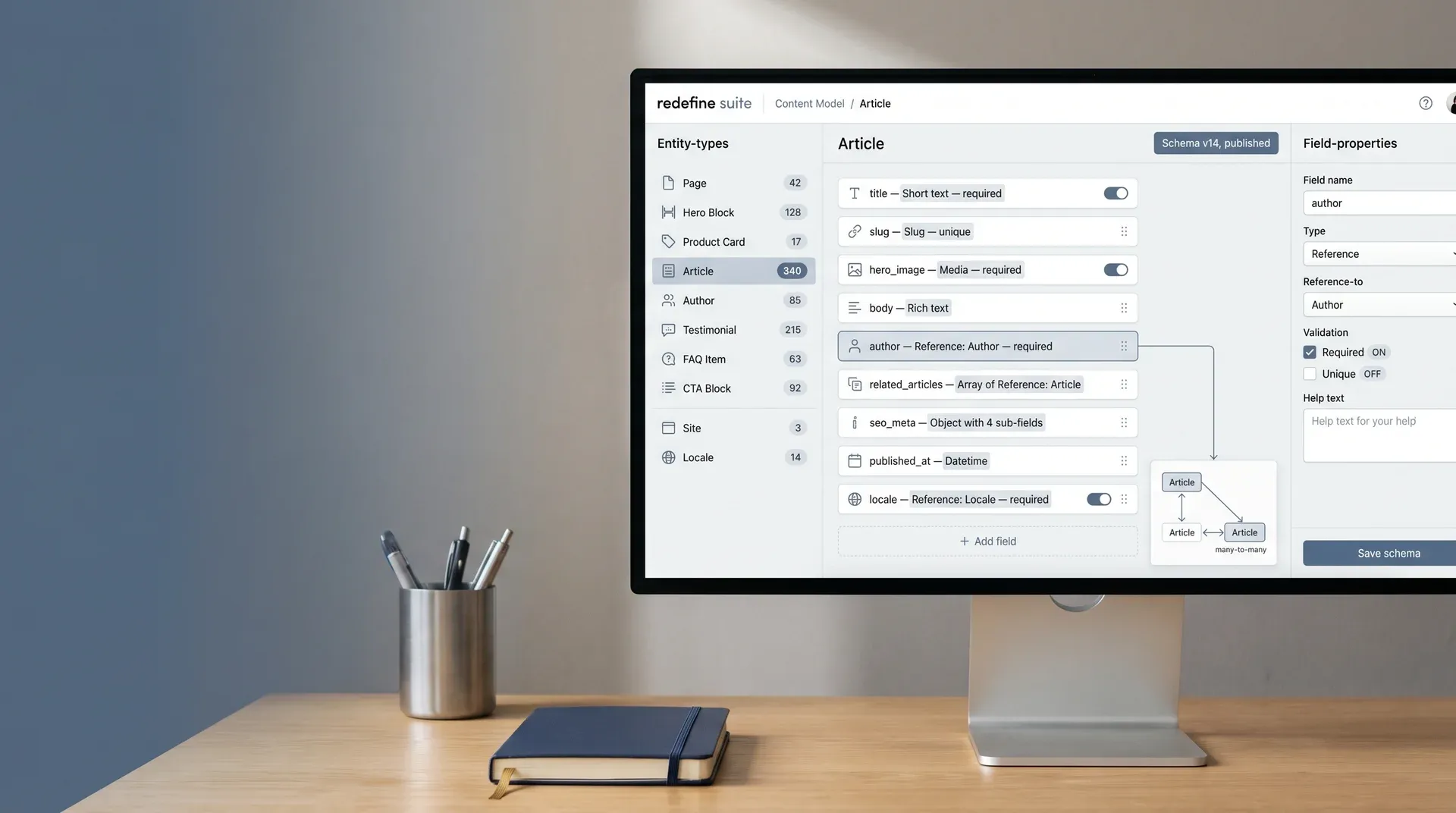
Content model, defined once
Entity types, fields, and relationships in one schema.
Developers define the shape once. Marketing teams create, edit, and publish forever.
Platform Capabilities
The capability every team needs. Does your current system have it?
✓ = Included natively ✕ = Not available ~ = Requires a custom build or paid add-on
| Capability | Redefine |
|---|---|
| Visual editor for non-developers | ✓ |
| Multi-step publishing approvals | ✓ |
| Multi-site from one instance | ✓ |
| Native localization workflows | ✓ |
| Content governance and full audit trail | ✓ |
| Connected to commerce platform natively | ✓ |
| Fully managed hosting and service agreement | ✓ |
| Marketing team independence day-to-day | ✓ |
Multi-Site in Action
One content record. One publish. Three brand sites update.
Click between brands. The same product content renders in each site's visual identity without duplication or separate instances.
industrialpro.com/products/gear-drive-500
INDUSTRIAL DRIVE SYSTEMS
GearDrive 500, High-Torque Industrial Gearbox
IP67 rated. 500Nm
continuous torque. Compatible with all major industrial automation protocols.
Request
QuoteDownload
Datasheet
SPECIFICATIONS
Torque500 Nm
IP RatingIP67
Lead Time4 to 6
weeks
Dark theme · Spec-first · Quote-focused calls to action
shop.consumerdirect.com/products/gear-drive-500
NEW ARRIVAL BESTSELLER
GearDrive 500
$2,499 $2,899SAVE
14%
Add
to CartSave
★★★★★4.9 (128 reviews)
Free shipping over $500. In stock.
Ships in 2 business days.
Light theme · Price-first · Add-to-cart experience
partners.company.com/catalog/gear-drive-500
PARTNER CATALOG - TIER 3
GearDrive 500
Your price:
$1,874.25 25%
off
Net 30 · Min 1 unit · Bulk
discounts available
Add
to OrderBulk
Quote
YOUR ACCOUNT
Discount25%
Net TermsNet 30
Indigo theme · Account pricing · Net terms · Partner-specific layout
Same content record. One publish button. Product name, description,
specs, and assets are authored once. Each site template renders them in its own brand identity. Changing the
description updates all three channels simultaneously.

Editorial, brand, legal — in order
Multi-step approvals with a full audit trail.
Configurable per content type, site, and locale. Every action logged with user identity, timestamp, and change detail.
Migration timeline
"How long will it take to switch?" 12 weeks. Live at the end.
Your existing content management system stays live throughout. Cutover happens at the end, with a tested rollback path.
1
Weeks 1 to 3
Content Model Setup
We map your existing
content management system content types and rebuild them in Redefine. Content model migration and team
access configuration.
2
Weeks 4 to 6
Content Entry Import
All content entries
exported from your current system and imported into Redefine. Your content team validates entries in a
staging environment.
3
Weeks 7 to 10
Front-End Reconnection
Your front-end team
switches the application programming interface calls from the old system to Redefine. REST and GraphQL
patterns are compatible. Minimal code changes.
4
Weeks 11 to 12
Cutover and Go Live
Tested rollback path in
place. Production cutover. Your previous system instance stays live as backup for 30 days. Your
marketing team takes the visual editor from day one.
Previous system stays live throughout migrationTested rollback path at every stageCompatible REST and GraphQL application programming interface patterns
Part
of the Redefine platform:All Core
Products ›Omnichannel Commerce Platform ›Forms and Workflow Software ›
"The developer team stopped receiving content tickets on day one of go-live. Our marketing team can now run an entire campaign, pages, banners, product copy, regional variants, without involving engineering once."
Vice President of Marketing
Business-to-business industrial manufacturer. 6
regional sites migrated.
Questions
What buyers ask before they decide.
Can marketing teams edit
content without a developer every time?
Yes. Developers define the content model once. After that, all content creation, editing, previewing, and publishing is handled by the marketing team in the visual editor with no code involved. The only time a developer is needed is when the content model structure itself needs to change, which happens far less frequently than content updates.
What front-end frameworks
does the headless content management system support?
The platform is front-end agnostic. Content is delivered via REST and GraphQL application programming interfaces to any framework: Next.js, Nuxt, Astro, React, Vue, mobile, or any custom stack. When content is published, webhook events fire and each connected front end revalidates automatically.
We run 8 regional
websites. Can one content management system instance manage them all?
Yes. Multi-site and localization are native modules. Each site has its own content space, publishing rules, and team permissions within one instance. Shared content can be authored once and localised into multiple language variants. Regional editors only access the sites assigned to them. Publishing to one locale does not affect others unless you explicitly push it across.
How does the content
management system connect to the commerce platform?
Content in the content management system links natively to product records in the Omnichannel Commerce Platform. A product page updated in the content management system publishes across business-to-business portals, direct-to-consumer storefronts, and marketplace listings simultaneously. These are the same platform, not separate tools connected by integrations.
Does the content
management system include publishing approvals?
Yes. Multi-step approval chains are configurable per content type, site, or locale. Legal review, brand review, and editorial sign-off can all be required in sequence. Every content action is logged with user identity, timestamp, and change detail. Role-based access determines who can create, approve, or publish at each level.
Is this the right fit?
Who the content management system is built for.
Be honest about the fit. The not-fit column builds more trust than the good-fit column.
Good fit when
- Marketing team files developer tickets for routine content changes today
- Running 2 or more brand sites or regional variants from separate systems
- Content needs to publish across commerce, portals, and marketplace channels simultaneously
- Legal or brand review is required before any content goes live
- Front end is headless or you want to move to a headless architecture
Not a fit if
- You want a single monolithic website with no future multi-site or headless plans
- Your team of one person handles all content and development tasks
- Looking for a one-time content migration with no ongoing editorial workflow
- Content is 100% developer-managed and marketing has no publishing role
Get your marketing team out of the ticket queue
One session. Your content team. Independent.
A content management system specialist builds a live walkthrough using your content structure, your brand sites, and your team setup. No demo account. Your actual architecture.
Scoped before work starts · line-by-line pricing · no commitment to receive a proposal
Tell us about your content workflow
The more specific you are, the more relevant the session will be.
Form
Brief received. We will review your content workflow and send a scoped proposal within 3 business days.
Submit your brief → call within 48 hours → proposal in 3 days → Sprint 1 within 1 week of sign-off
Call within 48 hours of submission
Scoped proposal in 3 days
Live demo on your actual architecture
You own all code and content on handoff
Get your marketing team out of the ticket queue
One session. Your content team. Independent.
A content management system specialist builds a live walkthrough using your content structure, your brand sites, and your team setup. No demo account. Your actual architecture.
Submit your brief → call within 48 hours → scoped proposal in 3 days → Sprint 1 begins within 1 week of sign-off