CMS Platform
Publish pages your team actually controls
Give content teams WYSIWYG editing, drag-and-drop layouts, inline live preview, and AI writing assistance: all in one place, with no developer dependency for routine publishing.
No developer tickets for content edits
Commerce-aware content out of the box
Live PIM data, no API integration

180+Content platform projects delivered
0Developer tickets required for routine content edits
1Session from blank canvas to published page
60%Faster content updates reported after migration
The content bottleneck
Your team shouldn't wait in a developer queue to update a headline
Most CMS tools force a choice: give developers total control, or give marketers a simplified editor that can't handle commerce complexity. Redefine removes that trade-off.
Without Redefine
Content team submits a developer ticket to change a banner headline: ticket takes 3 days
Product data on landing pages is manually copied from PIM: goes stale within hours of a price change
Each new campaign requires a developer build: time-to-publish measured in weeks, not hours
Visual editor tools lack commerce context: marketers can't see live pricing or inventory in preview
With Redefine
Marketers edit headlines, swap images, and publish pages directly: no developer ticket, no wait
Landing pages pull live PIM data automatically: price and inventory stay accurate without manual updates
Drag-and-drop page builder lets your team launch a campaign page in an afternoon
Inline live preview shows real prices, real product names, and real availability: before you publish

Authoring process
From blank canvas to published page in one session
Your content team owns every step: from layout to live. No handoffs to engineering for routine page work.
1
Day 1
Choose a layout template
Pick a starter or build from scratch with pre-approved content blocks
2
Same session
Edit inline with live preview
Click any element on the preview canvas to edit text, swap images, or reorder blocks
3
Same session
Pull live product data
Connect a PIM product reference: price, stock, and attributes populate automatically
4
Before publish
AI writing assistant review
AI suggests copy refinements grounded in your product catalog and brand tone
5
When ready
Submit for approval or publish
Send to a reviewer or schedule: the same workflow engine that handles order approvals
New Page: Template Library
Choose a starter layout
Campaign Landing
Product Feature
Editorial Story
Campaign Landing selected
Inline Editor: Summer Campaign
Editing: Headline
Discover our Summer Essentials
Click to edit any field directly on the page
DraftLast edited 2 min ago, by Sarah M.
Product Reference: PIM Connected
Live PIM data: auto-populated
SKU-48291 · Alpine Insulated Jacket
Sizes: XS to 3XL · 12 colorways
Price: $129.00
Pulled from PIM · Updates automatically
Campaign page inherits live product data
SyncedAI Writing Assistant
Suggested improvements
Original
"Buy our Summer Essentials collection today."
AI suggestion: based on product catalog
"Gear up for summer with the Alpine Jacket: 12 colorways, built for any conditions."
Publishing: Summer Campaign
Summer Campaign 2025
ApprovedReviewed by: Jamie L., Content Lead
Scheduled: Jun 1, 2025 · 9:00 AM
Same workflow engine as order approvals: no separate tools to learn
Key capabilities
Everything your content team needs in one editor
Sourced from the Authoring and Editing module. Every card shows how each capability works when you hover.
WYSIWYG rich text editing
Full-featured rich text editor with formatting, embeds, tables, and structured blocks: no markdown required.
Parity capability
Visual page builder with drag-and-drop
Build and rearrange page sections by dragging blocks: hero, feature rows, product grids, and calls to action, without touching code.
Parity capability
Inline editing and live preview
Click directly on the rendered preview to edit text, swap components, or adjust layouts. What you see in the editor is what goes live.
Parity capability
Differentiator
AI-assisted content writing: grounded in your catalog
The AI writing assistant doesn't pull from generic knowledge. It reads your live PIM product data: names, attributes, pricing, and positioning, to generate copy that is accurate and on-brand from the first suggestion.
Content templates and starter layouts
Lock down brand-approved layouts so every campaign page starts from a consistent, reviewed structure: no blank-canvas guesswork.
Platform Differentiator
Marketers publish product-aware pages without an API integration
A marketer can build and publish a landing page that pulls live PIM data: prices, inventory, product specs, without writing a single API call. The content layer and commerce layer share the same data model natively. No middleware. No custom development work.
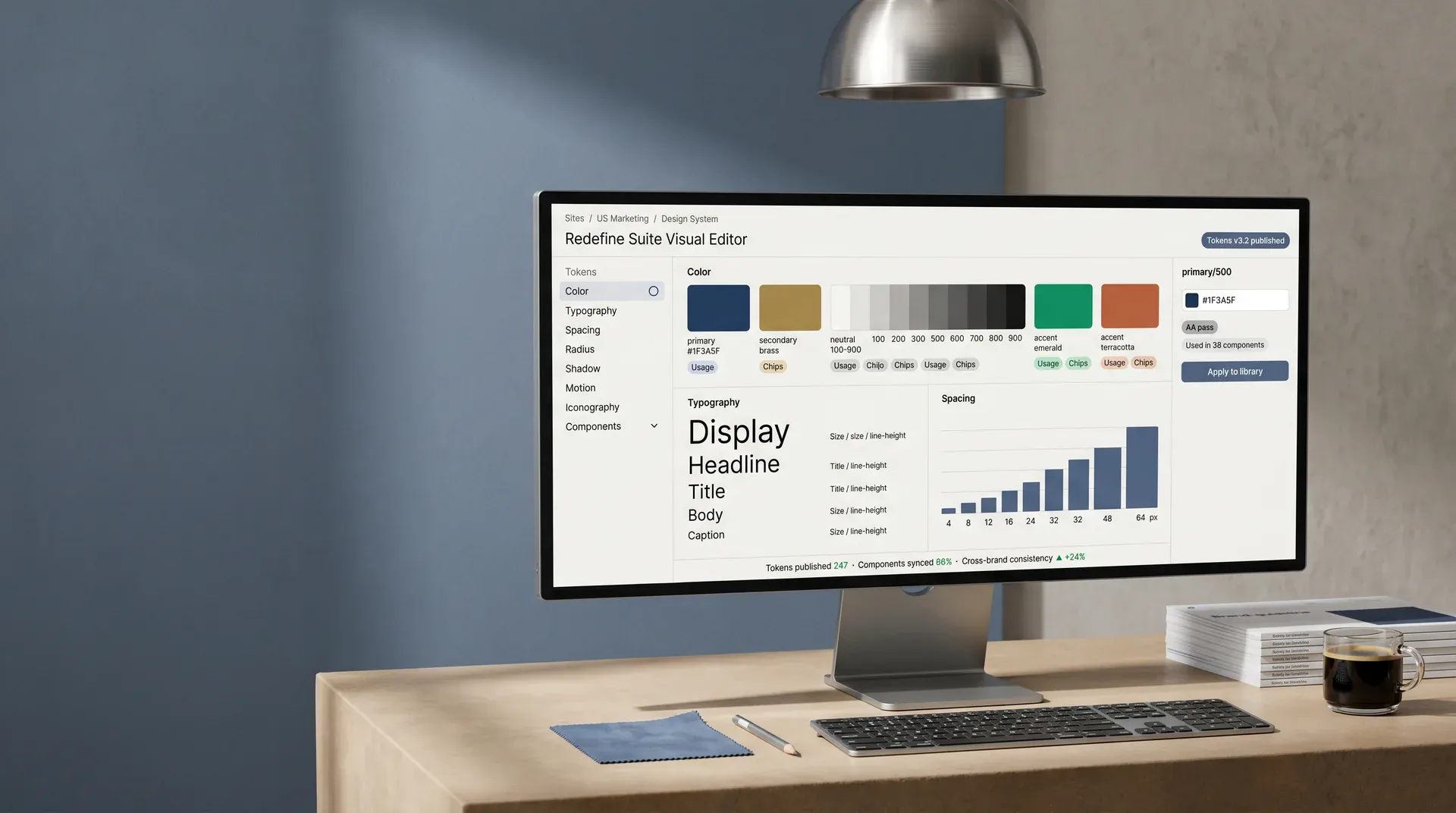
Design tokens, governed
A design system every page inherits automatically
Colors, typography, spacing, and component styles live in one token library. Update a token, and every page using it updates: no manual hunt-and-replace across sites.
Platform architecture
One data model: CMS, PIM, and commerce in sync
The visual editor doesn't bolt onto commerce as an afterthought. Content, product data, and commerce context share a native data layer: so changes in PIM appear in your pages automatically.
Visual Editor
WYSIWYG, drag-and-drop, inline preview
Publishing active
PIM and Product Data
Live prices, SKUs, attributes, availability
Synced in real time
Commerce Engine
Cart context, account tier, B2B segment
Context-aware content
Approval Workflow
Same engine as order, PIM, and form approvals
Unified workflow
Customer proof
When content management gets unified, publishing gets faster
Organisation
Multi-site healthcare content operation
Healthcare · Content ManagementA multi-property healthcare organisation managing website content across multiple sites, compliance-sensitive pages, and internal teams with different publishing permissions.
The problem
A custom CMS created operational bottlenecks. Fast content updates required manual effort, multiple system handoffs, and posed compliance risks when publishing permissions were unclear. Scaling content to multiple sites multiplied every inefficiency.
Result
0% faster content updates
The new CMS streamlined website management across multiple properties. Security and compliance controls were strengthened. Staff gained centralized, role-scoped publishing without external developer help. The platform scaled to new sites without rearchitecting the content layer.
Best-fit use cases
Built for every publishing role on your team
Campaign pages without developer tickets
Build campaign landing pages, seasonal promotions, and product spotlights directly: launch in hours, not days.
AI copy grounded in your products
Get copy suggestions that reference your actual catalog: product names, attributes, and pricing pulled in automatically.
See exactly what goes live, before it does
The inline live preview renders with real prices and real product data: not placeholder content that gets corrected after publish.
Role-based permissions per team
Control who can draft, review, and publish. Set permissions by site, content type, or team: with the same access control used across the whole platform.
Approved templates, enforced structure
Publish brand-approved starter layouts so every team member starts from a consistent, reviewed structure: not a blank canvas.
Scheduled publishing, no last-minute rushes
Plan content ahead with scheduled publish and expiry times. Pages go live and come down on schedule: without anyone watching the clock.
API-first delivery: one CMS, any channel
Content authored in the visual editor is delivered via REST and GraphQL to any frontend: web, mobile, kiosk, email, from a single source of truth.
Multi-site from a single admin
Each site runs its own content scope, permissions, and template inheritance. One admin, zero duplication of setup work. Linked from the Multi-Site CMS module.
Governance baked in, not bolted on
Content approval is part of the same workflow engine used across the platform. Audit trails, locking, and conflict prevention keep compliance requirements met.
Why Redefine is different
Visual CMS tools give you the editor. Only Redefine gives you the context.
Other visual CMS tools are strong on layout and editing. What they cannot give you is native commerce context: the live prices, inventory states, and account tiers that should shape every piece of content. Redefine stores all of that in the same data layer as your editor.
Capability
Typical standalone visual CMS
Redefine
WYSIWYG editing
Drag-and-drop page builder
Live preview with real product data
Product-aware landing pages without API work
AI writing grounded in catalog data
Unified approval workflow (CMS and commerce)
Multi-site from a single admin
Paid add-on
Mobile preview
See the page on every device before you publish
Toggle desktop, tablet, or mobile inside the canvas. The preview renders with live product data on every breakpoint: no surprises after publish.

Yes. The drag-and-drop builder, inline editor, and live preview are designed for marketers and content managers, not developers. Routine publishing tasks require no code changes and no developer tickets. Developers configure and maintain the templates; content teams operate the editor independently after that.
Because the CMS and PIM share a native data model, the preview canvas renders live prices, real stock levels, and accurate product attributes: not placeholder copy. When a product changes in PIM, the page preview reflects that change immediately, before you publish.
Yes. Content authored in the visual editor is delivered via REST and GraphQL APIs to any frontend. The Headless CMS module handles distribution: your content team edits in the visual interface while your developers consume structured content through the API layer.
Content approvals run through the same workflow engine that handles order approvals, PIM enrichment reviews, and form routing. Your team learns one system. Reviewers receive tasks in their normal queue. Publishing Workflows covers the approval and scheduling layer in more detail.
The AI writing assistant generates copy in the locale context of the page being authored. Combined with the Localization Workflows module, your team can author localized content with AI assistance while keeping locale-specific variants and overrides in one place.
Is this right for you?
A good fit, and when it is not
Good fit when
- Your marketing team files developer tickets for routine content changes like updating a headline or swapping a banner image
- You operate a commerce catalog and want landing pages to pull live prices and inventory without custom API work
- You need role-based publishing permissions and content approval to satisfy compliance or governance requirements
- You manage content across more than one site or brand and want a single admin without duplicating setup work
Not a fit if
- You publish fewer than a handful of pages per month and have no commerce data to connect
- A single developer manages all content directly in code and your team has no non-technical authors
- You need a standalone blog tool with no connection to product data or multi-channel delivery
Not sure? Tell us your situation and we'll be straight with you.
Get started
See your content team publish without limits
We walk you through your team's specific workflow: campaign pages, product launches, multi-site rollouts, or all three. No commitment. No pitch.
Form
Call within 48 hours · proposal in 3 days · Sprint 1 within 1 week of sign-off
Brief received
We'll review your workflow and send a scoped proposal within 3 business days.
Response within 48 hours
Proposal in 3 days
180+ projects completed
Full code ownership on handoff
See it working
See your content team publish without limits
We walk you through your team's specific workflow: campaign pages, product launches, multi-site rollouts, or all three. No commitment. No pitch.
Submit your brief → call within 48 hours → scoped proposal in 3 days → Sprint 1 within 1 week of sign-off
No commitment. No pitch. 30-minute session, your workflow.