Personalized platform walkthrough
See your exact stack replaced in one demo.
Tell the team which products matter most. The demo covers your actual use case, not a scripted tour. 30 to 45 minutes. No commitment required.
SOC 2 Type II certified
No credit card
Typically responds within one business day
Book a personalized demo
Select the products you want to see. The team builds the session around your priorities.
Form
Brief received. We will review your workflow and confirm your demo within 1 business day.
No commitment. No pitch. The team follows your timeline.
Responds within 1 business day
Session scoped to your team
40 or more demos per week
SOC 2 Type II certified
Who the demo is built for
The platform fits mid-market brands and distributors managing complex operations
Industries
- Manufacturing and industrial supply
- Distribution and wholesale
- Promotional products and corporate apparel
- Consumer brands selling business-to-consumer and direct-to-consumer
- Retailers managing multiple storefronts
- Heavy equipment and dealer networks
Roles in the room
- Operations Manager or Chief Operating Officer
- Chief Marketing Officer or Marketing Director
- IT Director or Chief Technology Officer
- Ecommerce Director
- Product or Merchandising Lead
- Finance or Revenue Leader
Strong fit signals
- Running 3 or more separate commerce or operations tools
- B2B and direct-to-consumer channels managed from separate platforms
- Marketplace expansion in the next 12 months
- ERP integration that is painful or incomplete
- Analytics that require manual business intelligence exports
- Team spending hours per week on sync and data hygiene
The demo can cover any
of these integrations
SAP ERPNetSuiteMicrosoft DynamicsAcumaticaAmazonWalmarteBayGoogle ShoppingSalesforceWarehouse Management System and Third-Party Logistics+ See all integrations
What you will actually see
A live platform. Real workflows. One admin.
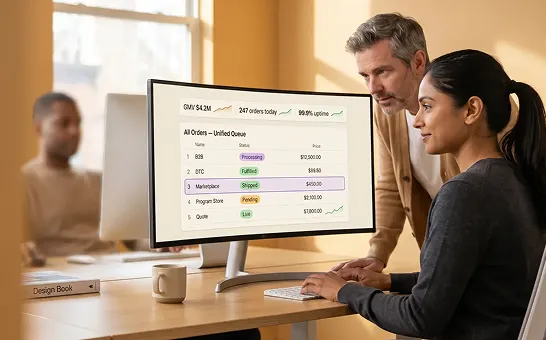
The demo runs on the live Redefine platform with realistic data. You interact with the real product, not a recorded video or a slide tour.
All Orders - Unified Queue
247 orders
today#B2B-9841Apex Industrial Supply - Net-30 orderProcessing$14,220
#DTC-7203Storefront checkout - card paymentFulfilled$189
#MKT-4417Amazon FBA order - auto-routedShipped$67
#PRG-2198Program store - allowance redemptionPending
approval$340
#B2B-9840Global Fasteners Ltd - Request for Quote convertedLive$8,450
All channels in one queue - B2B, direct-to-consumer, marketplace, program stores99.9% uptime
What changes after the demo
You see your problem solved, live
Not a feature checklist. A working demonstration of the exact workflow your team is dealing with, order routing, listing sync, enrichment, or approval logic, running in the platform.
You understand the integration story
How your enterprise resource planning system, warehouse management system, and marketplace accounts connect. What data flows where. What migration involves. The team answers the questions your IT lead will ask before you even get there.
You leave with a clear decision path
A summary of what was covered, the products most relevant to your stack, and a path to proof-of-concept or pricing, with no pressure to move faster than makes sense for your team.
What the demo covers
A live walkthrough built around your actual priorities
30 to 45
minutes
Focused on the products you selected. Not a generic tour, the agenda is set based on your form responses before the session starts.
Bring your
whole team
Operations leads, IT owners, marketing directors, and finance stakeholders all benefit. The team adjusts depth and language for who is in the room.
Live platform,
real data
You see the actual Redefine platform, not a slide deck. The demo environment includes realistic product catalogs, order flows, and channel configurations.
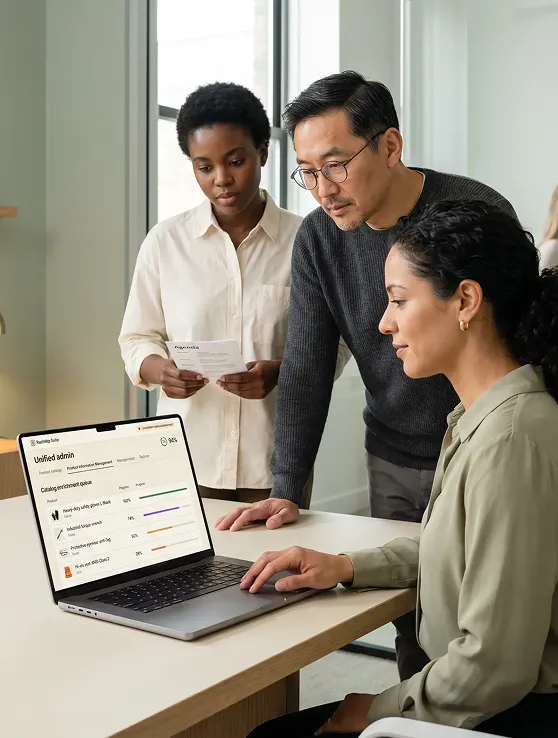
Typical demo agenda
1
Your stack and your goals (5 minutes)
The team asks what you currently run, what is breaking, and what a better outcome looks like for your team in the next 12 months.
2
Live walkthrough of your priority products (20 minutes)
The products you selected get covered in depth. You see real workflows, order routing, Product Information Management enrichment, marketplace sync, approval routing, not feature lists.
3
How the platform connects to your existing systems (10
minutes)
Enterprise resource planning, warehouse management system, marketplace accounts, customer relationship management, the team walks through which integrations are native, what the data flow looks like, and what migration typically involves.
4
Your questions (remaining time)
No pitch close at the end. The team answers what you came in with and leaves you with the resources to move at your own pace.
Is now the right time?
Check the pain points your team is living with right now
Tick everything that rings true. The panel on the right shows which Redefine products address each one, and builds the case for the conversation.The summary below shows which Redefine products address each one, and builds the case for the conversation.
0
/ 6 pain points
Select the pain points your team faces today.
Products that
address your selections
B2B portal - catalog syncLive
Amazon - last feed pushQueued
Open order approvals3
pending
Suppressed listings detected12
flagged
Product Information Management completeness
score94%
What happens after a demo
Teams that booked a demo and moved forward
Company
Corporate Gear
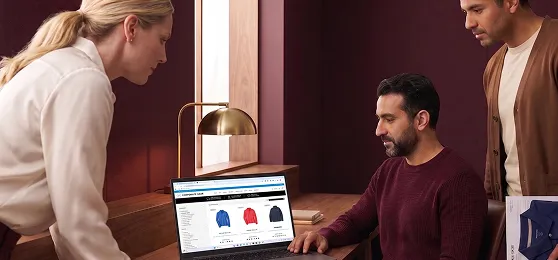
A corporate branding and apparel ecommerce operation serving enterprise clients with branded merchandise and custom apparel programs across multiple fulfillment channels.
Problem
Fragmented ecommerce systems created visibility gaps, limited personalization, and poor customer journey alignment. Existing workflows constrained lead generation and made revenue scaling difficult without significant manual overhead.
Result
14
M annual revenue
Unified headless commerce with enterprise resource planning integration, user experience optimization, and data-driven marketing. Revenue scaled to over $120M annually through improved conversion, system unification, and personalized customer experiences.
$120M
Annual revenue
1
Unified platform
Continuous testing and data-driven optimization contributed to substantial revenue growth, from a platform that connected enterprise resource planning, commerce, and analytics in one system.
Evaluating alternatives
The demo answers the comparison question directly
If you are evaluating Redefine against a best-of-breed stack or a single-category tool, the demo covers how the platform compares, with real workflows, not bullet-point feature tables.
If you are
considering
B2B Commerce
Platforms
Strong B2B commerce depth, but limited when you also need direct-to-consumer, program stores, native Product Information Management, and cross-platform analytics in one place.
If you are
considering
Standalone
Product Information Management Tools
Deep Product Information Management capabilities, but weaker when buyers need the same product data to power commerce checkout, marketplace listings, and program store assortments simultaneously.
If you are
considering
Marketplace
Feed Management Tools
Solid marketplace feed management, but isolated from the Product Information Management that governs your product data and the order management system that routes your orders, requiring middleware to connect them.
Before you book
Common questions about the demo
Still deciding whether to book? These are the questions most teams ask before the session.
Average response time
1 business day
Demos held per week
0
A focused demo runs 30 to 45 minutes. You tell the team which products and use cases matter most, and the session covers exactly those areas, not a scripted tour of everything. If you want a broader platform walkthrough, a 60-minute session can cover 4 to 5 product areas in depth.
No preparation is required. It helps to know which products or pain points are most pressing for your team. The demo team will ask a few questions at the start to tailor the session, the more context you share in the booking form, the more relevant the demo will be.
Yes. Demos work best with the people who will actually use the platform, operations leads, marketing directors, IT owners, or finance stakeholders. The team will adjust the level of detail and product focus based on who is in the room.
After the demo you receive a summary of what was covered, links to relevant product pages and comparison resources, and a clear path to a proof-of-concept or pricing discussion if the fit is right. There is no pressure to move fast, the team will follow your timeline.
Absolutely. If your most pressing question is how Redefine connects to your enterprise resource planning system, how the Product Information Management syncs to Amazon, or how the order routing handles drop-ship suppliers, the team can build the demo around that specific workflow. Just note it in the form.
Ready to see it live?
Your stack replaced in one walkthrough
Pick the products. The team tailors the demo. 30 to 45 minutes to see your exact use case running on one platform.
Responds within one business day
The team confirms your
booking and sends pre-read materials
SOC 2 Type II certified
Your data is handled
securely throughout the evaluation process
No time pressure after
Proof-of-concept and
pricing conversations happen at your pace