Category Mapping Software
Map once. List everywhere.
Every marketplace has its own category tree, attribute schema, and identifier requirements. Redefine maps your product catalog to every channel taxonomy once, then keeps it live automatically as channels update their requirements.

The Mapping Problem
Each marketplace wants your catalog its own way
Without Redefine
- Manually re-mapping attributes in every feed tool for every new channel launch
- Listings rejected because your taxonomy does not match Amazon, Walmart, or eBay category trees
- Barcode and product identifier formats (ASIN, EAN, UPC) differ by channel with no central management
- Pricing and inventory rules set up repeatedly in disconnected spreadsheets per channel
- Category schema changes from marketplaces break live listings with no automated detection
With Redefine
- One central mapping layer connects your product information manager catalog to every channel taxonomy without re-doing work
- Listings validated against marketplace taxonomy before submission so rejections are caught at source
- Product identifiers (ASIN, EAN, UPC, MPN) managed in one place and transformed per channel automatically
- Price and inventory override rules defined once, applied per channel without spreadsheet maintenance
- Taxonomy schema changes detected automatically with alerts before live listings break

Module Overview
What Category and Attribute Mapping does
This module is the translation layer between your product catalog and every marketplace's requirements. It lives inside the same platform as your product information manager, order management, and pricing systems, so changes in your catalog propagate to channel mappings automatically.
You define your product data once. The mapping module handles category path assignment, attribute field normalization, product identifier transformations, and per-channel pricing and inventory rules. There is no separate feed tool to maintain.
Taxonomy mapping
Map your catalog categories to marketplace category trees
Attribute normalization
Transform field names and values to match each channel
schema
Product identifier mapping
ASIN, EAN, UPC, MPN managed centrally per channel
Price and inventory rules
Override rules scoped per channel without spreadsheets
Mapping StatusAll
Channels Active
Amazon US
1,247 stock-keeping unitsMapped
Walmart Marketplace
984 stock-keeping unitsMapped
eBay
1,102 stock-keeping unitsMapped
Etsy
312 stock-keeping unitsIn
Progress
Google Shopping
1,247 stock-keeping unitsLive
0 listing rejections in last 30 days
Mapping Process
From catalog import to live channel listings in 4 steps
Your catalog data enters once. Mapping, normalization, validation, and channel sync happen inside one platform without separate tools.
Catalog Import
StatusCompleted
3,647
Items imported
142
Attribute gaps
23
ID conflicts
Amazon attribute coverage87%
Walmart attribute coverage74%
Category Mapping Rules
Your category: Outdoor Knives
Amazon: Sporting Goods › Hunting & Fishing ›
Knives & Tools
Walmart: Sports & Outdoors › Hunting › Knives
Your category: Kitchen Accessories
Amazon: Home & Kitchen › Kitchen & Dining ›
Kitchen Utensils
Walmart: Home › Kitchen › Gadgets & Tools
3,504 of 3,647 items assigned to valid
category
paths
Field Transformation Map
| Your field | Amazon field | Walmart field |
|---|---|---|
| product_name | item_name | productName |
| brand | brand_name | brand |
| weight_kg | item_weight (lbs) | weight (oz) |
| sku | seller_sku | sku |
Identifier assignments: ASIN auto-matched · EAN
validated · UPC verified
Pre-submission Validation
Required fields present3,644 / 3,647
Category path valid3,647 / 3,647
Product identifiers verified3,641 / 3,647
Price rule overrides pending6 items
Ready to sync: 3,641 items across 5
channels
Core Capabilities
Everything your catalog needs to list on any channel
Category mapping to marketplace taxonomy
Your internal category structure maps to Amazon, Walmart, eBay, Etsy, and 100+ marketplace-specific category trees. Rules run automatically when new products are added.
Auto-updates when channel taxonomy changes
Attribute mapping and field normalization
Field names, data types, measurement units, and value formats are normalized per channel. A single product attribute in your product information manager outputs the correct format to every channel without duplication.
Unit conversion handled automatically
Product identifier and barcode mapping
ASIN, EAN, UPC, MPN, and GTIN all managed in one record per product. Each channel receives the correct identifier format. Conflicts and duplicate identifiers are flagged before submission.
ASIN lookup and match built in
Price and inventory rule mapping per channel
Define override rules for pricing (margin floor, markup by channel, promotional pricing windows) and inventory (allocation by channel, buffer stock, channel priority) without spreadsheets or separate tools.
Rules update live when base price changes
Pre-submission validation and rejection dashboard
Every listing is validated against the target channel schema before it is submitted. Rejection reasons are surfaced inside your workspace with actionable resolutions, not a raw API error log.
Rejection root cause identified in platform
Taxonomy change monitoring and alerts
When Amazon, Walmart, or any connected marketplace updates their category schema or attribute requirements, your team is alerted before listings break. Affected products are shown with suggested remapping actions.
Monitors schema versions across all channels
Client Proof
Revenue tripled with multi-channel commerce systems

## 200×200
Off Grid Knives
Outdoor
Goods • Multi-channel CommerceCompany
A direct-to-consumer outdoor knives brand selling across BigCommerce, Amazon, and additional marketplace channels from a single catalog.
The Problem
Listing management was fragmented across marketplaces with no unified system for category assignment, attribute normalization, or order routing. Revenue was capped at under $1 million per year despite strong product demand.
Solution
An integrated multi-channel commerce system unified the product catalog, marketplace listings, category and attribute mapping, and order management. Amazon and BigCommerce channels connected to the same product record with channel-specific rules applied automatically.
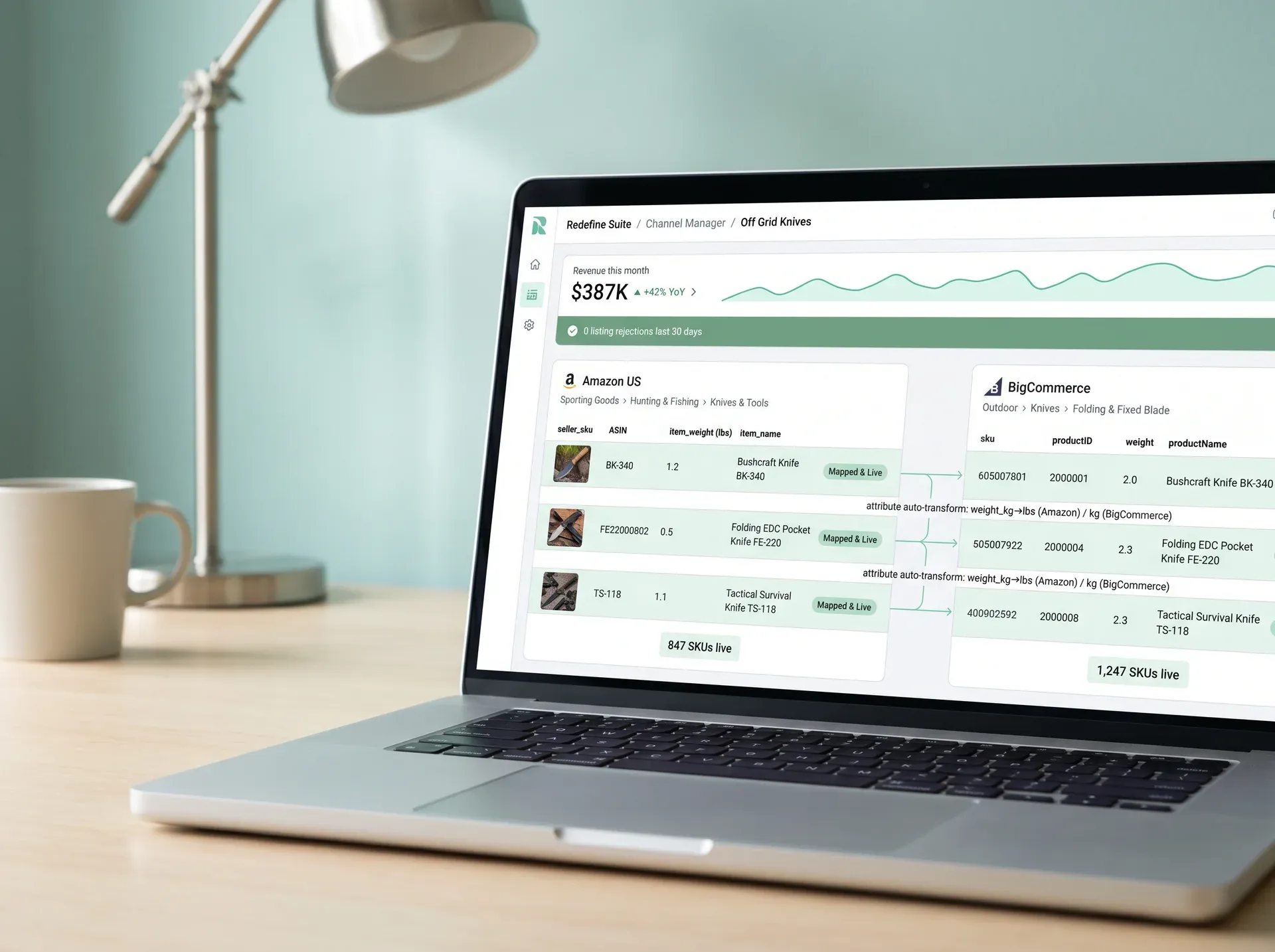
Result
$3.8M
Annual revenue, up from $1 million within three years of deploying integrated multi-channel commerce and catalog mapping systems.
- 3.8x revenue growth across all active channels
- Email marketing became a major recurring revenue driver from a single catalog source
- Improved organic rankings increased channel discovery without paid spend increase
Why Redefine
Mapping built into your commerce platform, not bolted on
Typical marketplace tools handle feeds and listings well but are thinner on product information manager governance, operational handoff, diagnostics depth, and unified reporting. Redefine ships category and attribute mapping as part of the same platform your product data, orders, and pricing already live in.
| Capability | Typical marketplace tool | Redefine |
|---|---|---|
| Category mapping to marketplace taxonomy | Manual rules per tool | Native, auto-maintained |
| Attribute normalization from product information manager | Re-done per channel tool | Directly from live product information manager
attributes |
| Product identifier management (ASIN, EAN, UPC) | Partial, no central record | Centralized per product, all identifiers |
| Pre-submission validation and diagnostics | Raw API error logs only | Actionable root cause in dashboard |
| Price and inventory rule mapping | Separate feed logic required | Native rules engine, no extra tools |
| Connected to product information manager, order management, and pricing natively | Integration required | Same platform, no integration needed |
| Taxonomy schema change monitoring | Manual check or listings break | Automated alerts before breakage |
Best-Fit Use Cases
Who category mapping software is built for
Multi-channel sellers
Brands selling on 3 or more marketplaces simultaneously where maintaining separate category mapping per tool creates operational overhead and errors.
International expansion teams
Operations teams launching products into new regional marketplaces where taxonomy structures, attribute schemas, and identifier requirements differ from home market channels.
Catalog managers with large product counts
Product teams managing 1,000 or more items where manual category assignment per marketplace at scale is no longer practical without automated mapping rules.
Brands launching new channels fast
Go-to-market teams launching on a new marketplace where the target channel's taxonomy, attribute requirements, and identifier format are unfamiliar and need to be mapped correctly from day one.
Distributors with supplier catalog complexity
Business-to-business distributors ingesting supplier catalogs with inconsistent attribute naming, category structures, and product identifier formats before mapping them outward to marketplace channels.
Teams with active listing rejection problems
Operations teams losing revenue to listing rejections caused by category mismatches, missing required attributes, or invalid product identifiers that pre-submission validation would have caught.
Related Modules
Category mapping connects across your platform
Parent
Module
Marketplace and Channel Management
The full channel management suite this module lives inside
Sibling
Module
Marketplace Management Software
Listing management and marketplace account operations
Sibling
Module
Feed Management Software
Product feed generation, scheduling, and channel publishing

Common Questions
Questions about category mapping software
Feed management handles the generation, formatting, and scheduling of product data exports to channels. Category mapping is the structured translation layer that assigns each product to the correct taxonomy path and normalizes attribute fields before those feeds are generated. The two work together but solve different problems. Redefine ships both inside the same platform so the mapping layer feeds directly into feed generation without a separate integration.
Redefine monitors the schema versions published by connected marketplaces. When a taxonomy change is detected, your workspace flags the affected listings before they break in the channel. You receive an alert inside the platform showing which products are affected and what the recommended remapping action is. No listings go dark without your team being notified first.
No. Your product catalog and internal category structure are defined once. Adding a new channel means creating a new mapping ruleset for that channel's taxonomy, which builds on the existing catalog structure. You do not re-enter product data or rebuild attribute definitions. Most new channel mappings complete within 24 to 48 hours of setup when the base catalog is already mapped.
Each product record in Redefine stores all relevant identifiers in a single structured field. ASIN lookup and matching against Amazon catalog data is built in. EAN and UPC validation runs at import. When a channel requires a specific identifier format, the mapping layer retrieves the correct identifier for that channel without manual lookup or spreadsheet cross-referencing. Conflicts and missing identifiers are surfaced in the diagnostics dashboard before submission.
Yes. The rules engine in the mapping module supports channel-scoped price overrides, margin floors, promotional pricing windows, and inventory allocation rules that differ by channel. A product with a base price of $49.99 can sell for $52.99 on one marketplace and $51.49 on another based on channel-specific margin targets, without creating separate product records or managing the logic in spreadsheets.
Is This a Fit?
Good fit and not-fit
Good Fit
- Selling on 3 or more marketplaces and maintaining separate category mapping per tool is creating errors
- Catalog has 1,000 or more items where manual category assignment per marketplace is no longer practical
- Losing revenue to listing rejections from category mismatches or missing required attributes
- Launching on a new marketplace and need correct taxonomy and attribute mapping from day one
Not The Right Fit
- Selling exclusively on a single direct-to-consumer storefront with no marketplace presence
- Catalog is under 50 items with a single channel, manageable manually without automation
- Needing a standalone feed export tool only, without a connected commerce platform
Not sure? Tell us your situation and we will be straight with you. Submit your brief.
Get Started
Map your catalog to every channel, once
Tell us which channels you are targeting and how many items you are working with. We will review your situation and tell you exactly what a mapping engagement looks like for your catalog.
Call within 48 hours
We review your brief before the call
Scoped proposal in 3 days
Line-by-line. No commitment to receive it.
Sprint 1 within 1 week of sign-off
Catalog audit and initial mapping started immediately
Brief received
We will review your catalog situation and send a scoped proposal within 3 business days. Expect a call from us within 48 hours.
form
No commitment. No pitch. Call within 48 hours → proposal in 3 days → Sprint 1 within 1 week of sign-off
48h response
3-day proposal
100+ projects
You own the code
Channel Management Suite
See channel management workflows end to end
Category mapping is one module in a platform that connects your product data, marketplace listings, order routing, and reporting without integration work between tools.