One rules engine. Every workflow.
A workflow rules engine that runs forms, approvals, PIM, and publishing on one shared logic layer.
Stop rebuilding the same conditional logic in four different tools. Define a rule once. Apply it to a form, an order approval, a product publish, or a content release — same engine, same audit trail, same change history.

320+
Live rules across customer tenants
4
Modules sharing one rule layer
0
Duplicate rule rewrites needed
The cost of fragmented rule logic
Same rule. Four tools. Four maintenance cycles.
When a salesperson hits a $50k threshold, finance needs to approve. When a product changes price by more than 10%, merchandising needs to sign off. When a form submitter is a logged-in dealer, fields hide. These are the same shape of rule. Most teams write them three times.
The old way
Rule logic trapped inside each tool
- Form builder owns its own conditional logic, with its own interface and its own audit history.
- Approval workflow lives in a different system with a different rules language.
- Product Information Management validation rules are written by a different team in yet another configuration screen.
- When the threshold changes, you change it in four places and pray nothing drifts.
- No single audit trail when a regulator asks who approved what and when.
The Redefine way
One engine. One rule. Many contexts.
- Write the rule once in a shared engine and reference it from forms, approvals, Product Information Management, and content.
- Change the threshold in one place and every workflow that uses it updates immediately.
- Field-level validation, scoring, routing, and access control share the same expression language.
- Every change is versioned and tied to a user, with a single audit log across the platform.
- Compliance and operations read the same source of truth — no reconciliation calls required.
What this module does
A single brain for every conditional decision.
The Workflow Rules Engine is the shared logic layer that decides what happens when a customer submits, a price changes, an order needs approval, a stock-keeping unit enters publish state, or a content asset is staged. It runs on the same expression syntax everywhere — IF the customer is a tier-2 dealer AND order total is over $25,000, THEN route to regional manager, hide tax line, and trigger purchase order upload.
Operators build rules in a visual canvas. Developers can extend with JavaScript when needed. Compliance gets one immutable log.
Liverule.dealer-large-order-routing
v 4 · updated 2 days agoWhen
customer.tier == "dealer-2"
AND
order.total > 25000
AND
order.region in ["EMEA","APAC"]
Then
route_to("regional_manager")
hide_field("checkout.tax_breakdown")
require_upload("po_document")
notify("[email protected]")
Forms
used
Approvals
used
PIM
—
Publish
used
See the engine in motion
Five rule families. One engine.
Watch how the same engine drives pricing, routing, approvals, validation, and notifications. Tap any tab to dwell on it. Auto-advances every 4 seconds.
ActiveBound to: PriceList API, Storefront, Quote
builder
| Tier | Qty | Discount | Status |
|---|---|---|---|
| Retail | 1 to 9 | 0% | Live |
| Dealer-1 | 10 to 49 | 12% | Live |
| Dealer-2 | 50 to 199 | 22% | Live |
| Dealer-2 | 200+ | 28% + quote review | Routes |
Same rule is referenced by the storefront
price tag, the quote builder, the customer service representative override screen, and the
enterprise resource planning sync. Change once.
1→ EMEA Ops
EMEA dealer submission
region == "EMEA" && tier in
["dealer-1","dealer-2"]
2→ Regional Manager
Wholesale over $25k
type == "wholesale" && total >
25000
3→ Engineering Review
Custom stock-keeping unit configuration
items.any(sku.startsWith("CFG-"))
4→ General Queue
Default fallback
no match above
428
Today
3.2s
Average evaluation
0
Misroutes
Order #PO-2849172 · $48,200
Pending
1
Sales Rep: Mira Patel
Approved · 9:02 AM · auto-fired
2
Regional Manager: Diego Sanz
Approved · 9:41 AM
3
Finance: awaiting
Escalates to CFO in 4h 12m if no action
4
Operations release
Triggers on finance approve
Chain pulled from rule.approval-chain-large-po: same rule used by
Forms, Storefront checkout, and Quote-to-cash.
Stock-keeping unit codeValid
Pattern:
^[A-Z]{3}-\d{4,6}$ · unique across catalogList priceBlocked
Must be ≥ cost × 1.15. Current value 9%
below margin floor
Hero imageValid
Min 2000px wide · WebP or JPG · under 800
KB
Compliance copyWarn
Required when category in
["medical","electrical"]. Field empty
Same validators run inside the Product Information Management editor, the bulk-import API, and the
public-facing partner upload form.
Email: [email protected]
When approval pending over 4 hours · sent
9:41 AM
Slack: #ops-emea
When route_to == "EMEA Ops" · throttle
1/min
Webhook: enterprise resource planning
sync
When status == "approved" · retry x3
backoff
In-app: operations dashboard
Real-time pulse on rule_id match
Notification logic is a rule too: channel, throttle, retry, and quiet hours all configured in the
same editor.
Key capabilities included
Everything a serious rules engine should ship with.
Form visibility rules by user role or account
Hide pricing fields from guests, show non-disclosure agreement upload to enterprise leads, reveal stock-keeping unit configurator only for tier-2 dealers. All from one role-aware expression engine.
Field-level data validation rules
Regex, range, dependency, schema, asynchronous lookup, and cross-field conditions. Same validators run on the form, the API, and the bulk import. No drift.
Scoring and calculated logic
Lead scoring, fit scoring, risk scoring, dynamic totals, and weighted formulas live in the same engine.
Access control by login and single sign-on
SAML, OIDC, magic link, or token. Rule predicates can reference identity claims directly. No glue code.
Audit log and version history
Every rule change is signed, timestamped, and tied to a user. Replay any decision exactly as it ran.
True
differentiator
One rules engine shared across forms, order approval, Product Information Management governance, and content publishing
Every standalone tool has a rules feature inside one module. Redefine ships one engine that all four modules call: one rule, four contexts, one audit trail.
One library. One log.
Every rule, every version, every decision — in one place.
The rules library shows what's live across forms, approvals, Product Information Management, and publishing — with owner, version, last-fired timestamp, and a signed audit log you can replay decision by decision.

Why standalone form tools fall short
Form tools stop at submissions. Your workflow doesn't.
Most form builders ship conditional logic and call it done. When the submission has to route to a regional manager, attach to a Product Information Management record, trigger an enterprise resource planning webhook, and update a content audit trail, the rules engine inside a form tool can't reach those systems. Yours can.
| Capability | Standalone form tool | Redefine Rules Engine |
|---|---|---|
| Conditional form logic | Inside the form only | Same rule, anywhere on the platform |
| Approval chains | Add-on or bolt-on workflow tool | Native chain builder, same engine |
| Product Information Management and catalog validation | Out of scope | Field-level, schema-aware, asynchronous |
| Content publishing gates | Out of scope | Pre-publish rule pack |
| Enterprise resource planning and order management system push | Webhook only, no audit | Webhook, queue, retry, signed log |
| Single immutable audit log | Per-tool, per-vendor | One log across all modules |
Best-fit use cases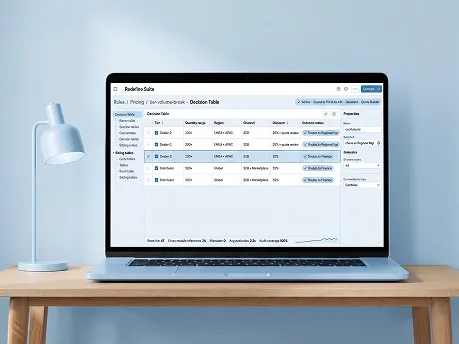
When teams reach for the rules engine.
The cleanest fit: any team running parallel logic in three or more tools. Below are the patterns we hear most often during scoping calls.
B2B
Commerce
Dealer pricing and quote routing
Tier-aware pricing, contract-pricing overrides, large-order escalation, and quote-to-cash routing all driven by one shared rule set.
Product
Ops
Product Information Management governance and publish gates
Margin floors, mandatory compliance fields by category, image quality checks, and channel-readiness rules enforced at edit, import, and sync.
Forms
and Intake
Multi-role intake forms
Hide, reveal, require, score, and route based on identity claims, account tier, region, or earlier answers, without separate form builders per persona.
Finance
and Risk
Approval thresholds and escalation
Spend caps, delegated approvers, escalation timers, weekend and holiday calendars, and audit-grade chain history: one rule, every workflow.
Content
Ops
Pre-publish content checks
Brand voice patterns, mandatory disclaimers, regional swaps, and reviewer assignment by content type. Gates run before publish, not after.
Related integrations and modules
The engine plugs into the rest of your stack.
Module
Forms and Workflow Software
The full suite that wraps the rules engine: intake, approvals, audit, and submission storage.
Explore the suite
ModuleOnline Form Builder
Visual builder that exposes the rules engine in every field: visibility, validation, scoring, routing.
Open the builder
ModuleApproval Workflow Software
Native chain builder with delegation, escalation, and signed audit log, using the same engine.
See approvals
Proof in production
How CollectPCS runs pre-orders, payment plans, and inventory release on one rule set.

Premium
CollectiblesB2B
+ B2C
CollectPCS
Pre-orders, limited inventory releases, partial-payment plans, and mixed domestic and manufacturer-direct international fulfillment on a single rule set.
The problem
Standard ecommerce workflows could not support pre-orders, limited release windows, flexible payment plans, and mixed fulfillment models. High-value collectibles require precise inventory control, controlled availability, and reliable handling of manufacturer-direct international shipping alongside domestic partners.
The result
0%
of pre-order, payment-plan, and inventory-release decisions moved onto a single rules canvas: admin-controlled, audit-logged, with no parallel logic in shipping or payment scripts.
Rules that moved
into the engine
Pre-order capture rules · partial-payment scheduling · admin-only inventory release · domestic versus manufacturer-direct routing
Operational gain
Granular control over payment capture, order processing, and inventory allocation without increasing operational friction.
Tech stack
Headless storefront · custom backend commerce logic · rules engine driving payments, fulfillment, and inventory
Source: CollectPCS engagement summary, Redefine project archive.
Frequently asked questions
Real reasons buyers pause. Answered.
Both. Operators build most rules visually in a drag-and-drop canvas with named blocks. Developers can drop into JavaScript expressions for complex predicates. The engine evaluates either path identically and signs both into the same audit log.
Form-builder logic stays inside the form. Our engine sits across forms, approval workflows, Product Information Management, and content publishing. A single threshold (for example, $25k) is referenced from one place and applied everywhere. No parallel maintenance, no drift.
Yes. Rules can reference asynchronous data sources including enterprise resource planning balance checks, credit limit lookups, OFAC screening, address validation, and real-time inventory. The engine handles timeouts, retries, and fallback paths so a slow third-party service does not stall a workflow.
Every rule evaluation logs the rule identifier and version, the input payload, the predicate result, the executed actions, the user or system that triggered it, and the timestamp. Logs are append-only, signed, and queryable through the platform user interface or a streaming export.
First rules go live in week two. Most teams migrate the highest-value workflow (typically approvals or Product Information Management gates) first, prove the model with a 4-week pilot, then port the rest of the logic in 6 to 10 weeks depending on how many tools currently hold the rules.
Honest fit check
Who this is for, and who it isn't.
Strong fit
- You run the same rule logic across three or more tools today.
- You have B2B pricing, approval chains, or Product Information Management governance in play.
- Compliance or audit asks for a single source of truth on decisions.
- Operators want to change rules without filing a developer ticket.
Not the right fit
- You need a single intake form with five conditional fields. A form builder is enough.
- All your rules live in a single enterprise resource planning system and nothing else needs to read them.
- There is no operator who would own rule changes. Only developers.
- Your workflow is stable, low-volume, and never crosses systems.
Not sure? Tell us your situation in the form below and we'll be straight with you.
Tell us about your rules
See the engine running on your workflow.
We'll review the rules you run today, sketch a unified canvas on a 30-minute call, and ship a scoped sandbox in 5 business days so you can evaluate it before any commitment.
Scoped before work starts · line-by-line pricing · no commitment to receive a proposal
Response
Within 48 hours
Sandbox
5 business days
Workflows live
320+ in production
Code ownership
Yours, from day one
Form
Call within 48 hours · scoped sandbox in 5 business days · first rule live in week 2
Brief received. We'll review your rules and reach out within 48 hours with a scoped sandbox plan.
Response within 48 hours
Scoped proposal in 3
days
320+ workflows live in
production
Code ownership yours from day
one