
Mid-market technology leaders keep asking the same question heading into 2026: does a custom build actually pay off, or is it safer to configure what already exists? The short answer sits below, followed by the tradeoffs that decide which side of that line your business falls on.
Custom software is worth it for a mid-market business in 2026 when the workflows driving revenue cannot be replicated inside a SaaS platform or a configured ERP system without heavy compromise. It is not worth it when Microsoft Dynamics 365, NetSuite, or a well-integrated ecommerce platform already solves the same problem in a fraction of the time. The cost most teams underestimate is not the build itself, it is the ongoing maintenance, security patching, and internal ownership a custom system demands after launch.
- Custom software pays off in 2026 when core workflows cannot fit inside SaaS or ERP constraints without compromise.
- Off-the-shelf platforms and configurable ERP systems like Dynamics 365 Business Central win on speed and lower ongoing ownership burden.
- The build vs buy decision hinges on integration complexity, differentiation needs, and who maintains the system after go-live.
- Redefine Innovations builds custom software and implements Dynamics 365 ERP for mid-market and enterprise teams weighing both paths.
Why this matters
A build vs buy decision made in 2026 sets the technical direction for a mid-market business well past this budget cycle. Choose wrong and you either pay a SaaS vendor indefinitely for features the business will never fully use, or you tie up engineering headcount maintaining a custom system nobody outside IT can extend.
Redefine Innovations has delivered enterprise software, ERP, and ecommerce projects for more than 25 years across 500-plus engagements, and the pattern is consistent: companies that regret a custom build usually skipped the step of checking whether Dynamics 365 Business Central, NetSuite, or a headless commerce platform already covered most of what they needed.
Is custom software worth it for a mid-market business in 2026?
Yes, for the narrow set of mid-market businesses whose core process, pricing logic, inventory rules, or customer workflow cannot be configured inside an existing platform. No, for the much larger group whose real need is a better-configured ERP or a properly integrated SaaS stack. The table below breaks down where each approach wins in 2026.
| Approach | Best for | Time to value | Ownership after launch | Verdict |
|---|---|---|---|---|
| Custom software | Unique processes SaaS can't model | Slowest, spans multiple quarters | High, needs an internal or retained dev team | Build only if truly differentiated |
| SaaS / off-the-shelf | Standard workflows, fast rollout | Fastest | Low, vendor handles most upkeep | Buy for commodity functions |
| Configurable ERP (Dynamics 365 Business Central) | Finance, inventory, and operations at mid-market scale | Moderate, weeks to a few months for core modules | Moderate, partner-supported | Configure before you build |
| Low-code / no-code | Internal tools, workflow automation | Fast for narrow use cases | Moderate, depends on platform limits | Use for internal tools, not core commerce |
Microsoft positions Dynamics 365 Business Central as its ERP built for small and midsize businesses (Microsoft Learn, https://learn.microsoft.com/en-us/dynamics365/business-central/), which is exactly why most mid-market ERP evaluations start there before anyone opens a custom development conversation.
The pattern in the table holds across ecommerce, finance, and operations in 2026: flexibility costs time, and speed costs control. Mid-market leaders who map their own priority against those two axes usually get the build vs buy call right before a single requirements document gets written.
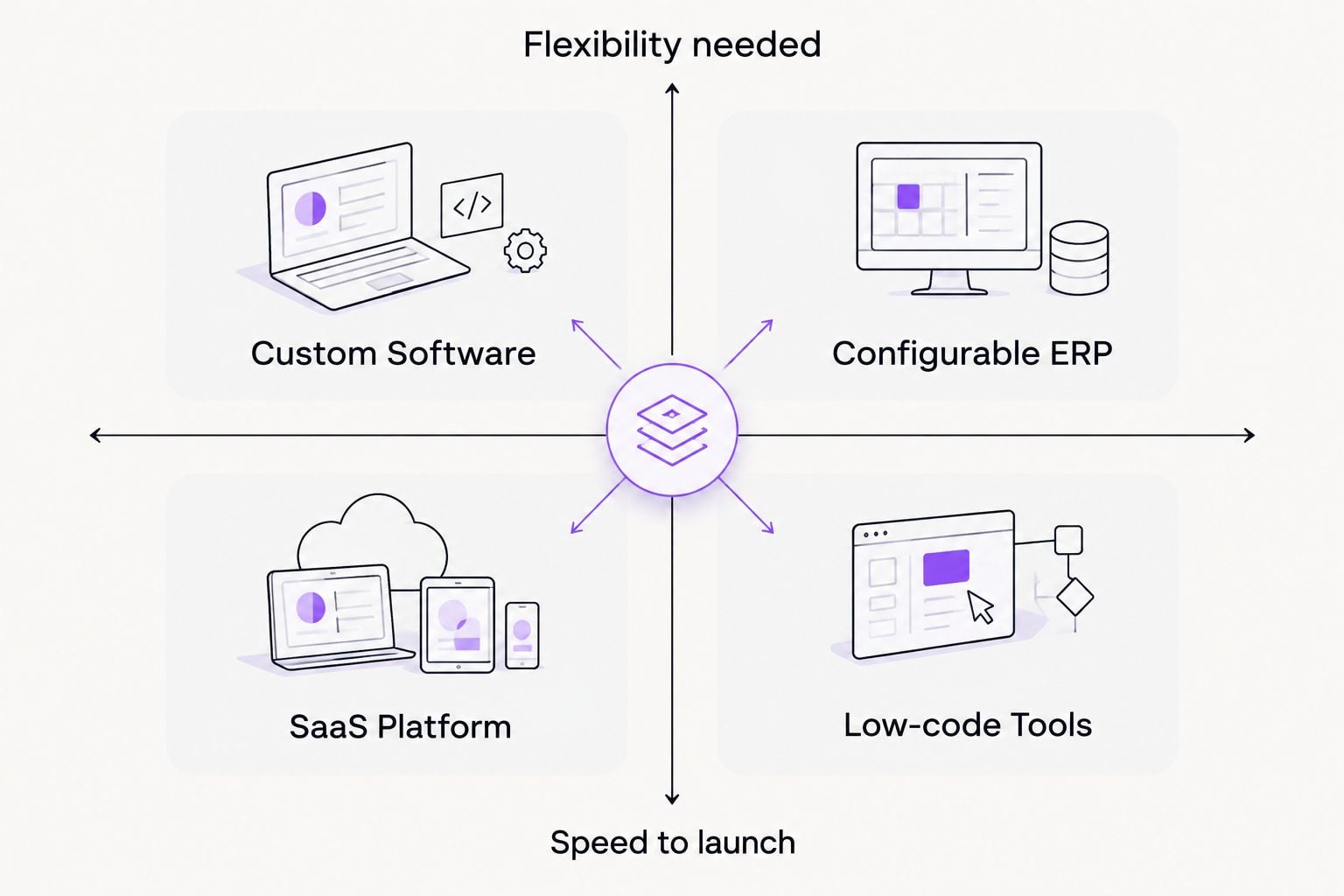
Custom software: best for differentiation, not speed
Custom software makes sense in 2026 when a mid-market business has a genuinely unique process, a proprietary pricing model, or a workflow that no SaaS vendor has built for. It also makes sense when the business plans to sell that workflow as a competitive advantage, not just run it internally.
Pros: full control over the data model, no per-seat licensing ceiling, and the ability to build exactly what the business needs instead of working around a vendor's roadmap.
Cons: the longest timeline of any option, the highest ongoing ownership cost, and full exposure if the internal or retained team that built it moves on.
Verdict: build only when the workflow is a real differentiator, not a convenience.
SaaS platforms: best for speed, not control
Off-the-shelf software wins when the workflow is common: accounting, basic CRM, standard ecommerce checkout, help desk ticketing. These are solved problems, and a mid-market business gains nothing by re-solving them internally in 2026.
Pros: fastest time to value, vendor-managed security and uptime, predictable support.
Cons: feature ceilings, data lock-in with the vendor, and licensing costs that scale with headcount or usage regardless of how much of the platform actually gets used.
Verdict: buy for any process that isn't part of what makes the business different.
Configurable ERP: best for structured, repeatable operations
Dynamics 365 Business Central sits between custom software and pure SaaS. It handles finance, inventory, procurement, and operations with enough configuration depth that most mid-market businesses never need a custom module for those functions. See how it stacks up against other ERP paths in the NetSuite alternatives comparison, which covers the same build vs configure tradeoff from the ERP side specifically.
Pros: partner-supported implementation, deep native integration with Microsoft's ecosystem, and configuration options that cover most mid-market operational needs without custom code.
Cons: heavily customized configurations can become nearly as hard to maintain as custom software, and switching ERP platforms later is expensive.
Verdict: configure before you build, especially for finance and inventory.
Low-code platforms: best for internal tools, not core commerce
Low-code and no-code tools fill the gap for internal automation: approval workflows, internal dashboards, one-off data entry tools. They are not built to run a mid-market business's core commerce or ERP backbone in 2026.
Pros: fast to stand up, low engineering overhead, easy for business users to adjust.
Cons: platform ceilings on complexity, and a hard wall when the workflow needs true integration depth with core ERP or ecommerce systems.
Verdict: use for internal tools, skip for anything customer-facing or revenue-critical.
Why the answer varies for mid-market businesses
- Integration complexity: a business running five disconnected systems needs different software than one already on a unified ERP.
- How differentiated the workflow actually is: a genuinely unique process justifies custom code; a common one doesn't.
- In-house engineering capacity: custom software without a team to maintain it after launch turns into unmanaged risk within a year or two.
- Regulatory and compliance requirements: industries with strict audit trails sometimes need custom controls a SaaS platform won't expose.
- Transaction volume and scale: high-volume mid-market operations hit SaaS platform limits that low-volume businesses never notice.
- Tolerance for vendor lock-in: businesses planning an acquisition or platform migration in the next few years should weigh how portable each option is.
Is custom software cheaper than SaaS in the long run?
Custom software is rarely cheaper than SaaS once maintenance, security patching, and internal ownership are counted. SaaS pricing is predictable and vendor-managed; custom software shifts that cost onto the business's own team indefinitely, and that ownership cost compounds every year the system stays in production.
How long does a custom software build take for a mid-market company?
A custom software build for a mid-market company runs considerably longer than a SaaS rollout, typically spanning multiple development phases rather than a single sprint. Configurable ERP implementations like Dynamics 365 Business Central usually reach core functionality faster because the modules already exist and only need configuration, not development from scratch.
Should you build custom software or customize Dynamics 365 Business Central first?
Customize Dynamics 365 Business Central first for finance, inventory, and operations before considering a custom build, since most mid-market requirements fit inside its configuration options. Reserve custom development for the specific workflow that genuinely cannot be configured, and Redefine Innovations scopes that gap analysis as part of its ERP implementation and custom software work for mid-market and enterprise teams.
Frequently asked questions
Is custom software worth it for a small business in 2026?
Custom software is rarely worth it for a small business in 2026 because the ownership and maintenance burden outweighs the benefit at low transaction volume. SaaS platforms cover most small-business workflows at a fraction of the ongoing cost.
What is the biggest hidden cost of custom software?
The biggest hidden cost of custom software is long-term maintenance and security patching, not the initial build. Once a system is in production, someone has to own updates, bug fixes, and infrastructure indefinitely.
Is Dynamics 365 Business Central good for mid-market ecommerce operations?
Dynamics 365 Business Central works well for mid-market finance, inventory, and operations, and integrates with major ecommerce platforms for order and fulfillment data. It is Microsoft's ERP built specifically for small and midsize businesses.
Should a mid-market business build or buy software?
A mid-market business should buy for standard workflows and build only for processes that are a genuine competitive differentiator. Most operational functions, like accounting and inventory, are better served by a configured ERP than custom code.
How do you know if a workflow needs custom software?
A workflow needs custom software when no existing SaaS or ERP configuration can model its logic without significant compromise. If the process is proprietary or a core competitive advantage, it usually justifies a custom build.
Is low-code a substitute for custom software?
Low-code is a substitute for custom software only for internal tools and workflow automation, not for core commerce or ERP systems. It hits complexity ceilings quickly once integration requirements grow.
What is the risk of over-customizing an ERP system?
Over-customizing an ERP system creates the same long-term maintenance burden as custom software, since heavily modified configurations become hard to upgrade or migrate. Configuration within the platform's native options avoids this risk.
How long does an ERP implementation take compared to a custom build?
An ERP implementation like Dynamics 365 Business Central generally reaches core functionality faster than a custom build because the modules already exist and only need configuration. A custom build starts from zero and takes considerably longer to reach the same functional depth.
One last thing
The mid-market businesses that get the most value out of custom software in 2026 rarely start with a blank canvas. They start by running the gap analysis against Dynamics 365 Business Central or a similar configurable ERP, find the one workflow that genuinely doesn't fit, and build only that piece. Custom software built on top of a properly configured ERP core costs less to maintain than custom software built to replace the whole stack.
Scope your build vs buy decision
Get a technical assessment before committing engineering budget.
Growth & strategy insights, no fluff
One short email a month on integration, ecommerce, and scaling smart.
You're in — check your inbox to confirm.