Azure development company
Azure development services

Azure applications from an azure development company, architected to scale, not just deployed to run.

We build cloud-native applications on Azure with the right services chosen for your workload, infrastructure managed as code, and DevOps pipelines that ship on every commit. App Service, AKS, Azure SQL, Entra ID, Key Vault. Architecture decisions made before any resource is deployed.

Azure reference architecture • production
👤
Client
User / App
CI/CD
Azure DevOps
🌐
Compute
App Service
🗄
Database
Azure SQL
🔑
Secrets
Key Vault
🛡
Identity
Entra ID
📊
Observability
Monitor
All services healthy • 99.97% uptime • Azure West Europe • DR: North Europe

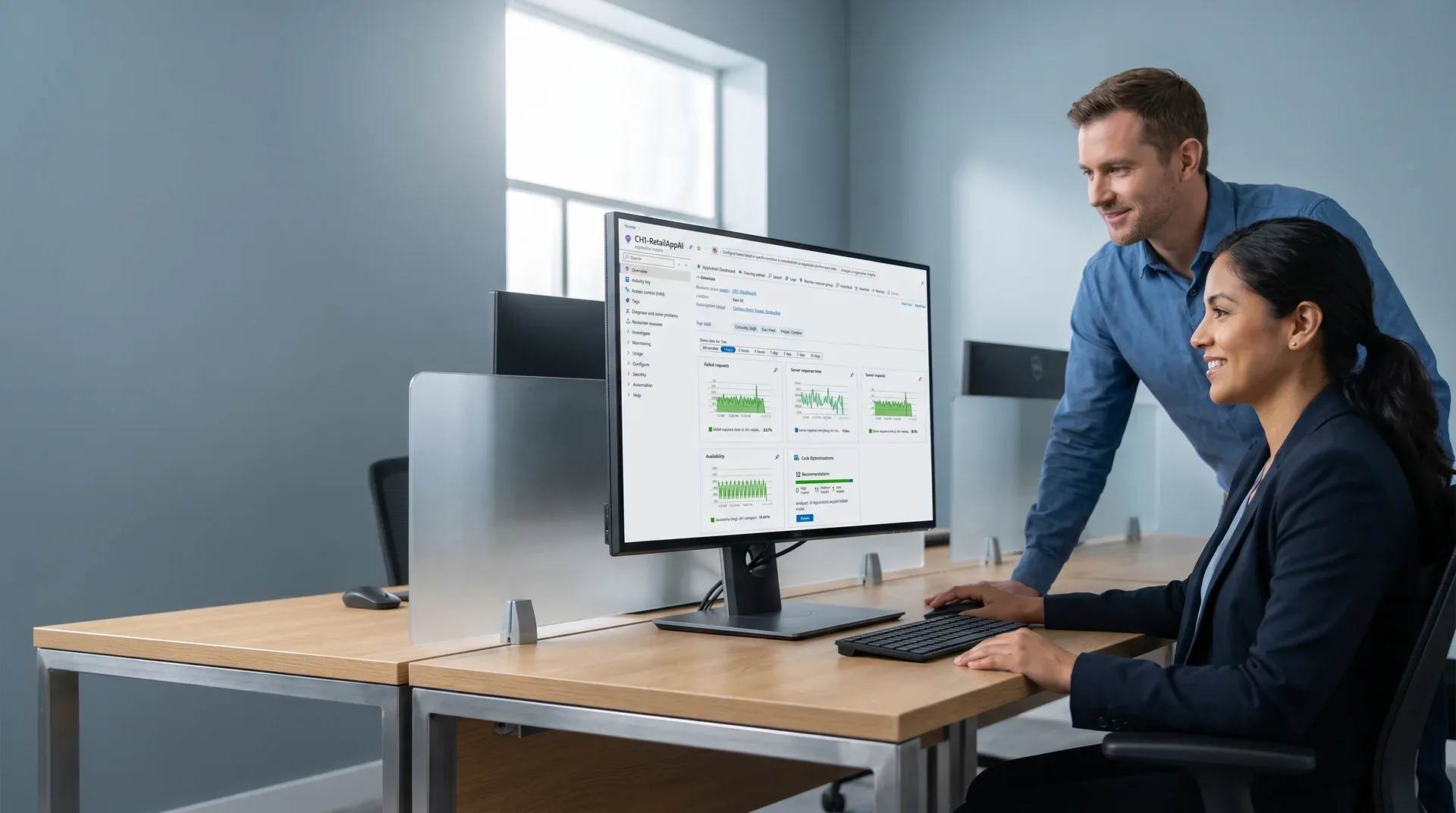
Hero · cloud development team reviewing Azure architecture documentation on large monitors

Cloud development team reviewing Azure Portal dashboards and architecture diagrams on large monitors with natural office light from behind-shoulder wide angle shot
The Azure Architecture Problem

Most Azure projects are deployed correctly. They are designed incorrectly from the start.

0%
of cloud projects experience significant cost overruns due to over-provisioning or wrong service selection
0x
higher cost to rearchitect a production Azure application than to design it correctly from Sprint 1
0%
of Azure deployments that were clicked together in the portal, not managed as infrastructure as code, require manual recreation after incidents
How most Azure projects fail
Services selected for familiarity, not workload fit
App Service chosen for a workload that needed AKS. Azure SQL chosen for a document workload. Wrong foundation, expensive rewrite later.
Infrastructure clicked together in the portal
No Bicep or Terraform. Environments cannot be recreated. An incident requires manual reconstruction from memory.
Secrets in application config, not Key Vault
Connection strings and application programming interface keys committed to code or stored in app settings. First security audit fails on secrets management.
How Redefine approaches Azure from Sprint 1
Architecture Decision Record before any resource is created
Every Azure service choice is documented with rationale, alternatives considered, and cost model. You approve before we deploy.
100% infrastructure as code from day one
Bicep or Terraform. All environments are reproducible in under 20 minutes from the repo. Portal changes are never the source of truth.
Key Vault for every secret from Sprint 1
Managed identities for service-to-service auth. Key Vault references in app configuration. Zero secrets in code or config files.
Azure Service Map

Every Azure service we implement, backed by azure development consulting — expand each to see how we configure it and when we choose the alternative.

This is the same architecture reference we start every Azure engagement with. Expand each service to see how we configure it, what alternatives we considered, and when we choose them.

PaaS hosting for web applications, REST APIs, and background WebJobs. We configure custom domains, SSL, auto-scale rules based on CPU or HTTP queue depth, and deployment slots for zero-downtime releases. Standard tier or higher for production to get the 99.95% SLA.

How we configure it: Bicep + App Service Plan · Deployment slots · Application Insights · Custom autoscale rules

When we choose the alternative: Azure Kubernetes Service — for containerized microservices or heavy traffic workloads

Managed Kubernetes for containerized applications requiring fine-grained control over resource allocation, multi-container workloads, or service mesh networking. We configure node pools, Horizontal Pod Autoscaler, Azure Container Registry, and AGIC for ingress.

How we configure it: AKS + ACR + AGIC · Helm charts · Azure Monitor for containers · Workload Identity

When we choose the alternative: App Service — for single-container or simpler apps that don't need Kubernetes complexity

Event-driven serverless compute for triggers, webhooks, timer jobs, and queue processing. Consumption plan for sporadic workloads, Premium plan for VNet integration and warm instances. Durable Functions for long-running orchestrations.

How we configure it: Bicep + Function App · Service Bus or Event Grid triggers · Managed Identity · Key Vault references

When we choose the alternative: Logic Apps — for integration workflows without custom code; App Service WebJobs for always-on background tasks

Fully managed SQL Server with built-in high availability, automatic backups with point-in-time restore, and Advanced Threat Protection. We configure elastic pools for multi-tenant cost efficiency, geo-replication for disaster recovery, and Transparent Data Encryption.

How we configure it: Azure SQL · Elastic Pool (multi-tenant) · Private Endpoint · Entra ID authentication · Long-term backup retention

When we choose the alternative: Cosmos DB — for document-oriented or globally distributed workloads needing sub-10ms latency

Globally distributed NoSQL for document, key-value, graph, and column-family workloads. Single-digit millisecond reads. We scope the consistency level, partition key strategy, and RU provisioning model before any data model is built.

How we configure it: Cosmos DB · SQL API or MongoDB API · Multi-region writes · Private Endpoint · Server-side functions

When we choose the alternative: Azure SQL — for relational data with complex joins, transactions, or reporting requirements

Centralized secret, key, and certificate management. Every application secret is stored in Key Vault. Applications reference secrets through Managed Identity, never connection strings in config files. We configure access policies, soft-delete protection, and HSM-backed keys for regulated workloads.

How we configure it: Key Vault · Managed Identity · Key Vault references in App Service · Secret rotation policies · Diagnostic logs

When we choose the alternative: Application settings — not recommended for secrets. Always Key Vault.

Identity platform for user authentication (SSO, MFA, Conditional Access) and service-to-service authorization (Managed Identity, App Registrations). We configure Entra ID for your application, set up user flows or B2C for external users, and implement role-based access control against Azure resources.

How we configure it: Entra ID · App Registration · Managed Identity · Conditional Access · MSAL libraries

When we choose the alternative: Custom auth — building your own identity system when Entra ID covers the requirement is rejected in our architecture review

Full CI/CD with multi-stage YAML pipelines. Build, test, SAST scan, publish artifacts, and deploy across environments with approval gates. We configure branch policies, environment protection, and integration with Azure Boards for traceability from ticket to deployment.

How we configure it: Azure DevOps · YAML pipelines · Environments + approvals · Azure Artifact feeds · SAST integration

When we choose the alternative: GitHub Actions — for teams with existing GitHub workflows; we build in either depending on your preference

Full-stack observability from VM metrics to user sessions. Application Insights SDK added to every application for distributed tracing, custom metrics, and failure rate alerting. Azure Monitor alerts fire before your users notice a problem.

How we configure it: Azure Monitor · Application Insights · Log Analytics workspace · Alert rules · Workbooks · Smart detection

When we choose the alternative: Third-party APM — Datadog or Dynatrace for advanced APM features; we integrate either alongside Monitor when required

Azure Development Outcomes

Five Azure capabilities. Measured outcomes. Not promises.

Value stack · Azure DevOps pipeline on large monitor showing successful deployment stages, dev team nearby
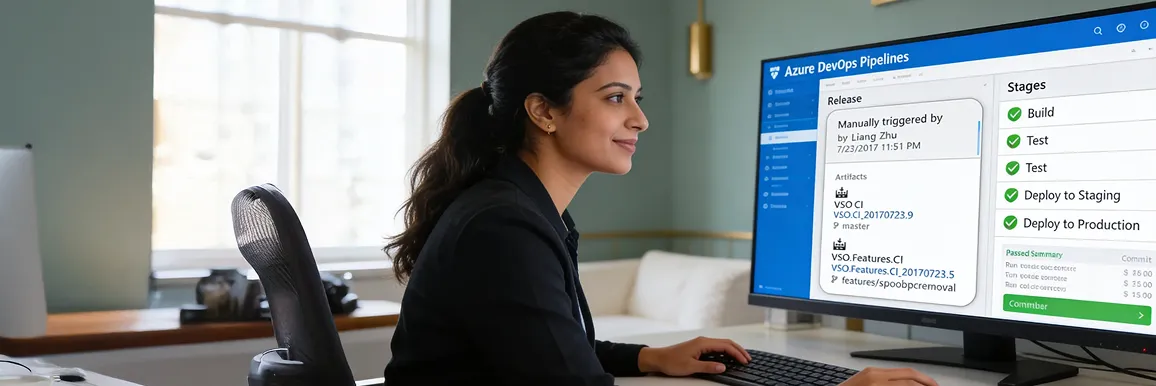
Developer reviewing successful Azure DevOps CI/CD pipeline on large monitor with green deployment stages and natural office light in over-shoulder perspective
🌐
0%
infrastructure as code coverage
All environments from Bicep or Terraform. Zero portal drift. Reproducible in under 20 minutes.
🔄
0
minutes average deployment
Azure DevOps pipelines with parallel jobs, caching, and environment promotion gates.
🛡
0
secrets in application code
Key Vault references and managed identities. Connection strings never leave the vault.
📊
0%
uptime SLA on App Service Standard tier and above
Azure Monitor alerts, health probes, and auto-restart configured from Sprint 1.
🗃
0s
point-in-time restore for Azure SQL
Geo-redundant backups with 7 to 35-day retention configured on every production database.
Client Result

Azure infrastructure design for Microsoft Dynamics 365 Business Central ERP migration.

Proof · IT manager and business lead reviewing new Business Central ERP running on Azure, satisfied

IT manager and business lead reviewing new Microsoft Dynamics 365 Business Central ERP system live on Azure infrastructure with natural office light and satisfied expressions
99.9%
Enterprise ERPAzure Infrastructure
Problem
Legacy ERP system had functional and scalability limitations constraining business operations and growth. Legacy architecture increased operational risk and made compliance, performance, and reporting requirements difficult to meet.
What we delivered
Microsoft Dynamics 365 Business Central on Azure infrastructure with Entra ID identity management, Azure-based security posture, and a scalable cloud foundation designed for future growth. Finance, sales, and customer operations unified on one platform.
System uptime
0%
post go-live on Azure infrastructure
Azure services used
Dynamics 365 Business Central
Azure Cloud Infrastructure
Microsoft Entra ID
Azure Security Center
How Redefine Azure Compares

Not every azure development agency approaches cloud architecture the same way.

Azure capability
Freelancer
Azure boutique
Redefine
Architecture Decision Record before deployment
Service rationale documented before any resource is created
Rarely
Sometimes
Every project
100% infrastructure as code (Bicep or Terraform)
No portal-only resource creation
Often portal
Varies
Standard
Key Vault for all secrets from Sprint 1
Zero secrets in config or code
Often config
Sometimes
Always
Azure Monitor and Application Insights set up at launch
Not added later as an afterthought
Afterthought
Standard
Sprint 1
Cost model documented before provisioning
No surprise Azure bills
Not provided
Estimate only
Documented
DR and backup strategy included in architecture
Point-in-time restore, geo-redundancy scoped up front
Extra scope
Sometimes
Included
Common Questions

What CTOs and engineering leads ask before an Azure engagement.

We build on Azure App Service, Azure Kubernetes Service, Azure Functions, Azure SQL, Cosmos DB, Key Vault, Entra ID, Azure Monitor, and Azure DevOps. Service selection is driven by your workload requirements, not familiarity bias. We document the rationale for every service choice in the Architecture Decision Record before writing any infrastructure code. Expand any service in the Azure service map above to see how we implement it.
Yes. We use Bicep and Terraform for Azure infrastructure as code. All infrastructure is version-controlled alongside application code, so every environment change is tracked, reviewable, and reproducible. We do not click through the Azure portal to create production resources. No portal drift means your environments are always reproducible from the repo in under 20 minutes.
Yes. We assess your current architecture, define the target Azure architecture, and plan the migration path before moving anything. Migrations are staged to avoid downtime: lift-and-shift for quick wins, followed by cloud-native refactoring where the workload benefits from Azure-native services. See also our legacy application modernization services.
Security is scoped at the architecture level. We implement Entra ID for identity and access control, Key Vault for secrets management, Azure Policy for governance guardrails, and Microsoft Defender for Cloud for posture management. For regulated workloads, we scope the compliance boundary and service selection against the applicable standard before the first resource is deployed.
Azure development engagements typically run between $40,000 and $250,000 depending on application complexity, number of Azure services, infrastructure requirements, DevOps pipeline build, and ongoing maintenance scope. Infrastructure costs depend on your workload and scale targets. We produce a cost model for both development and infrastructure before quoting. We scope before we quote.
Book an Azure Architecture Call

Hire azure development for your Azure project.

We respond within two business days. No commitment. No pitch.

Form
48 hours
Response
IaC
Bicep • Terraform
0
Secrets in code
99.9%
Uptime SLA target

Get on a call with us to see how we can help you

Get a Quote