Your Cloud Platform Choice Is an Architecture Decision That Lasts Five Years
AWS, Azure, and Google Cloud builds for engineering teams that need production-grade infrastructure, not just a server. Redefine scopes your workload, picks the right platform, and ships IaC-first architecture with a DevOps pipeline included.
85+ platform projects shipped. Every engagement scoped before a single line of code is written.

Choose the Cloud Platform That Fits Your Workload, Not Your Vendor's Default
AWS, Azure, and Google Cloud each have a different cost profile, performance ceiling, and team fit. The right choice depends on your traffic patterns, compliance requirements, and what your engineers already know. All three produce infrastructure you own.
AWS Development Services
Lambda, ECS, RDS, S3, and the full AWS service catalog. Best for teams that need maximum service breadth and engineering flexibility. Built and deployed by AWS-certified engineers.
Azure Development Services
Azure Functions, AKS, Cosmos DB, and App Services. The right choice for Microsoft-stack teams, Dynamics 365 integrations, and enterprises already inside the Azure ecosystem.
Google Cloud Development Services
Cloud Run, BigQuery, Firestore, and GKE. Built for data-heavy applications and AI workloads where BigQuery analytics and Vertex AI are requirements, not add-ons.
Explore Other Development Services
Wrong Platform Choice Costs You Years, Not Months
Most teams pick a cloud provider based on who their last hire knew. That's not an architecture decision. The result is years of workarounds, mounting cloud bills, and features that take three sprints because the platform fights the product.
Your AWS environment was provisioned manually. No IaC, no reproducibility. Every new environment is a guessing game and a potential outage.
Deployments happen manually via SSH or a build script someone wrote in 2021. Every release is a 3-hour event that risks rolling back the wrong version.
Your cloud bill climbs every month. No tagging strategy. No reserved capacity. No one owns cost governance. You're paying for idle compute at peak rates, and the bill increases faster than your revenue does.
You built a monolith when you needed microservices, or containerized a simple app that should be serverless. Scaling costs 10x what it should.
IAM roles with wildcard permissions, open security groups, no WAF, no secrets manager. Your platform is one misconfiguration away from a breach.
You chose the wrong cloud provider for your use case three years ago. Now migrating would take 18 months and $400K. You're stuck maintaining a platform that fights your product.
Every resource defined in Terraform or CloudFormation. Reproducible environments in minutes. New staging environment spun up as part of the sprint review process.
GitHub Actions or AWS CodePipeline with automated testing gates, blue-green deployments, and rollback in 90 seconds. Your team ships feature flags on a Tuesday without drama.
Reserved instances, Savings Plans, and auto-scaling policies are configured in Sprint 1. Across our last 12 client engagements, cloud costs dropped an average of 35% within 60 days of engagement start.
We match architecture to your actual workload profile. Serverless where it reduces operational cost. Containers where your team needs to scale. Monolith when it's the right tool. The choice is based on data, not defaults.
Least-privilege IAM, encrypted secrets via AWS Secrets Manager or Azure Key Vault, WAF rules configured, and SOC 2-ready access logging. Security is architecture, not an afterthought.
We build abstraction layers into every project so your application logic stays independent of any single cloud provider's proprietary APIs. If your business needs to migrate in three years, you can do it in months, not years.
Full-Stack Platform Engineering, Not Just the Parts a Contractor Will Touch
Application architecture, infrastructure provisioning, DevOps automation, observability, and security posture — delivered together. When the platform fails at 2 a.m., you want a team that built all of it, not one that handed the security off to someone else.
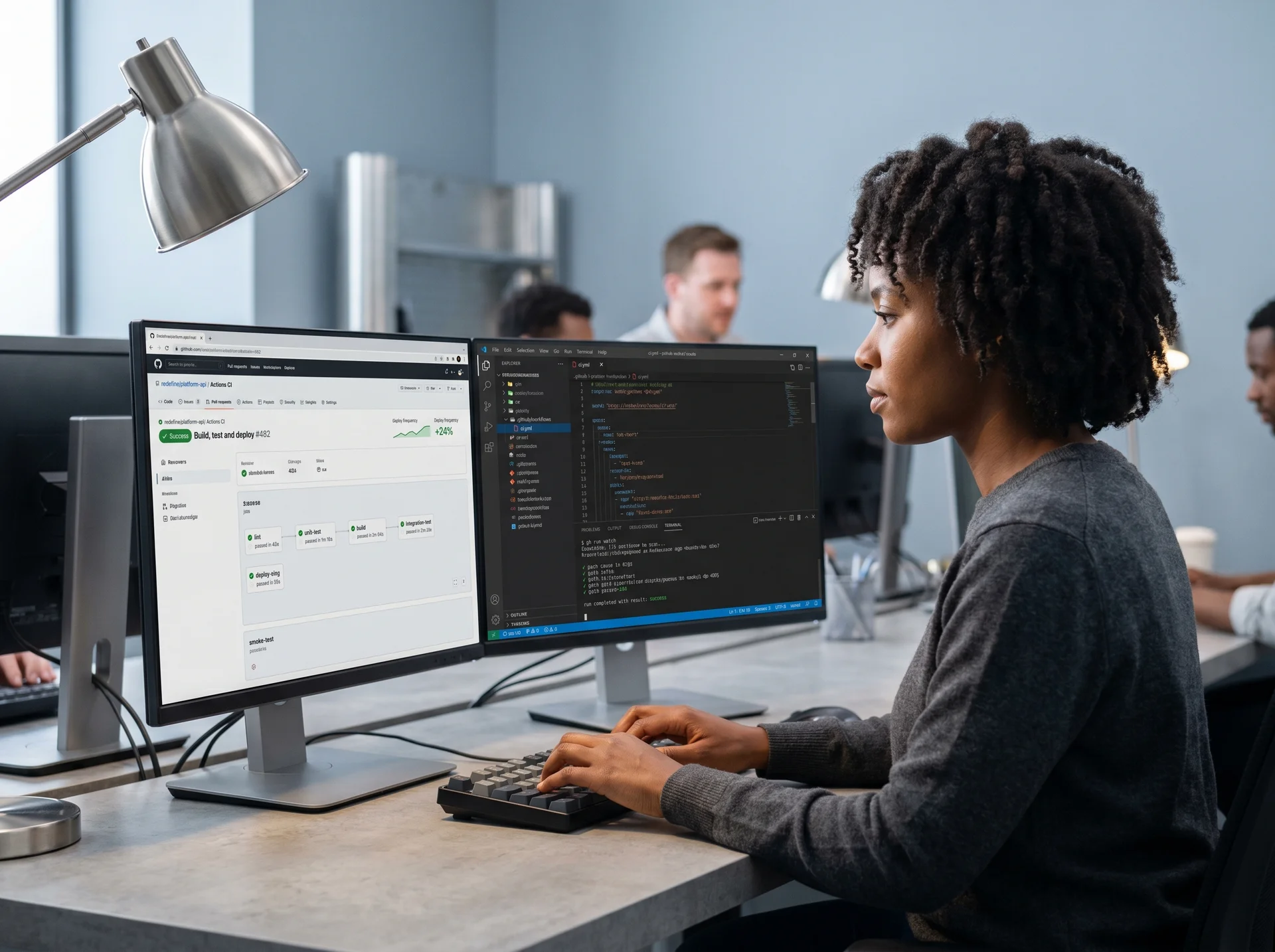
Automated Pipelines That Ship Without Drama
GitHub Actions, AWS CodePipeline, Azure DevOps, or Cloud Build. Every pipeline includes automated testing, linting, security scanning, and zero-downtime deployment strategies. Your team merges a PR and goes home.
Architecture Designed for Your Traffic, Not the Provider's Default
We build your VPC, subnet layout, load balancing, auto-scaling groups, and database cluster around your actual traffic patterns. Terraform, Pulumi, or CDK — whichever your team can maintain. Infrastructure that costs less to run, and less to change.
within 60 days of engagement start
SOC 2 and HIPAA-Ready Security Posture
Least-privilege IAM policies, encrypted secrets management, WAF configuration, and audit-logging baked in from day one. Not retrofitted six months before your compliance audit.
You See Everything Before Your Users Do
Datadog, CloudWatch, or Grafana stacks configured with meaningful alerts. P95 latency dashboards, error rate tracking, and cost anomaly detection so incidents become non-events.
Kubernetes Without the Operational Overhead
EKS, AKS, and GKE cluster setup with Helm charts, horizontal pod autoscaling, and resource quotas. Managed Kubernetes that your team can actually operate, with runbooks included.
platform projects shipped since 2018
cloud providers, one team, zero re-learning curve
to a scoped architecture proposal in your inbox
uptime SLA on all managed platform retainers
Six Weeks from Brief to Production. Every Step Defined Before It Starts.
Every engagement follows this exact sequence. No phases are skipped. No work begins without an approved exit condition from the previous phase. Click any phase to see the deliverables.
Discovery Sprint
Platform recommendation with TCO model. Your CTO signs off before any infrastructure is provisioned.
IaC Foundation
Every resource in Terraform or CDK. Three environments reproducible from code with zero manual steps.
Pipeline Build
CI/CD pipeline live, security scanning built in, and your team makes a test commit to see it deploy.
Application Deploy
Production environment live, load-tested, and switched over with zero downtime.
Observability and Ops
Dashboards, alerting runbooks, and a live handoff call. You own the platform. We stay available.
Click any phase above to see the deliverables, tools, and team responsibilities for that step. Each phase has a defined exit condition before the next begins.
One B2B Platform Rebuild. What Actually Happened.

DrivingI
B2B Promotional ProductsEstablished B2B promotional products company with complex catalogs, customer-specific pricing, and approval-based purchasing workflows.
DrivingI's legacy platform failed at the most critical B2B function: keeping inventory accurate. Real-time syncing broke regularly, catalogs were slow to load, and customer-specific approvals were entirely manual. Data lived in three separate systems — the ERP, CRM, and marketing tools — with no reliable connection between them. Every order required someone to manually verify what the system said was wrong.
We rebuilt the platform on Node.js and Next.js with a headless architecture. Microsoft Dynamics inventory syncs in real time. Customer-specific pricing, approval workflows, and access controls are built into the core product. Salesforce CRM is integrated. BI tooling gives the operations team visibility into performance without asking an engineer.
Live inventory visibility across all customer accounts
Inventory accuracy went from unreliable to 100% live across all accounts.
Order approval time dropped. Customers stopped contacting support to verify what the portal said.
The engineering team can now add catalog sections, run promotions, and integrate new tools without a rebuild.
Most Agencies Treat Your Cloud Platform as a Commodity. We Don't.
Staff augmentation firms pick the cloud because it's familiar. We pick it because the workload demands it. Platform choice is an architecture decision. Getting it wrong costs years of rework and re-architecture budgets your board won't approve twice.
| Capability | Typical Partner | Redefine |
|---|---|---|
| Platform selection process | Recommend what the team already knows | Workload profiling and total cost of ownership
analysis before any code is written |
| Infrastructure as Code | Optional or added at extra cost | Infrastructure as Code on every engagement:
Terraform, Pulumi, or CDK. Non-negotiable. |
| CI/CD pipeline | Basic pipeline, manual quality assurance
gates | Automated testing, security scanning, blue-green
deployments with 90-second rollback |
| Security posture | Handled separately or not at all | SOC 2 and HIPAA-ready patterns built into the
architecture from Sprint 1 |
| Cloud cost optimization | Not included in project scope | Reserved instances, auto-scaling, and resource tagging delivered with your infrastructure. Cloud spend drops an average of 35% within 60 days. |
| Handoff and docs | Basic README, no runbooks | Architecture decision records, runbooks, incident
response playbooks, and a handoff call included |
Everything You Should Ask a Cloud Platform Partner Before You Hire One
We run a workload profiling session in Week 1 that covers your traffic patterns, data storage requirements, existing team expertise, compliance obligations, and growth trajectory. AWS tends to win for organizations with diverse service requirements and large engineering teams. Azure is the right choice for Microsoft-stack teams or companies running Dynamics 365. GCP is best for data-intensive applications with AI and ML workloads that benefit from BigQuery and Vertex AI. The recommendation is documented with a total cost of ownership model so you can challenge the reasoning.
Yes, and this is the most common engagement type. We start with a cloud architecture review that produces a prioritized list of improvements: IaC migration for manually provisioned resources, CI/CD pipeline modernization, IAM policy tightening, cost rightsizing, and observability gaps. We then execute improvements in sprints without disrupting running services. You can continue shipping features while we improve the foundation underneath.
Platform audits and remediation projects start at $12,000 for a four-week sprint. Full platform builds — including IaC foundation, CI/CD pipeline, security posture, and observability stack — range from $35,000 to $150,000 based on scope. Complex enterprise deployments with multi-account AWS organizations, EKS cluster setup, and full compliance frameworks are scoped specifically. Every engagement starts with a Discovery Sprint. No line-item pricing is committed until both sides agree on scope. You will not receive a bill for work that was not in the approved proposal.
We support multi-cloud but we challenge the requirement first. Most multi-cloud architectures are the result of mergers, vendor lock-in anxiety, or organizational politics rather than genuine technical requirements. If multi-cloud is the right answer for your workload, we build abstraction layers that minimize provider-specific dependencies and design networking, identity federation, and data replication to work across providers. If single-cloud is adequate, we say so clearly rather than billing for unnecessary complexity.
Every platform build includes a structured handoff: architecture decision records, runbooks for common operational tasks, incident response playbooks, and a two-hour handoff call where your team takes ownership. For teams that want ongoing managed support, we offer SLA-based retainers covering incident response, patching, capacity management, and periodic architecture reviews. These are optional. You keep full platform ownership regardless.
Good platform discipline at the startup stage prevents the re-architecture tax at Series B. We calibrate complexity to your actual stage: a seed-stage product gets a lean Terraform setup, a simple GitHub Actions pipeline, and the security basics needed for SOC 2 readiness. We don't over-engineer. The goal is giving your founding engineers an infrastructure foundation they can grow into, not one they have to rip out at scale. A Discovery Sprint is $4,000 flat and gives you a specific architecture recommendation your team can execute with or without us.
Send Us Your Brief. Get a Scoped Architecture Proposal in 3 Days.
We review your brief, scope the architecture, and send a written proposal before you commit to anything. No sales pitch. No pressure. Just a specific answer to your specific situation.
One week. Flat fee. You get a specific platform recommendation with a total cost of ownership model, an architecture diagram, a sprint-by-sprint build roadmap, and a security and compliance gap analysis. Whether you build with us or not, you keep everything.
Scoped before work starts. Line-by-line pricing. No commitment to receive a proposal.
Your Platform Decision Shapes the Next Five Years
Get an architecture recommendation before you commit to any cloud provider, any vendor, or any build approach. A Discovery Sprint costs $4,000 and answers the question in one week. No commitment. No pitch. Just a specific answer.