The ecommerce software development company that takes you from
$1M to $10M
and keeps building from there.
Headless storefronts. Real-time ERP sync. Checkout built to convert. On Shopify, BigCommerce, or custom architecture. Our clients have grown from $1M to $120M in annual revenue on platforms we built.
Parsons Kellogg
Headless + ERP
Half Price Drapes
Shopify + BI
Off Grid Knives
BigCommerce
The platform worked at $1M.
It breaks at $10M.
Inventory goes out of sync across channels
Manual SKU updates between Shopify, ERP, and Amazon. Oversells happen. Customer service handles the fallout.
Page speed collapses under catalog growth
A theme that loaded in 2s with 200 SKUs takes 8s with 20,000. Search and filtering become unusable.
Checkout is a conversion graveyard
No A/B testing on the checkout flow. No dynamic upsells. Abandoned carts have no recovery sequence. 3% conversion rate when 5% is available.
Data lives in five systems nobody can join
Shopify has orders. Klaviyo has email. ERP has cost. No one can see real margin and lifetime value in one place.
Mobile experience is a shrunken desktop
66% of traffic is mobile. The theme was designed for desktop. The "responsive" version is just squished.
Real-time inventory synced across every channel
API-first ERP integration with webhook-driven updates. Shopify, Amazon, and wholesale all read from one source of truth.
Sub-2s load times at 200K SKUs
Headless frontend with incremental static regeneration caching. Faceted search via Elasticsearch. Speed is architecture, not optimization.
Checkout engineered for conversion
Custom checkout flows with post-purchase upsells, saved payment, and Klaviyo abandonment sequences firing within 15 minutes.
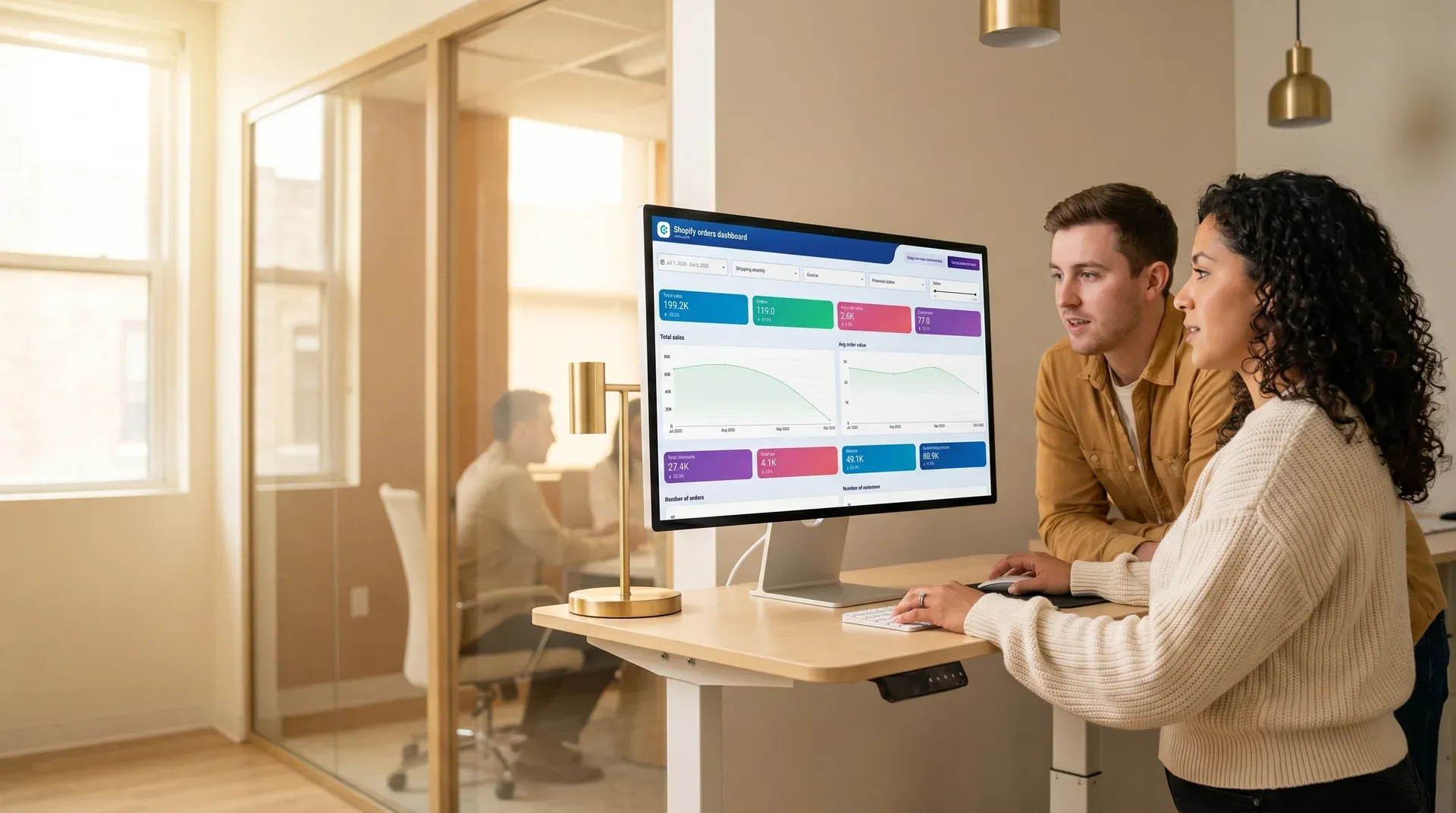
One revenue dashboard across all systems
Power BI pulling from Shopify, Klaviyo, ERP, and fulfillment. Real margin, lifetime value, and customer acquisition cost visible in a single view.
Mobile-first from the first wireframe
Designs and development start on mobile viewport. Desktop is the extension. Not the other way around.

"Our inventory was right. Our Shopify was not. We found out when customers started emailing."
Redefine client, apparel brand, 2024 onboarding
Every layer of your ecommerce stack. Click any part to see what we build there.
Redefine engineers every layer of a commerce platform, from the storefront your customers see to the revenue dashboards your leadership team reads every morning. Click any node to explore what we build.
Ecommerce app development: storefronts built for conversion and speed
Headless (Next.js + Shopify / BigCommerce API) or platform-native. Designed mobile-first. Performance budgets agreed before design begins. Core Web Vitals targets in the architecture brief.
Catalog architecture for 200K or more SKUs
Product information management, faceted search with Elasticsearch or Algolia, and variant logic for complex configurable products. Automated pipelines sync your catalog directly from your ERP and supplier feeds.
Checkout flows engineered for conversion
Custom checkout extensions on Shopify or headless checkout builds. Post-purchase upsell sequences, dynamic discounting, cart abandonment triggers to Klaviyo. B2B checkout with multi-step purchase approvals and net terms.
Payment infrastructure for retail and B2B
Stripe, Braintree, and Adyen integrations. Subscription billing with proration and dunning. Buy Now Pay Later (Klarna, Afterpay). B2B net terms and invoicing. Multi-currency settlement for international markets.
Fulfillment and warehouse integration
3PL API integrations (ShipBob, ShipStation, custom warehouse systems). Real-time tracking updates pushed to Shopify and Klaviyo. Return management workflows. Multi-warehouse routing rules for split shipments.
Revenue analytics across every system
Power BI dashboards pulling from Shopify, Klaviyo, Google Analytics, and ERP. Real margin (not just revenue). Lifetime value cohorts. Channel attribution with first and last touch. Inventory demand forecasting.
Klaviyo and CRM: engineering email to drive 25-30% of total revenue
Server-side event tracking, lifecycle flows (welcome, abandonment, winback, VIP), SMS sequences, and segmentation by purchase behavior and lifetime value tier. On platforms we build, email drives 25 to 30% of total revenue. Basic Klaviyo embeds do not get there.
Four brands. Four transformations.
Revenue numbers from verified
client records.
Parsons Kellogg
Promotional apparel · 30 stores · 1M+ SKUs · 6 years
Half Price Drapes
Home decor ecommerce · Shopify + Amazon + wholesale channels
Peekawhoo
Baby and toddler retail · DTC with six-figure Klaviyo revenue
Off Grid Knives
Specialty retail · advertising-restricted category · 3.8x in 3 years
in 3 years
More work available. Share your sector and we will send relevant case studies.
See More Client ResultsArchitecture first.
Revenue proof second.
Documentation
on every handoff.
Headless ecommerce development: storefronts that get faster as your catalog grows
A decoupled frontend gives you sub-2s load times at 200K SKUs, A/B testing on any page without theme constraints, and a Shopify admin your team already knows. Your next developer can ship a feature without touching the commerce layer.

ERP integration with real-time bidirectional sync
We connect Shopify, BigCommerce, and custom storefronts to Dynamics 365, NetSuite, or your custom ERP system. Orders flow down, inventory flows back up. No manual export. No oversell. No morning reconciliation ritual.
Conversion engineering from product page to post-purchase
On checkout flows we have built, conversion rates have risen 1 to 2 percentage points. We optimize from the product page through post-purchase: A/B tested checkout, post-purchase upsells, and Klaviyo abandonment sequences. Every change runs behind a feature flag before full rollout.

From $14M to $120M in annual revenue.
Same brand. New
platform.

Annual revenue
from $14M
Parsons Kellogg started with a $14M fragmented operation. Orders lived in Shopify. Inventory lived in a disconnected ERP. Every morning, someone ran a manual reconciliation. We rebuilt the entire stack: headless commerce, Dynamics 365 ERP integration, Power BI dashboards, and automated warehouse workflows. Today the platform runs 30 stores, manages over one million inventory items, and no one runs a morning reconciliation anymore.
- 30 stores unified
- 1M+ SKUs managed
- Margin and LTV visible daily
- Zero manual order reconciliation
Headless Commerce Architecture
API-first platform supporting 30 concurrent stores
Power BI Executive Dashboards
Every store's margin, LTV, and fulfillment cost in one view
Dynamics 365 + API Integration
Orders auto-routed, inventory synced, warehouse operations zero-touch
What a typical ecommerce agency ships. What Redefine ships.
Architecture sprint before any design
Sprint 1 is always architecture: data model, integration map, performance budget, deployment strategy. You see the full blueprint before a design file opens.
Revenue attribution, not just delivery
Every project is scoped with a revenue or efficiency outcome attached. You track progress against a number, not a feature list.
Full-stack ecommerce in one team
Frontend, backend, ERP integration, analytics, and email marketing, all in scope. You manage one team, not three separate agencies.
Documentation your team can actually use
Architecture decisions documented. Integration maps delivered. Deployment runbooks included. Your next developer onboards in 2 days, not 2 months.
What ecommerce brands ask before they hire.
Platform choice, migration risk, ERP complexity, and timeline are the real blockers. Here are direct answers to each.
Zero commitment. Full proposal with line-item pricing before you decide.
An ecommerce discovery sprint delivers full architecture and integration map. You see every line item before signing. We recommend platform in writing before charging anything.
Shopify native when: you have under 50K SKUs, need fast time-to-market, and your checkout is standard. Shopify headless when: you need A/B testing on checkout, complex catalog logic, or a custom frontend that outperforms themes. BigCommerce when: you sell B2B with complex pricing rules, need native multi-storefront, or are migrating from Magento. We recommend in writing based on your catalog size, transaction volume, and integration requirements, before we charge anything.
We run old and new stores in parallel. The new platform is built and tested fully while the current store continues taking orders. We preserve the URL structure before switching any traffic. 301 redirects are mapped in the architecture sprint, not discovered at launch. A/B split of traffic begins when the new store passes all quality assurance checks, starting at 10%. We monitor search engine optimization rank, conversion rate, and page speed for the first 30 days before a full cutover. More on our approach in Legacy application modernization for ecommerce.
Custom ERPs are mapped in the discovery sprint. We document every data flow direction, event type, and field mapping before writing an API wrapper. We have integrated Dynamics 365, NetSuite, SAP Business One, and fully custom PHP and .NET ERP systems. The pattern is the same: write to a standardized intermediate layer, not directly to the ERP, so the ecommerce platform is ERP-agnostic. When you upgrade your ERP in 3 years, you update one connector, not rewrite your entire commerce stack.
Discovery sprint: 2 weeks. Simple catalog (under 5K SKUs, no ERP): 12 to 16 weeks. Mid-complexity (5K to 50K SKUs, one ERP integration, Klaviyo): 16 to 22 weeks. Enterprise (50K+ SKUs, multi-warehouse, complex B2B rules): 22 to 32 weeks. Every project starts with a sprint plan showing week-by-week deliverables. You see what ships in sprint 2 before you sign anything.
Yes, email is always in scope on ecommerce builds because a headless migration can break Klaviyo tracking if done without server-side event integration. We implement Klaviyo server-side tracking, custom event schemas, lifecycle flows (welcome, abandonment, post-purchase, winback), segmentation by product affinity and lifetime value tier, and template design. On platforms we've built, email contributes 25 to 30% of total revenue. That does not happen with a basic embed.
Tell us where you are. We tell you what we will build and whether it fits.
Ecommerce projects fail for three predictable reasons: wrong platform, underestimated integration complexity, or no architecture sprint. We tell you which of these three we see in your project before you sign anything.
Not sure where you fit? Tell us your current platform and revenue and we will be direct about the right approach for your situation.
Current store is hitting performance limits at scale
Page speed degrading, inventory sync unreliable, or checkout conversion rate below 3%.
Ready to move from Shopify theme to headless architecture
A/B testing checkout, performance, or catalog complexity is the driver.
Need ERP, fulfillment, or multi-channel integration
Dynamics 365, NetSuite, custom warehouse management system, Amazon, or wholesale channel sync.
Revenue between $1M and $100M and want to scale further
The platforms we have built have all grown by 2x to 6x within three years of delivery.
Probably not the right match if:
You need a simple theme install or a Shopify app configured
Shopify Experts and certified app partners handle this faster and cheaper.
Total project budget under $20,000
A full headless build with ERP integration typically starts at $40K. If that range is outside your current budget, start with a discovery sprint at a lower entry point.
Tell us your
revenue goal.
We scope the platform to get there.
No commitment. No pitch. We send a scoped proposal with architecture approach and line-item pricing within 3 business days.
Submit your brief
Describe your current platform, monthly revenue, and what is holding you back. 3 minutes.
Technical call within 48 hours
With an ecommerce architect. We ask about catalog size, integrations, and conversion goals.
Scoped proposal in 3 days
Platform recommendation, architecture approach, integration map, sprint plan, and line-item pricing.
Your project starts within 1 week of sign-off
Architecture sprint first. Data model and integration map before a single product page is designed. You see the full blueprint before any build begins.
Your team's commitment is 3 to 4 hours per week: sprint reviews, feedback on design decisions, and a final launch review. We handle everything else.
No commitment. No pitch. · Call within 48 hours · Proposal in 3 days