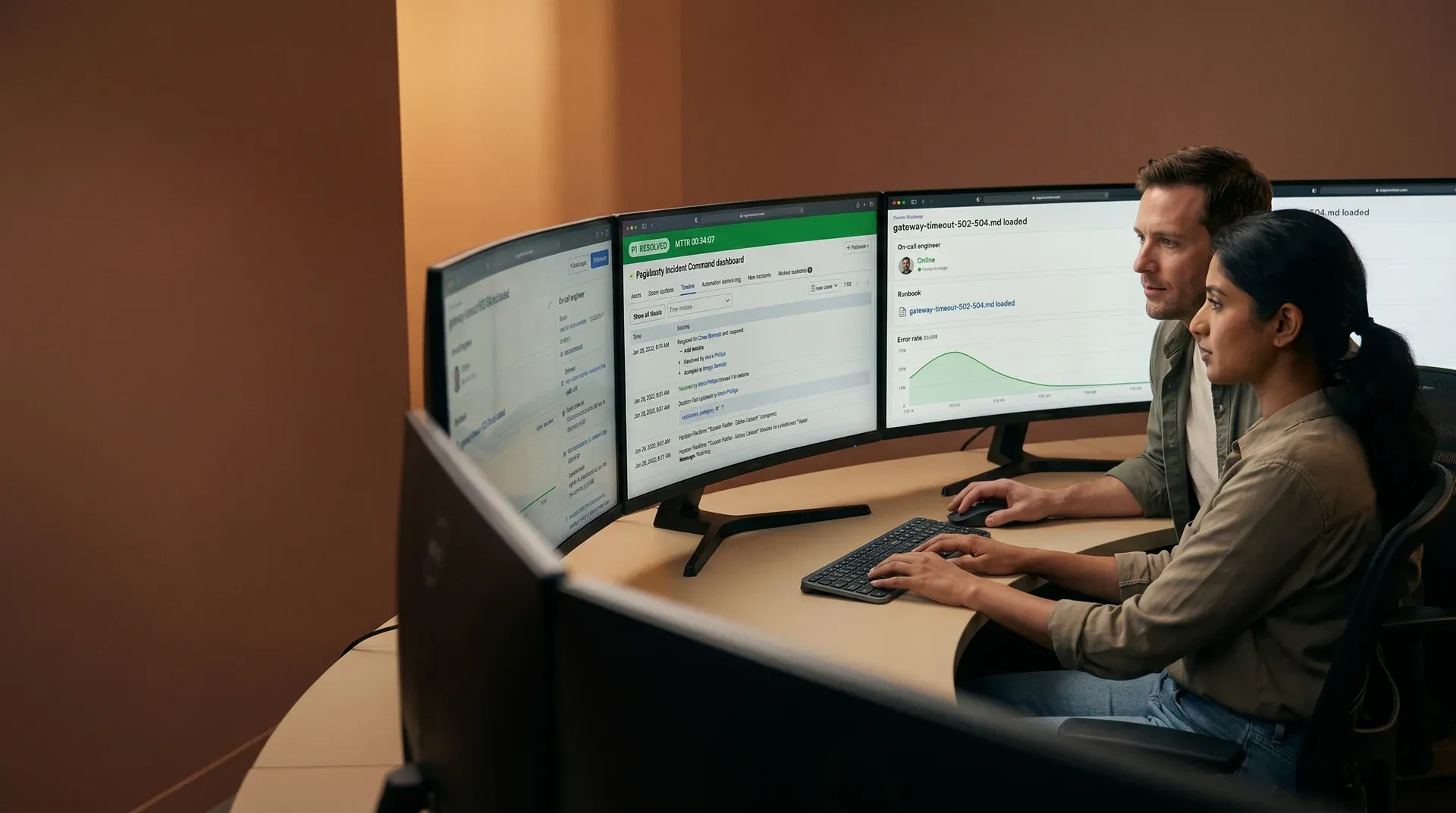
P1 acknowledged in under 60 seconds. Resolved in 34 minutes. Not a stranger at 2am.
When your platform goes down, you don't need a ticket queue. You need the engineer who wrote your runbook already working. Every P1 gets a named engineer, a live incident console, and a post-mortem in 24 hours.
Live simulation. Typical P1 resolution: 34 minutes.

Without a retainer, that call routes to a generalist support queue. With one, the engineer who wrote your runbook is already triaging the root cause.
Every minute offline has a price tag.
Pick your annual platform revenue below. See exactly how much a 4.4-hour unmanaged outage costs your business compared to a 34-minute managed response from a named engineer with a pre-written runbook.
Your team explains the system to a stranger while revenue bleeds. Generalist triage. No pre-written runbook. No context. Every minute costs more.
Named engineer. Runbook loaded. P1 acknowledged in under 60 seconds. Your platform recovers in 34 minutes, not 4.4 hours.
Watch a P1 resolve live.
Select an incident type. The command console logs every alert, action, and status change with timestamps. This is the same live timeline your engineering team sees during a real P1.
Select an incident type above to start the simulation. Watch a named engineer respond to a live P1 from first alert to resolution.

The post-mortem is what separates incident response from incident triage. You do not just recover. You prevent the next one.
Multi-marketplace platform stabilized. $30M annual revenue protected.

Sleekshop
Ecommerce · Multi-Marketplace
Sleekshop ran a multi-marketplace ecommerce operation across multiple sales channels. Fragmented integrations caused repeated incidents with no structured response protocol in place.
Every marketplace channel ran as a separate system. When an incident hit one channel, there was no shared alert layer and no runbook. Engineers triaged from scratch each time. As transaction volumes grew, the failure rate grew with them. Each new channel added another failure mode with no coverage.
Platform instability at scale is not just a technical problem. It is a revenue constraint. Every fragmented integration is a new failure mode with no response protocol.
Annual revenue scaled to $30M+ on a centralized, stable platform with automated incident detection. All marketplace integrations and fulfillment flows now have structured incident coverage.
Automation and centralized incident management cut manual triage time and reduced operational overhead across all channels.
Performance tuning and security hardening protected speed, uptime, and customer data as transaction volume scaled.
What most incident response services for software platforms skip.
What engineering leaders ask before starting a response retainer.
A P1 is any incident causing complete platform unavailability, greater than 50% error rate on a critical user-facing flow (checkout, authentication, search, payment), or data integrity risk. Specific P1 thresholds are defined during onboarding and written into your runbook. P2 incidents are partial degradations impacting a non-critical path but still requiring same-business-day resolution. You define what matters most. The runbook reflects your definition, not a generic template.
All response retainers begin with a technical onboarding: architecture review, infrastructure audit, alert threshold calibration, and runbook development for your specific stack. Onboarding takes one week and produces a set of incident-type runbooks for your platform. The 60-second acknowledgment is fast because the engineer already has context before any incident fires. A generic incident response vendor picks up the call and then starts learning your system. Our engineer already knows it.
A recurring incident after a post-mortem means the prevention step was not implemented. Our post-mortem always includes a prevention queue: a prioritized list of infrastructure or code changes that eliminate the root cause. If those changes are in scope for your retainer, we implement them. If they require a separate sprint, we scope it and flag it. A recurring P1 with an open prevention item is an escalation in our protocol. It is never treated as a routine repeat response.
No. Incident response works alongside your team, not instead of it. Most clients use incident response to remove on-call burden from product engineers who should be building, not fielding 3am alerts. Your team stays focused on the roadmap. Our engineer handles production stability. Teams without internal engineers use this service too: we own the full response scope and escalate only for decisions that require product context. See also managed application support for a broader coverage model.
Incident response retainers are scoped based on platform complexity, coverage hours (business hours versus 24/7), and incident volume tier. Retainers typically range from $800 per month for business-hours P1 coverage on a single-platform setup to $2,500 or more for 24/7 multi-platform coverage. Onboarding (runbook development, alert calibration, architecture review) is a one-time fee separate from the monthly retainer. Submit a brief and we deliver exact pricing within 24 hours. No commitment required to receive the scope.
Incident response for software platforms is built for live platforms with revenue at risk.
The clearest signal: you have experienced a P1 that cost you more in lost revenue than a year of this retainer. If that is true, this is the right fit.
Not sure? Tell us about your last incident and we will be direct about whether a retainer makes sense for your platform.
Right fit
Live production platform processing real revenue every hour
Your engineering team spends on-call hours on incidents instead of building product
Your last P1 took more than 2 hours to resolve with improvised triage
No pre-written runbooks or structured incident process in place
Not the right fit
Platform still in development with no live users
Build first: software maintenance
You need a full ops team, not just incident coverage
Consider: managed application support
Describe your last incident. We scope your response protocol in 24 hours.
No commitment. No pitch. Tell us your stack and your last P1. We send a written scope with the exact monthly cost before you decide anything.
Submit your platform brief and last incident details
Your stack, incident type, resolution time, and what failed. This lets us write your runbook before onboarding starts.
Written scope and exact pricing within 24 hours
Runbook plan, coverage tier, onboarding scope, and monthly retainer cost. No estimate. No range. Exact.
Engineer assigned and runbooks written within 1 week
Monitoring calibrated. On-call protocol live. Your 60-second P1 SLA starts from day one.
No commitment. No pitch. · Scope in 24 hours · On-call active in 1 week
You're covered. Brief received.
The engineer who reviews your brief is the one who goes on-call for your platform. Your written scope with exact monthly cost arrives within 24 hours.