Your dispatchers should run routes. Not phone calls.
We build custom TMS, WMS, route optimization, and ERP integration for logistics operations running 10 to 500+ vehicles. Every shipment, carrier, and warehouse shows up in one live dashboard. Your team stops chasing status by phone. We stop guessing at your specific workflow — the architecture sprint maps it first.
A Redefine-built TMS: live routes, real ETAs, zero status calls

From dispatch to delivery
Operations managers at our clients can tell you where every truck is right now. Not where it was this morning. Not after a phone call. Right now.
"I can tell you where a shipment was yesterday. I cannot tell you where it is right now."
Every logistics operations team we have worked with started here. Toggle between the common state and what your team runs after we build.
Drivers called for pickup status
No GPS integration. Dispatchers spend 40% of their day on the phone instead of optimizing routes.
Inventory counted manually every quarter
Stock discrepancies found 3 months after the fact. Warehouse team spends 2 days per quarter on manual counts.
Export documents built in Excel
EXIM compliance done manually. Documents wrong or late cause shipments to be held at customs.
Delivery numbers known 2 weeks late
No live reporting. Operations managers pull carrier emails each week to calculate on-time rate. By the time the number is ready, the chance to act on it is gone.
Customers call for shipment status
No customer portal. Customer service team handles 80+ shipment status requests per day via email and phone.
Drivers on WhatsApp for updates
Proof of delivery on paper. Exception reporting by text. No structured data from the field coming into operations.
Real-time GPS with automated estimated time of arrival updates
Live position data pushed every 60 seconds. Dispatchers see the entire fleet without a single phone call.
Barcode and RFID scanning with live warehouse management system sync
50,000+ items tracked in real time. Discrepancies flagged immediately on scan, not 3 months later.
EXIM module generates shipping bills, bills of lading, and customs declarations on dispatch
Statutory compliance handled by the enterprise resource planning system. Documents generated from shipment data. Zero manual preparation.
Live ops dashboard: on-time rate, fuel spend, and route deviation, updated every 60 seconds
On-time delivery, fuel efficiency, and route deviation visible in real time. Management acts on data, not memory.
Customer self-service tracking portal
Customers track shipments independently. Customer service team handles exceptions, not status requests.
Driver mobile app with digital proof of delivery
Photo capture, signature, barcode scan. All structured data. All synced to the transportation management system within 30 seconds of delivery.

"I can tell you where a shipment was yesterday. I cannot tell you where it is right now."
Every shipment, vehicle, and warehouse on one live screen.
This is the operations view your dispatch team sees from day one of go-live. No refresh button. No phone call to a driver. The data comes to them.
- GPS updates every 60 seconds — dispatchers see the full fleet without picking up the phone
- Route optimizer recalculates around traffic and time windows — drivers get the best sequence automatically
- Barcode and RFID scans update the WMS in real time — no end-of-day reconciliation
- EXIM documents generate on dispatch — no spreadsheet, no form-filling, no customs holds
- Customers track their own shipments — your team handles exceptions, not status calls
Built for the full supply chain. Not just one piece of it.
End-to-end transport management for single and multi-carrier fleets
Order-to-delivery workflow automation. Carrier rate comparison and spot bidding. Load planning, route sequencing, and real-time deviation alerts. Customer portal with live tracking. Driver app with digital proof of delivery.
Barcode, RFID, and visual bin management. Full receiving, put-away, picking, packing, and dispatch workflows. Batch management and traceability for regulated products.
Enterprise logistics softwareDynamics 365 and Dynamics NAV implementation and customization. Finance, inventory, production, and EXIM compliance in one system — so your warehouse counts and your finance records always agree.
average fuel and distance reduction per route
AI-powered route optimization with time-window constraints, vehicle capacity rules, and live traffic scheduling. Your drivers get the best sequence. Your fuel bill gets the difference.
AI optimization for logistics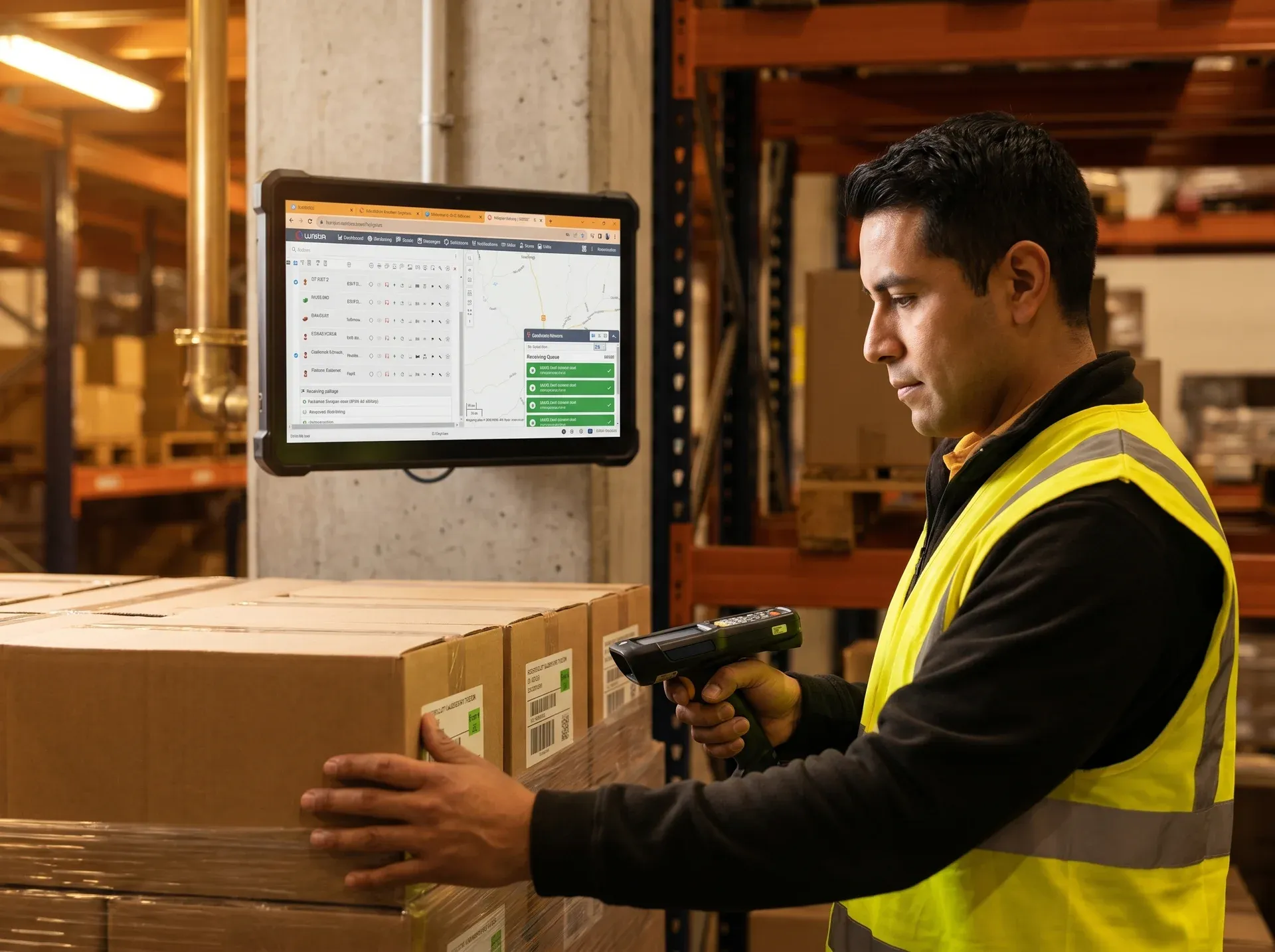
50,000 items. 30% export operations. EXIM done automatically. One Dynamics NAV system.

Phoenix Flexibles
Global Flexible Packaging Manufacturer
A global flexible packaging manufacturer that needed one ERP to run finance, inventory, production, and international trade compliance across multiple product lines.
The team ran finance, inventory, and production tracking in Excel. Poor visibility into stock and resources hurt production schedules. Export documentation was prepared by hand, causing customs errors and shipment holds. Finished goods had no barcode system — discrepancies were found months after the fact.
Manual Excel workflows across 50K+ items. No barcode system. EXIM compliance done by hand. Zero integration between inventory and production.
items tracked in real time across multiple product lines. Barcode scanning, automated EXIM documentation, and Dynamics NAV ERP integration now support a 30% export operation.
- Dynamics NAV unified finance, inventory, and production in one system
- Barcode scanning tracks finished goods with batch-level traceability
- EXIM module auto-generates shipping bills, bills of lading, and customs declarations on dispatch
Three standards. Written into every build.
Most agencies ship a platform and move on. These three standards apply to every logistics project we take on, before the first sprint review begins.
Every platform we build feeds live GPS into the TMS, live bin counts from barcode scans into the WMS, and live ops dashboards that refresh without a manual export. Batch reports delivered two days late are not dashboards. Operations managers at our clients make decisions on today's data, not last week's. That is the only version of a logistics platform we build.
The inventory in your WMS and the inventory in your ERP must agree. We design that integration as a day-one architecture requirement. We have implemented Dynamics NAV and Dynamics 365 for manufacturing, distribution, and logistics operations running 50,000+ item catalogs. The ERP integration design document is Sprint 1 output.
Operations manuals, dispatcher training guides, driver app onboarding, and warehouse scanning runbooks are delivered at handoff. So are the technical architecture docs and API references. Your team trains new dispatchers without calling us. Your IT team adds a new vehicle type to the TMS without calling us. Dependency is a delivery failure, not an upsell opportunity.
Straight answers to the questions logistics teams always ask.
Platform choice, ERP complexity, and integration scope are where most buyers get vague answers. These are not vague answers.
Scoped before work starts. You get the full proposal before spending a dollar.
A logistics discovery sprint delivers a full architecture document, integration map, and ERP design before any development begins.
Tell us what your operation looks like. We will tell you if we are the right fit.
Some operations are not ready for custom logistics software. When that is the case, we say so. A process audit before a build saves everyone time.
Not sure where you fit? Tell us your operation : fleet size, warehouse SKU count, current tools, biggest friction. We will be straight with you about fit and realistic scope — before you commit to anything.
Running more than 10 vehicles or 5,000+ SKUs in a warehouse
Custom TMS and WMS pay for themselves at this scale. Off-the-shelf tools start showing friction past this point.
Dispatchers spend more than 30% of their day on the phone
Live GPS and real-time estimated time of arrival notifications eliminate the status call loop entirely.
Export operations with manual EXIM document preparation
ERP auto-generates shipping bills, bills of lading, and customs declarations on dispatch. Manual prep and customs holds both stop.
ERP inventory does not match the physical warehouse count
Barcode scanning synced to Dynamics resolves discrepancies the moment a scan happens — not at the end of the quarter.
Probably not the right match if:
You need a basic shipment tracker for an existing ecommerce store
Shopify and WooCommerce have pre-built carrier integrations. They solve this faster and for less money.
Total project budget under $15,000
A TMS with ERP integration and a driver app takes real architecture time. Below this budget, we cannot do the build justice.
Tell us how your operation
runs today.
We scope the platform to fix it.
No commitment. No pitch. Send a brief and a scoped proposal with architecture approach and line-item pricing arrives in 3 business days.
Submit your brief
Describe your operation: vehicle count, warehouse size, current tools, and your biggest friction point. Takes 3 minutes.
Technical call within 48 hours
With a logistics architect. We ask about your ERP, what systems need to connect, and any compliance requirements.
Scoped proposal in 3 days
Architecture approach, integration map, sprint plan, and line-item pricing. Full document. No vague estimates.
Sprint 1 within 1 week of sign-off
The architecture sprint delivers a data model and ERP integration design before a dispatch screen is ever designed.