On-premise to cloud migration company

Your servers stay up. On premise to cloud migration consulting that moves your infrastructure.

We move on-premises workloads to AWS, Azure, and GCP with a secure landing zone, zero-downtime cutover, and infrastructure as code from Sprint 1. Compliance scope defined before workload one is moved.

Submit brief → call within 48 hours → migration readiness assessment in 3 days → Sprint 1 starts week 2

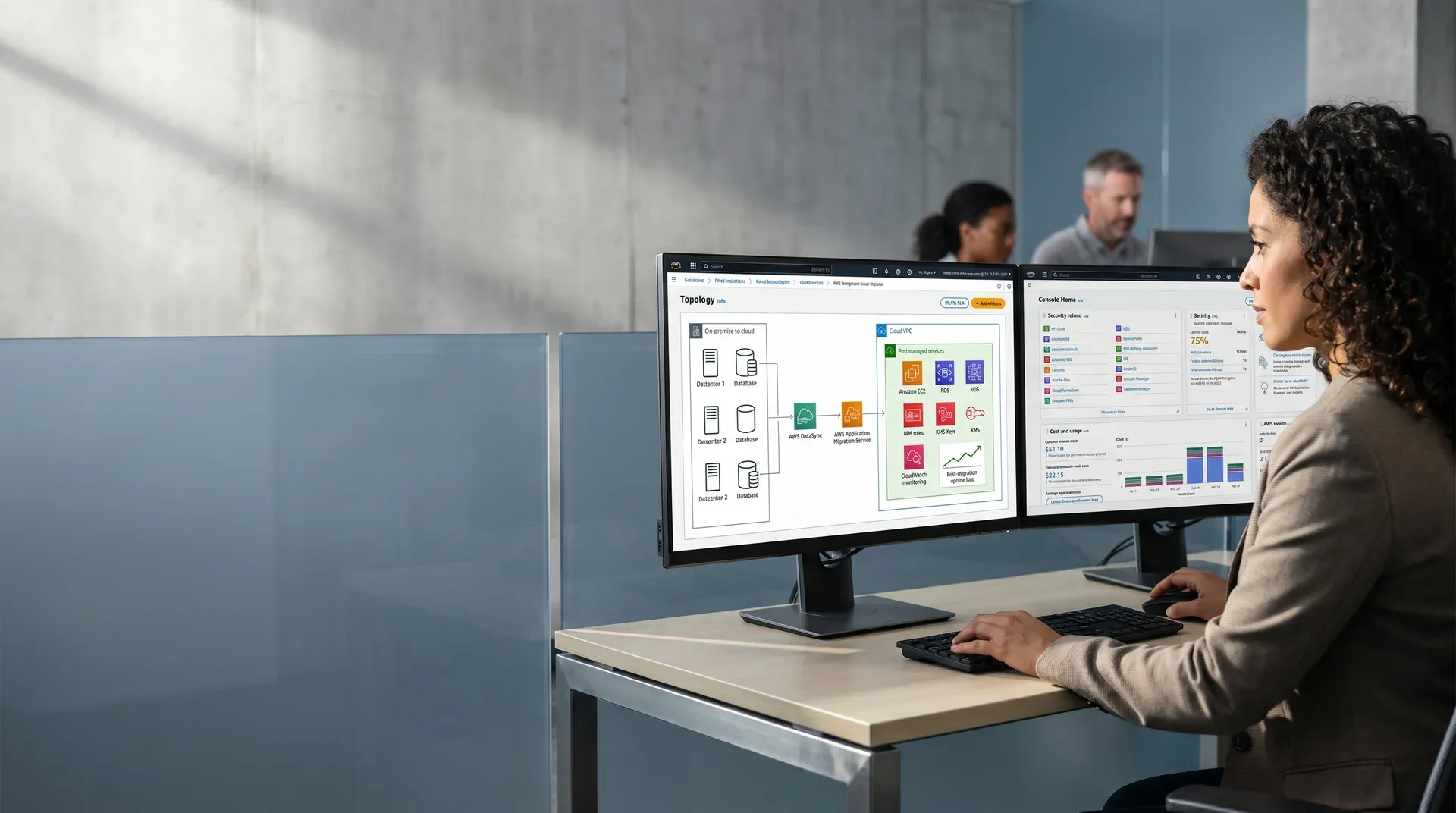
On-premise to cloud migration topology • live
ON-PREMISES CLOUD ENVIRONMENT MIGRATION PIPELINE 🖥 App Server 💾 Database 🔧 Services 📁 File Store 🔍 Assess Week 1-2 🏗 Landing Zone Week 3-4 ACTIVE 🔄 Migrate Week 5-12 🛡 Validate Week 13-16 Cloud Compute 🔐 IAM + KMS 📊 Managed DB 📈 Monitor
Platform
AWS / Azure / GCP
Downtime
Zero required
Infrastructure
100% as code
Rollback
Tested before cutover
Cloud infrastructure architect reviewing an AWS and Azure on-premise-to-cloud migration topology and architecture diagram on dual monitors in soft morning side light
Why on-premises is getting more expensive

On-premises infrastructure does not get cheaper. It gets more expensive every year you stay on it.

The cost of staying on-premises
📅
Hardware refresh every 3 to 5 years
Capital expenditure of $50k to $500k+ regardless of whether you actually need the capacity at that moment.
🚨
Unplanned outages with no service level agreement
On-premises hardware failure means your team scrambles. No cloud provider service level agreement. No automated failover. No managed redundancy.
🔒
Compliance audits cost more on-premises
Manual evidence collection, physical access logs, and network segmentation documentation take 3 to 4 times longer in on-premises environments.
📈
Capacity planning is always wrong
You over-provision for peak and under-utilize the rest of the year. Or you under-provision and hit limits during your busiest periods.
🧑‍💻
IT staff time on maintenance, not development
Patching, backup management, hardware monitoring, and incident response consume senior engineering hours that should go toward your product.
After migrating to cloud with Redefine
💰
Capex replaced with predictable opex
Pay for what you use. No hardware refresh budget. Cost model and savings estimate produced before workload 1 is moved.
99.9% uptime service level agreement with automated failover
Multi-AZ or multi-region redundancy. Cloud provider service level agreement backed by contractual credits. Automated recovery without a 2am call to your team.
📋
Compliance-ready infrastructure from day one
Cloud landing zone built with IAM, VPC isolation, KMS encryption, and audit logging in place before any workload is migrated. Compliance scope defined in week 1.
📊
Scale up or down in minutes, not months
Auto-scaling responds to real demand. No over-provisioning. Black Friday scale available on demand, not pre-purchased six months before.
🚀
IT team focused on product, not patching
Managed services handle patching, backups, and infrastructure monitoring. Your engineers ship features instead of maintaining servers.
Cloud migration return on investment calculator

Enter your numbers to weigh on premise to cloud migration pricing versus staying on-premises.

Adjust the sliders to reflect your environment. The calculator computes your 3-year Total Cost of Ownership on-premises versus on cloud, and shows the savings at your specific scale.

Your on-premises environment
Servers / virtual machines24
Hardware refresh cost (3-year, $k)$180k
IT staff hours on maintenance / month80 hours
Unplanned downtime hours / year24 hours
Revenue per hour (downtime cost, $k)$12k
3-year cost comparison
Staying on-premises$0
Migrating to cloud$0
3-year estimated savings
$0
Hardware + ops + downtime cost reduction
Saved on hardware
$0
Saved on downtime
$0
Estimate only. Cloud costs vary by workload type, region, reserved instance commitment, and optimization level. Migration cost not included. We produce a detailed cost model during the assessment.
How we run every cloud migration

Four phases. Every workload assessed, architected, migrated, and validated before the next one moves.

Infrastructure team reviewing a printed cloud landing-zone architecture diagram and laptop console at a large table in soft diffused office light
01

Migration readiness assessment

We document every workload: dependencies, integration points, data volumes, compliance requirements, and performance baselines. No workload moves without an assessed migration profile and a defined target architecture. This phase takes 2 weeks and prevents the surprises that cause migrations to fail.

Workload inventoryDependency mappingCost model
02

Cloud landing zone architecture

The landing zone is the governed cloud environment every workload migrates into. We design the account structure, VPC and network topology, IAM policies, security controls, and cost allocation before moving any workload. A landing zone prevents the governance debt that accumulates when workloads migrate into an unstructured cloud environment. Built with Terraform or Bicep, 100% reproducible.

VPC designIAM policiesKMS encryption
Azure development services →
03

Workload migration and cutover

We migrate workloads in priority order defined during the assessment. Stateless applications move first. Stateful services and databases migrate after their dependencies are established in the cloud. Each workload runs in parallel on both environments before traffic is shifted. A rollback plan is documented and tested for every workload before production traffic moves.

Parallel-runZero downtimeTested rollback
All migration services →
04

Stabilization, optimization, and handover

After cutover, we run a 30-day stabilization period: monitoring, cost review, performance tuning, and reserved instance sizing. At the end, your team receives a full runbook, Terraform or Bicep codebase, architecture documentation, alerting playbooks, and an operations handover session. We do not disappear after go-live.

Cost optimizationFull runbookTeam handover
Client result.

FinTech compliance migration: on-premises to Google Cloud Platform with IAM, VPC isolation, and audit-ready infrastructure.

Compliance lead and engineer reviewing an all-green cloud security and compliance audit dashboard on a large monitor after migration in soft office side light
FinTechRegulated environment
The problem

The existing on-premises infrastructure limited scalability and made it difficult to meet evolving compliance expectations. Regulatory requirements demanded strong access controls, network isolation, encryption, and auditability throughout the migration process. Manual evidence collection for audits was consuming weeks of engineering time per compliance cycle.

  • Compliance evidence collected manually each cycle
  • No VPC isolation between environments
  • On-premises capacity could not support growth
What we delivered

A secure cloud landing zone was designed on Google Cloud Platform, incorporating IAM policies, VPC-based network isolation, and key management using KMS. Encryption was enforced for data at rest and in transit. Legacy workloads and databases were migrated in a controlled manner, integrating identity providers and access controls to maintain security continuity. The architecture was built for traceability, least-privilege access, and audit readiness.

Result
0%
reduction in compliance audit preparation time post-migration, with automated evidence collection replacing manual processes
Google Cloud PlatformIAMVPCKMSTerraform
Why Redefine for cloud migration

What our on premise to cloud migration agency does differently on every engagement.

Migration practice
Typical partner
Redefine
Landing zone built before workload 1 moves
Governed cloud environment defined before migration begins
Ad hoc
Always
100% infrastructure as code (Terraform or Bicep)
No portal-click environments that cannot be reproduced
Sometimes
Standard
Compliance scope defined before any workload moves
IAM, VPC, encryption, audit logging scoped in week 1
Post-migration
Week 1
Rollback plan tested before production cutover
Rollback is verified, not assumed, before traffic shifts
Not standard
Mandatory
Workload-specific cost model before you commit
Cloud costs estimated per workload, not as a flat percentage
Rough estimate
Per workload
30-day stabilization and full runbook handover
We stay engaged after go-live, not just at cutover
Extra cost
Included
Common questions

What IT leaders ask before a cloud migration engagement.

A standard migration with 10 to 30 workloads typically runs 8 to 16 weeks. Timeline depends on workload complexity, compliance requirements, network architecture, and integration points. We scope the timeline during a 2-week assessment before quoting. Try the return on investment calculator above to estimate what staying on-premises costs you during that time.

No. We use parallel-run migration patterns for all production workloads. The on-premises system stays live while the cloud environment is built and validated. Traffic is shifted incrementally once the cloud environment passes validation. A rollback plan is defined and tested before production traffic moves.

Compliance scope is defined in week 1. For regulated industries, we design the cloud landing zone around your compliance framework before any workload is moved. IAM, network isolation, encryption at rest and in transit, and audit logging are built into the architecture, not retrofitted after migration.

We migrate to AWS, Azure, and Google Cloud Platform. Platform selection is made during the assessment based on workload requirements, compliance obligations, vendor relationships, and team expertise. We do not recommend a platform based on familiarity bias. See also Azure development services.

A cloud landing zone is a pre-configured, governed cloud environment defining account structure, network topology, IAM, security policies, and cost allocation before any workload migrates. Without a landing zone, workloads migrate into an unstructured environment that becomes expensive and difficult to govern at scale. We build the landing zone before migrating workload 1.

Book a cloud migration assessment

Hire on premise to cloud migration help. Tell us about your on-premises environment.

We respond within two business days. No commitment. No pitch.

Form

Submit brief → call within 48 hours → migration readiness assessment in 3 days → Sprint 1 starts week 2

48 hours
Response time
Zero
Downtime needed
100%
Infrastructure as code
Tested
Rollback first
IT and cloud team reviewing an all-green CloudWatch monitoring dashboard showing every workload running in the cloud after migration in soft office light
Your on-premises servers do not have to become cloud problems. With on premise to cloud migration consulting, they become cloud advantages.

No commitment. No pitch.

Related cloud and migration services

Get on a call with us to see how we can help you

Get a Quote