Move to BigCommerce with zero data loss and no SEO drop
Your products, orders, customers, and rankings follow you over. Our 45-day migration process handles every detail from data mapping to go-live monitoring so your revenue never pauses.

Most migrations go wrong. Yours does not have to.
Full data audit before a single record moves. Every SKU, image, order, and customer account is mapped and verified.mplete 301 redirect matrix built before launch. Crawl tested against your pre-migration baseline.
Every integration is remapped in staging first. ERP, 3PL, email, payments, and loyalty are all verified before cutover.
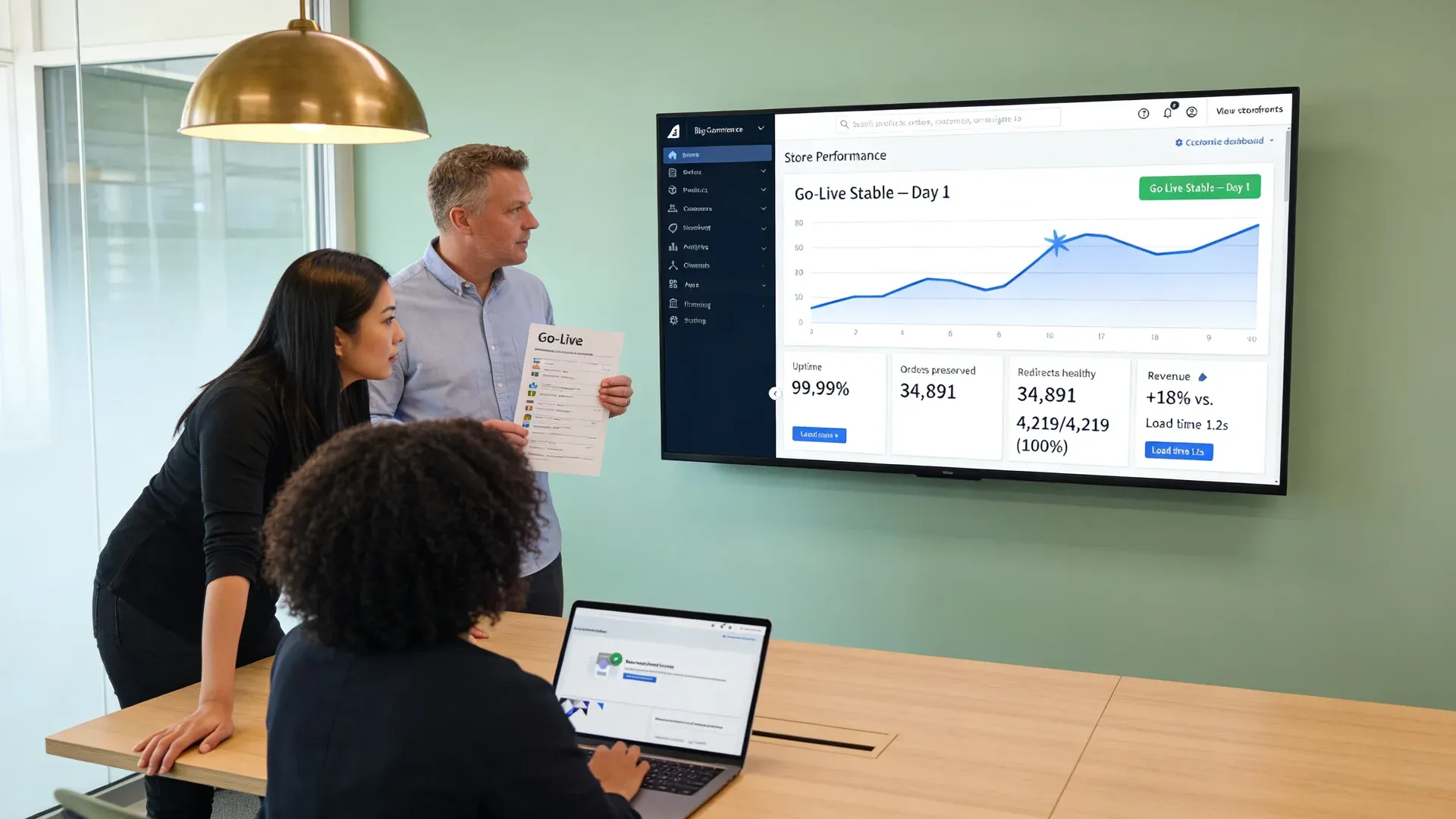
Cutover scheduled in your lowest-traffic window with live monitoring. Your store is back selling in hours, not days.
Data exported by hand with missing fields, broken images, and orphaned variants.
No redirect plan, organic traffic drops 30 to 60 percent inside the first 90 days.
Integrations reconnected without a plan, causing order sync failures and inventory drift.
Cutover handled during peak hours, hours of downtime, lost orders, team panic.
From signed agreement to live BigCommerce store in 45 days
Every phase has a defined owner, a clear output, and a preview you can review before the next phase begins. You always know exactly where your migration stands.
| Source field | BigCommerce target | Status |
|---|---|---|
| product.title | name | Mapped |
| variant.sku | sku | Mapped |
| customer.tags | customer_group | Review |
| metafield.desc_tag | meta_description | Mapped |
| discount.code | promotions.code | Building |
Everything transfers. Nothing gets left behind.
A migration is not a copy-paste job. We build, test, and verify every deliverable below before your store goes live.
Complete data migration
We transfer every product, variant, image, order, customer account, review, and metadata field. Each one passes field-level validation. Nothing stays behind on the old platform.
Search engine optimization preservation
Full 301 redirect matrix, meta tag parity, canonical structure, structured data, and a pre-launch crawl report. Your rankings travel with you.
Integration remapping
We reconnect your ERP, 3PL, payment gateways, email, loyalty, and analytics. Every one is tested in staging before cutover day.
Phased cutover plan
DNS change scheduled in your off-peak window. A full rollback plan exists if anything unexpected surfaces. Live monitoring runs for 72 hours post-launch.
Custom theme build
We build a Stencil theme from your brand guidelines. It is tuned for Core Web Vitals and tested across devices before migration day.
Your data flows through a tested pipeline, not guesswork
Every stage runs in isolated staging before it touches your live store. Click any node to see what happens inside that phase.
Click any node above to see what happens inside that phase.
Platform-specific migration tracks
Each source platform has different data models, URL patterns, and integration footprints. Select yours to see the relevant migration scope and considerations.
Shopify exports are well-structured, so data extraction moves fast. The real work is Shopify's app sprawl. Loyalty, reviews, and subscriptions may need native BigCommerce replacements or API bridges. You keep every feature your customers already use.
Shopify Plus stores often run custom checkout scripts, B2B price lists, and multi-storefront setups. We map each one to BigCommerce's native multi-storefront and B2B features. Your wholesale and multi-brand logic survives the move.
Magento's complex entity-attribute-value database model and custom module ecosystem require careful extraction. We audit every extension dependency before migration begins and build a full functionality equivalency map.
WooCommerce data lives inside WordPress, which means product data, media, and order history are spread across multiple database tables and storage locations. We extract, normalize, and verify every record before transfer.
Custom-built stores vary the most in data model and business logic. We start every custom migration with a full technical discovery sprint to document every business rule before writing a single migration script.
Revenue follows the store when the migration is done right
Peekawhoo sells personalized children's gifts direct to consumers. The brand grew fast. Its old platform capped customization, slowed the backend, and hurt organic visibility.
The old setup limited personalization, tangled inventory and customer data, and hid performance. Peekawhoo needed a full platform rebuild to keep scaling.
- Conversion rate up and organic rankings recovered
- Inventory unified across online and in-store
- BigCommerce platform built to scale
We built a custom BigCommerce store from deep UX research and applied 650-plus design guidelines. We ran the SEO strategy in parallel. We added point-of-sale integration to unify every sales channel under one data model.
The new platform delivered full personalization capability, faster page loads, improved search visibility, and streamlined operations from day one post-launch.
Not all BigCommerce migration partners work the same way
Most migration pages list the same bullet points. The differences that actually matter show up in your post-launch traffic, order sync reliability, and integration uptime.
Before you commit to a migration
The questions your team will ask in the first call. Answered here, transparently.
Most BigCommerce migrations complete in 30 to 45 days depending on catalog size, integration complexity, and cutover timeline. Enterprise scopes with custom integrations or 100K-plus stock keeping units may run 60 to 90 days. Your specific timeline is confirmed at the end of the discovery audit.
Not when the migration follows a structured search engine optimization preservation plan. Proper 301 redirect mapping, URL parity audits, and pre-launch crawl testing protect your organic rankings through and after cutover. We deliver a crawl-verified redirect report before your DNS changes.
Products, variants, images, pricing, inventory, customer accounts, order history, reviews, and content management system content. Integration credentials and application programming interface connections are remapped during the migration architecture phase. A full entity list is produced in the discovery audit before any transfer begins.
Cost depends on source platform, catalog size, integration count, and theme scope. See the migration cost guide for typical ranges by platform and project tier. Most projects are scoped after the free discovery call.
Yes. Migrations are handled from Shopify, Shopify Plus, Magento, Adobe Commerce, WooCommerce, and custom-built platforms. Each source platform has a dedicated migration track with platform-specific data handling and search engine optimization protocols.
Book your migration assessment. Your store stays live while we plan.
In 45 minutes you get a migration assessment, a data risk summary, and a draft timeline with a rough cost range. No commitment. No pitch.