iPaaS integration services that stop the copy-paste between your systems
We connect your ecommerce platform, ERP, and warehouse tools into one automated data layer. Orders, inventory, and customer records sync on their own. Your team stops rekeying data and starts making decisions.
integration projects delivered across ecommerce, ERP, and operations platforms
Hero · Integration operations hub

Manual sync is a full-time job that produces half-right data
Your ecommerce platform, ERP, and warehouse tools do not share data. So your team fills the gap with spreadsheets. That is not a workflow. It is a liability.
Without integration
Inventory counts that are always wrong
Orders ship against stock that was sold elsewhere hours ago.
One person owns all the exports and imports
A single point of failure that takes vacation, gets sick, and leaves.
Duplicate records and mismatched customer data
Finance reports different numbers than the operations team every single quarter.
Hours lost to rekeying data that already exists
Work that should be automated is instead being done manually every morning.
With iPaaS integration services
Real-time data sync across every platform
Inventory, orders, and customer records update the moment a transaction fires.
Automated flows that run without human input
Order routing, inventory updates, and fulfillment pushes run on a schedule or event trigger. No human intervention needed..
One version of the truth across all your systems
Finance, operations, and fulfillment all work from the same source of record.
Capacity freed for work that actually grows revenue
Your team stops maintaining spreadsheets and starts making decisions from clean data.
From disconnected systems to automated data layer in five phases
Every custom iPaaS integration engagement follows a structured delivery process. Defined milestones, visible progress, no dependency on tribal knowledge.
Discovery and system audit
We map every system in your stack, catalogue the APIs and data models in use, and document the exact flows that need to exist.
Architecture and data mapping
We design the integration architecture, define field-level transformation rules, and confirm the trigger events that will move data between platforms.
Connector build and configuration
We build or configure the connectors, set up authentication, and implement error-handling logic so failures surface with context, not just a silent miss.
Testing, validation, and reconciliation
We run end-to-end tests across every scenario, validate output records against source data, and reconcile record counts before any flow runs in production.
Go-live, monitoring, and handoff
We cut over in a controlled window, configure alerting, deliver documented runbooks, and run a structured handoff period so your team owns the system going forward.
Phase 1 of 5 · Discovery
4 systems identified · 2 confirmed · estimated flows: 9
Phase 2 of 5 · Architecture
Order sync: Shopify to ERP
Trigger: order.created · Transform: line items, customer, shipping · Destination: sales order
Inventory writeback: ERP to Shopify
Trigger: item ledger entry · Interval: every 15 minutes · Field: available quantity
Fulfillment push: 3PL to Shopify
Trigger: shipment confirmed · Transform: tracking number, carrier · Update: fulfillment record
Phase 3 of 5 · Build
Phase 4 of 5 · Testing
Phase 5 of 5 · Live
Outcomes your team notices on day one of go-live
Our iPaaS integration consulting approach is built around operational outcomes, not connector counts. Every deliverable targets specific manual work it will remove.
Real-time data across every platform
Inventory quantities, order statuses, and customer records update the moment an event fires, not on the next manual export.
Custom transformation logic, not generic mapping
We build the field-level rules, validation logic, and conditional routing your business requires, not the lowest common denominator a template provides.
Error handling that surfaces problems, not silences them
Failed records are caught, logged with context, and surfaced to your team through the alerting channel you already use, before they cascade.
Documented runbooks your team actually inherits
Every integration we deliver ships with a structured handoff, flow documentation, and the monitoring setup your operations team needs to own it confidently.
Scalable architecture built for new systems
The integration layer we build is designed to absorb new endpoints as your tech stack evolves, without rebuilding core flows from scratch.
Code ownership, not platform lock-in
Everything we build is yours. You own the connectors, the logic, and the configuration. No vendor holds your integration hostage behind a subscription tier.
Multi-platform sync: from manual chaos to automated operations
A multi-channel distributor running Shopify, Dynamics 365 Business Central, and a third-party logistics warehouse management system managed all three through manual exports and scheduled email attachments. Inventory was always several hours behind. Orders missed fulfillment windows.
Operational pain
- Inventory and orders spread across three systems with no automatic sync
- One staff member owned all data transfers, creating a single point of failure
- Customer data inconsistencies between the storefront and enterprise resource planning system
Sync success rate post go-live
Reduction in manual operational workload
Automated flows replacing manual exports
Case Study · Live integration monitor
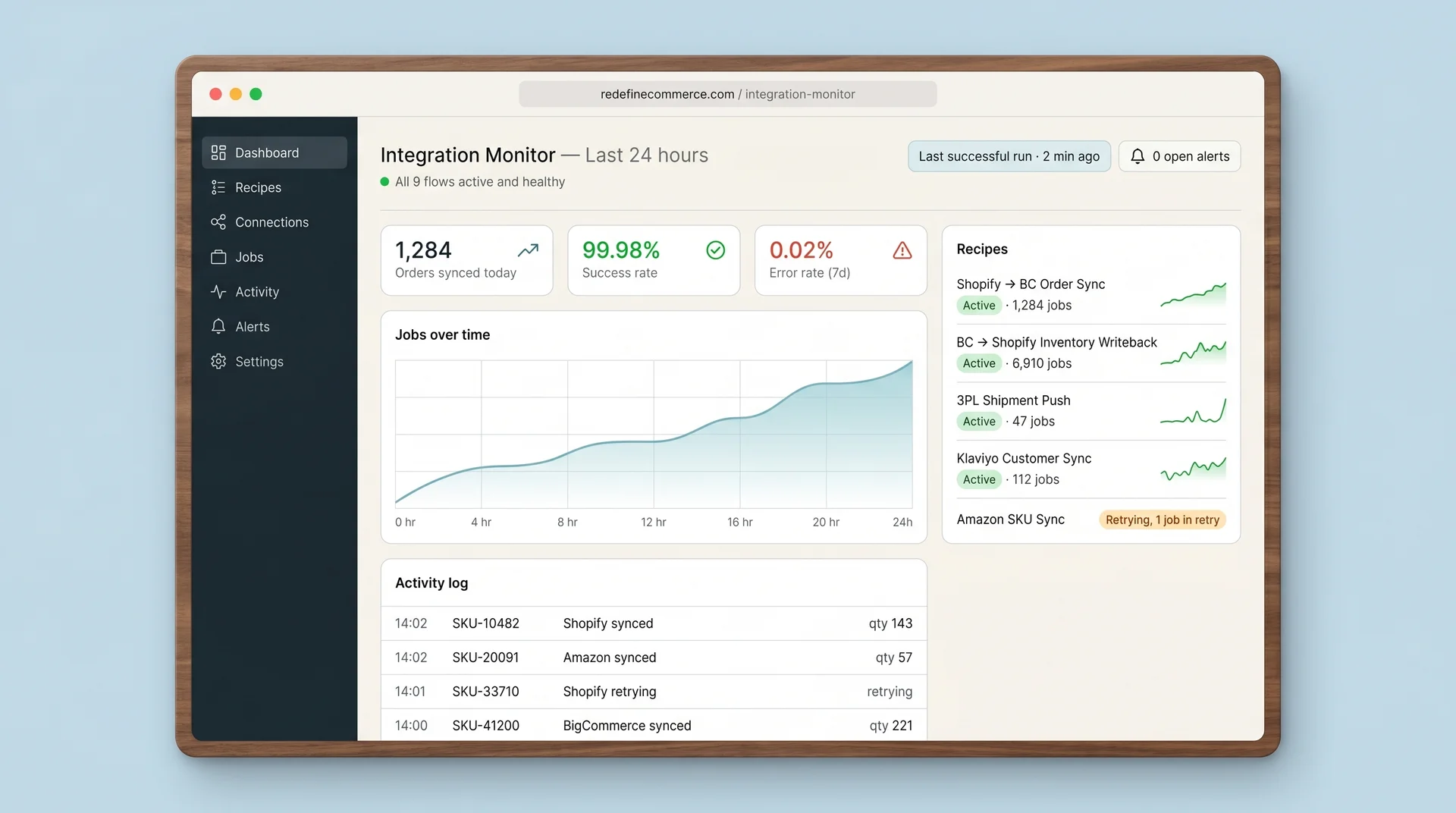
We built two-way integrations between Shopify, Business Central, and the warehouse management system. Orders, inventory, and customer data now sync automatically across all three. The operations team stopped running manual exports. Nine automated flows replaced the spreadsheet-driven process that had been breaking every month.
A live view of every integration flow, not a dashboard full of guesses
Every iPaaS integration solution we ship includes live monitoring. Your team sees the state of every flow, every record, and every failure as it happens.
Active flow · Order to ERP to 3PL
1,284
Orders today
99.98%
Success rate
1.2s
Avg latency
Last 24 hours · Inventory sync events
Most integration projects fail because of the handoff, not the build
Other implementation partners deploy connectors and leave. We design the architecture, build the logic, and document every flow. Your team inherits a system they can operate, monitor, and extend without calling us every week.
Differentiation · Integration team at work

What other integration partners do
- Deploy pre-built connectors and call the project complete
- Build custom logic that only they can maintain or extend
- Leave error handling as a backlog item for version two
- Provide zero documentation after go-live
- Lock integrations to a platform subscription you cannot escape
What Redefine delivers
- Custom iPaaS integration logic designed around your specific data models
- Full code ownership transferred to your team at handoff
- Error handling, alerting, and retry logic built into every flow
- Structured runbooks and handoff documentation for every integration
- Architecture designed to absorb new systems as your stack grows
Questions teams ask before starting an iPaaS integration project
iPaaS (integration platform as a service) is a cloud-hosted middleware layer. It connects multiple applications through a single, managed environment. Point-to-point connections require separate custom code for every system pair. iPaaS routes data through reusable connectors and centralized logic instead. You add new systems, adjust flows, and monitor everything from one place. No rebuilding from scratch.
Our iPaaS integration services connect ecommerce platforms, ERPs, CRMs, warehouse management systems, marketplaces, payment gateways, and marketing platforms. We also integrate custom internal applications. If a system has an API or supports standard file exchange, we can wire it into your integration layer.
Most single-pair integrations go live within three to six weeks. Multi-system orchestration projects with three or more platforms typically deliver in six to twelve weeks depending on data complexity, custom transformation requirements, and the number of endpoints. We publish a line-by-line timeline before any work begins.
We use both. Pre-built connectors accelerate standard connections between common platforms. For systems with unique data models, non-standard authentication, or business logic that off-the-shelf connectors cannot handle, we build custom iPaaS integration logic that transforms, validates, and routes your data exactly as your workflows require.
All iPaaS integration solutions we deliver include documented runbooks, error-alerting configuration, and a structured handoff period. We offer ongoing monitoring retainers for teams that want us to own incident response, add new endpoints, and manage platform-version changes as your technology stack evolves.
Tell us what your team is syncing manually. We'll scope the automation.
Scoped before work starts, line-by-line pricing, no commitment to receive a proposal.
Response in 48 hours
A real integration engineer reviews every brief
Proposal in 3 days
Line-by-line scope with delivery timeline
200+ projects delivered
Across ecommerce, ERP, and logistics
Full code ownership
No platform lock-in, no ongoing license required
Brief received
We'll review your workflow and send a scoped proposal within 3 business days.
Your integration can be scoped, built, and live in weeks
No commitment. No pitch. A line-by-line proposal based on your systems and the exact flows you need automated.
Submit your brief · call within 48 hours · scoped proposal in 3 days · Sprint 1 begins within 1 week of sign-off