Integration migration services that replace failing middleware with zero downtime
Your connectors were built for a smaller business. We move every sync, mapping, and workflow to a platform you own. Each connection is validated in parallel and switched with zero downtime.

A dying integration layer charges rent every single day
Nobody budgets for the middleware that quietly stopped scaling. The cost shows up as people, not invoices. Re-keyed orders. Stale inventory. A support queue full of "where is my order."
Life with legacy middleware
- Syncs fail overnight. Someone re-enters orders by hand the next morning.
- Inventory updates lag by hours. The storefront sells stock the warehouse already shipped.
- The vendor ended support. The one person who understood it left in 2023.
- Every new system needs a fragile workaround. The old layer cannot connect to modern APIs.
- License renewals climb while reliability falls, and nobody can explain what you are paying for.
Life after replacement
- Orders, inventory, and customers move in near real time across every system.
- Failures alert your team in minutes with the exact record that broke. Retries happen automatically.
- Every mapping is documented. Any developer can maintain the stack, not just the one who built it.
- New systems plug into the same platform in days. Same monitoring from day one.
- You own the credentials, the code, and the platform contract. No lock-in, ever.
Middleware migration services close that gap in weeks, not quarters.
One stack before. One stack after.
Same five systems. Same data flows. A completely different failure profile. That is what an integration platform migration looks like.
Legacy middleware
Vendor support ended · undocumented mappings · nightly batch only
Every flow passes through one fragile, unsupported hub.
Modern integration platform
Event driven · documented mappings · monitored with alerting · owned by you
Same systems, rebuilt flows, automatic retries, full audit trail.
Six deliverables you keep after every integration migration
You get a working replacement, not a recommendation deck. Every deliverable is yours to keep, whether or not we ever work together again.
Integration audit and dependency map
Every connection, schedule, and hidden script catalogued before anything moves, so nothing gets orphaned mid-migration.
Field-level data mapping sheets
Source field to target field, transformation rules, and edge cases documented in plain language your team can review and approve.
Rebuilt flows on a platform you own
Connections rebuilt as integration replacement services should be: event driven where possible, in your account, under your credentials.
Parallel-run validation
Old and new flows process the same live events side by side until outputs match record for record. Cutover happens only after proof.
Zero-downtime cutover and decommission
Traffic switches one connection at a time in an approved window. The legacy layer stays available as rollback until you sign off, then it is retired cleanly.
Monitoring, alerting, and 30-day hypercare
Dashboards and alerts wired before go-live, plus 30 days of watch-and-fix support after the last connection moves.
Scoped before work starts · line-by-line pricing per connection · no commitment to receive a proposal.
From fragile to fully replaced in five phases
Our middleware migration services follow the same disciplined sequence on every engagement. Each phase ends with a deliverable your team approves before the next begins.
Connections discovered: 14
3 undocumented scripts found on the legacy server · flagged for mapping
212 fields mapped · 9 awaiting your approval
Retries, dead-letter queue, and alert routing enabled on every built flow
Cutover unlocks after 7 consecutive clean days
30-day hypercare begins the moment the last flow switches
14 connections moved, zero orders lost
Harbor Supply Company
Wholesale distributionHarbor Supply distributes industrial hardware to 2,300 trade accounts across three warehouses and two storefronts.
The problem
Their on-premise middleware lost vendor support. Nightly batch failures forced staff to re-key hundreds of orders a week. The old layer could not support a new marketplace channel.
The solution and result
We rebuilt all 14 connections on a modern, monitored platform in 8 weeks. A 2-week parallel run validated every flow before the phased cutover.
drop in failed syncs within the first month after cutover
11,400 orders per month now flow with zero manual re-entry. The new marketplace channel went live 3 weeks after cutover.
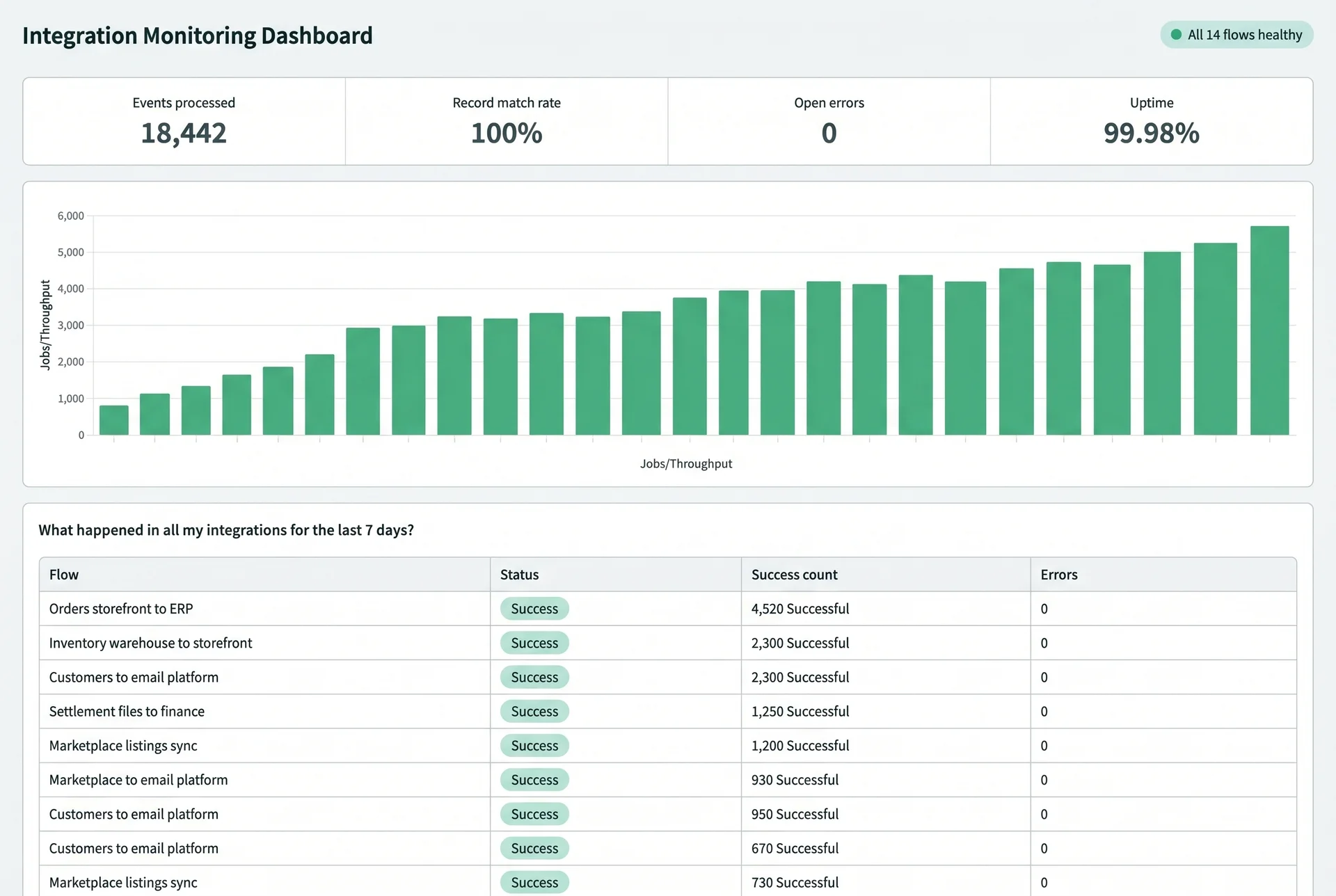
What a typical partner skips, we put in the contract
Most integration replacement services quote a rebuild and hope the cutover goes well. Hope is not a migration plan.
- Parallel run is mandatory, not optional. No connection switches until live output matches record for record.
- Scope locked before build. Connection-by-connection pricing in the proposal, so the number you approve is the number you pay.
- You own everything. Platform account, credentials, code, and documentation are yours from week one. No partner lock-in.
- One team, full estate. The same engineers who run your migration also build new connections, so handoffs never drop context.
Migration is one part of the picture. Explore our full integration services, including enterprise resource planning integration and ecommerce integration services.

Integration migration, answered straight
Integration migration services move your existing system connections to a modern platform. That includes order sync, inventory updates, and customer records. The work covers auditing every connection, rebuilding each one, and validating output side by side. The old layer retires only after the new one proves itself in production.
A typical integration platform migration covering 5 to 15 connections runs 4 to 10 weeks. The audit and mapping phase takes 1 to 2 weeks. The rebuild takes 2 to 5 weeks depending on connection count. The parallel run and cutover takes 1 to 3 weeks. Larger estates with 20 or more connections are phased by risk.
Yes. The new connections run in parallel with the old ones on the same live events. We compare output record by record until the match holds at 100 percent. Only then does traffic switch, one connection at a time, in a low-volume window. The old layer stays available as rollback until you sign off.
Our middleware migration services cover aging on-premise tools like Microsoft BizTalk Server. We also migrate early iPaaS products losing vendor support, point-to-point scripts, and scheduled file transfers. No-code automation tools that outgrew their original volume are a common case. If a connection moves data between two systems today, we can map it and rebuild it.
Cost depends on your connection count, field mapping depth, and validation window. We do not publish a flat rate. Every engagement is scoped before work starts with line-by-line pricing per connection. No commitment is required to receive a proposal. Submit a brief and you get a scoped number within 3 business days.
Get your scoped migration proposal in 3 days
Tell us what runs through your current integration layer. You get a connection-by-connection plan and price. Every proposal is scoped the same way, using our proven migration playbook.
What does this project involve? Pick all that apply.
Brief received, we'll review your workflow and send a scoped proposal within 3 business days.

Retire the middleware before it retires your operations
Every month on the old layer is another month of re-keyed orders and stale inventory. Your migration starts with one brief and a 48-hour call.