Redefine×Saratoga Hospital · Custom Laravel CMS
A custom CMS that runs the whole site from one dashboard.
Saratoga Hospital, a member of the Albany Med Health System, manages content across many locations, specialties and web properties. Redefine built a custom, Laravel-based CMS with one team: a centralized, secure, compliant platform that replaces fragmented workflows, meets healthcare security standards, stays accessible, and lets staff publish across every property from a single, intuitive dashboard.
UX & UICustom Laravel CMSPHP MVC architectureOWASP ASVS securityADA accessibility
One dashboard
▲ centralized control
Many properties, one place
Laravel
▲ PHP MVC architecture
Structured & maintainable
OWASP ASVS
▲ security aligned
Healthcare-grade compliance
ADA
▲ accessibility built in
WCAG-tested templates
Qualitative outcomes from the engagement brief. Percentages and dashboard details later on this page are illustrative samples pending verification.
Industry
Healthcare · hospital & health system
Deliverable
Custom content management system
Built with
Laravel · PHP MVC architecture
Focus
Security, compliance, accessibility & performance
Outcome
Centralized, secure, future-ready
Model
Fixed price · one team
Engineered for
- Custom CMS development
- CMS framework architecture
- UX & UI design
- OWASP ASVS security
- ADA / WCAG accessibility
- Performance & scalability
Summary
Saratoga Hospital, a member of the Albany Med Health System, needed a centralized, secure and compliant way to manage its website content across many properties. Redefine Innovations built a custom CMS with one in-house team: developed on the Laravel framework following PHP MVC architecture for structured, maintainable code; connected to existing systems through custom APIs and integrations; secured in line with OWASP ASVS standards with extensive testing; tuned with optimized database queries and a legacy-code upgrade for performance and scalability; and wrapped in a user-friendly, accessible interface that lets staff manage every property from a single central dashboard, with training and onboarding. The result: streamlined website management, stronger security and compliance, and a reliable, future-ready platform.
ClientSaratoga Hospital · Albany Med Health System member
PartnerRedefine Innovations · one team, fixed-price, full code ownership
PlatformCustom CMS on Laravel · PHP MVC architecture
IntegrationsCustom APIs connecting existing hospital systems
SecurityOWASP ASVS-aligned, with extensive testing & debugging
AccessibilityADA / WCAG accessible UI & templates
PerformanceOptimized queries & legacy upgrade for scalability
AdoptionSingle central dashboard, with staff training & onboarding
Note: the engagement scope and qualitative outcomes above are documented from the brief. All percentages, dashboard contents and testimonials elsewhere on this page are illustrative samples placed as structure, replace each with verified detail before publishing.
The challenge
A health system publishes constantly, locations, specialties, providers, visitor information, careers, all of it needing to be current, correct and consistent. Saratoga Hospital was doing that through fragmented, manual workflows that didn't scale and weren't built for a healthcare bar.
That created real risk. Updates were slow and effortful, control was scattered rather than central, and performance, scalability and regulatory compliance were all exposed. In healthcare, a content platform isn't just about convenience, it has to be secure, accessible and dependable by default.
The brief was a foundation, not a facelift: a centralized CMS that makes updates fast and safe, meets strict healthcare security standards, stays accessible to every visitor, and scales with the organization.
Fragmented
Manual, scattered workflows made updates slow and effortful, with no central control.
Compliance
The platform had to meet strict healthcare security standards and regulatory requirements.
Performance
Existing processes posed performance and scalability risks as content grew.
Accessibility
A public hospital site must be accessible to everyone, ADA / WCAG, by default.
Fragmented & risky
Scattered, manual content workflows cost staff time on every update and quietly accumulate security, compliance and accessibility risk, the kind of risk a healthcare organization can least afford. Centralizing on a secure, custom platform is what turns that exposure into control. (Directional context — verify time and risk figures against operations.)
The approach
Easy to use, hard to break.
Two tracks ran together: make publishing genuinely easy for staff, and build the platform underneath to a healthcare standard for security, compliance, accessibility and performance.
Track 01 · Author with ease
One dashboard staff actually like
A clean, accessible UI and a single central dashboard for managing content across every property, with training and onboarding so the team is productive from day one.
- Single central dashboard for every web property
- User-friendly UX/UI designed for non-technical staff
- Training & onboarding for confident adoption
Delivered: UX/UI · central dashboard · training
Track 02 · Secure, compliant, fast
Healthcare-grade underneath
A Laravel CMS on clean MVC architecture, integrated with existing systems, secured to OWASP ASVS, accessible to WCAG, and optimized for performance and scale.
- Custom Laravel CMS, PHP MVC, with APIs & integrations
- OWASP ASVS security & ADA / WCAG accessibility
- Query optimization & legacy upgrade for scale
Delivered: Laravel CMS · security & a11y · performance
Design & UX · the website
A patient-facing site built for clarity and care.
One calm, accessible brand system carried across every property — so patients find the care they need quickly, and staff publish it confidently from a single CMS. (Brand colours and type follow Saratoga Hospital’s guidelines; one supporting tone is derived. Representative reconstruction of the design direction — illustrative pending sign-off.)
Design direction · brand identity
SARATOGA HOSPITAL.
Albany Med Health System
S
H
Palette (brand guidelines · supporting tone derived)
Deep Indigo Blue#2D3672
Forest Green#2A7832
Charcoal Gray#4A4A4A
White#FFFFFF
Indigo Light · derived#3D4A8F
Type & hierarchy
Find the care
you need.
you need.
AaAaAaMontserrat / Karla
A calm, trustworthy type system in Montserrat and Karla, in deep indigo and forest green, built for clarity and accessibility across every page and property.
albanymed.org/saratoga
SARATOGA HOSPITAL.
Compassionate, expert care across the Capital Region.
Find a DoctorFind a Doctor
Search providers
Our Services
Specialties & care
Patient Portal
Records & visits
Clarity over clutter
Patients arrive stressed and searching, so the site is built to get them to care quickly and calmly.
Accessible by default
ADA / WCAG-aligned templates mean every patient can use the site, on any device or assistive technology.
One system, many properties
A consistent brand and component system spanning specialties, locations and the wider health system.
Live site:Visit albanymed.org/saratoga
Before & after
Fragmented and legacy to one secure platform.
Many properties on scattered, manual workflows and aging templates, rebuilt as one secure, accessible, Laravel-powered platform managed from a single dashboard. (Screenshots are placeholders — drop in the real before/after exports.)
● Before · legacy & fragmented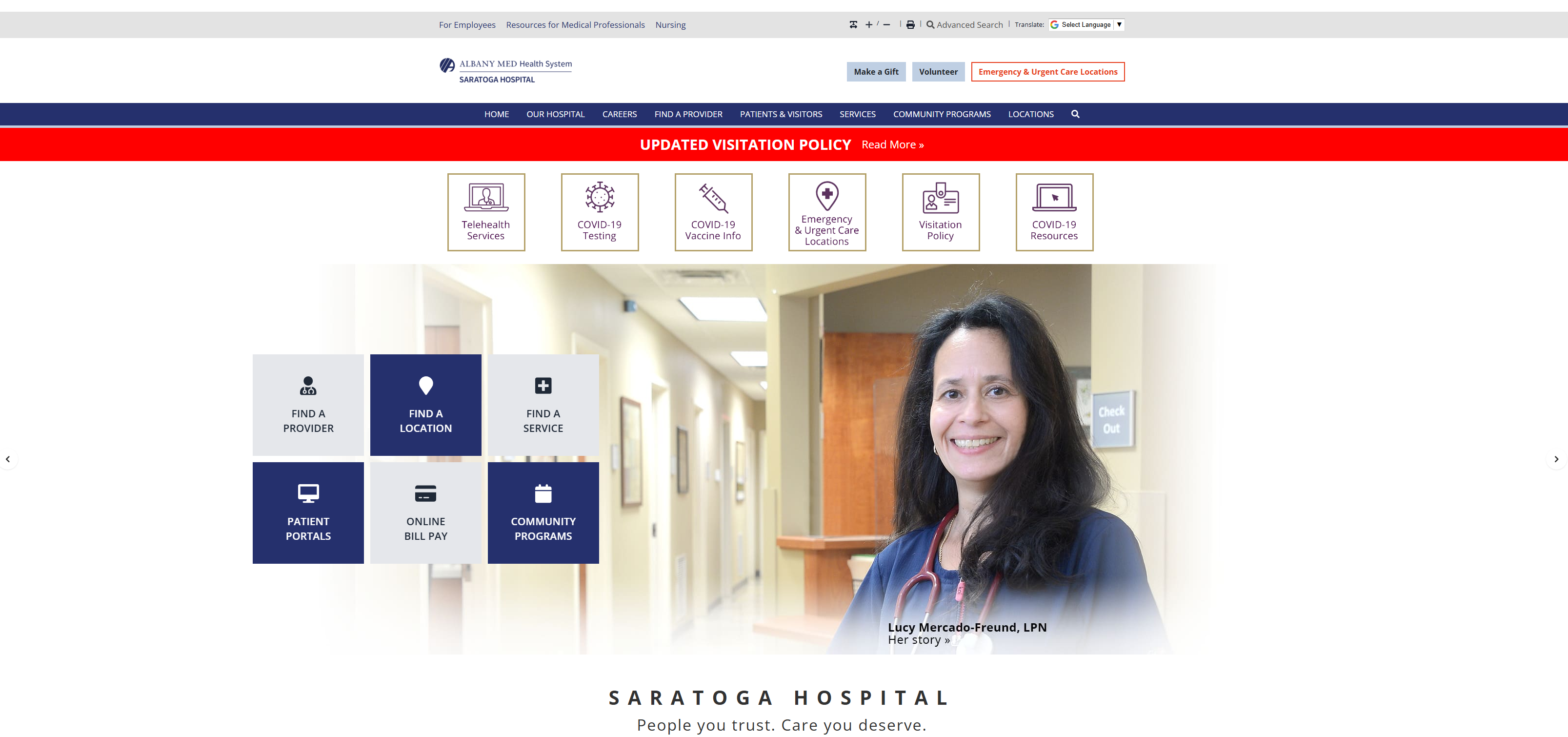
● After · centralized & accessible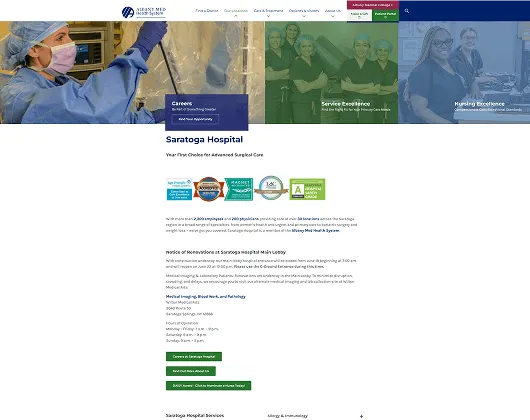
Properties
Scattered → one CMS
Accessibility
Gaps → ADA / WCAG
Security
Legacy → OWASP ASVS
Workflow
Manual → centralized
Before/after images are placeholders following the case-study asset path. The OWASP ASVS, ADA/WCAG and centralization outcomes are documented; upload the real exports (or update each src) before publishing.
The CMS · one central dashboard
Every property, managed in one place.
Instead of scattered, manual workflows, staff publish and govern content across all the hospital's web properties from a single, role-based dashboard. (Interface is a representative reconstruction of the design direction.)
Saratoga CMS
Property: saratoga.albanymed.org ▾SHEditor · role-basedDashboard
Pages
Media
Properties
Users & roles
Settings
Pages+ New page
Title
Property
Status
Updated
Cardiology — Services
Saratoga main
Published
2d ago
Find a Doctor
Medical Group
Published
5d ago
Visitor Information
Saratoga main
In review
1d ago
Community Health Center
Community Health
Draft
3h ago
Careers — Nursing
Careers
Published
1w ago
Dashboard layout, page list and properties are representative of the CMS design direction; replace with the real interface and content before publishing.
Architecture · Laravel & PHP MVC
Structured, maintainable, integrated.
The CMS follows clean PHP MVC on Laravel: every request flows through routing, security middleware, controllers and models, with custom APIs connecting the hospital's existing systems. The diagram is an inferred reconstruction for the team to confirm.
LaravelPHP MVCRoutingMiddlewareControllersModels & DBCustom APIsIntegrations
Request lifecycle (inferred · verify)
What we engineered
- Custom Laravel CMS on PHP MVC for structured, maintainable code.
- Custom APIs & integrations connecting existing hospital systems.
- Optimized database queries for speed and scalability.
- Legacy code upgraded for long-term compatibility.
- Extensive testing & debugging across the build.
- Multi-property model so one platform governs many sites.
Performance & scalability (inferred · verify)
01Slow, manual workflows replaced by a structured MVC platform
02Database queries profiled and optimized for faster page loads
03Legacy code upgraded so the platform is safe to build on
MaintainableFasterScalable
Laravel · PHP MVC · custom APIs · extensive testing · full code ownership on day one
Centralized multi-property management
One platform, many web properties.
A health system isn't one website, it's many: the main hospital site, the medical group, community health, careers and more. The CMS governs them all from one place, with consistent structure and role-based control. (Property list is representative; confirm the actual set.)
Saratoga Hospital
saratoga.albanymed.org
Managed
Medical Group
providers & specialties
Managed
Community Health Center
community care
Managed
Locations & Services
29+ care locations
Managed
Careers
recruiting & jobs
Managed
Foundation & Giving
donations & events
Managed
Many → 1
▲ properties unified
one dashboard
Central
▲ role-based control
consistent governance
Fast
▲ updates
no fragmented workflows
Property names are representative of a health-system content estate; replace with the real properties managed in the CMS.
Security & compliance
Built to a healthcare standard.
Security wasn't bolted on. The CMS was built in line with OWASP ASVS, with role-based access, hardened inputs, audit logging and extensive testing, so content management meets the strict expectations of a healthcare environment and protects data integrity. Controls below are representative of the coverage, for the team to confirm.
Authentication & sessions
Secure login and session handling, role-based access per property.
Access control
Least-privilege roles, so editors only touch what they should.
Input validation & encoding
Defenses against injection and cross-site scripting throughout.
Data protection & integrity
Encryption in transit and safeguards that keep content trustworthy.
Logging & auditability
An audit trail of who changed what content and when.
Dependencies & config
Legacy upgrade and secure configuration for long-term safety.
Control names and statuses are representative of an ASVS-aligned build; replace with the project's actual security assessment before publishing.
OWASP ASVS-aligned · role-based access · audit logging · extensive security testing
Accessibility · ADA / WCAG
Usable by everyone.
A public hospital site has to work for every visitor, including those using assistive technology. Accessibility was a first-class requirement: the UI and templates were designed and tested against WCAG / ADA criteria. The audit below is representative, for the team to confirm.
Criterion
WCAG
How it's met
Color contrast
AA
Text and UI meet contrast ratios for low-vision readability.
Keyboard navigation
A
Full keyboard operability with clear, visible focus states.
Semantic structure
A
Landmarks, headings and ARIA where native semantics fall short.
Images & media
A
Alt-text fields required in the CMS so editors can't skip them.
Forms & labels
A
Properly labeled inputs and accessible error messaging.
Screen-reader support
AA
Tested with assistive technology across key templates.
Criteria and conformance levels are illustrative of an accessibility pass; replace with the real audit (e.g. WCAG 2.1 AA results) before publishing.
The results
Streamlined, secure, and future-ready.
The custom CMS centralized content management, strengthened security and compliance, improved performance and scalability, and gave staff a single intuitive place to work. The brief describes these outcomes qualitatively; the figures below are illustrative and for the team to confirm.
Reading these numbers
The brief reports qualitative outcomes, streamlined management with less time and resource overhead, stronger security and compliance, improved performance and scalability, and easier multi-property publishing, but no published metrics. Every percentage on this page is a reasoned placeholder showing the kind of result the work targets. Replace each with the real number before this case study is published.
One dashboard
centralized
Many properties, one place (documented)
Laravel
PHP MVC
Structured & maintainable (documented)
ASVS
security aligned
Healthcare compliance (documented)
-62%
▼ content update time
Vs manual workflows (sample)
-41%
▼ page load time
Query optimization (sample)
ADA
WCAG accessible
Usable by everyone (documented)
Where the lift came from · before → after (illustrative · verify)
Content update time
-62% faster
Page load time
-41% faster
Properties from one place
all ← scattered
Accessibility conformance
WCAG AA ← gaps
Publishing efficiency & platform stability after launch (shape illustrative; confirm)
Outgrowing a content platform that can't keep up?
One team to design, build and secure a custom CMS that fits how you work, scoped fixed-price before a line of code.
Why it was low-risk
A custom platform you can trust with healthcare.
Fixed price, scoped first
The whole build scoped before work began, with no open-ended billing.
No subcontractors
One named, in-house team across Laravel, security and accessibility.
Security to ASVS
Built to OWASP ASVS with extensive testing and audit logging.
Accessible by design
ADA / WCAG criteria built into the UI and templates, not retrofitted.
You own everything
Full custom CMS, code and accounts handed over.
Trained & onboarded
Staff trained so the platform is adopted, not just delivered.
“We went from juggling separate, manual workflows to managing everything from one dashboard. Updates that used to take a day now take minutes, and nothing feels risky anymore.”
MC
Marie Chen
Digital Communications, Saratoga Hospital
Digital Communications, Saratoga Hospital
“Security and accessibility weren't afterthoughts, they were the starting point. We have a platform that meets our healthcare standards and that our team is genuinely confident using.”
JR
James Reilly
IT & Web Services, Saratoga Hospital
IT & Web Services, Saratoga Hospital
How it ran
A structured build (sequence inferred · verify).
Phase 1
Discovery & UX
Workflows mapped; dashboard & UI designed
Phase 2
Laravel CMS build
PHP MVC core, APIs & integrations
Phase 3
Security & a11y
OWASP ASVS hardening; WCAG accessibility
Phase 4
Optimize & test
Query tuning, legacy upgrade, testing
Outcome
Launch & train
Central dashboard live; staff onboarded
Start here
Need a content platform that's secure, accessible and built around you?
That's exactly the work we're built for: one accountable team designing, building and securing a custom CMS to your standards. Submit a brief and get a line-by-line proposal in 3 days.
No commitment. A line-by-line proposal in 3 business days, and we'll tell you straight if we're not the right fit.
★★★★★4.9 on Clutch500+ projects shipped21 yearsLaravel & PHP experts
Work under NDA? Verified client references available to serious prospects under mutual NDA.