Redefine Innovations×Toadys · End-to-end mobile app development
A consumer mobile app built to keep millennial users coming back — launched on schedule.
Toadys needed one cohesive build: in-app subscriptions, live WebRTC video calling, real-time engagement analytics, and enterprise-grade security — for an audience that judges a product in seconds. Redefine Innovations ran the full lifecycle with one accountable team and shipped it on time, with every contracted feature working on day one.
User experience designNative iOS developmentIn-app subscriptionsWebRTC videoEngagement analyticsSecurity & compliance
6 systems
▲ one codebase
Built to work together
100%
▲ live day one
Contracted features at launch (documented)
On schedule
▲ against agreed date
Delivery timing
Day 1
▲ from launch
Subscriptions earning revenue
Industry
Consumer mobile · creator engagement
Audience
Millennial, engagement-first
Outcome
On schedule · every feature live day one
Engagement
Design through post-launch support
Platform
Native iOS · Android billing · admin
Model
Fixed price · one team
Built on & aligned with
- Apple App Store
- Google Play Billing
- WebRTC
- OAuth 2.0 · TLS · AES-256
Summary
Toadys set out to launch a consumer mobile application for a millennial audience, with engagement, usability and monetization at the center. Redefine Innovations delivered end-to-end mobile app development that combined research-led experience design with robust backend integrations: in-app subscriptions through native billing (including Google Play Billing) with server-side receipt validation, engagement analytics, WebRTC peer-to-peer influencer video calls, and compliance-focused security. The result: the app launched on schedule with every contracted feature live on day one, with positive launch feedback and post-launch support keeping it stable as the product grows.
ClientToadys — consumer mobile
application
PartnerRedefine Innovations — one team,
fixed-price, full code ownership
OutcomeLaunched on schedule, every contracted
feature live day one (documented)
PlatformNative iOS (SwiftUI), Android billing, admin
layer
MonetizationIn-app subscriptions via native billing
with server-side receipt validation
VideoWebRTC peer-to-peer influencer video
calling
AnalyticsEvent instrumentation for engagement,
conversion and drop-off
SecurityEncryption in transit & at rest, OAuth
2.0, vulnerability testing, compliance-ready
Note: the on-schedule launch, every-feature-live-on-day-one delivery, positive launch feedback, and cleared pre-launch security audit are documented. Engagement, conversion and funnel figures, build-log counts and timeline windows on this page are illustrative samples pending verification, and the testimonial is a sample to replace with an approved client quote.
The challenge
Building a consumer mobile application for a millennial audience leaves no room for friction, no margin for a security lapse, and no second chance at a first impression. Every integration had to work invisibly — payments, video and analytics each carry real engineering risk, and any one of them can stall the experience if it is bolted on instead of built in.
The app needed subscriptions that monetize from day one, video that stays reliable across networks, and instrumentation that shows what users actually do. Security raised the stakes further: a consumer app handling payments and personal data needs encryption, vulnerability testing and compliance-ready architecture — without ever feeling locked down.
The hard part was making five demanding systems share one codebase and one experience, then launching the whole thing on schedule. That is an argument for one accountable team, not a chain of vendors handing risk between them.
Monetization risk
Native billing, server-side receipt validation, renewals and cancellations all had to work
before a single user subscribed.
Video reliability
WebRTC calls needed signaling, network traversal and stream management without slowing
the rest of the app.
Data exposure
Payments and personal data demanded enterprise-grade security that never made the
product feel heavy or restricted.
Launch timing
A consumer launch window is unforgiving. Every system had to integrate cleanly and ship
together, not one feature at a time.
One try per
user
For a millennial product, a broken subscription flow or a dropped video call on launch day is
not a bug ticket — it is churn before the audience ever forms. The real risk was never the
build budget; it was shipping something users try once and never reopen. Naming that risk is what reframes
the project from cost to protected launch.
The approach
Two tracks that ship one cohesive app.
A product and experience track shaped what millennial users feel. A platform and trust track built the payments, video and security underneath it. Both ran toward a single launch date.
Track 01 · Product & experience
What millennial users feel
Research-led design, validated on screens before a line of production code.
- Research into millennial usage patterns to shape onboarding, discovery and engagement
- A shared design system of tokens, components and flows for design and engineering
- High-fidelity prototypes tested before code — revisions happened on screens, not in builds
- A native iOS build in SwiftUI tuned for speed, fluid interactions and App Store compliance
- A subscription upgrade path designed to convert without interrupting the experience
Delivered: research-led design system, tested prototypes, native iOS application*
Track 02 · Platform & trust
What makes it dependable
Payments, video, analytics and security, engineered to run quietly underneath.
- In-app subscriptions through native billing, including Google Play Billing, with server-side validation
- WebRTC video calling with signaling servers, TURN fallback and media stream management
- Analytics instrumentation tracking engagement, conversion and drop-off across the product
- Encryption in transit and at rest, secure token authentication and vulnerability testing
- Post-launch support covering monitoring, crash triage and iterative improvement
Delivered: live subscriptions, reliable video, instrumented analytics, hardened
security*
Design & UX · the app
A design system built to hook in seconds.
Research-led UX turned into one cohesive brand and interface system — carried across onboarding, subscriptions, live video and the feed — so a millennial, engagement-first audience feels at home from the very first screen. (Brand colours and primary type follow Toadys’ guidelines; supporting tones are derived. Representative — illustrative pending sign-off.)
Design direction · brand identity
TOADYS.
Consumer mobile · creator engagement
T
O
A
Palette (brand guidelines · supporting tones derived)
Deep
Purple#472368
Olive
Green#658B29
White#FFFFFF
Purple Deep · derived#2E1745
Olive Deep · derived#4E6B1F
Type & hierarchy
Tap in.
Stay for the feed.
Stay for the feed.
AaAaAaBarlow · UI
A bold, high-energy type system in Barlow with condensed display headers, vivid accents and generous spacing — tuned for fast comprehension on a phone in the first few seconds.
Toadys · iOS app
TOADYS.
Live video, subscriptions and a feed that keeps you coming back.
Download on iOSLive Video
WebRTC
Subscriptions
In-app billing
Engagement Feed
Real-time
Judged in seconds
A millennial, engagement-first audience decides fast, so the first-run experience is built to hook immediately.
One system, one feel
Subscriptions, video and analytics share a single design language, so the app feels cohesive, not stitched together.
Built to keep them coming back
Patterns tuned for retention: frictionless onboarding, clear value, and a feed that rewards every return visit.
How it was built
Five layers, one build pipeline.
Five demanding layers were built to work together so no single integration becomes a bottleneck — parallel work feeding a shared build, shipped as one App Store release.
Design system · component library
Interface tokenstype · colour ·
spacing
Engagement flows designedonboarding · feed
· upgrade
Research into millennial usage patterns shaped every interaction. Prototypes were tested before any code was written, keeping revisions on screens instead of in builds. The design system became the shared language between design and engineering for the rest of the project.
Xcode · build log
SwiftUI components compiled*94 / 94
Unit tests passing*312
/ 312
Accessibility audit*compliant
A native SwiftUI build was tuned for fast, fluid interactions with no loading lag on the moments that matter, and App Store compliance was handled as the build progressed — not patched in at submission. *Sample figures, illustrative of a build of this shape.
Billing · subscription lifecycle
Server-side receipt validationevery
purchase
Renewals & grace periodshandled
Upgrade / downgrade / cancelfull lifecycle
In-app subscriptions were built on native billing, including Google Play Billing, with server-side receipt validation confirming every purchase. Trials, renewals, upgrades and cancellations were all handled, so the revenue model ran correctly from day one.
WebRTC · call quality monitor
P2P connectionpeer to peer
TURN fallbacknetwork traversal
Live stream health*monitored
WebRTC powered the influencer video call feature with signaling servers, TURN fallback for network traversal, and media stream management. Analytics ran in parallel so the product team could see what users do, not guess. *Sample telemetry.
Security · pre-launch audit
Transport encryption (TLS)enforced
Data at rest (AES-256)encrypted
Authentication (OAuth 2.0)secure tokens
Vulnerability testingcleared
Encryption in transit and at rest, secure token authentication and vulnerability testing were completed before launch. Compliance-ready architecture handles personal data to applicable standards, and post-launch support keeps the app stable through OS updates.
Post-launch · operations
Monitoring & crash triageongoing
OS update compatibilitytracked
Iterative improvementanalytics-led
The modular architecture and clean integration points mean new features build on the foundation, not over it — so the product can grow from the analytics it now generates.
What was delivered
Every system a consumer mobile app needs to grow.
Consumer mobile applications succeed on how deeply their core systems integrate. Toadys received all six in a single cohesive build, not a stack of disconnected features.
We supported ongoing SEO and App Store Optimization with regular updates, improving search visibility and driving more traffic to both the website and the native app.
User experience design
A research-led design system spanning onboarding, engagement, discovery and subscription
flows. Every interaction was prototyped and tested before development, which cut revision cycles
during the build.
Native iOS development
A SwiftUI application built for performance and App Store compliance — fast, clean
and responsive, with no loading lag on the interactions that matter to a millennial audience.
In-app subscriptions
Native billing with server-side receipt validation, trial management, renewals, grace
periods and cancellation flows. Revenue runs autonomously from day one of launch.
WebRTC video calling
Peer-to-peer encrypted video calls for influencer interactions, with signaling
infrastructure, TURN fallback and media quality management. Calls stay reliable across networks
without degrading the app.
Engagement analytics
Instrumented tracking for session behaviour, feature interaction, conversion events and
drop-off points. The product team decides what to build next from data, not guesswork.
Security & compliance
Transport layer security, AES-256 encryption at rest, OAuth 2.0 authentication and
vulnerability testing completed before launch. Compliance-ready architecture handles personal data
to applicable standards.
Prototype to production
From a tested prototype to a shipped native app.
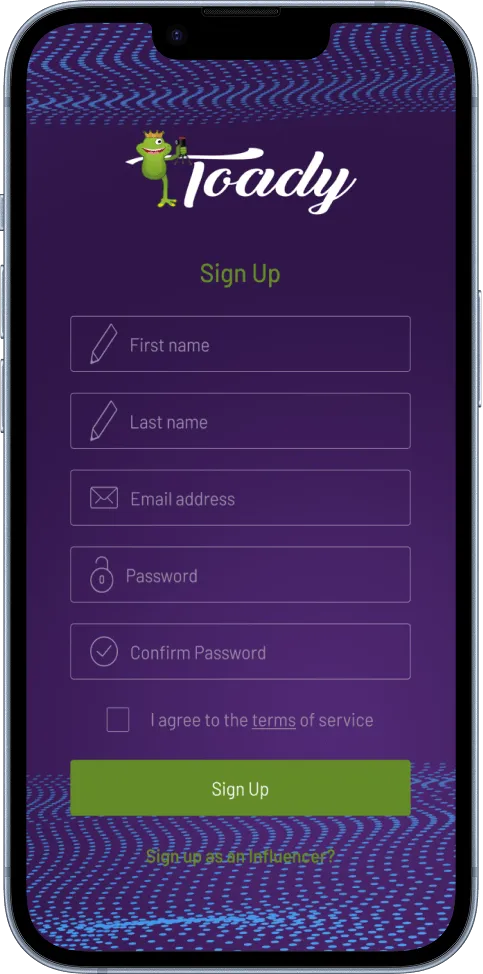
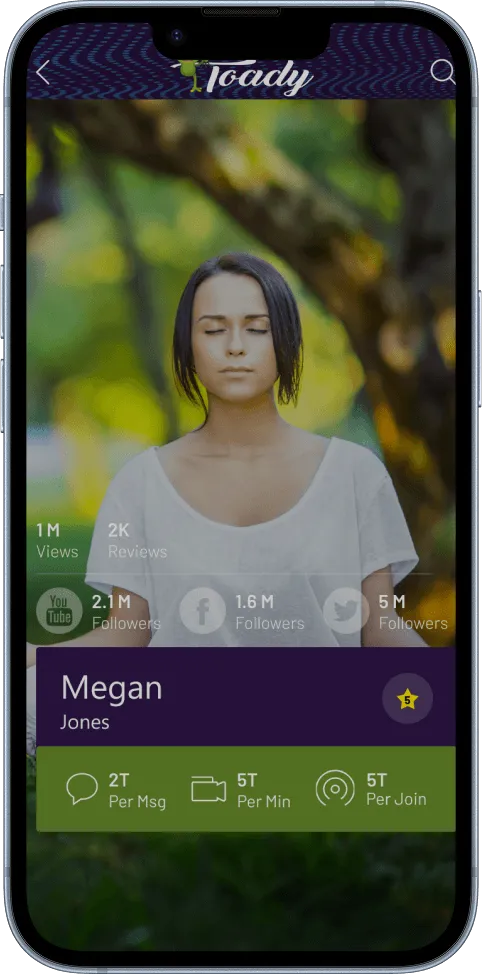
Testing the experience first meant the production build had fewer surprises and a cleaner path to launch. Place the high-fidelity Figma prototype beside the shipped native screens.
100%
Feature delivery on launch
6
Build pillars, one codebase
Cut*
Revision cycles before build
On time
Launch timing
Security architecture
Trust built into every layer of the data path.
A consumer app handling payments and personal data needs defense at every step, from the device to the database. Here is the path a request travels, and what protects it along the way.
In transit & at rest
Encryption everywhere data moves or sits, so a leak at one layer does not expose the rest.
Token authentication
Secure OAuth 2.0 tokens, not long-lived credentials, gate every authenticated request.
Receipt validation
Server-side validation confirms every subscription purchase before access is granted.
Tested & compliant
Vulnerability testing before launch, with compliance-ready handling of personal data.
Analytics & engagement
Instrumented to show what users actually do.
Engagement analytics turn the app into a feedback loop. The product team sees session behaviour, feature use, and where users drop off — then decides what to build next from evidence instead of opinion. The views below are sample layouts; the bars, curves and figures are placeholders for real instrumented data.
Engagement over the first weeks after launch · sessions index (shape illustrative —
replace with real instrumented data)*
Engagement dashboard · sample view
live*
Sessions tracked
per flow*
Events instrumented
step*
Funnel drop-off
entry · 100%*
strong*
healthy*
rising*
rising*
What the funnel reveals
Onboarding completion*strong
View → start conversion*healthy
Video call engagement*rising
Each step is measured so the team sees exactly where users hesitate — and can target the next iteration at the precise drop-off point rather than guessing.
* Sample dashboard for layout. Replace bars, curve and labels with real instrumented metrics before publishing.
Session & behaviour tracking
Every meaningful interaction is instrumented, so engagement patterns show up as data,
not anecdotes.
Conversion & drop-off events
Subscription and video flows are measured step by step, so the team sees exactly where
users hesitate.
A foundation for what's next
A modular architecture and clean integration points mean new features build on the
foundation, not over it.
The results
Launched on schedule, built to keep growing.
The application launched on schedule with every contracted feature working on day one. Launch feedback focused on usability, engagement and trust, and the architecture is ready for the next phase of features.
How these outcomes are reported
The launch facts come from the project record — every contracted feature live on day one, with positive user feedback. Engagement and funnel figures marked * are illustrative samples for layout, pending replacement with real instrumented analytics. No outcome here is invented.
100%
▲ live on launch day
Contracted features (documented)
6
▲ one codebase
Core systems built to work together
On time
against the agreed date
Delivery schedule (documented)
Positive
usability & engagement
Launch feedback (documented)
Cleared
▲ before launch
Security & compliance audit items (documented)
Scalable
ready for what's next
Foundation for the next feature set
Launch quality · what shipped working (documented unless marked *)
Features delivered on launch
100% documented
Payment flows working at launch
100% documented
Security audit items cleared
100% documented
Post-launch stability
strong sample*
Launch feedback themes
Usability and ease of navigation · video call quality and reliability ·
subscription and payment experience · overall engagement and differentiation.
“Redefine Innovations built exactly what we needed: a mobile app millennial users want to engage with. The subscription flow worked from day one, the video calls are reliable, and the analytics give us everything we need to keep improving.”
PL
Product Lead
Toadys — sample quote, replace with a verified, named client quote
Toadys — sample quote, replace with a verified, named client quote
The timeline
From research to a launched mobile app.
Sample phasing for a build of this shape. Replace the windows with the verified engagement record before publishing.*
Phase 01 · Weeks 1–3*
Research & experience design
Millennial usage research, a design system, and high-fidelity prototypes tested before any
code. Output: a validated experience and a clear build plan.
Phase 02 · Months 1–2*
Native iOS build
The SwiftUI application came together against the design system, tuned for speed and App
Store compliance as the build progressed.
Phase 03 · Months 2–3*
Payments, video & analytics
In-app subscriptions, WebRTC video calling and engagement analytics were integrated and
tested together, so no single system became a bottleneck.
Phase 04 · Month 3*
Security audit & QA
Encryption, secure authentication and vulnerability testing were verified, and the full
feature set was hardened for a confident launch.
Phase 05 · Launch & ongoing
Launch on schedule & support
Every contracted feature shipped on day one. Post-launch support covers monitoring, crash
triage, OS updates and iterative improvement based on analytics.
Why Redefine Innovations
Mobile development that ships complete and stays stable.
Many mobile teams hand over a codebase and disappear. Redefine Innovations builds every integration correctly from the start, structures the risk onto us, and stays accountable through post-launch support.
End-to-end ownership
Design, native development, integrations, security and support from one team. No gaps
between disciplines that surface as integration failures near launch.
Fixed-price sprints
Every feature, integration and milestone is scoped line by line before any code. The
budget you approve is the budget that applies at launch.
Senior team only
The people who scope your build are the people who build it. No handoff to a junior bench
once the contract is signed.
You own everything
Code, designs and accounts live in your names from day one. Leaving is always easy, which
is part of why clients stay.
Weekly working demos
You see real software every week, not status decks. Problems surface in days, while they
are still cheap to fix.
Accountable after launch
Post-launch support covers monitoring, crash triage, OS updates and iterative improvement,
with scope defined before work begins.
Who this is for
Is this the right engagement for your mobile app?
A consumer build with payments, video and analytics is a serious commitment. Here is where this engagement fits well, and where another approach would serve you better.
A strong fit when
- You are building a consumer mobile app with monetization, video or analytics requirements
- You need in-app subscriptions integrated with Apple or Google native billing from day one
- Security and compliance are non-negotiable because your app handles payments or personal data
- You want fixed-scope delivery with a defined budget, not an open development retainer
- Post-launch support and iterative improvement based on real analytics are part of your plan
Another approach fits better when
- You need a simple prototype or MVP with no integrations
- Your project needs a team on hourly rates without defined scope
- The application handles no payments, user data or compliance requirements
- You want a web application rather than a native iOS or Android build
Ready to build
Your mobile app deserves a build team that ships what it scopes.
No pitch calls. No discovery fees. A line-by-line proposal in three business days based on what you actually need to build.
No commitment. Submit your brief → call within 48 hours → scoped proposal in 3 days → Sprint 1 begins within one week of sign-off.
★★★★★4.9 on Clutch500+ projects delivered21 years building software