Replace MicroStrategy with Power BI Without Losing Your Reports
A structured microstrategy to power bi migration services engagement, scoped in writing before development begins, with every report inventoried, rebuilt, and validated in parallel.
Your team's time investment across a full migration is typically 3 to 4 hours per week, one sprint review, async feedback on report deliverables, and a final quality assurance sign-off. We handle everything else.
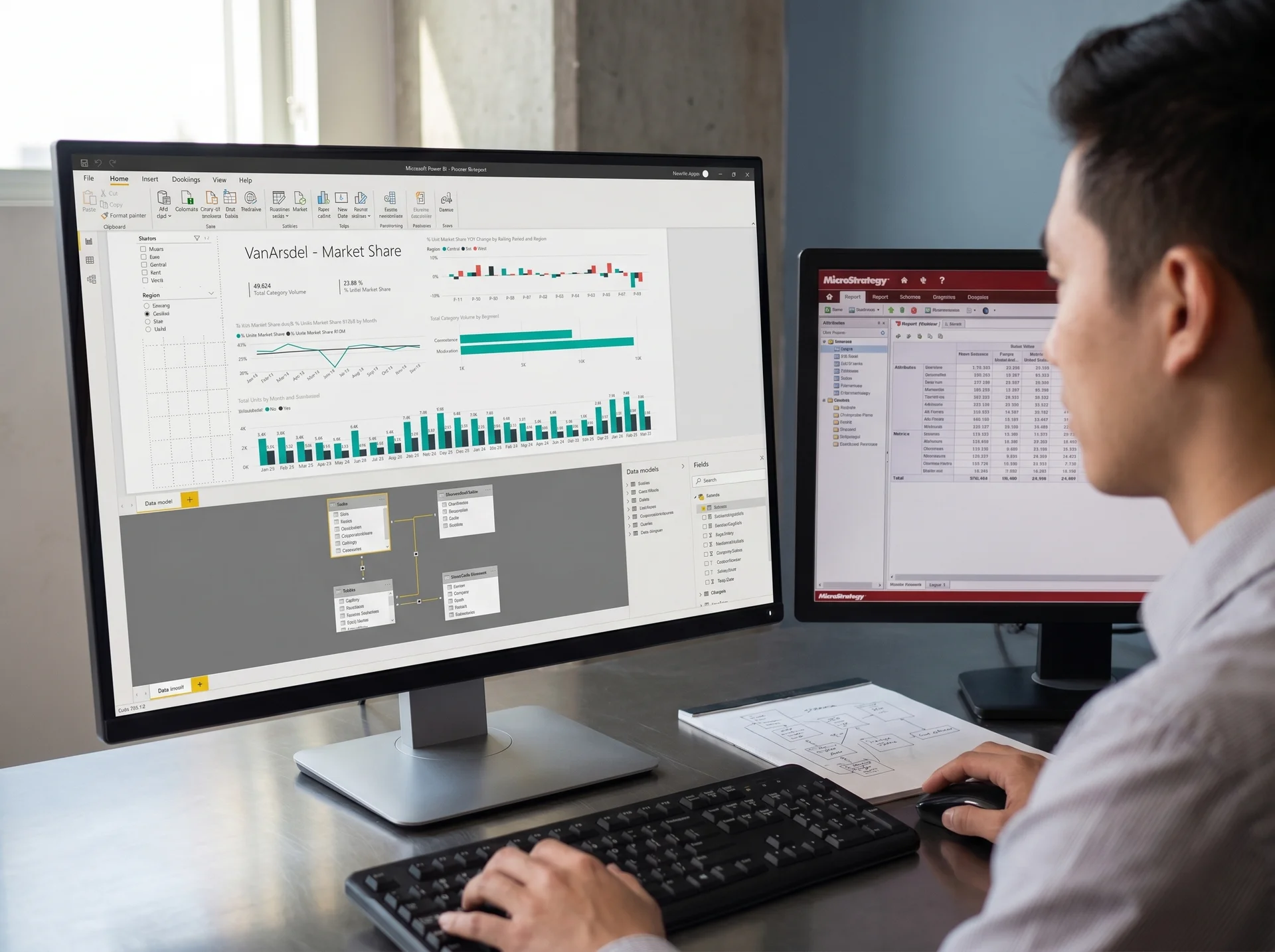
Hero · Analytics team reviewing Power BI dashboards

MicroStrategy served its purpose. The maintenance cost did not.
Licence costs, infrastructure overhead, and a shrinking internal skills pool are real reasons organizations explore microstrategy to power bi replacement. The friction is not switching, it is switching without breaking what your business runs on.
Before migration
- Six-figure annual licence and infrastructure spend for a reporting layer used by fewer than 40 people
- One or two internal people who still understand the MicroStrategy environment, with no succession plan
- Reports that cannot reach cloud data sources your team has already moved to
- Upgrade cycles that break custom metrics and require months of re-testing
After migration to Power BI
- Reports rebuilt on a semantic model your entire team can maintain in weeks, not months
- Native connectors to Azure, Fabric, SharePoint, Dynamics 365, and your cloud data sources
- Row-level security and workspace governance built into the migration, not bolted on later
- Every report signed off by your team before the legacy environment is decommissioned
Is your environment ready to migrate?
Check the statements that apply to your organization. Your readiness score helps us scope the right level of engagement for your microstrategy to power bi migration.
Check the items above to see your migration readiness level.
What your score means
0 to 30%: Foundation work first
Your environment needs data source mapping and a governance plan before migration begins. We scope this as Phase 0.
31 to 60%: Structured migration
A phased microstrategy to power bi migration consulting approach works well here. We lead report inventory, data model rebuild, and validation in parallel sprints.
61 to 90%: Accelerated path
Your fundamentals are in place. Migration can begin within two to three weeks of scope sign-off with a compressed timeline.
91 to 100%: Ready to go
Your environment is well-prepared. We can deliver a scoped proposal within three business days of your assessment call.
From MicroStrategy inventory to Power BI go-live in four phases
Every microstrategy to power bi migration company says they have a process. This one is documented in writing, assigned to named phases, and signed off before development starts.
Migration Approach · Developer mapping report schemas
Environment Audit Output
We catalogue every report, filter the active ones, map data sources, and hand you a written scope before a single line of Power BI code is written.
Semantic Model Structure
Your MicroStrategy attributes and metrics become documented DAX measures inside a governed Power BI semantic model, not improvised visual-level calculations.
Parallel Validation Log
Both environments run in parallel for a minimum of two weeks. Every report is number-matched against its MicroStrategy source before the legacy platform is decommissioned.
Governance Handoff Package
You receive workspace governance documentation, a naming-convention standard, an admin runbook, and four structured training sessions so your team owns what they received.
Migration Approach · Developer mapping report schemas
Every deliverable, scoped before work begins
You receive a line-by-line proposal before a single report is touched. This is what a professional microstrategy to power bi migration partner delivers, not a statement of work written after discovery.
Full Environment Audit
Complete inventory of reports, metrics, data sources, and user access patterns. You know what you have before deciding what to migrate.
Semantic Model Ownership
Every measure is documented and built in the Power BI semantic model. Your team receives a DAX library they understand and can extend without dependencies on outside help.
Report Rebuild, Not Copy-Paste
Each active report is rebuilt to its functional equivalent in Power BI, with a layout review, filter logic validation, and number-match before sign-off.
Security and Governance Built In
Row-level security, workspace access, and a naming-convention standard are part of the migration scope, not afterthoughts requested during the cutover.
Parallel Run Period
Both environments run simultaneously for a minimum of two weeks. Business owners sign off on results before the MicroStrategy environment is decommissioned.
Training and Handoff
Structured training sessions for report authors and administrators, plus a written admin runbook. Your team is self-sufficient on day one after go-live.
Migrating from a different platform?
From fragmented reporting to $120 million in revenue visibility
A promotional products organization seeking professional microstrategy to power bi migration services completed a full Power BI transformation. Operating across 30+ stores with over one million inventory items had no unified reporting layer. Manual processes, fragmented systems, and limited analytics slowed decision-making and constrained warehouse operations.
Visibility gap across 30+ storefronts, multiple backend platforms, and Dynamics 365 ERP with no unified dashboard layer
Manual reporting and warehouse workflows that could not scale to support the revenue growth target
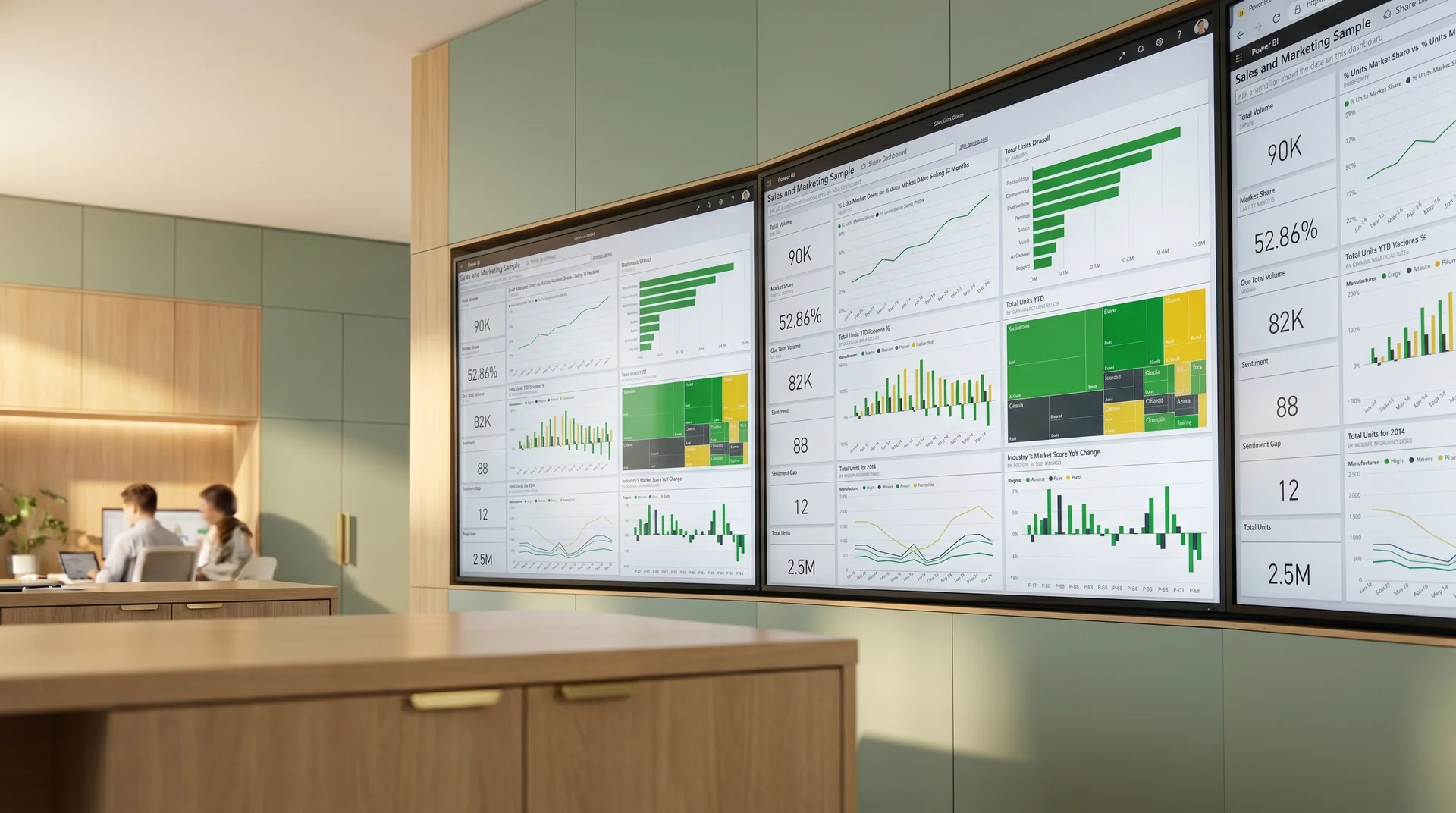
Custom Power BI reports and dashboards connected to Dynamics 365 ERP provided real-time visibility across all stores and operational metrics
Headless ecommerce architecture and RESTful APIs connected Dynamics 365, Power BI, and mobile applications into a single unified data flow
Annual revenue achieved after Power BI analytics and ERP integration, scaled from under $14 million. Real-time reporting reduced decision latency and improved warehouse efficiency organization-wide.
The risks other implementation partners skip over
A microstrategy to power bi migration company that does not surface these risks before scoping is not giving you an honest proposal.
Metric Definition Drift
MicroStrategy metrics computed in the intelligence server do not always produce identical results when rebuilt naively in DAX. Each measure is validated against source data during the parallel run.
Source System Credentials
Many MicroStrategy environments use shared service accounts with undocumented or embedded credentials. Data source mapping in Phase 1 surfaces every connection before the build begins.
Unmapped Custom Prompts
Custom prompt logic in MicroStrategy has no direct Power BI equivalent. Each instance is reviewed, and a Power BI parameter or slicer approach is designed on a report-by-report basis.
Shadow Reports
Reports built by individual analysts that are not tracked in the main MicroStrategy catalogue. Usage analysis in Phase 1 surfaces these before the scope is fixed.
Refresh Performance
Large MicroStrategy datasets imported naively into Power BI can cause Premium timeouts. Import versus DirectQuery strategy is evaluated per data source during the data model phase.
Licensing Surprises
Power BI licensing requirements depend on your user count, capacity needs, and whether Fabric is already in your Microsoft agreement. Licensing review is part of Phase 1, not an afterthought.
What makes this different from typical implementation partners
Most other implementation partners begin development before the report inventory is complete. That is how migrations stall at 70% and run three months over timeline.
What we do differently
Written scope delivered after discovery, before any development. Every report, data source, and phase milestone named and signed off.
Number-match validation on every report during the parallel run, not a visual inspection and a verbal confirmation.
Governance documentation, training, and admin runbook delivered as part of the engagement, so your team owns the environment from day one.
You own all deliverables, all code, all documentation. No lock-in to ongoing support contracts to keep reports working.
How other implementation partners often work
Start development with an incomplete report inventory and add scope mid-project when the full complexity becomes apparent.
Validate reports visually rather than numerically, leaving metric drift to be discovered by the business after go-live.
Deliver reports without documentation, leaving your team unable to extend or troubleshoot without returning to the partner.
Frequently asked questions
Most migrations complete in 8 to 16 weeks depending on report volume, data source complexity, and your team's availability for review cycles. We scope the timeline in writing before any work begins, with phase milestones and sign-off checkpoints built in.
Direct conversion without review is not recommended. MicroStrategy's semantic layer, metric definitions, and custom prompt logic do not map 1:1 to Power BI's data model and DAX. Each report is audited, catalogued, and rebuilt to its functional equivalent rather than copied over.
Your source systems remain unchanged. We document every data connection in MicroStrategy, validate equivalents in Power BI, and rebuild the semantic layer with documented DAX measures. A parallel run period ensures reports produce consistent results before the MicroStrategy environment is decommissioned.
Our microstrategy to power bi migration services engagement begins with an assessment covering a full audit of your MicroStrategy environment including report inventory, data source mapping, attribute and metric complexity, and user access patterns. You receive a written scope, phased timeline, effort estimate, and risk register before any development begins.
Is this microstrategy to power bi migration partner the right fit?
Good fit for organizations that
- Are evaluating microstrategy to power bi migration services and have an existing MicroStrategy environment with a defined plan to decommission it within 12 months
- Can assign one internal point of contact for report review and sign-off during the parallel run period
- Want governance and documentation delivered, not just reports that work on day one
- Are evaluating Microsoft Fabric or already on the Microsoft 365 stack and want a unified analytics path
Not a fit if you
- Need a full report migration completed in under four weeks without an audit phase
- Have no internal data team or executive sponsor to review and sign off on migrated reports
- Are not yet committed to decommissioning MicroStrategy and are exploring options without a decision
Not sure? Tell us your situation and we will be direct with you. Share your setup and get a straight assessment.
Get a scoped migration assessment
Submit your brief and receive a written scope, timeline, and effort estimate within three business days. Scoped before work starts, line by line, no commitment required to receive the proposal.
What best describes your situation?
Call within 48 hours · proposal in 3 days · Sprint 1 within 1 week of sign-off
Brief received
We will review your workflow and send a scoped proposal within 3 business days.
Response within 48 hours of brief submission
Written scoped proposal in 3 business days
60+ projects completed across Power BI and analytics
Full code ownership transferred at project close
Pre-Footer · Migration roadmap presentation

Your MicroStrategy environment has an expiry date. Yours should too.
No commitment. No pitch. A scoped proposal in three business days so you know exactly what the migration costs, what it includes, and when it ends.
Your team's time investment is typically 3 to 4 hours per week. One sprint review, async feedback, and a final sign-off. We handle everything else.